
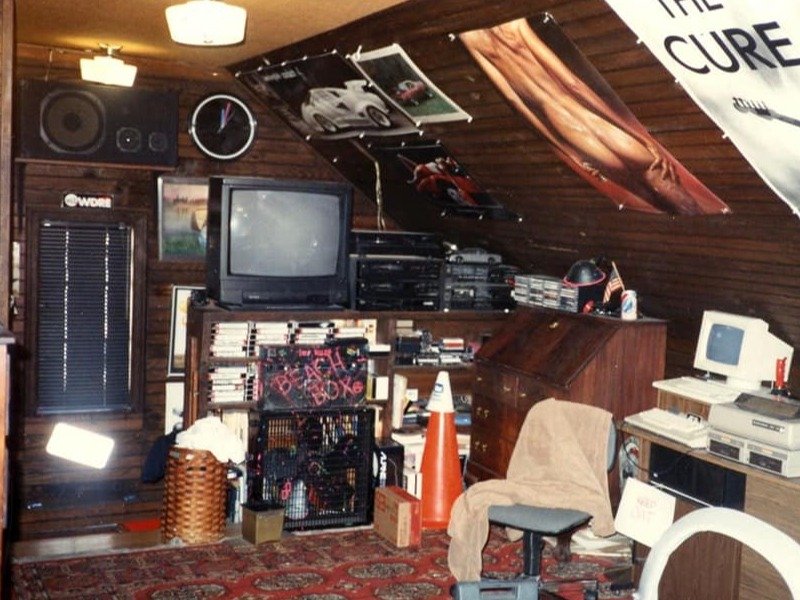
There was something wonderfully chaotic about the 1980s bedroom.
By modern standards, the technology was primitive. Screens were tiny, batteries lasted about eleven minutes, loading a game could involve several minutes of electronic screaming, and anything remotely portable tended to require enough AA batteries to power a small submarine.
None of that mattered.
Your bedroom was headquarters. It was a games room, music studio, cinema, computer lab, telephone exchange and private retreat, all squeezed between a wardrobe, a bed covered by some spectacularly patterned duvet and a wall plastered with posters.
The technology was rarely coordinated. A portable television might be balanced on a chest of drawers. A cassette recorder sat beside a pile of tapes with handwritten labels. Somewhere underneath it all was a terrifying collection of mains adapters, aerial cables and extension leads.
And if you grew up in Britain during the 1980s, there is a decent chance at least a few of these twenty technological treasures found their way into your room.
1. The Portable Television
Calling it "portable" was occasionally optimistic.
The classic 1980s portable television was usually a chunky plastic box with a screen somewhere around the size of a modern tablet, except considerably deeper and considerably heavier. Many had rotary tuning controls, a telescopic aerial and satisfying mechanical buttons that actually clunked when pressed.
Having your own television in the bedroom felt like an enormous upgrade in personal freedom.
Suddenly you were no longer completely dependent on whatever the family had decided to watch downstairs. You could disappear upstairs and watch Top of the Pops, Saturday morning television, a rented video or something you probably should not have been watching quite that late.
Picture quality depended heavily on geography, aerial position and possibly planetary alignment.
Getting a clear picture could involve extending the aerial, rotating it slightly, moving the entire television three inches to the left and then being forbidden from walking anywhere near it.
Remote controls were by no means guaranteed either. Changing channels could still mean physically getting out of bed.
Unthinkable now.
2. The ZX Spectrum
Few machines belong in a British 1980s bedroom quite as naturally as the ZX Spectrum.
That little black computer with its distinctive rubber keyboard turned bedrooms across Britain into arcades, programming laboratories and places where children discovered entirely new swear words while waiting for cassette games to load.
The Spectrum arrived in 1982 and became one of the defining British home computers of the decade.
Its games came on ordinary audio cassettes, which meant loading one involved connecting a cassette recorder, typing the appropriate command and listening to several minutes of shrieking electronic noise.
Then you waited.
And waited.
If everything went well, a game appeared.
If everything did not go well, you discovered after five minutes that absolutely nothing had loaded and you had to start again.
Yet somehow this made games feel more valuable. When Jet Set Willy, Manic Miner, Chuckie Egg or one of hundreds of other titles finally appeared, you were committed.
There was no instantly switching to something else because you were mildly bored.
You had invested time in this.
You were playing it.
3. The Commodore 64
Of course, not every bedroom belonged to the Spectrum camp.
Some contained the Commodore 64, and playground arguments could become surprisingly heated over which machine was superior.
The Commodore 64 was technically impressive and particularly famous for its sound capabilities. Its SID sound chip helped give many games music and effects that remain instantly recognisable decades later.
For British owners, software commonly arrived on cassette, bringing the familiar ritual of loading, rewinding and occasionally wondering whether the tape recorder volume setting was responsible for ruining your afternoon.
The machine itself looked more serious than the Spectrum. Its full size keyboard and substantial case made it feel almost professional.
You might have been playing International Soccer rather than preparing quarterly accounts, but the hardware certainly looked important.
Today, original Commodore 64 machines have become highly collectible. Back then, though, they were simply part of the furniture in thousands of bedrooms.
4. The BBC Micro
The BBC Micro often entered our lives at school first.
There it sat, usually looking enormously expensive and slightly intimidating, while a teacher attempted to introduce thirty children to computing.
But plenty also made it into British homes.
Produced by Acorn Computers as part of the BBC's computer literacy project, the BBC Micro had a more educational reputation than some of its rivals. That did not prevent people from spending considerable amounts of time playing games on it.
Anyone who encountered one is likely to remember its distinctive keyboard, red function keys and wonderfully solid construction.
It felt like equipment.
The BBC Micro also introduced a generation to programming. Typing BASIC programs from magazines might seem absurdly laborious now, but there was genuine magic in entering lines of code and seeing something you had created appear on the screen.
Even if it was only a square moving badly across the display.
5. The Amstrad CPC
Then came the Amstrad CPC range, another major participant in Britain's 1980s home computer battle.
One of its great attractions was that it could be bought as a relatively complete package, including a monitor rather than expecting the family television to perform double duty.
That was an important distinction.
Nothing caused domestic tension quite like announcing that nobody could watch television because you needed it for your computer.
The CPC's colourful graphics and built in cassette deck on models such as the CPC 464 made it particularly appealing. There were fewer trailing bits of equipment, and the whole setup looked impressively futuristic sitting on a bedroom desk.
If you owned the version with the green screen monitor, "colourful graphics" became slightly theoretical, of course.
You knew the colours were in there somewhere.
6. The Atari 2600
Before many British bedrooms had home computers, there were games consoles.
The Atari 2600 was one of the machines that helped establish the idea of playing arcade style games at home.
Its wood effect styling now looks wonderfully period specific. Nothing says advanced electronic entertainment quite like finishing a games console in imitation timber.
Games came on cartridges, which immediately gave the Atari one substantial advantage over cassette based computers.
You inserted the cartridge.
You switched it on.
The game appeared.
No loading noise. No counter numbers scribbled on cassette boxes. No five minute wait followed by disappointment.
The joystick was equally memorable, a simple black stick with a single red button.
One button.
Modern games can involve controllers with sticks, triggers, touchpads, motion sensors and enough combinations to qualify as vocational training.
Atari gave you one button and expected you to cope.
7. Game & Watch
Long before the Nintendo Game Boy became the handheld machine everybody wanted, Nintendo's Game & Watch series was quietly proving that electronic gaming could fit into your pocket.
Well, a reasonably generous pocket.
Each Game & Watch unit generally contained one game built around a custom LCD display. The graphics were fixed shapes rather than pixels drawn freely across a screen, but that limitation became part of their charm.
Games such as Donkey Kong became playground treasures.
The dual screen Donkey Kong unit was particularly memorable and helped introduce Nintendo's cross shaped directional pad, a design concept that would become standard across gaming.
Game & Watch machines were endlessly replayable despite their simplicity.
There were no downloads, updates, achievements or online rankings.
You simply tried to beat your previous score.
Then your friend tried.
Then you wanted it back because technically it was your turn.
8. A Casio Calculator Watch
Few objects captured 1980s ideas about the future better than the calculator watch.
Casio produced numerous digital watches with tiny calculator buttons on the face, creating the thrilling possibility that complicated mathematics could now be performed directly from your wrist.
In reality, pressing those buttons with normal sized fingers could resemble attempting surgery while wearing boxing gloves.
Still, that was irrelevant.
You had a calculator.
On your watch.
This was clearly the future.
Calculator watches became symbols of glorious electronic geekery. They combined genuinely useful technology with exactly the kind of unnecessary complication that made gadgets exciting.
They are also a perfect example of why 1980s technology remains so collectible today. Modern devices can do infinitely more, but few provoke the same immediate reaction when spotted across a room.
9. The Sony Walkman
Few products changed everyday behaviour as dramatically as the Sony Walkman.
Portable cassette players had existed before, but the Walkman helped make private, personal music listening a normal part of life.
Put on the lightweight headphones, press the wonderfully physical play button and suddenly the outside world had its own soundtrack.
The bedroom ritual was just as important.
You might have a collection of prerecorded albums, home recordings and compilation tapes lined up beside the bed. Cases would crack. Inlay cards would become increasingly battered. Favourite tapes developed mysterious handwritten annotations.
And, naturally, you eventually discovered that batteries tended to fail at the least convenient moment.
As the power faded, songs began slowing down until your favourite singer sounded as though they were performing from the bottom of a well.
For anyone rebuilding a collection of 1980s technology today, an original Sony Walkman remains one of the most evocative objects you can own.
10. The Personal Stereo That Wasn't a Walkman
Of course, millions of us used the word Walkman even when the device in our hand was made by somebody else.
Sony's brand became so closely associated with personal cassette players that practically any portable tape machine risked receiving the name.
There were models from Panasonic, Aiwa, Sanyo, Philips and numerous other manufacturers, along with plenty of cheaper alternatives.
Some offered auto reverse. Some had graphic equalisers. Some had radio tuners. Some merely played tapes and consumed batteries with terrifying enthusiasm.
What mattered was having music with you.
A personal stereo gave teenagers something previous generations had not experienced in quite the same way: control over a completely private listening world.
Parents could no longer complain about the volume.
Although they could still complain that you could not hear them shouting for you.
11. The Ghetto Blaster
At the opposite end of the portable audio spectrum was the ghetto blaster.
These large cassette radio combinations, also commonly called boom boxes, were portable in the sense that somebody had attached a handle.
Some were enormous.
Twin cassette decks, detachable speakers, graphic equalisers and banks of switches turned the biggest examples into monuments to 1980s audio design.
Chrome, LEDs and speaker grilles were positively encouraged.
In a bedroom, a decent boom box could become the centre of the entire audio system. You listened to the radio, played tapes and, crucially, recorded things.
That last part mattered enormously.
Because before streaming, downloads and instant access to almost every song ever recorded, capturing music required planning.
12. The Radio Cassette Recorder
If your bedroom contained one essential piece of music technology, this might have been it.
The radio cassette recorder was how enormous numbers of people built their music collections.
You listened to the radio with a blank cassette ready.
Then came the opening notes of a song you wanted.
PANIC.
Find record.
Press record.
Try not to make any noise.
Then hope the DJ would resist talking over the ending.
They rarely did.
Recording the Top 40 became a weekly ritual for many British teenagers. Your resulting cassette might contain clipped introductions, abruptly terminated endings and fragments of enthusiastic radio presenters, but it was yours.
Compared with asking a smart speaker to play virtually any song instantly, the process seems absurd.
It was also strangely satisfying.
13. The Double Cassette Deck
Eventually, serious tape operations required two decks.
A twin cassette machine opened up possibilities.
You could copy tapes.
You could make compilations.
You could combine music from different sources into one carefully organised collection.
The mixtape became its own art form.
Song order mattered. Tape length mattered. Handwriting on the insert mattered. Giving somebody a compilation tape could involve more thought than most modern playlists receive in their entire existence.
There was always the mathematical challenge of fitting everything onto a C60 or C90 without leaving half a song stranded at the end of Side A.
That final few minutes became a puzzle.
You developed an intuitive understanding of track lengths simply because tape was finite.
14. The Alarm Clock Radio
Before smartphones absorbed yet another function from our lives, waking up involved dedicated hardware.
The bedside clock radio was a staple of the 1980s bedroom.
Its glowing digital numbers illuminated the room throughout the night, usually in red or green. Large buttons across the top controlled the alarm, radio and the most important technological innovation of all: snooze.
Setting the alarm sometimes required an unexpectedly precise sequence of holding one button while pressing another.
Get it wrong and you could accidentally shift the actual time instead.
The radio alarm itself presented another gamble. You might wake gently to music or suddenly find yourself being shouted awake by an excitable breakfast presenter.
And if you chose the buzzer setting, you were clearly made of stronger material than the rest of us.
15. The Electronic Organ or Keyboard
Electronic keyboards became increasingly visible in homes during the 1980s, helped by falling prices and manufacturers such as Casio and Yamaha.
For children, these were extraordinary machines.
Press one button and you had a piano.
Another gave you something vaguely resembling a trumpet.
Then there were the rhythms.
Bossa nova.
Disco.
March.
Rock.
You could trigger an automatic beat and immediately become a one person band, albeit one whose entire repertoire consisted of the opening few notes of whatever song somebody had recently shown you.
Some keyboards included tiny demonstration tunes that were played so frequently they became permanently embedded in the memories of everyone living in the house.
Parents probably remember those too.
Less fondly.
16. The Electronic Handheld Game
Beyond Game & Watch, the 1980s produced an enormous variety of dedicated electronic games.
Some used LCD screens. Others used LEDs. Many were based around sport, driving, shooting or simplified versions of arcade concepts.
Companies including Grandstand became familiar names in British homes.
These devices frequently promised an arcade experience through packaging decorated with thrilling artwork.
The game itself might consist of eight flashing red lights.
It did not matter.
Your imagination supplied the missing graphics.
Electronic games occupied that fascinating period between traditional toys and modern video games. They were physical objects with distinctive cases, buttons, artwork and sounds.
That physical personality is one reason surviving examples remain so appealing to collectors.
17. The Stylophone
The Stylophone actually originated well before the 1980s, but plenty survived into bedrooms during the decade, often passed down from older siblings or discovered among family possessions.
Its concept was beautifully simple.
A small electronic keyboard was played using a stylus rather than fingers.
Touch the stylus to the metal keyboard and the instrument produced its wonderfully distinctive buzzing electronic tone.
It was simultaneously futuristic and slightly ridiculous.
Which made it brilliant.
The Stylophone also had genuine musical pedigree, having been used by professional musicians, but for many children the experience involved repeatedly poking the keyboard and discovering just how annoying one tiny electronic instrument could become.
Modern synthesiser apps may contain thousands of sounds.
The Stylophone had character.
Character wins.
18. The Telephone Extension
Not everybody had a telephone in their bedroom, which made having one feel particularly grown up.
The classic British telephone of the period was still very much a physical object. Substantial handset. Coiled cable. Proper ringing bell on older models. Push button phones became increasingly common, gradually replacing rotary dial designs.
A bedroom extension transformed teenage communication.
Privacy was relative, obviously.
There was always the possibility that somebody elsewhere in the house might lift another receiver.
You learned to recognise the almost imperceptible click.
"Get off the phone!"
There was also the problem of telephone bills, especially when calling friends outside the local area.
Modern teenagers can message entire groups continuously without giving much thought to individual communication costs.
In the 1980s, an extended telephone conversation could eventually result in parental financial enquiries.
19. The VCR
A video cassette recorder might technically have lived downstairs beneath the main television, but by the late 1980s some extremely fortunate bedrooms had access to one.
VHS transformed television viewing.
Programmes no longer necessarily disappeared forever when broadcast. You could record them.
Assuming you programmed the machine correctly.
And the clock was correct.
And somebody had not changed channels.
And there was enough room left on the tape.
The words "DO NOT TAPE OVER" became one of the most ignored instructions in British domestic history.
Video rental added another layer to the excitement. A trip to the local video shop meant shelves filled with oversized cases whose artwork often made films look considerably more dramatic than they really were.
Bringing a film upstairs to watch privately on your own small television felt ridiculously luxurious.
20. The Cassette Storage Case
This final item was not exactly cutting edge technology, but no authentic 1980s bedroom music setup was complete without somewhere to keep all those tapes.
Cassette storage came in numerous forms.
Plastic racks.
Wooden racks.
Cases with handles.
Purpose built drawers.
Or, increasingly, a completely uncontrolled pile beside the stereo.
Every cassette became a physical record of your listening history.
Commercial albums sat beside copied tapes. Homemade compilations lived beside recordings from the radio. Labels were handwritten, crossed out and rewritten. Some tapes mysteriously contained completely different music from whatever was written on the case.
Finding a particular song could involve opening several boxes and trying to remember whether it was somewhere on "MIX 4", "RADIO", "BEST SONGS" or the completely unhelpful cassette labelled simply "TAPE".
Inefficient?
Completely.
Memorable?
Absolutely.
Why the 1980s Bedroom Felt So Different
Looking back at all this equipment, what stands out is how many separate objects we needed.
Music required cassettes, a radio, a tape recorder and perhaps a Walkman.
Gaming required cartridges or tapes, a console or computer and usually a television.
Photography involved a camera and film.
Television required a television.
Telephone calls required a telephone.
An alarm required an alarm clock.
Today, one rectangular slab of glass sitting beside the bed performs most of those jobs better than the original equipment ever could.
Yet something has been lost along the way.
Every item in the 1980s bedroom had its own personality.
A cassette deck had switches, motors and noises. A Spectrum had rubber keys and rainbow stripes. A Walkman clicked when you pressed Play. A television had tuning controls. An electronic game had graphics permanently moulded into its screen.
You learned how these things behaved.
You knew which cassette recorder needed its volume set to seven to load a Spectrum game. You knew the exact angle required for the television aerial. You knew the battery compartment lid on your personal stereo only stayed closed because somebody had wrapped an elastic band around it.
Technology developed quirks because physical objects developed histories.
They scratched.
They faded.
They broke.
They were repaired.
They acquired stickers.
They were lent to friends and returned mysteriously damaged.
Eventually they disappeared into cupboards, lofts, jumble sales and charity shops as newer technology replaced them.
Why We Still Love 1980s Technology
That helps explain why so much 1980s technology has become collectible.
It is not simply because the machines are old.
They represent a period when consumer electronics became dramatically more personal.
Computers moved into bedrooms.
Music left the living room.
Video games became part of everyday home entertainment.
Portable electronics meant technology could come with us.
Children who grew up surrounded by those devices are now rediscovering them, sometimes buying the exact machines they owned and sometimes finally buying the ones they desperately wanted but never had.
And there is something especially enjoyable about using this technology again.
Loading a cassette into an old Walkman forces you to listen differently.
Playing a Spectrum game means accepting its limitations.
Picking up an original handheld electronic game reminds you just how little was required to keep us entertained.
The devices demand more participation than modern equivalents.
You cannot swipe everything away after eight seconds.
Sometimes you have to press Play and see what happens.
The Bedroom Where the Future Arrived
The 1980s were full of technology that promised glimpses of the future.
Home computers suggested everyone would soon become a programmer.
Electronic keyboards put synthesised music within reach of ordinary families.
Portable stereos turned music into something intensely personal.
Video recorders gave us control over television schedules.
Handheld games hinted at entertainment that could travel anywhere.
Some of those predictions were remarkably accurate.
The technology itself simply became so much smaller, faster and more capable that we barely notice it anymore.
Perhaps that is why recreating an 1980s bedroom can produce such a powerful burst of nostalgia. These machines were not invisible infrastructure. They were big, colourful, noisy objects that demanded attention.
You remember the buttons.
You remember the sounds.
You remember the packaging.
You remember the frustration when they failed.
And you definitely remember the excitement when you first got them.
For all the extraordinary things modern technology can do, it is difficult to imagine anyone becoming nostalgic in forty years about updating the operating system on their phone.
But somewhere, somebody is currently unpacking an old ZX Spectrum, finding a cassette they have not seen since 1987 and wondering whether it will still load.
And when that familiar electronic screech starts coming from the tape recorder, the bedroom suddenly does not feel quite so far away.
For more stories about classic computers, forgotten gadgets and the technology we grew up with, join RetroWins or sign up to stay in the loop. There is plenty more sitting in the great British technological attic waiting to be rediscovered.






