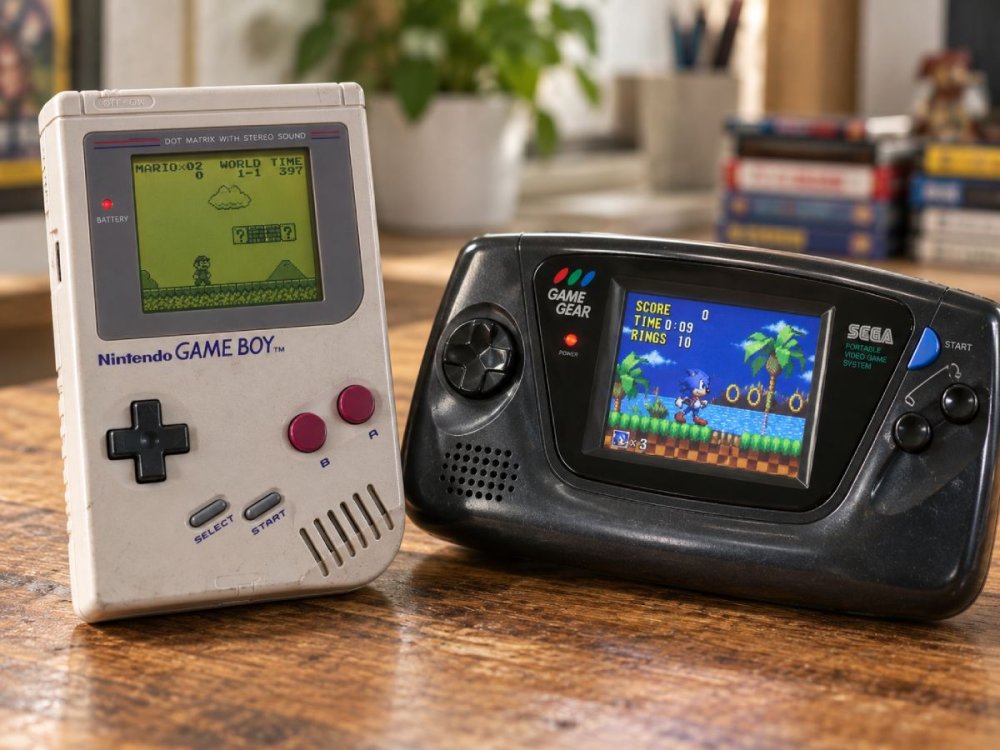
A handheld game in the 1980s was never merely something to play while waiting around. It was a tiny, treasured machine with a particular set of beeps, a battery compartment held shut with a coin, and plastic buttons polished smooth by determined thumbs. The most iconic handheld games of the 1980s could turn a car journey, a wet playtime or the back row of a family gathering into a private arcade.
Before the Game Boy rewrote the rules at the end of the decade, portable gaming was wonderfully varied. Some machines had glowing red LEDs, some relied on crisp black LCD characters, and some made astonishing promises on their boxes that were only half true. That was part of their charm. Here are the handheld heroes we owned, borrowed, begged for and occasionally watched vanish into someone else's Christmas stocking.
1. Mattel Auto Race
Released in the late 1970s but still a familiar sight well into the next decade, Mattel Auto Race looked less like a console than a compact piece of space-age dashboard equipment. Its red LED dots represented your car, rival traffic and the road ahead. In reality, it was brutally simple: move left, move right, avoid crashing.
Yet those glowing lights had real drama. There was no scenic backdrop, no loading screen and no gentle learning curve. The speed increased, the dots crowded in and suddenly you were gripping a plastic rectangle as though qualifying at Silverstone. Its limitations were obvious, but so was its magic: this was a game you could hold in your hands without a television anywhere nearby.
2. Merlin
Merlin was the electronic wizard that seemed to be in every Argos catalogue, every toy cupboard and every playground conversation. With its bright red body, eleven chunky illuminated buttons and oddly serious face, it looked like a prop from a BBC science-fiction programme.
Created by Parker Brothers, Merlin offered several games, including memory tests, musical challenges and a version of noughts and crosses. That range mattered. Where many handhelds did one thing brilliantly until the novelty wore off, Merlin felt like a whole games shelf condensed into a slightly mysterious red device. It beeped, flashed and demanded concentration - exactly the sort of technology we believed was cleverer than it really was.
3. Microvision
The Microvision deserves its place in any conversation about iconic handheld games from the 1980s because it introduced a thrilling idea: interchangeable cartridges. Long before we swapped Spectrum tapes or blew dust from console cartridges, this odd-looking machine let players change the game rather than replace the whole unit.
Its screen was tiny, its controls were built into each cartridge and its reliability could be temperamental. Still, games such as Block Buster and Star Trek Phaser Strike made the Microvision feel like a glimpse of the future. It was a proper portable system, not simply one game sealed inside a plastic case. For children used to being told to share the television, that distinction was enormous.
4. Nintendo Game & Watch: Ball
Nintendo's first Game & Watch, Ball, arrived in 1980 with a design so neat it now feels inevitable. The task was simply to keep balls in the air by moving a little juggler's arms. The LCD figures were fixed images rather than moving sprites, but our brains did the rest. A missed catch felt like a genuine calamity.
Ball also established the Game & Watch formula: a slim case, a monochrome display, a few responsive buttons, a score counter and, crucially, a clock. Parents could just about see it as a useful watch. We knew better. It was a game hiding in plain sight at the dinner table.
5. Game & Watch: Donkey Kong
If Ball was Nintendo's clever opening move, 1982's Donkey Kong was the moment the range became playground royalty. The orange Multi Screen unit folded like a compact, revealing two LCD displays and a layout that made it feel far more advanced than most pocket games.
Mario climbed ladders, avoided hazards and tried to rescue Pauline from the barrel-throwing ape. It captured the shape and spirit of the arcade original rather than reproducing it exactly, but that hardly mattered. The split-screen design, the satisfying clack of the controls and the sense that you owned a miniature arcade machine made it unforgettable. For many British children, this was the handheld to envy.
6. Game & Watch: Mario's Cement Factory
Nintendo produced dozens of Game & Watch models, but Mario's Cement Factory has a special place in the memory bank. Its broad, panoramic layout put Mario in charge of a chaotic cement works, shuttling buckets before the whole operation overflowed.
It was wonderfully industrial: conveyor belts, timed movements and a relentless tempo that made a simple job feel heroic. This was the appeal of the best LCD games. They took an everyday task - juggling, cooking, crossing a road, operating a factory - and made it urgent through a handful of black shapes and insistent electronic chirps.
7. Tomytronic 3-D
Tomytronic 3-D games were the sort of objects that made a child stop dead in a toy shop. Their large red viewing visor suggested serious equipment, not a modest battery-powered diversion. You pressed your eyes to the eyepiece and saw bright, separate LED images that created a convincing stereoscopic effect.
Titles including Thundering Turbo, Sky Attack and Planet Zeon offered racing, aerial combat and space battles with a depth most handheld games could not touch. They were bulkier than a Game & Watch and hardly ideal for a coat pocket, but that was not the point. Tomytronic 3-D felt like owning an arcade attraction. The trade-off was price, size and a gameplay loop that could become familiar, yet the first look through that visor was pure 1980s wonder.
8. Bandai Solar Power Frogger
Bandai's Solar Power range brought a genuinely futuristic detail to the handheld shelf: a solar panel. No rummaging for AA batteries, no plea to Dad to check whether the batteries in the torch still worked. Put the unit under a strong light and you were ready to play.
Frogger was a natural fit. Its crisp LCD action asked you to guide the little frog through traffic and across a dangerous river, with logs and vehicles appearing in fixed positions. It did not have the colour or noise of the arcade cabinet, but it had something equally powerful - you could take it into the garden and play it under daylight. For a generation raised on battery anxiety, solar power felt almost magical.
9. Entex Space Invader
Space Invaders had already taken over arcades, pubs and seaside amusement arcades, so a portable version was a serious proposition. Entex's handheld interpretation used a fluorescent display and a tabletop-like form that gave it more presence than the usual pocket LCD game.
The alien invasion was abstract, of course, but the tension survived. You watched the enemy descend, timed your shots and tried to hold your nerve as the screen grew more threatening. It also reminded us that handheld gaming was not always about portability in the modern sense. Some machines travelled from bedroom to kitchen table rather than slipping into a blazer pocket, and were no less loved for it.
10. Tiger Electronics Football
Tiger Electronics became a major name in the 1980s by turning popular sports, films and arcade ideas into affordable LCD handhelds. Football was among the most recognisable, asking players to dodge defenders using fixed black shapes on a silver-grey screen.
These games were not sophisticated, and that was never really the deal. Tiger handhelds were available, understandable and perfect for a birthday, a holiday or a lucky Saturday trip into town. Their plastic cases were often brightly branded, their sounds were sharp and their rules could be learned in seconds. They made a useful truth clear: a game did not need to be technically impressive to become part of someone’s childhood.
11. Casio Game Watches
The calculator watch was already the height of playground status, but Casio’s game watches pushed the idea further. Here was a digital watch that could tell the time, set an alarm and offer a miniature game when nobody was looking. It was technology with a secret life.
The tiny displays meant the games were necessarily basic, often built around catching, dodging or timing. But wearing one on your wrist gave it an advantage no larger handheld could match. It was always there. Whether teachers approved is another matter, but the appeal of pressing those minute buttons during a dull moment was hard to resist.
12. Nintendo Game & Watch: Fire
Fire was one of the Game & Watch games that showed how much tension Nintendo could create from a single repeating idea. Two rescuers held a trampoline while jumpers leapt from a burning building. Miss them and the alarmed little figure was carried away. It was grimly dramatic in that cheery, simplified 1980s way.
The game was easy to grasp but difficult to master, especially as the pace increased. More than that, Fire has the unmistakable feeling of the era: small enough to take everywhere, designed with care and built around an idea so clear that it needed no tutorial. You switched it on, heard the opening sound and immediately knew what was required.
Why these 1980s handhelds still matter
Modern portable games can deliver enormous worlds, online play and graphics that would have looked impossible on a home computer in 1985. But these earlier machines had personality in every compromise. Their fixed graphics encouraged imagination. Their beeps became soundtracks. Their chunky cases, decals, solar panels and folding screens made each game feel like a distinct object rather than another app behind the same glass rectangle.
That is why a battered Game & Watch or a red Merlin can still stop us in our tracks. The best of them are not just reminders of old games. They are reminders of being given a few quiet minutes with a machine that felt entirely our own - and discovering that a handful of buttons could hold a whole afternoon.