
There are certain objects that can transport you back to the 1980s faster than any photograph.
The clunk of a cassette deck button. The faint glow of a red LED display. The terrifying mechanical noise of a computer loading a game from tape. The peculiar sensation of carrying something described as "portable" that required six batteries and had roughly the same weight as a house brick.
The best 1980s gadgets were not necessarily clever by modern standards. In fact, quite a few were hilariously inconvenient. But that was part of their charm. They had buttons, switches, aerials, wires, cartridges, tapes and instruction manuals. Things clicked. Things whirred. Things occasionally needed a firm tap on the side.
And when you got a genuinely exciting piece of technology, it felt special.
So, if you grew up in Britain during the 1980s, see how many of these 25 gadgets immediately unlock a memory.
1. Sony Walkman
Few gadgets say "1980s" quite like the Sony Walkman.
Portable cassette players existed in countless shapes and brands, but Walkman became the name everybody knew. Owning one meant suddenly having a private soundtrack to your life.
You could listen to an album in the back of the car, on the bus or while wandering around pretending you were in a music video.
Of course, portable music required preparation. You needed tapes. You needed spare batteries. You needed headphones with foam covers that seemed genetically programmed to disintegrate.
And when the batteries began dying, you knew about it. Music slowed gradually until your favourite singer sounded as though they had consumed several pints of cough medicine.
Compared with streaming millions of songs from a phone, it was absurdly limited.
It was also brilliant.
2. ZX Spectrum
For thousands of British children, the ZX Spectrum was not simply a computer. It was a portal.
That little black machine with its famous rubber keyboard brought computer gaming into bedrooms across the country.
Getting a game running involved a ritual that younger generations may struggle to comprehend. Put the cassette in. Type the loading command. Press play. Then listen to several minutes of electronic shrieking while coloured bars appeared around the screen.
And wait.
Sometimes it worked.
Sometimes, after several minutes, it didn't.
Yet somehow this made successfully loading a game feel like an achievement in itself.
Games such as Manic Miner, Jet Set Willy and Chuckie Egg became part of British childhood, while magazines encouraged owners to type entire programs into their machines by hand.
The Spectrum turned plenty of children into gamers. It also quietly turned some of them into programmers.
3. Commodore 64
If you had a ZX Spectrum, there was a reasonable chance one of your friends had a Commodore 64.
This could lead to serious playground debate.
The C64 was a chunkier machine with a proper keyboard, impressive sound capabilities and an enormous library of games. Its distinctive SID sound chip produced music that remains instantly recognisable to retro gaming fans.
Loading from cassette could still test the patience of a saint, although disk drives were available for those fortunate enough to have one.
The real joy was visiting somebody's house and seeing games that looked or sounded different from the versions on your own computer.
Forget console wars. British children were arguing about computer formats years before PlayStation and Xbox existed.
4. Nintendo Game & Watch
Before a handheld console meant carrying hundreds of games in your pocket, there was Game & Watch.
Each Nintendo unit generally did one thing, but it did that one thing extremely well.
The little LCD characters moved between fixed positions on the screen while you desperately tried to improve your score. Some versions opened like a tiny clamshell and provided two screens, years before Nintendo returned to the same broad idea with the DS.
Part game, part gadget and part desirable playground object, Game & Watch machines felt incredibly futuristic.
If somebody brought one into school, people noticed.
5. Big Trak
Big Trak looked like somebody had driven a small tank straight out of a low budget science fiction film and into the Argos catalogue.
That, naturally, made it magnificent.
The six wheeled programmable vehicle allowed you to enter a sequence of commands using the keypad on its back. Forward. Turn. Forward again. Fire the light beam.
In theory, you could carefully calculate a route around the living room.
In practice, Big Trak tended to wander into furniture while everybody shouted conflicting instructions.
It was one of those classic electronic toys that made programming feel exciting before most children had any idea what programming actually was.
6. Speak & Spell
Speak & Spell was educational technology disguised as something you actually wanted to play with.
Its bright casing, chunky keyboard and electronic voice made it look gloriously futuristic.
The machine would say a word, then ask you to spell it. Simple enough, until that synthesised voice produced something that sounded only vaguely related to any word known to the English language.
Still, there was something compelling about hearing a toy talk back to you.
For a generation used to mostly silent toys, electronic speech seemed extraordinary.
7. Casio Calculator Watch
Why carry a calculator when you could strap one to your wrist?
Calculator watches represented an extremely specific version of the future, one in which everybody would apparently need to perform arithmetic at a moment's notice.
The tiny buttons were not particularly easy to press unless you possessed fingers roughly the dimensions of cocktail sticks, but that hardly mattered.
You had a calculator.
On your watch.
For an 1980s schoolchild, that was practically the same as being James Bond.
8. Sony Discman
The Discman arrived as compact discs began their march towards taking over our music collections.
Compared with cassettes, CDs felt impossibly sophisticated. They were shiny, digital and allowed you to jump directly between tracks without rewinding anything.
Portable CD players came with one rather significant drawback, however.
Movement.
Walking too enthusiastically could cause the music to skip. Running was basically an act of war against the laser mechanism.
Later players became much better at handling movement, but early portable CD listening sometimes involved walking with the care of somebody transporting a glass of water filled precisely to the rim.
9. Casio VL Tone
The Casio VL Tone was a tiny electronic keyboard that proved musical instruments did not need to be large, expensive or particularly serious.
It combined keyboard sounds, rhythm features and calculator functions into an object that seemed designed specifically to fascinate children.
The sounds were unmistakably electronic, which was precisely the point.
Cheap electronic keyboards became a fixture of 1980s bedrooms, often resulting in extremely experimental family concerts involving two fingers and an unwavering rhythm track.
Parents showed remarkable patience.
10. Atari 2600
Although launched before the 1980s, the Atari 2600 remained a major part of early home gaming culture during the decade.
Its wood effect styling alone deserves recognition. Nothing says advanced electronic entertainment quite like making your games console resemble a piece of lounge furniture.
Cartridges made gaming wonderfully direct. Push one into the machine, switch it on and play.
The graphics were primitive by modern standards, but imagination did a lot of heavy lifting. A handful of pixels could become a spaceship, a tank or an adventurer.
Games did not need fifty hour storylines. Sometimes you just wanted to beat your brother's score.
11. Pocket TVs
A television small enough to hold in your hand seemed almost ridiculous.
And therefore absolutely essential.
Pocket televisions from companies such as Casio usually came with tiny screens and telescopic aerials. Getting a decent picture could involve standing in an oddly specific part of the room while holding the aerial at an angle apparently known only to satellite engineers.
But when the picture appeared, none of that mattered.
Television was happening in your hand.
The smartphone has made this completely ordinary. In the 1980s, it felt like witchcraft.
12. Polaroid Cameras
Photography once involved a mysterious period between taking a picture and finding out whether anybody had their eyes open.
A Polaroid removed much of that suspense.
Take the photograph and, moments later, a physical picture emerged.
Watching the image gradually appear was part of the experience. There was something wonderfully tangible about it, especially when compared with today's habit of taking fifteen nearly identical photographs and immediately forgetting all of them.
Polaroid pictures were expensive enough to matter. You tended to think before pressing the shutter.
Usually.
13. Boom Boxes
A proper 1980s boom box was not subtle.
It had speakers, cassette decks, radio controls, meters, buttons and often enough chrome detailing to be visible from space.
Many models were supposedly portable, although carrying a large one for any distance was an excellent upper body workout.
Dual cassette decks brought another major technological breakthrough into the home: copying tapes.
This also enabled the creation of mixtapes, perhaps one of the most carefully engineered forms of social communication ever devised.
Choosing the songs mattered.
Choosing their order mattered.
And trying to stop recording before the radio DJ started talking mattered most of all.
14. Personal Stereo Headphones
The headphones supplied with portable cassette players deserve their own mention.
They were lightweight, usually had a thin metal headband and featured little foam pads in black, orange or another suitably 1980s colour.
They were not luxurious.
They did not cancel noise.
They did not detect when you removed them from your head.
They played music directly into your ears without disturbing your parents, which was more than enough.
Those foam covers also had a limited lifespan. Sooner or later they began tearing apart, leaving you listening through two tiny exposed plastic speakers.
Still worked.
15. Binatone TV Games
Before sophisticated home computers became commonplace, TV games offered beautifully simple entertainment.
Binatone machines and similar systems connected to the television and let families play variations of tennis, squash and football using extremely basic on screen graphics.
A "tennis player" was basically a white line.
The "ball" was a square.
Nobody complained.
These machines are a perfect reminder of how quickly imagination fills the gaps when technology gives it just enough to work with.
16. Electronic Organisers
Towards the end of the decade, electronic organisers offered a tantalising glimpse of a paperless future.
You could store telephone numbers, appointments and notes on a device small enough to carry around.
Admittedly, entering the information through tiny keys could make writing a person's address feel like completing a government census.
But electronic organisation felt incredibly sophisticated.
Today your phone automatically synchronises contacts across multiple devices. Back then, having twenty telephone numbers stored in something with an LCD screen felt seriously advanced.
17. Remote Control Cars
Radio controlled cars were among the most desirable electronic toys of the decade.
Some were fast. Some were remarkably slow. Some had proper proportional steering, while cheaper models operated on the more adventurous principle of going forwards until you wanted to turn, at which point they reversed in a curve.
Battery life was rarely generous.
You could spend hours waiting for rechargeable batteries to be ready, then enjoy what felt like seven glorious minutes of driving.
Those seven minutes were worth it.
18. Simon
Simon had four large coloured buttons and a simple objective: repeat an increasingly long pattern of lights and sounds.
That sounds easy.
It isn't.
The first few rounds gave you the dangerous confidence that you might possess some kind of extraordinary photographic memory.
A short while later, you were staring helplessly at four coloured buttons wondering whether the last sequence had been red, green, yellow, blue or something entirely different.
Simon was simple, addictive and brilliantly designed.
It also had the unique ability to make an entire family suddenly go quiet.
19. Stylophones
The Stylophone actually originated earlier, but continued to fascinate children who encountered one in the 1980s.
Instead of conventional keys, you played it using a small stylus across a metal keyboard.
The resulting electronic buzz was distinctive, strange and immediately entertaining.
It felt less like playing a musical instrument and more like operating a tiny laboratory device.
Which, for a child, was probably better.
20. View Master
Not every memorable gadget needed batteries.
The View Master used circular reels containing tiny photographic images. Insert a reel, look into the viewer and click the lever to move from one image to the next.
The stereoscopic images appeared in 3D, giving children miniature windows into cartoons, landscapes and other worlds.
It was simple mechanical technology, but the effect could feel magical.
There were no loading screens, subscriptions, updates or passwords.
Just put the reel in and click.
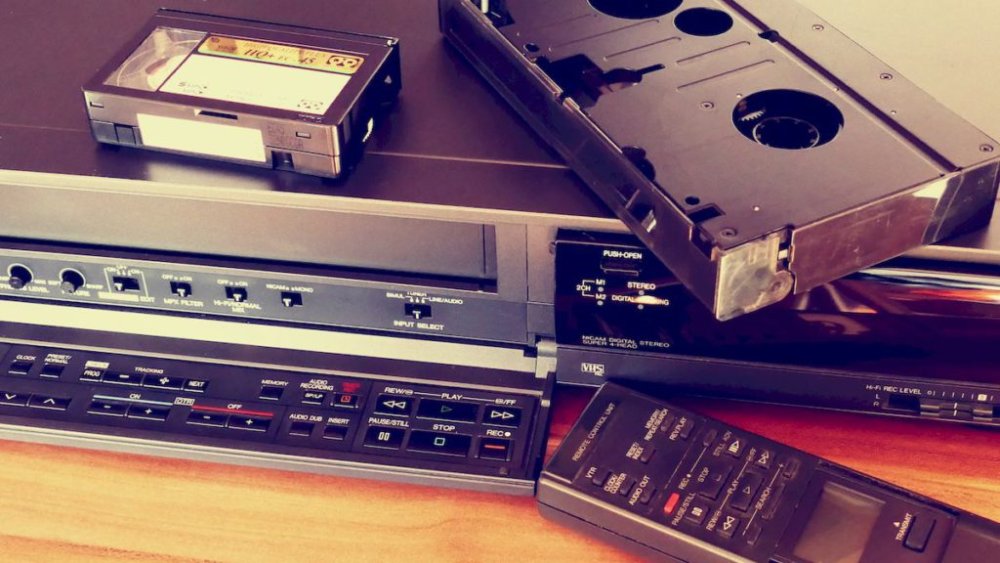
21. VHS Video Recorders
The VHS recorder transformed British television habits.
For the first time, missing a programme did not necessarily mean missing it forever.
Assuming, of course, somebody had successfully programmed the video recorder.
This was not always guaranteed.
Setting a timer could feel like operating the flight computer on a commercial aircraft. Entire families had one designated person who knew how to do it, while everybody else feared touching anything.
Then there were tapes labelled with cryptic collections such as:
"Christmas 86 / Minder / Football / DO NOT RECORD"
Someone always recorded over it.
22. Cordless Telephones
The traditional house telephone had one major limitation: the wire.
Then cordless phones arrived.
Suddenly you could walk around the house while talking to someone. You could even go into another room.
This was freedom.
The handset usually sat in a charging cradle, and losing it somewhere in the house introduced an entirely new domestic problem.
Before mobile phones, a cordless telephone felt genuinely luxurious. You were still attached to your home telephone line, but at least you were no longer physically attached to the wall.
23. Digital Alarm Clocks
The red glow of a digital alarm clock is one of those tiny details buried deep in 1980s memory.
The displays were bright enough to illuminate half the bedroom at night. Some models combined alarm clocks with radios, allowing you to wake to music rather than a mechanical bell.
Naturally, this required tuning the radio correctly.
There was also the eternal fear that a power cut had reset the clock, leaving it flashing a meaningless time while you slept peacefully through school or work.
Today's phone alarms are undoubtedly more practical.
They are nowhere near as atmospheric.
24. Electronic Handheld Games
Not every handheld game came from Nintendo.
The 1980s were full of electronic games based around LCD screens, LED displays and simple sound effects.
Football games. Racing games. Space games. Shooting games.
Sometimes the graphics consisted of little more than a few glowing lines, but these machines could absorb ridiculous amounts of time.
Their limitations made them strangely compelling. There were no enormous worlds to explore or endless downloadable updates.
There was one game.
You learned it.
Then you became extremely good at it.
25. The Ferguson Videostar and the Family Camcorder
Home video equipment brought another technological revolution into ordinary family life.
Early consumer video cameras and camcorders were not the tiny devices we know now. They could be large, expensive and distinctly noticeable when somebody produced one at a birthday party.
Suddenly family memories could move and talk.
Unfortunately, this also meant somebody's dad would occasionally spend the entire school sports day looking through a viewfinder instead of watching what was happening.
Home video from this era has a character all its own. Slightly soft pictures, unpredictable zooming, muffled conversations and somebody eventually noticing the camera and immediately behaving unnaturally.
Decades later, those imperfect recordings are priceless.
Why 1980s Gadgets Felt So Exciting
Looking back at these 1980s gadgets, it is tempting to focus on how limited they were.
A Walkman played one cassette at a time. A Spectrum could take several minutes to load a tiny game. A pocket television struggled to produce a stable picture. A VHS recorder could reduce an intelligent adult to a state of complete confusion.
Modern technology has removed nearly all of those frustrations.
It has also removed some of the anticipation.
Technology in the 1980s frequently made you participate in the process. You selected the record. Loaded the cassette. Tuned the radio. Programmed the computer. Positioned the aerial. Rewound the tape. Changed the batteries.
You learned the peculiarities of your own machines.
You knew exactly how far to turn the volume knob before it crackled. You knew which cassette player needed its eject button pressed slightly sideways. You knew your television behaved better if the aerial pointed towards the window.
Our gadgets had personalities, although admittedly some of those personalities were extremely annoying.
The Argos Catalogue Effect
There is another reason these machines remain so deeply connected with childhood nostalgia.
You often spent far more time wanting them than actually owning them.
The Argos catalogue could function as an enormous book of dreams. Pages of computers, stereos, televisions, electronic games and radio controlled cars were studied with extraordinary concentration.
Catalogues from Dixons, Comet and other high street retailers performed much the same role.
Christmas involved strategic page folding.
Birthdays involved hints that gradually lost all subtlety.
And when you finally received the gadget you had been staring at for months, the excitement was enormous.
Unboxing also felt different.
Packaging was full of polystyrene, cardboard inserts, instruction books, cables and mysterious accessories. New electronics had that unmistakable smell that is difficult to describe but apparently permanently stored somewhere in the brain.
Why We Still Love 1980s Gadgets
Part of the appeal is obviously nostalgia.
These objects remind us of childhood bedrooms, Saturday mornings, Christmas mornings, school friends, family holidays and long afternoons when entertainment was something you actively chose rather than an endless stream waiting to fill every spare second.
But there is more to it than that.
Old technology is interesting because you can often understand it simply by looking at it.
Buttons have labels.
Switches physically move.
Cassette mechanisms open.
Volume knobs turn.
Cartridges slot into machines.
Modern technology frequently hides everything behind a smooth glass screen. That is incredibly convenient, but perhaps less satisfying to fiddle with.
It also explains why so many 1980s gadgets are collectible today. Original computers, portable cassette players, electronic games and audio equipment are increasingly being restored rather than thrown away.
A working Walkman is no longer merely an obsolete music player. It is a beautifully mechanical little reminder of how portable music once worked.
A ZX Spectrum is not simply an inadequate computer. It represents the moment millions of people first discovered what having a computer at home could mean.
A Game & Watch is not just an LCD toy. It is part of the history of handheld gaming.
Context changes everything.
A Decade When Technology Still Felt New
Children growing up now are surrounded by technology vastly more powerful than anything we could have imagined in the 1980s.
A modern smartphone combines a camera, television, music player, games console, calculator, map, telephone, video recorder, alarm clock and computer into one thin rectangle.
Technically, there is no contest.
Yet that might be precisely why individual gadgets used to leave such strong memories.
Each one had a purpose.
Your camera was a camera.
Your stereo played music.
Your Game & Watch played a game.
Your alarm clock woke you up.
And your Spectrum produced terrifying noises for six minutes before occasionally informing you that something had gone wrong.
Progress is wonderful, but perfection is not always memorable.
The 1980s gadgets we grew up with were chunky, temperamental and often spectacularly inefficient. They were also exciting, tactile and full of character.
Perhaps that is why seeing one again can instantly bring back a room, a person or a moment you have not thought about for forty years.
If this has sent you mentally rummaging through childhood cupboards looking for your old Walkman, Big Trak or calculator watch, join RetroWins or sign up to stay in the loop. We will keep bringing back the machines, toys and technology that made growing up with gadgets so much fun.






