
30 Electronic Toys From the 1980s You'll Want to See Again
There was something gloriously optimistic about electronic toys from the 1980s. Give a toy a few flashing LEDs, a handful of buttons and the ability to produce an ear splitting beep, and suddenly it felt as though the future had arrived in your bedroom.
It didn't matter that the "computer" inside was considerably less powerful than the thing controlling your washing machine today. To an eight year old in 1983, it was astonishing.
The decade gave us talking toys, programmable vehicles, handheld electronic games, robot companions, miniature arcade machines and various plastic contraptions whose main purpose seemed to be annoying everybody else in the house.
Some were genuinely clever. Some were wonderfully pointless. Quite a few consumed batteries at a rate normally associated with industrial equipment.
And we loved them.
Here are 30 memorable electronic toys from the 1980s that might just unlock a part of your brain that has been quietly storing beeps, flashing lights and Christmas morning memories for the last four decades.
1. Big Trak
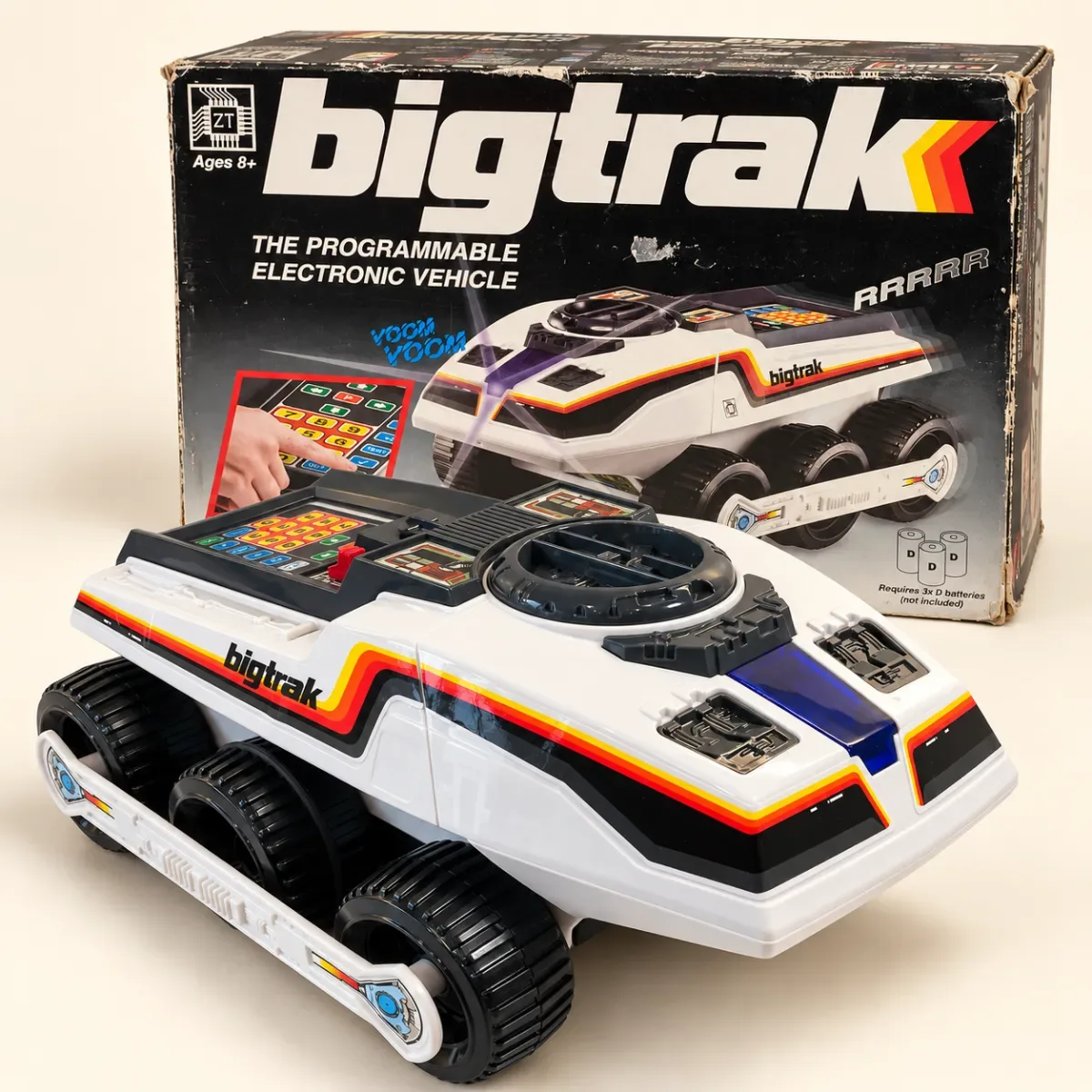
Few 1980s toys looked quite as futuristic as Big Trak.
This six wheeled programmable vehicle had a keypad on the top that allowed you to enter a sequence of commands telling it to move forwards, turn, pause and fire its front mounted light.
The real magic came from planning a route.
You might instruct Big Trak to travel across the lounge, turn around the coffee table, head towards the kitchen and dramatically fire its "photon beam" at your unsuspecting dad.
That was the theory, anyway.
In practice, one slightly inaccurate turn could send it crashing into the sofa.
Big Trak somehow made rudimentary programming feel like playing with a spaceship. Even the angular grey body and futuristic decals looked like something NASA might have accidentally left behind.
It remains one of the quintessential electronic toys from the 1980s.
2. Grandstand Astro Wars
Anyone who owned Astro Wars will probably remember the sound before anything else.
Grandstand's tabletop electronic game recreated a simple space battle using bright fluorescent display technology and a cabinet styled to resemble a miniature arcade machine.
You controlled your ship from the bottom while attacking enemies above, accompanied by a constant barrage of electronic noises.
It was hardly subtle.
Astro Wars was part of a wave of tabletop games that attempted to bring the arcade experience into British homes. Compared with a modern handheld console it seems incredibly limited, but at the time having something resembling an arcade cabinet sitting on your bedroom floor felt impossibly exciting.
And that glowing display still looks fantastic.
3. Speak & Spell
The bright red Speak & Spell was supposedly educational.
This important detail made it considerably easier to persuade parents to buy one.
Created by Texas Instruments, Speak & Spell used speech synthesis to say words aloud and challenge children to spell them using the distinctive keyboard on the front.
Its robotic voice became instantly recognisable.
You could practise spelling, play word games and repeatedly make it say things simply because hearing a machine talk still felt extraordinary.
Today, synthetic speech is everywhere. Your phone can read an entire book to you without anyone finding it remotely remarkable.
Back then, a red plastic box saying "incorrect" in an electronic American voice seemed like witchcraft.
4. Simon
Simon was beautifully simple.
Four large coloured buttons lit up in an increasingly long sequence, accompanied by four distinctive tones. Your job was to remember the pattern and repeat it.
That's essentially the entire game.
And somehow it could occupy people for hours.
Part of Simon's appeal was its wonderfully chunky design. The circular black case and four enormous red, blue, green and yellow panels made it instantly recognisable.
It was also one of those rare electronic toys that adults would happily play after the children had gone to bed.
Things became remarkably serious once somebody reached a long sequence.
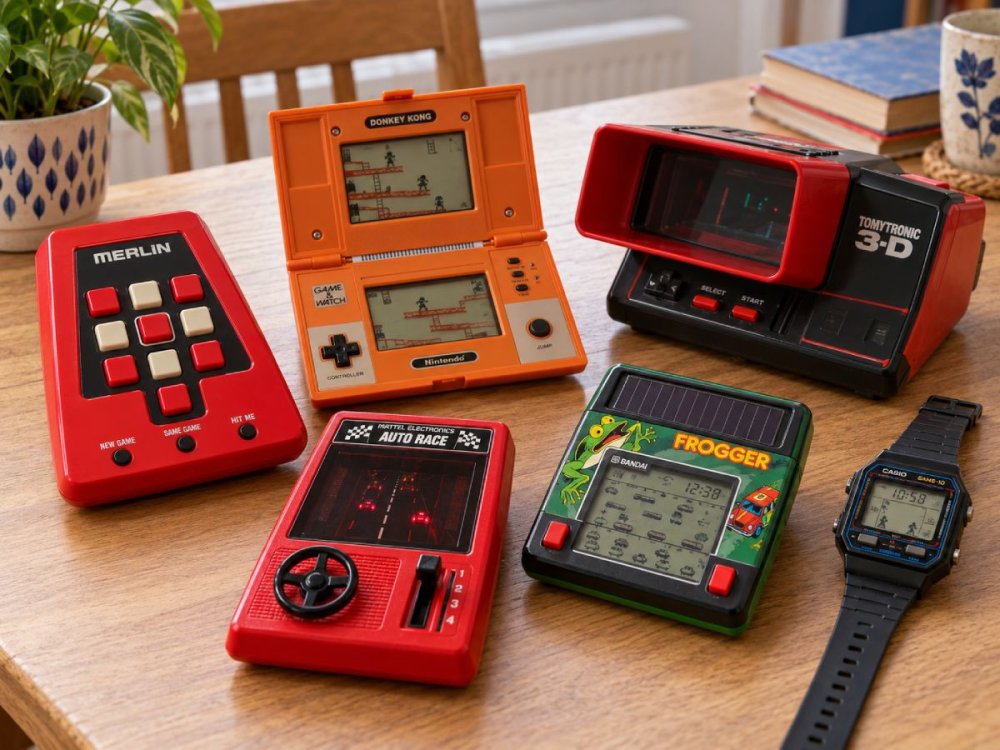
5. Merlin
Merlin looked like a large red telephone from a science fiction film.
Released around the beginning of the decade, the handheld electronic game had a numeric style keypad filled with red LEDs and offered several different games.
You could play Tic Tac Toe, test your memory, create simple music and tackle other electronic challenges.
The clever part was that one relatively simple piece of hardware could perform several completely different functions.
At a time when many electronic toys essentially did one thing, Merlin felt unusually sophisticated.
It also had the pleasing advantage of looking extremely mysterious when switched off. Unless somebody explained it, there was absolutely no clue what you were supposed to do with it.
6. MB Electronic Battleship
Traditional Battleship required two plastic grids, tiny pegs and considerable honesty.
Electronic Battleship added noises.
Naturally, this made it better.
Players entered the positions of their ships into the console and then called out coordinates while the machine kept track of hits and misses.
The sound effects transformed a familiar board game into something that felt much more technological.
There was also something deeply satisfying about pressing the chunky controls and hearing the game respond.
No internet connection. No colour screen. No downloadable updates.
Just two people attempting to sink each other's plastic aircraft carriers while a grey box beeped approvingly.
7. Tomytronic 3D
Before virtual reality headsets became fashionable, there was Tomytronic 3D.
These strange binocular shaped electronic games were held directly in front of your eyes. Inside, the display created an immersive effect that felt incredibly futuristic at the time.
Different versions offered racing, shooting and space themed games.
Of course, nobody wearing one looked remotely futuristic.
From the outside you resembled someone staring very intensely into a pair of plastic binoculars while occasionally twitching.
But the private little game world inside was surprisingly compelling.
For children accustomed to small LCD screens, having the display completely fill your view was genuinely impressive.
8. Nintendo Game & Watch
Nintendo was already making its way into British pockets long before the Game Boy appeared.
The Game & Watch series consisted of compact LCD games, each generally built around a particular theme or character.
Popular examples included Donkey Kong, Fire, Parachute and Mario Bros.
The controls were simple, the graphics were fixed LCD shapes and the games were ruthlessly addictive.
Donkey Kong was particularly important because its clamshell design included the now familiar directional pad.
Game & Watch units also doubled as clocks, hence the name, which meant you could theoretically claim they served a useful household purpose.
Nobody was fooled.
9. Tomy Atomic Pinball
Tomy's Atomic Pinball brought a miniature approximation of the amusement arcade into the home.
Lights flashed, the score climbed and the whole machine made exactly the sort of electronic racket you wanted from an early 1980s tabletop toy.
It wasn't exactly equivalent to having a full sized pinball table in your bedroom, but that didn't matter.
The attraction was partly visual. Atomic Pinball looked busy, mechanical and exciting even before you started playing.
For children fascinated by amusement arcades, anything that recreated even a tiny piece of that atmosphere at home had immediate appeal.
10. Grandstand Firefox F7
Grandstand sold a remarkable range of electronic games in Britain during the late 1970s and 1980s, and Firefox F7 is one of the names likely to provoke an immediate flash of recognition.
The futuristic tabletop game put the player in control of a spacecraft, using a colourful electronic display and gloriously synthetic sound effects.
Like many games of the period, the artwork surrounding the display did a significant amount of imaginative heavy lifting.
The actual moving graphics might have been simple, but the cabinet artwork told you that an enormous intergalactic battle was taking place.
Your imagination supplied the rest.
11. Tomy Turnin' Turbo Dashboard
This was driving simulation before anybody worried about frame rates.
Tomy's Turnin' Turbo Dashboard gave children a steering wheel, gear lever, dashboard and moving road display. You sat in front of it and pretended to drive.
That sounds basic now.
It didn't feel basic then.
The dashboard presentation was the key. Rather than simply controlling something on a screen, you had a miniature cockpit in front of you.
You could steer, change gear and enjoy the illusion that you were travelling considerably faster than somebody sitting cross legged on a bedroom carpet.
12. Casio VL Tone
Strictly speaking, Casio's VL Tone instruments sat somewhere between musical gadget and toy, which is exactly why so many children desperately wanted one.
The famous VL 1 combined a tiny keyboard, calculator functions, rhythm accompaniment and primitive synthesiser capabilities in one wonderfully compact device.
Its little built in rhythms and electronic sounds were instantly captivating.
You could spend ages making dreadful music and feel enormously accomplished doing it.
Small electronic keyboards became fixtures in countless 1980s bedrooms, frequently guaranteeing that everybody else in the house would hear the same eight notes approximately 400 times.
13. Stylophone
The Stylophone originally appeared before the 1980s, but plenty of British children encountered one during the decade.
It used a small metal keyboard played with a wired stylus, producing a distinctive buzzing electronic tone.
There was something delightfully immediate about it. Touch the stylus to a key and the little box squealed into life.
The instrument had already acquired pop culture credentials through musicians including David Bowie, which gave this otherwise rather strange little device a certain cool factor.
Calling the sounds "beautiful" might be generous.
Memorable, absolutely.
14. Star Bird
Milton Bradley's Star Bird was a magnificent electronic spaceship that responded to how you physically moved it.
Point the nose upwards and the engine sound increased in pitch. Bring it down and the sound changed again.
This was enormously satisfying.
You didn't simply press buttons and watch something happen. You flew the thing around the room yourself, complete with electronic engine noises.
Star Bird actually originated at the end of the 1970s, but remained very much part of the electronic space toy culture that flowed into the early 1980s.
It also encouraged the traditional childhood activity of running around indoors holding a spaceship at eye level.
Furniture tended to suffer.
15. Major Morgan
Major Morgan looked like a friendly electronic keyboard that had somehow joined the army.
Produced by Playskool, the colourful musical toy used interchangeable song cards that fitted across the keyboard. These showed children which notes to press to play familiar tunes.
It was simple, cheerful and surprisingly memorable.
For many children it offered an early introduction to making music without requiring traditional lessons or the ability to read conventional notation.
More importantly, you could usually make something vaguely recognisable emerge from it within a few minutes.
That was enough to feel like a musical genius.
16. Teddy Ruxpin
Teddy Ruxpin arrived in the mid 1980s and managed to make the humble teddy bear technologically exciting.
Insert a special cassette and Teddy would tell stories while moving his mouth and eyes in synchronisation with the recording.
Seeing a soft toy apparently talking to you was extraordinary.
It could also be slightly unsettling when you encountered one unexpectedly in a dark bedroom, but that was a separate issue.
Teddy Ruxpin represented a new breed of interactive toy where electronics were hidden inside something familiar.
Children weren't simply listening to a tape. The character appeared to be telling the story directly to them.
17. Alphie
Playskool's Alphie was another friendly robot designed to make educational activities feel more exciting.
The original version was a chunky plastic robot with cards that could be inserted into its body for different learning activities.
Lights helped indicate answers and guide children through simple exercises involving letters, numbers and patterns.
The robot styling mattered enormously.
An ordinary educational activity sheet was homework.
Put essentially the same activity inside a smiling plastic robot and suddenly it was technology.
This was a remarkably successful strategy throughout the decade.
18. Omnibot
If Big Trak looked futuristic, Tomy's Omnibot looked as though the future had actually arrived and wanted to make you a cup of tea.
Introduced during the 1980s, Omnibot was a remote controlled robot with an unmistakably retro futuristic appearance.
It could move around, carry objects on a tray and offered additional features that made it far more elaborate than the average toy robot.
The larger Omnibot models were expensive aspirational toys, the sort you might study obsessively in catalogues even if there was absolutely no chance of finding one under the Christmas tree.
Today the combination of white plastic, dark visor and boxy robot proportions could hardly look more 1980s.
And that is precisely why collectors love them.
19. Armatron
Armatron was a robotic arm controlled using a wonderfully complicated looking collection of levers and joysticks.
Made by Tomy, it allowed you to rotate the arm, adjust its joints and operate a gripping claw.
The challenge was manipulating objects without knocking everything over.
It required more coordination than it initially appeared, which was part of the fun.
Armatron felt less like a conventional toy and more like operating some piece of industrial machinery that had mysteriously been shrunk to bedroom size.
For mechanically minded children, it was fascinating.
20. Screwball Scramble
Screwball Scramble wasn't dominated by electronics, but no tour through memorable 1980s toys feels quite right without it.
Tomy's obstacle course challenged players to guide a metal ball through a series of mechanical hazards using buttons, levers and carefully timed movements.
The clock added pressure.
This transformed an already fiddly challenge into a frantic battle against time, usually accompanied by considerable shouting.
You would finally master one section only to send the ball flying off somewhere else seconds later.
It was infuriating in exactly the right way.
21. Lights Alive
Lights Alive turned a grid of illuminated pegs into an electronic drawing board.
Push the pegs and points of light appeared, allowing you to create simple glowing pictures and patterns.
For anyone used to drawing on paper, creating pictures using light felt remarkably high tech.
It was essentially pixel art before most children had any idea what a pixel was.
Pictures were necessarily blocky, but that was part of the charm.
A rocket, a house, a face or your name all looked much more impressive simply because they were glowing in the dark.
22. VTech Talking Whiz Kid
Electronic learning toys became increasingly ambitious during the 1980s, and VTech was one of the companies enthusiastically combining education with buttons, keyboards and synthetic voices.
The Talking Whiz Kid range provided activities involving spelling, vocabulary, numbers and other educational subjects.
Again, speech was the headline attraction.
A machine responding verbally to your answers felt incredibly sophisticated.
Modern children can have fluid conversations with computers. In the 1980s we were impressed when a plastic box correctly pronounced a word after several seconds of button pressing.
Progress is a funny thing.
23. Grandstand Munchman
If Munchman looked suspiciously familiar to arcade fans, there was a reason.
The tabletop electronic game offered maze chasing gameplay that clearly appealed to children obsessed with Pac Man and the arcade craze surrounding it.
Its colourful fluorescent display looked terrific in a darkened room.
Many Grandstand games relied on this same basic formula: take the excitement of an arcade game, simplify it sufficiently to work on affordable domestic electronics, then package it in a miniature cabinet that looked irresistible in a catalogue.
For many British children, it worked perfectly.
24. Grandstand Scramble
Scramble was another hugely memorable Grandstand tabletop game.
Inspired by the famous arcade style of side scrolling space shooters, it challenged players to navigate and shoot their way through a hostile landscape.
Again, the technology seems simple through modern eyes.
That misses what these machines represented.
Going to an arcade meant needing coins, permission and usually a trip somewhere. A tabletop electronic game was yours. You could play until your parents told you to stop.
Or until the batteries gave up.
Whichever came first.
25. Parker Brothers Q*bert Electronic Game
Q*bert was one of the great characters of the early video game boom, and naturally found his way into dedicated electronic games.
The attraction of these devices wasn't perfect arcade accuracy. Nobody genuinely mistook them for the machines found in amusement arcades.
It was ownership.
An arcade character that previously existed on an enormous cabinet could now live in your bedroom.
The distinctive pyramid based gameplay translated surprisingly well to compact electronic formats and Q*bert's wonderfully odd appearance made him perfect toy box material.
26. Epoch Astro Command
Space themed electronic games were absolutely everywhere, and Epoch's Astro Command was another memorable example.
The tabletop format, illuminated display and physical controls were designed to create the feeling of commanding some highly advanced spacecraft.
As with many 1980s electronic toys, the experience depended heavily on imagination.
A handful of illuminated shapes became alien spacecraft. A plastic control panel became a starship bridge.
Children were remarkably willing collaborators with limited technology.
Give us three flashing lights and a convincing explosion sound and we'd happily save the galaxy before tea.
27. Electronic Detective
Electronic board games occupied a strange but wonderful middle ground.
They still involved sitting around a physical board with other people, but an electronic unit controlled some part of the experience.
Electronic Detective, released by Ideal, used a computerised console to provide information as players investigated a fictional crime.
The electronic element gave the game an intriguing sense of unpredictability.
Instead of simply following printed instructions from a card, you were consulting a machine.
For a generation discovering home computers at the same time, that small change made a board game feel distinctly modern.
28. Computer Battleship
Battleship received several increasingly electronic incarnations over the years, and the computerised versions pushed the concept even further.
Instead of relying entirely on another player, certain versions allowed you to battle against the machine itself.
For a child in the 1980s, playing a board game "against the computer" sounded enormously impressive.
The intelligence involved was obviously nothing like modern game AI, but again, context matters.
Computers were still mysterious objects to many families.
The idea that one could sit on the table and play Battleship with you was enough.
29. Radio Controlled R2 D2
Star Wars merchandising had already transformed the toy industry by the time the 1980s arrived, and electronic versions of R2 D2 were almost inevitable.
Remote controlled R2 D2 toys allowed children to send the famous astromech droid trundling around the house.
There are few fictional characters better suited to electronic toy form.
R2 D2 was already supposed to be a moving, beeping robot, so even relatively simple toy versions could feel convincing.
The sound effects helped enormously.
A plastic robot making familiar electronic chirps while moving across the carpet didn't need much imagination to become the real thing.
30. Lazer Tag
By the second half of the 1980s, electronic toys were becoming increasingly ambitious.
Lazer Tag turned running around firing imaginary weapons at your friends into a genuinely electronic game.
Players used futuristic looking infrared equipment that could register successful hits.
The appeal was immediate.
Instead of somebody simply shouting "I got you!" followed by ten minutes of argument, the electronics could settle the matter.
At least that was the theory.
The combination of wearable technology, flashing lights, science fiction styling and competitive play made Lazer Tag feel enormously futuristic.
Modern laser tag venues are far more elaborate, but the essential thrill hasn't changed very much.
Why 1980s Electronic Toys Felt So Exciting
Looking back at these electronic toys from the 1980s, one thing becomes obvious: the technology itself was only half the attraction.
The other half was possibility.
Electronics were suddenly appearing everywhere.
Home computers were arriving in ordinary British homes. Digital watches were becoming affordable. Video games were spreading from arcades into living rooms. Synthesised speech meant machines could apparently talk. Remote controls meant toys could move without being touched.
Children could see technology changing around them almost year by year.
Electronic toys tapped directly into that excitement.
A Big Trak wasn't just a plastic vehicle. It was a robot you could programme.
Speak & Spell wasn't just a spelling exercise. It was a computer talking to you.
Tomytronic 3D wasn't merely another electronic game. You put it over your eyes and disappeared into the screen.
The limitations were often part of the charm.
Displays were crude, speakers were tinny and controls could be awkward. Many toys had tiny repertoires of sounds and actions that children memorised completely within days.
Nobody cared.
Your imagination filled the enormous gap between what the packaging suggested and what the electronics could actually achieve.
The Sounds We Still Remember
One particularly powerful trigger for nostalgia is sound.
1980s electronic toys had some spectacular noises.
There were chirps, buzzes, warbles, alarms and synthetic explosions. Speech synthesis had its own peculiar robotic character. Electronic games often communicated almost entirely through a handful of tones.
Parents probably remember the sounds for slightly different reasons.
A toy with no headphone socket could dominate an entire room.
This was particularly impressive when several children brought electronic toys together and switched everything on simultaneously.
The resulting noise resembled a computer factory experiencing a nervous breakdown.
Yet hearing those sounds again today can instantly transport people back to childhood.
Visual design matters, but sound has an extraordinary ability to unlock forgotten memories.
Batteries, Catalogues and Christmas Morning
You can't properly remember 1980s electronic toys without remembering batteries.
Lots of batteries.
Christmas morning could rapidly turn into a desperate search through kitchen drawers for AAs, Cs, Ds or the mysterious rectangular 9 volt battery that nobody seemed to have.
Some toys came with batteries.
Many absolutely did not.
Then there were the catalogues.
For British children, the Argos catalogue was practically a consumer electronics bible. Toy pages were studied with extraordinary concentration.
You didn't casually browse them.
You performed research.
Pages were folded. Desired items were circled. Prices were assessed against the approximate generosity of grandparents.
Catalogue photographs also had a habit of making electronic toys appear enormous, so occasionally Christmas morning included the surprising discovery that your dream arcade machine was approximately the size of a toaster.
It didn't usually matter.
Once those batteries went in and the lights came on, everything was forgiven.
Why Original 1980s Electronic Toys Are Collectible Today
Many surviving toys from the decade are now sought after by collectors.
Part of that interest is obvious nostalgia. Someone who desperately wanted an Omnibot at ten years old may finally be in a position to buy one forty years later.
Condition makes an enormous difference.
Original packaging, manuals, accessories and inserts can be particularly desirable because those were precisely the things children tended to lose, tear or throw away.
Working examples are also attractive, although vintage electronics inevitably bring complications.
Battery compartments can suffer corrosion. Old mechanisms wear out. Rubber components deteriorate. Speakers fail. Plastic becomes brittle.
Then there is the greatest enemy of vintage toys everywhere: somebody leaving batteries inside them for twenty years.
A boxed electronic toy that still works properly can therefore feel surprisingly special.
It isn't merely an object that survived. It is a little functioning piece of the technological optimism of the 1980s.
Electronic Toys From the 1980s Had Something Modern Toys Can't Quite Recreate
Modern toys are technically astonishing.
They can recognise voices, connect to smartphones, display full colour graphics and contain processors vastly more powerful than entire home computers from the 1980s.
Yet greater capability doesn't automatically produce greater wonder.
Part of the excitement of 1980s electronic toys came from seeing these technologies for the first time.
The first toy that talked felt extraordinary because talking machines weren't surrounding you already.
The first programmable vehicle seemed remarkable because most people had never programmed anything.
A pocket sized electronic game felt magical because interactive digital entertainment itself was still relatively new.
Each small technological leap was visible.
You could almost watch the future arriving one Christmas at a time.
Still Beeping After All These Years
The best electronic toys from the 1980s weren't necessarily sophisticated.
They were memorable.
Big Trak wandering slightly off course. Simon speeding up while you desperately tried to remember the next colour. Speak & Spell announcing another spelling failure. A glowing Grandstand game illuminating your bedroom after the lights were supposed to be off.
Those experiences became attached to particular places, people and moments.
That is why finding one of these toys again can produce such an unexpectedly strong reaction.
You're not simply looking at some old plastic and circuitry.
For a moment, you're back on the carpet with an Argos catalogue beside you, trying to work out how many batteries the future requires.
And apparently, it requires quite a lot.
If this has stirred a few memories, join RetroWins or sign up to stay in the loop. We'll be revisiting more classic computers, gadgets, electronic toys and wonderfully unnecessary technology from the days when a flashing red LED could make almost anything seem futuristic.