
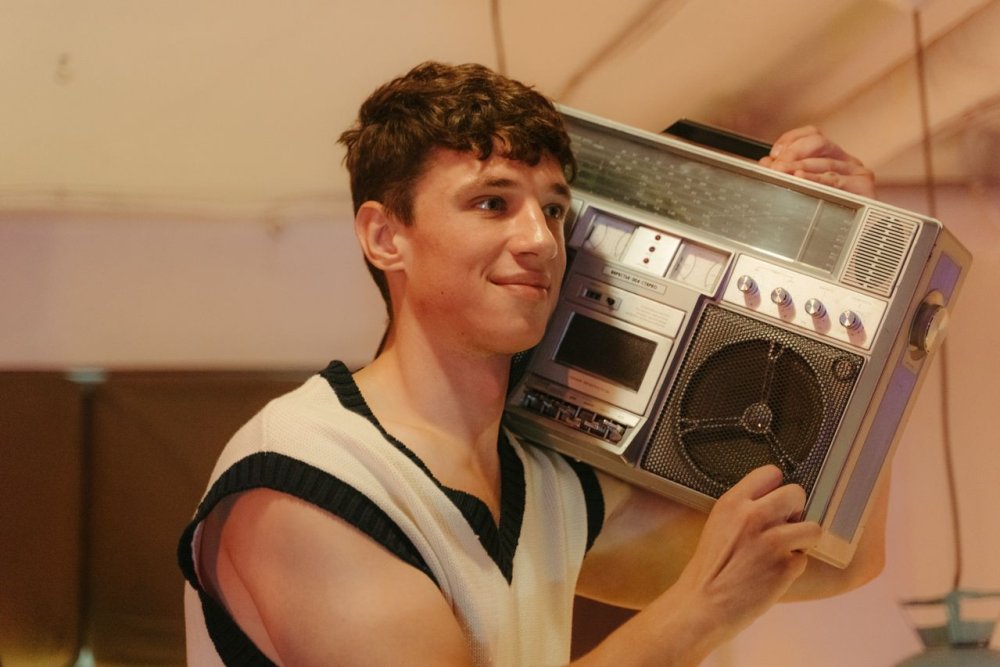
There was a point in the 1980s when carrying your music around did not mean slipping something the size of a digestive biscuit into your pocket. It meant grabbing a plastic handle attached to several kilograms of cassette decks, loudspeakers, chrome buttons, aerials and batteries, then confidently setting off as though this were a perfectly sensible way to listen to a bit of music.
Welcome to the wonderful world of 80s boomboxes.
These magnificent machines were portable in much the same way that a small microwave is portable. Yes, you could carry one. Yes, many of them had handles specifically for that purpose. No, you probably did not want to walk five miles with one.
None of that mattered.
A proper 1980s boombox was not trying to disappear into your life. It wanted to dominate it. Bigger speakers were better. More buttons were better. Two cassette decks were definitely better than one. Graphic equalisers, flashing LEDs, detachable speakers and enough chrome-effect plastic to interfere with passing aircraft only improved matters.
For a generation growing up before phones became entertainment centres, the boombox was music system, radio, recording studio and social object all rolled into one gloriously oversized box.
And, for a while at least, bigger really was better.
What Exactly Was a Boombox?
The basic idea was simple. Take a portable radio cassette recorder, give it decent-sized speakers and enough amplification to fill a room, then make the whole thing capable of running from batteries.
The result went by several names.
Boombox became the term most closely associated with the big, imposing machines popularised through American street culture. In Britain, plenty of people simply called them radio cassette players, portable stereos or, depending on the size of the thing, "that enormous stereo in your bedroom".
Earlier portable cassette recorders had already combined radios and tape decks, but the late 1970s and 1980s saw manufacturers become increasingly ambitious. Speakers became larger. Stereo sound became commonplace. Twin cassette decks appeared. Graphic equalisers grew more elaborate.
And the styling became impossible to ignore.
Some 80s boomboxes were relatively restrained, but the best remembered examples looked like miniature recording studios designed by somebody who had recently discovered silver plastic.
You got tuning displays, sliders, switches, microphone sockets, headphone sockets, volume dials, tone controls, tape counters and mysterious buttons you pressed once before deciding never to touch them again.
If there was an empty patch of front panel, somebody would find a way of putting another control on it.
The Appeal of 80s Boomboxes Was Impossible to Miss
Modern electronics are often designed around invisibility. Speakers hide in ceilings. Phones have almost no physical buttons. Wireless earbuds disappear into your ears.
The boombox took precisely the opposite approach.
It announced itself.
Put one on a shelf and it immediately became one of the most noticeable objects in the room. Carry one outside and it became part of your appearance. Turn one up and everybody nearby became involved, whether they had expressed any interest in your choice of music or not.
This was technology with presence.
The bigger the speakers, the better it looked
Nobody studying hi-fi engineering would suggest that simply making a speaker grille larger automatically improves sound quality.
To a twelve-year-old in 1986, however, this was scientific fact.
Large speaker grilles made a boombox look serious. Extra tweeters made it look even more serious. Separate bass drivers practically confirmed that you had accidentally bought professional broadcasting equipment.
Manufacturers knew exactly what they were doing.
Many machines exaggerated their audio credentials through design. Speaker surrounds became chunkier. Drivers were highlighted with silver rings. Labels proudly announced features such as stereo, bass boost or multi-band radio reception.
Some units even had detachable speakers, allowing you to pull the whole arrangement apart and create something approaching a proper home stereo.
Or, more realistically, allowing you to place one speaker on your desk and the other on a pile of computer magazines three feet away.
Instant hi-fi.
The Wonderful Excess of Buttons, Sliders and LEDs
Part of the pleasure of old technology is that you could usually see what it did.
The controls on a boombox were physical, obvious and satisfyingly mechanical.
Press play and a chunky key dropped into position with a clunk.
Press stop and it snapped back up again.
Open the cassette door and a complicated collection of rollers, heads and tiny metal parts was waiting behind it.
There was no animated graphic pretending that something had happened. Something genuinely had happened.
Graphic equalisers made everyone an audio engineer
A graphic equaliser was one of the most desirable boombox features of the decade.
Five sliders looked good.
Seven sliders looked better.
Ten sliders suggested that perhaps EMI ought to give you a ring.
Whether most teenagers actually understood what each frequency band did was another matter entirely.
There were two accepted settings.
One involved carefully arranging the sliders into a visually pleasing curve.
The other involved pushing nearly everything upwards.
This second setting was obviously louder and therefore scientifically superior.
Some machines included LED level meters, occasionally stretching dramatically across the front panel as the music played. Watching those coloured lights flicker could become an activity in itself.
It sounds ridiculous now, but people used to sit and look at their stereos.
And it was brilliant.
Twin Cassette Decks Changed Everything
If there was one feature capable of turning an ordinary radio cassette into an object of serious desire, it was the second tape deck.
Dual cassette machines were everywhere by the later 1980s.
Their appeal was obvious. You could copy tapes.
That sentence alone will cause a large percentage of people over forty to remember entire afternoons.
Put the original cassette in deck one. Put a blank cassette in deck two. Press the correct combination of buttons. Try not to touch anything for the next forty minutes.
Congratulations, you had become the local record industry.
The homemade cassette economy
Copied tapes passed between friends constantly.
Someone bought an album. Someone else wanted it. A blank C90 appeared from a drawer.
Soon the album existed in several bedrooms, usually with handwritten track listings squeezed onto the tiny card inside the cassette case.
The quality depended on several factors, including the tape, the machine and whether somebody had accidentally left Dolby noise reduction switched differently between recording and playback.
Sometimes the copy sounded perfectly respectable.
Sometimes it sounded as though the band were performing from inside a wardrobe.
Nobody seemed particularly bothered.
Music was music.
High-speed dubbing sounded incredibly futuristic
Some 80s boomboxes offered high-speed dubbing, allowing tapes to be copied faster than normal playback speed.
This felt like sorcery.
The cassette being copied produced a frantic, squeaky version of the music while the receiving deck quietly created your new tape.
It also introduced another valuable childhood lesson: never attempt to listen properly while high-speed dubbing is active unless you enjoy hearing pop music performed by extremely agitated mice.
Recording the Radio Was a National Hobby
Long before streaming services, downloading tracks or even widespread CD ownership, the radio was one of the easiest ways to discover and collect new music.
A boombox gave you the necessary equipment to capture it.
This created one of the defining domestic rituals of the 1980s: sitting beside the radio with your fingers resting over record and play, desperately waiting for the DJ to stop talking.
The song started.
You pressed the buttons.
Then, approximately four seconds before the end, the presenter began speaking again.
Disaster.
Entire generations owned homemade compilation tapes featuring DJs shouting over the first or last few seconds of nearly every track.
The Sunday chart recording operation
For many British teenagers, recording songs from the weekly singles chart became a routine.
Blank cassette ready.
Levels checked.
Finger hovering.
Any conversation in the room immediately became unacceptable.
Parents entering halfway through a favourite song risked being greeted with the sort of furious expression normally reserved for somebody interrupting major surgery.
You might spend an hour building the perfect tape and still end up with half a weather bulletin, three station jingles and somebody announcing that Madonna had moved up two places.
It did not matter.
That cassette became yours.
Cassettes Had Their Own Little Rituals
Using a boombox properly involved a surprising amount of physical interaction.
You selected the tape.
Opened the case.
Turned the cassette the right way up.
Opened the deck.
Pushed it inside.
Closed the door.
Pressed play.
At the end of the side, unless your machine had auto-reverse, you got up and turned the cassette over.
Music required participation.
Fast forward was mostly guesswork
Finding a particular song meant pressing fast forward, waiting, pressing stop, pressing play, discovering you had gone too far, pressing rewind and trying again.
The tape counter helped, assuming you had remembered the number.
You usually had not.
Occasionally the cassette packaging listed approximate counter positions, but these varied between machines anyway.
So most people simply developed instinct.
"I reckon the song starts about here."
Play.
Wrong song.
Fast forward again.
This could continue for several minutes, yet nobody considered it an outrageous inconvenience.
And then the tape got eaten
Every cassette user remembers the sound.
The music slowed.
Something went wrong.
You pressed stop.
The cassette came out trailing several feet of brown magnetic tape like an electronic party streamer.
Your expensive stereo had eaten your favourite album.
There followed an emergency repair operation involving a pencil.
The holes in a cassette hub accepted a standard pencil surprisingly well, allowing loose tape to be wound back manually. Bic pens sometimes worked. Certain pencils were better than others.
This became knowledge you simply acquired by living through the cassette era.
Nobody taught it at school, although perhaps they should have.
Batteries: The Price of True Portability
The phrase "portable stereo" was technically accurate, but portability came with conditions.
Large boomboxes could consume a formidable collection of batteries.
Six chunky batteries was common. Some larger units wanted eight or more.
The battery compartment itself could resemble ammunition storage.
Load it up and the machine became noticeably heavier. Turn the volume up and eventually the batteries began surrendering.
First the sound lost a little energy.
Then cassette playback started becoming suspiciously slow.
Eventually your favourite singer sounded as though they had aged thirty years halfway through the chorus.
Fresh batteries restored everything instantly, but batteries were not cheap.
For that reason, a large number of supposedly portable boomboxes spent most of their lives sitting conveniently close to a mains socket.
Their handles remained ready for adventure.
Adventure rarely happened.
The Boombox in British Bedrooms
The cultural image of the classic boombox often involves New York streets, breakdancing and early hip-hop culture.
That association is genuine and enormously important to the history of the machine.
But in Britain, many boomboxes lived rather less glamorous lives.
They sat in bedrooms.
On shelves.
Next to Commodore 64s.
Beside ZX Spectrums.
Under posters.
Surrounded by cassettes, computer games, school books and mysterious collections of cables nobody remembered buying.
For plenty of young people, the boombox was their first proper personal stereo system.
Not personal in the Walkman sense, where only you could hear it. Personal in the sense that it belonged to you.
That mattered.
Your parents might have had a respectable hi-fi downstairs, possibly enclosed in a wooden cabinet and treated like furniture.
The boombox was yours.
You controlled what came out of it.
Within reason.
And subject to somebody downstairs shouting, "Turn that down!"
Music Was Only Half the Fun
One of the brilliant things about cassette technology was that recording audio was incredibly accessible.
You could record almost anything.
Many boomboxes had built-in microphones. Others allowed external microphones to be connected.
This led to hours of deeply questionable entertainment.
Homemade radio shows
Put a microphone in front of a child and eventually they will pretend to be a radio presenter.
The boombox made this easy.
You could introduce records, create jingles, interview siblings, invent adverts and produce entire imaginary radio stations.
The finished programme might contain twenty minutes of whispering, uncontrolled laughter and the family dog wandering through the recording.
Professionally speaking, it was not Radio 1.
Creatively, it was fantastic.
Recording television and other noises
Portable cassette recorders also captured television themes, comedy sketches and anything else people wanted to preserve.
Before video recorders became commonplace in every home, recording the sound of something could be better than losing it entirely.
Children recorded themselves.
Families recorded messages.
Teenagers recorded songs.
People discovered that almost any sound could become permanent if you pointed a microphone at it and pressed two buttons simultaneously.
There was something wonderfully democratic about that.
Some 80s Boomboxes Were Absolutely Enormous
Boombox design became something of an arms race.
Manufacturers including Sharp, JVC, Panasonic, Sony, Sanyo, Hitachi and others produced a vast range of machines during the era.
At one end were sensible portable radio cassette players.
At the other were enormous multi-speaker systems that looked capable of launching small aircraft.
The most extreme examples are the ones collectors now particularly admire.
Large speaker arrays.
Multiple cassette decks.
Complex equalisers.
Chrome trim.
Detachable sections.
Meters everywhere.
The overall design philosophy seemed to be: if one feature looks impressive, add two.
They were not subtle.
That is exactly why they remain interesting.
The Boombox and Street Culture
No discussion of the boombox can ignore its connection with hip-hop and urban culture, particularly in the United States during the late 1970s and 1980s.
Portable high-powered stereos allowed music to move into public spaces.
Breakdancers could bring tracks with them.
Groups could gather around music without needing access to a club or venue.
The boombox became visually tied to hip-hop culture through photographs, films, music videos and television.
That image travelled internationally.
Even British youngsters who had never seen anyone genuinely carrying a giant stereo through the Bronx recognised the visual language immediately.
Boombox on shoulder.
Tracksuit.
Street.
Volume.
It became shorthand for a particular kind of musical confidence.
The machines themselves were only part of that cultural movement, but their portability made them unusually suited to it.
A home hi-fi stayed at home.
A boombox could go where the people were.
The Arrival of the CD Changed the Shape of Things
The compact disc began moving into mainstream consumer audio during the 1980s, initially at a price that kept it well beyond many young people's budgets.
Eventually CD players started appearing in portable stereos too.
At first this seemed like the ultimate upgrade.
Digital sound.
Instant track selection.
No rewinding.
No tape hiss.
No pencils required.
CD boomboxes became increasingly common in the 1990s, often adopting softer, more rounded styling.
Technically, they were an improvement in many ways.
Visually, something had changed.
The great silver rectangular slabs of the early and mid 1980s gradually gave way to smaller, curvier systems.
The age of the truly outrageous boombox was ending.
Why Modern Bluetooth Speakers Feel Completely Different
A modern portable Bluetooth speaker can outperform an old boombox in ways that would have seemed absurd forty years ago.
A tiny speaker can produce surprisingly deep bass.
Rechargeable batteries last for hours.
Thousands of songs arrive wirelessly from a device in your pocket.
There is no tape hiss.
No tuning.
No rewinding.
No enormous packet of batteries.
It is all objectively convenient.
And yet the experience is completely different.
Modern speakers are delivery systems.
The boombox was part of the activity.
You handled the music.
You selected physical media.
You recorded things.
You watched meters move.
You adjusted sliders.
You waited for tapes.
The equipment demanded attention.
That inconvenience created memories.
Nobody gets nostalgic about their phone automatically connecting to a Bluetooth speaker. There is almost nothing to remember. It simply works.
Useful? Absolutely.
Memorable? Not quite in the same way.
Why 80s Boomboxes Are Collectable Today
Original 80s boomboxes have become desirable pieces of retro technology, particularly the larger and more visually dramatic models.
Part of the appeal is obvious.
They look superb.
A large silver 1980s stereo makes an immediate statement in a room even when switched off.
Collectors also enjoy the engineering. These were mechanical devices as much as electronic ones, particularly around the cassette mechanisms.
That creates challenges, of course.
Forty-year-old cassette decks need attention
Rubber belts deteriorate.
Pinch rollers harden.
Tape heads become dirty.
Switches become noisy.
Cassette doors stick.
A machine that looks immaculate can still require considerable work before the tape deck behaves properly.
Fortunately, enthusiast communities have kept a great deal of repair knowledge alive.
Restoring a boombox can become a hobby in itself.
There is a particular satisfaction in watching a cassette deck spring back into life after decades of silence.
Condition matters enormously
Cosmetic condition can be just as important as mechanical condition.
Broken aerials, missing knobs, cracked battery covers and damaged speaker grilles can be difficult to replace.
Some machines survived childhood almost miraculously well.
Others look as though they spent the last forty years touring with Motörhead.
Either can be interesting, depending on whether you want a display piece or something to restore.
The Details That Bring the Memories Back
Nostalgia rarely lives in the headline specifications.
It hides in tiny details.
The click of the power switch.
The hiss between radio stations.
The aerial that never quite stayed at the angle you wanted.
The cassette door that needed a little extra push.
The tape counter returning to 000.
The volume dial crackling because somebody had not turned it for twenty years.
The faint mechanical noise of a cassette turning while music played.
The red recording light.
The smell of warm electronics and old plastic.
The family argument over whose batteries had disappeared into it.
These things are almost impossible to reproduce through modern technology because they were consequences of the limitations.
And those limitations made the machines distinctive.
When Your Stereo Was Part of Your Identity
There was something else about the 1980s boombox that has largely disappeared.
Technology used to communicate taste through its physical appearance.
A big stereo said something about you.
So did your record collection.
Your cassette storage rack.
The stickers you put on things.
The headphones hanging from the side.
Your bedroom could reveal an entire personality before you had even said hello.
Modern streaming libraries are practically invisible.
Someone might have 12,000 songs saved and you would never know.
In the 1980s, fifty cassettes took up a shelf.
The boombox sat beside them like the control centre.
Music had geography.
We Lost Something When Everything Became Easy
Nobody should pretend every aspect of cassette-era audio was wonderful.
Tapes snapped.
Recordings hissed.
Batteries died.
Radio reception faded.
Finding a specific track could become a five-minute operation.
Large boomboxes were ridiculously heavy.
Modern music technology solved practically all of these problems.
But it also removed much of the ritual.
There is something psychologically different about choosing a physical cassette, putting it into a machine and listening to it.
You have made a decision.
There is no endless feed sitting beneath it.
No recommendation algorithm waiting.
No notification covering the album artwork.
Often, you simply listened.
A boombox encouraged that kind of attention because it was a machine dedicated to music.
And because changing the song every twenty seconds was far too much effort.
Bigger Really Was Better
Few pieces of 1980s technology embodied the decade's enthusiasm for visible hardware quite like the boombox.
The best 80s boomboxes were loud, complicated, slightly ridiculous and completely unapologetic about taking up space.
They gave teenagers control over their own music.
They allowed records and radio broadcasts to be captured onto cassette.
They provided the soundtrack to bedrooms, parks, kitchens, garages and countless afternoons spent making compilation tapes.
Most importantly, they made listening feel like something you did rather than something happening quietly in the background.
Today, a speaker small enough to fit in your hand can stream almost every song ever recorded.
That is extraordinary technology.
But put a giant silver twin-cassette boombox on a table, press one of those enormous mechanical play buttons and watch the level meters start dancing.
Suddenly convenience does not seem quite so important.
Sometimes you want the big speakers.
The chunky buttons.
The unnecessary equaliser.
The cassette deck.
And preferably a handle sturdy enough to carry the whole ridiculous thing.
If that sounds familiar, join RetroWins or sign up to stay in the loop for more stories about the gadgets, computers and wonderfully impractical technology we still cannot quite forget.






