
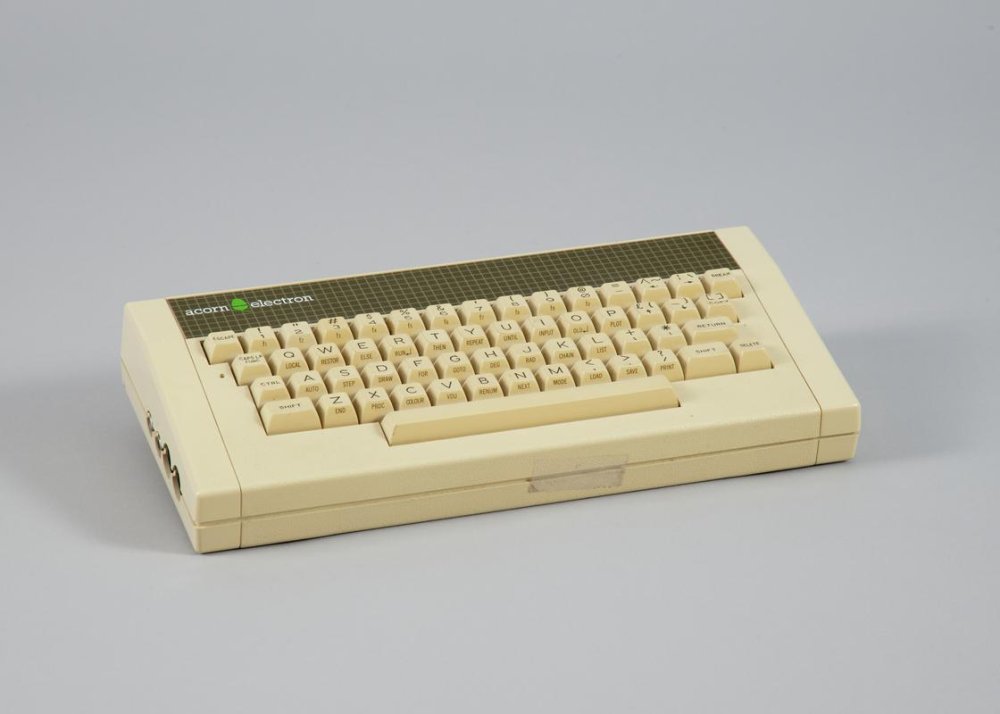
There was something wonderfully optimistic about British home computers in the early 1980s. They arrived in beige boxes, connected to the family television, made alarming noises when loading software and somehow convinced an entire generation that typing 10 PRINT "HELLO" meant they were only a few afternoons away from becoming computer programmers.
Some machines became legends. The ZX Spectrum seemed to be everywhere. The Commodore 64 built an enormous games library and an equally enormous army of loyal owners. The BBC Micro became part of the furniture in British schools.
Then there was the Acorn Electron.
Smaller, cheaper and less intimidating than the BBC Micro, the Electron was supposed to bring Acorn's computing world into more British homes. It looked smart, had a genuinely good keyboard and shared much of its software heritage with one of the most respected computers of the decade.
It should have been a huge success.
Instead, a mixture of unfortunate timing, production problems and technical compromises meant the Acorn Electron never quite became the home computer phenomenon Acorn hoped it would.
Yet for those who owned one, that hardly matters.
The Electron remains one of the most likeable British computers of the 1980s, a machine remembered for hours spent staring at loading screens, typing BASIC programs from magazines and discovering that a tiny computer connected to the television could somehow make an entire afternoon disappear.
Acorn Needed a Computer for the Living Room
To understand the Acorn Electron, you have to start with its considerably more expensive relative.
The BBC Micro was launched in 1981 after Acorn won the contract to provide the computer associated with the BBC Computer Literacy Project. It became enormously influential, particularly in British education.
If you went to school in the 1980s, there is a good chance you encountered one.
For many children, the BBC Micro was simply "the computer".
It lived on a trolley somewhere near the back of the classroom, often accompanied by a large television or monitor. Depending on the enthusiasm of the teacher, it might have been used for programming, educational software or occasionally something far more important, such as trying to land a spaceship without smashing it into the surface of an imaginary planet.
The trouble was that the BBC Micro was expensive.
For schools, businesses and serious enthusiasts, that could be justified. For parents standing in a high street electrical shop comparing computers that would eventually end up connected to the television in the lounge, it was a harder sell.
The ZX Spectrum was cheaper. So were various other machines fighting for space in Britain's increasingly crowded home computer market.
Acorn needed something more affordable.
Its answer was the Acorn Electron, announced in 1983.
The idea was clever. Take much of what made the BBC Micro appealing, simplify the hardware, put it into a smaller case and sell it at a price that made sense for ordinary households.
On paper, it had everything it needed to succeed.
Unfortunately, 1983 was not a year in which the British home computer market rewarded anyone for arriving late.
The Acorn Electron Looked the Part
One of the things that still makes the Acorn Electron appealing today is its appearance.
It is a beautifully tidy little machine.
Where some home computers of the period looked like engineering prototypes that had somehow escaped from a laboratory, the Electron had a compact, understated design. Its pale case, dark keyboard and simple shape gave it a slightly more grown-up feel than some of its rivals.
And crucially, it had a proper keyboard.
Anyone who grew up with the ZX Spectrum's rubber keys will immediately understand why that mattered.
The Spectrum was a brilliant computer, but typing on an early 48K model could feel as though you were attempting to communicate with a calculator through a layer of pencil erasers.
The Electron's keyboard felt reassuringly conventional.
For parents who had been told their child absolutely needed a computer "for educational purposes", this probably helped.
It looked like something you might genuinely learn programming on.
Of course, the educational argument was one of the great home computer sales tactics of the 1980s.
You would explain that computers were clearly the future. You needed one to learn BASIC. It would improve your schoolwork. Possibly mathematics. Possibly science. Possibly your entire career.
Then, approximately nine minutes after the machine was plugged in, somebody would load a game.
Opening the Box Felt Like Getting a Piece of the Future
It is difficult to recreate just how exciting a new home computer felt in the early 1980s.
Modern technology arrives already familiar. A new laptop is usually a thinner, quicker version of the laptop you already own. A new phone is an improved rectangle replacing your previous rectangle.
Home computers felt different.
They were mysterious.
Opening an Acorn Electron meant discovering a machine that appeared capable of almost anything, largely because most people had very little idea what computers were actually capable of.
The computer itself was only part of the experience.
There were manuals to read, cables to connect and television tuning to sort out. Software came on cassette. Programs could be typed manually. Magazines promised games, utilities and projects you could create yourself.
You weren't simply consuming things through the computer. You were expected to interact with it.
That changed your relationship with the machine.
Even children who primarily wanted to play games often ended up learning fragments of BASIC simply because the computer invited experimentation.
You might type something from the manual.
Then change a number.
Then change another number.
Then accidentally break everything.
Then type RUN again.
That process, repeated endlessly across British bedrooms during the 1980s, probably taught more people about computers than any carefully designed educational app ever could.
The Acorn Electron and BBC BASIC
One of the Electron's great strengths was its use of BBC BASIC.
BBC BASIC had an excellent reputation, and deservedly so. It was powerful, relatively approachable and closely associated with the educational side of Britain's computer boom.
Switching on an Acorn Electron dropped you almost immediately into a programming environment.
There was no graphical desktop.
No user account.
No software update notification.
No licence agreement asking whether you had read 47 pages of terms and conditions.
You switched it on and the computer was ready for instructions.
That simplicity now feels almost radical.
The blinking cursor effectively said: right then, what are we doing?
For beginners, BASIC allowed incredibly simple programs.
Print some words.
Draw something.
Make a noise.
Create a loop.
Build a primitive game.
It was programming with immediate feedback, and that mattered. You could type a handful of commands and see something happen.
The Electron was therefore not merely a games machine disguised as an educational computer. It genuinely was a useful route into programming.
Of course, many owners still spent most of their time playing games.
This was the 1980s. There were priorities.
Loading Games From Cassette
For anyone who did not experience cassette-based software, explaining it now makes the whole thing sound completely absurd.
You put a cassette into a tape recorder.
You typed a command.
You pressed play.
Then you waited.
And waited.
The computer listened to a stream of electronic noise and somehow transformed it into a game.
That was normal.
The Acorn Electron commonly relied on cassette storage, and loading software became part of the ritual of owning one.
The sound is difficult to forget.
Those harsh electronic tones, somewhere between a fax machine, a modem and a robot experiencing emotional distress, meant something was happening.
You weren't entirely sure whether it was happening correctly, but it was happening.
The tension increased as the loading process continued.
Had you set the volume correctly?
Was the tape damaged?
Had somebody previously stopped it halfway through the program?
Would the computer suddenly report an error after several minutes and force you to start again?
Modern gaming can involve enormous downloads and updates, but somehow waiting for a progress bar while fibre broadband pulls down 80GB does not create quite the same emotional involvement.
Cassette loading required faith.
The Electron's Biggest Problem Was Speed
The Acorn Electron was designed to provide much of the BBC Micro experience at a lower cost, but achieving that price meant simplifying the hardware.
This came with consequences.
Although the Electron used the same 2 MHz 6502A processor family associated with the BBC Micro, its memory system was different. Video and processor access had to share resources, which could reduce effective performance depending on the display mode being used.
In plain English, some software ran noticeably slower.
That mattered.
Software converted from the BBC Micro did not necessarily behave identically on the Electron. Games that relied heavily on speed could feel less responsive, and developers sometimes needed to optimise titles specifically for the machine.
It was not disastrous. Plenty of excellent games appeared for the Electron.
But the comparison with the BBC Micro was always there.
The Electron looked like the BBC Micro's smaller sibling, shared its BASIC and could run a substantial range of related software, yet it was not simply a miniature BBC Micro.
Some compromises had been made.
And unfortunately for Acorn, compromises become much more noticeable when rival computers are already sitting beside yours on shop shelves.
The Christmas That Got Away
The Electron's launch timing caused one of the biggest problems in its history.
Acorn announced the machine in 1983 and expected strong demand, particularly during the Christmas period.
Demand was not the problem.
Making enough computers was.
Production difficulties meant Acorn could not supply anything like the number of Electrons it had hoped to sell during the crucial Christmas 1983 shopping season.
That was a serious blow.
The early British home computer market moved incredibly quickly. Missing Christmas did not simply mean losing a few months of sales. It gave competitors more time to establish themselves.
Parents who could not buy an Electron were unlikely to tell their children they would simply wait until next year.
They bought something else.
Probably a Spectrum.
Possibly a Commodore.
Maybe an Amstrad a little later.
Once a machine entered the house, everything followed it. Games were bought. Magazines were purchased. Friends swapped software and recommendations. Familiarity developed.
Home computers were ecosystems before anyone used the word ecosystem every twelve seconds.
Acorn had generated interest in the Electron, but struggled to turn that enthusiasm into actual machines at exactly the moment when it mattered most.
By the Time It Arrived, the Market Had Changed
The British computer market of the early 1980s was astonishingly competitive.
Manufacturers seemed to be releasing machines faster than consumers could learn their names.
Sinclair had the ZX Spectrum.
Commodore had the VIC-20 and Commodore 64.
Dragon Data had the Dragon 32.
Oric had the Oric-1 and Atmos.
Atari had its 8-bit machines.
Amstrad soon arrived with the CPC range.
And that is before getting into the stranger corners of the market.
The Acorn Electron therefore had to fight for attention in an environment where price mattered enormously and software libraries could make or break a machine.
The Spectrum in particular had huge momentum.
Its enormous selection of games became one of its strongest selling points. You did not need to understand processors or memory architecture. You could look at a shelf full of colourful cassette boxes and know there would always be something new to play.
The Electron built a respectable library, but it never achieved quite the same gravitational pull.
Still, the Acorn Electron Had Some Excellent Games
It would be unfair to talk about the Electron as though owners spent the entire decade wishing they had bought something else.
They didn't.
The machine had plenty of memorable software.
And one game above all others became deeply associated with Acorn's computers.
Elite
Few games from the 1980s have a reputation quite like Elite.
Created by David Braben and Ian Bell, Elite first appeared on the BBC Micro and Acorn Electron in 1984.
At a time when many games involved moving across a few screens and chasing high scores, Elite offered something that felt impossibly ambitious.
You flew a spacecraft.
You traded goods between star systems.
You fought other ships.
You upgraded your equipment.
You moved through an enormous procedurally generated universe.
The wireframe graphics now look simple, but that misses the point completely.
In 1984, Elite felt vast.
Your imagination filled the space between those white lines.
The game was particularly significant because it demonstrated that home computer games could offer more than straightforward arcade action. They could create worlds.
For Electron owners, having access to Elite was a serious point of pride.
Repton
Another name closely associated with Acorn computers was Repton.
Developed by Tim Tyler and published by Superior Software, Repton combined puzzle solving with arcade-style gameplay.
You navigated underground levels, collected diamonds, avoided hazards and tried not to make one irreversible mistake that would leave you staring at the screen wondering exactly how your carefully planned route had gone so spectacularly wrong.
Repton became one of those games people remember not simply because it was enjoyable, but because it demanded concentration.
It was the kind of game where someone watching over your shoulder would inevitably suggest a move approximately half a second after you had already made the wrong one.
Chuckie Egg
Then there was Chuckie Egg, another classic of the British home computer era.
The basic concept was straightforward. Guide Hen-House Harry around platforms collecting eggs while avoiding roaming hens.
Simple.
Except it wasn't.
Like many games from the period, it had that wonderful ability to make you completely furious while also ensuring you immediately started another attempt.
Chuckie Egg appeared on several computers, but for plenty of Electron owners it became part of the machine's identity.
Other Familiar Titles
The Electron catalogue included versions of many games familiar to BBC Micro users, alongside original releases and conversions.
Publishers including Acornsoft and Superior Software supported the machine, and the familiar cassette packaging became part of the experience of owning an Electron.
Browsing those titles in a computer shop was half the fun.
You judged games by screenshots, cover artwork and a paragraph on the back that usually made the software sound roughly four times more advanced than it actually was.
Sometimes you bought something brilliant.
Sometimes you discovered the screenshots had been doing an enormous amount of promotional work.
That was part of the adventure.
Computer Magazines Were Almost as Important as the Computer
Owning an Acorn Electron did not end with buying the machine.
You entered an entire culture.
Computer magazines were everywhere during the 1980s, and they were essential reading for enthusiasts.
They carried reviews, news, programming tutorials, hints, letters and, most importantly, pages of program listings.
This produced another forgotten ritual.
Typing.
Lots of typing.
You might spend an entire evening entering a BASIC program printed across several pages.
Each line had to be copied carefully.
One wrong character could cause the whole thing to collapse.
Then came the debugging process.
The computer would complain.
You would check the line.
It looked correct.
The computer would continue complaining.
Eventually you would discover that you had typed a zero instead of the letter O somewhere around line 430.
Victory.
Modern software arrives finished. Usually.
Programs typed from magazines arrived as a cooperative project between the magazine, the computer and your own increasingly questionable eyesight.
Yet there was tremendous satisfaction when something finally worked.
You had not simply installed a program.
You had built it, or at least manually reconstructed it one line at a time.
The Electron Was Properly Expandable
Although the Electron was designed as a cheaper machine, Acorn did not leave it completely isolated.
An expansion connector on the rear allowed additional hardware to be attached.
One of the most significant accessories was the Acorn Plus 1, which expanded the machine's capabilities and provided cartridge slots along with additional interfaces.
There was also the Plus 3, which incorporated a 3.5-inch floppy disk drive.
This was a serious upgrade from cassette storage.
Floppy disks were faster, more convenient and considerably less dependent on whether your tape recorder happened to be feeling cooperative that afternoon.
The problem was cost.
By the time you started adding expansions, part of the Electron's original appeal as an affordable alternative to the BBC Micro began to weaken.
Still, for enthusiasts, these accessories gave the machine far more room to grow than its compact appearance suggested.
It Was a Computer You Could Understand
One thing that makes machines like the Acorn Electron fascinating today is how approachable they were.
Not necessarily easy, but understandable.
Modern computers are astonishingly capable, yet much of what they do is hidden.
You tap an icon and a stack of technologies involving processors, operating systems, internet services, cloud infrastructure and encryption springs into action behind the scenes.
The user sees almost none of it.
An 8-bit home computer felt much closer to the surface.
You switched it on.
There was BASIC.
You typed commands.
Things happened.
The limited memory and relatively simple hardware made the boundaries visible.
You knew the machine had limitations because you regularly crashed into them.
Program too large?
Out of memory.
Game taking ages to load?
That was the cassette.
Graphics slowing everything down?
You could see it happening.
These frustrations made the machines oddly educational.
You learned how computers worked because they constantly reminded you that they were computers.
What Owning an Acorn Electron Actually Felt Like
Specifications never really explain why people become attached to old technology.
Nobody sits forty years later getting emotional about memory bandwidth.
What stays with you are the rituals.
The Electron sitting beneath the television.
The power supply somewhere behind the furniture.
The cassette recorder beside it.
The pile of tapes.
The manuals.
The magazines.
The games borrowed from friends.
The slightly awkward negotiation required because someone else wanted to watch television.
That last problem is almost forgotten now.
The television was not simply a display.
It was the household television.
If you wanted to use your computer, everyone else temporarily lost access to whatever happened to be on BBC One or ITV.
This gave home computing a strange social dimension.
Your computing session could end not because you were finished, but because somebody wanted to watch Coronation Street.
Children today will never know such adversity.
Acorn Electron Versus ZX Spectrum
It is difficult to discuss the Acorn Electron without comparing it with the ZX Spectrum.
The Spectrum ultimately became the much bigger home computing success, particularly in gaming.
It was relatively cheap, widely available and backed by an enormous software library.
Yet the Electron had advantages.
The keyboard was better.
BBC BASIC was excellent.
The machine's connection to the BBC Micro ecosystem gave it an educational credibility the Spectrum could not quite match.
Its design also felt more substantial.
If the Spectrum was the rebellious little games machine being smuggled into the house under the excuse of learning programming, the Electron looked like it might genuinely fulfil the promise.
Unfortunately, the Spectrum's momentum proved incredibly difficult to overcome.
Games mattered.
Price mattered.
Availability mattered.
And in those areas, Sinclair had built an enormous advantage.
Acorn Electron Versus BBC Micro
The comparison with the BBC Micro was even more complicated.
The Electron existed because the BBC Micro was too expensive for many households.
So naturally, everyone compared the two.
That meant the cheaper machine was permanently measured against its more capable sibling.
The BBC Micro offered greater expansion options and generally stronger performance. It had become established in schools and enjoyed enormous prestige.
The Electron offered some of that experience for less money.
For a home user, particularly a child who had used BBC Micros at school, that could be incredibly appealing.
There was something exciting about having something at home that felt connected to the computer from the classroom.
It was familiar.
The commands looked familiar.
Some software looked familiar.
The difference was that now you could experiment without a teacher hovering nearby wondering why nobody was doing the assignment.
Why Didn't the Acorn Electron Become Bigger?
There was no single reason.
Its production problems during the crucial 1983 Christmas season certainly hurt.
Its performance compromises compared with the BBC Micro mattered.
The competition was fierce.
And the home computing market itself was changing quickly.
By the middle of the decade, companies were fighting a brutal price war.
Computers that had originally seemed sophisticated and expensive were being discounted heavily.
The Electron itself eventually appeared at significantly reduced prices, but by then the market had shifted.
Acorn had created a good computer.
It simply never achieved the dominant position the company had hoped for.
That makes the machine's story slightly frustrating.
There was nothing fundamentally ridiculous about the Electron.
It was not some bizarre technological dead end.
It had strong software, an excellent programming language, a decent keyboard and a connection to one of Britain's most important computer platforms.
It just entered a vicious market where good was not enough.
The Connection With Britain's Computer Education Boom
The Electron's heritage also makes it particularly interesting from a British perspective.
Acorn was not simply another home computer company.
The BBC Micro had become deeply connected with Britain's attempt to introduce computers to the public.
The BBC Computer Literacy Project included television programmes designed to explain computing to ordinary viewers at a time when the entire concept was still unfamiliar.
That world can feel almost unimaginable now.
Computers were not assumed knowledge.
People genuinely needed television programmes explaining what they were, what they could do and why they might matter.
Children were learning alongside adults.
Schools were buying machines.
Parents were being told that computing would become important.
And, for once, that particular prediction turned out to be spectacularly accurate.
The Acorn Electron was intended to bring some of that educational computing experience home.
It therefore occupies an interesting position in British technology history, sitting somewhere between classroom computer and bedroom games machine.
Why the Electron Is So Collectible Today
Retro computing has grown enormously in popularity, and the Electron fits beautifully into that world.
Part of the attraction is practical.
The machine is compact and instantly recognisable.
It looks good on display without requiring half a room.
There is also a healthy amount of software to explore, particularly for anyone interested in the BBC Micro and Electron ecosystem.
But the biggest appeal is historical.
The Electron represents a very specific moment in British computing.
It came from an era when companies such as Acorn and Sinclair were building machines that would help shape Britain's relationship with technology.
These were computers designed and manufactured during a period of extraordinary experimentation.
Nobody knew what the standard home computer would eventually become.
Every company had its own approach.
Different keyboards.
Different graphics systems.
Different storage methods.
Different operating environments.
Different ideas about what people even wanted computers for.
That variety makes retro computers endlessly interesting.
The Electron is not merely an old computer.
It is one answer to a question the technology industry was still trying to solve.
Restoring an Acorn Electron Today
Buying an original Electron today can be surprisingly tempting.
But as with any computer approaching middle age, condition matters.
Old power supplies, capacitors, keyboards and connectors can all require attention. Cassette hardware introduces another collection of potential problems, particularly if the tape recorder itself has been sitting untouched for decades.
Fortunately, retro computing communities are exceptionally good at keeping old machines alive.
Modern storage solutions can make loading software easier.
Replacement components are available.
Enthusiasts document repairs and modifications.
You can therefore enjoy an Electron without necessarily recreating every inconvenience of 1983.
Although there is something to be said for loading at least one game from cassette.
You should experience the full suspense once.
Then use modern storage and reclaim several hours of your life.
Modern Technology Is Better, but Somehow Less Exciting
There is no sensible argument that the Acorn Electron is more useful than a modern computer.
Your phone could probably emulate dozens of Electrons while simultaneously streaming music, navigating across the country and showing you photographs of somebody else's lunch.
But usefulness is not the reason these machines remain interesting.
The Electron belonged to a period when computing felt exploratory.
You were not simply using applications.
You were discovering what the machine could do.
The limitations encouraged curiosity.
You typed commands because there was nothing stopping you.
You opened manuals because you needed them.
You experimented because that was part of the point.
A modern computer tries very hard to hide complexity.
An Acorn Electron effectively handed you a programming language and said, there you go.
That difference is enormous.
The Acorn Electron Deserved Better
The Acorn Electron was never going to replace the BBC Micro, and history suggests it was never going to dislodge the ZX Spectrum either.
But its reputation deserves more than a footnote.
It was compact, well designed and genuinely pleasant to use.
It gave home users access to BBC BASIC.
It hosted some superb games.
It encouraged programming.
And for thousands of British children, it became the computer sitting beneath the television that introduced them to a completely new kind of technology.
Perhaps that is why the Electron still inspires such affection.
It did not dominate the decade.
It did not win the home computer wars.
It simply became your computer.
And when you are ten years old, sitting cross-legged in front of the television waiting for a cassette to finish loading, that is the only market share statistic that really matters.
The Acorn Electron deserved more commercial success than it received, but four decades later it has something arguably more valuable: a loyal group of people who still remember exactly what it felt like to own one.
For more forgotten machines, classic gadgets and stories from the golden age of home technology, join RetroWins or sign up to stay in the loop. There is plenty more lurking in Britain's collective technological attic.






