
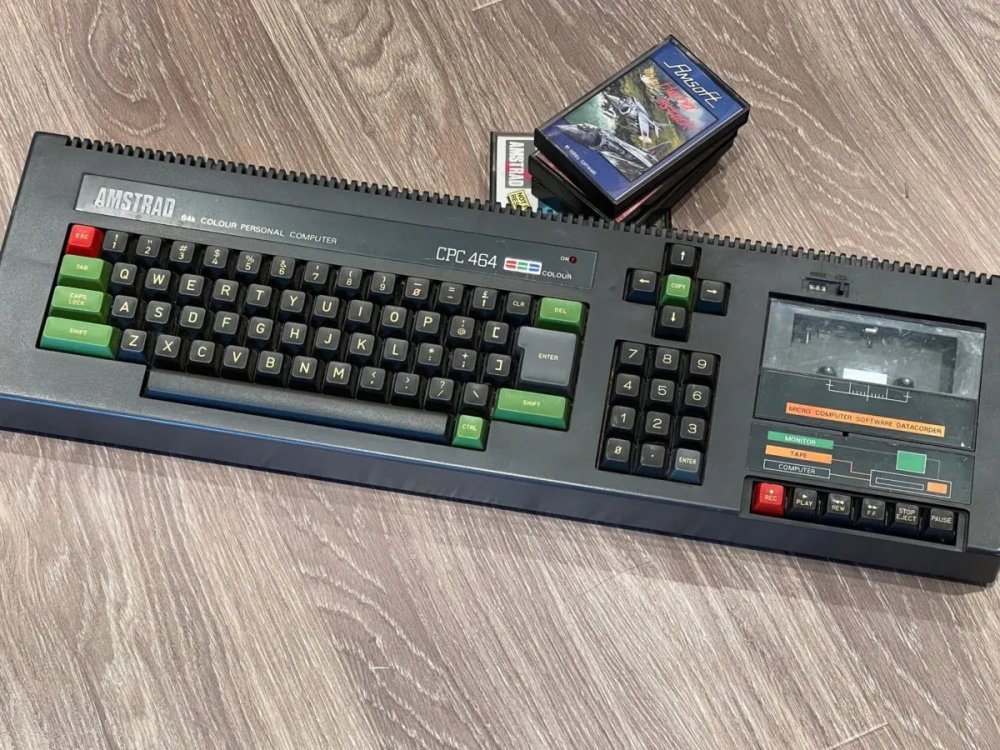
There was something wonderfully sensible about the Amstrad CPC 464.
Other home computers of the 1980s might require you to find a cassette recorder, dig out the correct lead, tune the television to some mysterious empty channel and then carefully arrange the whole lot across the living room without anybody tripping over it.
Amstrad looked at all that and apparently thought: why not just put the cassette player in the computer?
So they did.
The result was one of the most distinctive British home computers of the decade. A long, black machine with brightly coloured keys at one end, a proper keyboard in the middle and a cassette deck bolted into the right-hand side as if this were the most obvious arrangement in the world.
And, actually, it rather was.
Launched in 1984, the Amstrad CPC 464 arrived relatively late to the great British home computer party. The ZX Spectrum and Commodore 64 were already established, playground loyalties had been declared and thousands of households had already discovered that owning a computer involved spending a surprising amount of time staring at flashing borders.
Yet the CPC 464 carved out a substantial following of its own.
Partly because it was capable. Partly because its games could look excellent. But also because Amstrad sold something that many rivals didn't quite manage.
It felt like a complete computer.
The Amstrad CPC 464 Arrives
By 1984, Britain was already thoroughly obsessed with home computers.
The ZX Spectrum had made computing relatively affordable. Commodore had the formidable Commodore 64. The BBC Micro was appearing in schools. Computer magazines were everywhere, usually accompanied by screenshots that looked impossibly exciting compared with the BASIC prompt currently sitting on your television.
Amstrad entered that market with the CPC 464, the first machine in what became the Amstrad CPC range. CPC stood for Colour Personal Computer, although wonderfully you could also buy one with a green-screen monitor, slightly undermining the name from day one.
The machine used a Zilog Z80 processor running at 4 MHz and came with 64KB of RAM. It offered three main graphics modes, including a chunky 16-colour mode that became particularly recognisable in CPC games. Sound came from the capable AY-3-8912 chip.
All perfectly respectable specifications for the time.
But specifications weren't what made the CPC 464 immediately different.
Look at one.
You can't miss it.
That cassette deck is sitting right there.
The Cassette Player Was Actually Part of the Computer
For younger readers, this needs explaining.
Games did not arrive instantly through broadband connections. There was no app store. There wasn't even a shiny disc in a plastic case for most CPC 464 owners.
You bought your software on an ordinary-looking audio cassette.
Inside that cassette was a computer program represented as data. The computer would read the signal from the tape and, assuming everything went according to plan, eventually turn it into a game.
"Eventually" is doing quite a lot of work in that sentence.
Cassette loading was slow.
Sometimes very slow.
But the Amstrad CPC 464 at least removed one of the complications by building the tape deck directly into the computer.
No separate cassette recorder was required. No hunting around for somebody's portable tape player. No wondering whether the family hi-fi could somehow be persuaded to load Chuckie Egg.
You put the cassette into the computer itself.
Even now, the mechanical controls are instantly evocative. Play. Record. Rewind. Fast Forward. Stop/Eject. Pause.
They looked like the controls from a cassette recorder because that's exactly what they were.
There was something wonderfully physical about the whole arrangement. Loading a game wasn't something happening invisibly inside a machine. You could see the tape turning.
If you wanted to start again, you rewound it.
If you overshot, you fast-forwarded or rewound a little and hoped for the best.
Modern computing has become extraordinarily good at hiding what it is doing. The CPC 464 seemed determined to show you every stage of the process.
The Ritual of Loading a Game
Anyone who grew up with cassette-based computers remembers that starting a game was not merely an action.
It was a procedure.
On the Amstrad CPC 464, you'd insert the cassette, type the appropriate command and press the Play button when instructed.
Then came the noise.
That noise.
To anyone unfamiliar with cassette-loaded software, it sounded as if a fax machine had become trapped inside a modem during an electrical storm.
Shrill tones, electronic screeching and bursts of digital chaos represented the software being transferred from tape into the computer's memory.
You waited.
And waited.
Occasionally you were rewarded with a loading screen, an image gradually revealing itself while the computer continued working.
Sometimes you wandered off to make a drink.
Sometimes you read the cassette inlay.
Sometimes you sat there watching because the entire concept still felt vaguely magical.
There was a computer game on that little strip of magnetic tape.
Not music. Not speech.
A game.
And somehow these horrible noises were making it appear.
Then Came the Dreaded Loading Error
Of course, there was another possible outcome.
The game didn't load.
Perhaps the tape was slightly worn. Perhaps something had gone wrong. Perhaps the computer had simply decided that you'd become too confident and required humbling.
Whatever the cause, after several minutes of anticipation you discovered that you were not going to be playing the game after all.
So you rewound the tape and tried again.
This is one of those experiences that sounds completely unacceptable now.
Imagine buying a modern game and being told there was a small but genuine possibility that it simply wouldn't start, and that your best course of action was to rewind it manually and have another go.
There would be outrage.
There would be social media campaigns.
There would be a 47-minute YouTube documentary entitled The Loading Disaster Nobody Is Talking About.
In the 1980s, you mostly sighed and pressed Play again.
It Looked Like a Serious Machine
The Amstrad CPC 464 didn't look much like the ZX Spectrum.
The Spectrum was tiny, charming and slightly strange. Its rubber-keyed original incarnation looked like something that could have been issued to the crew of a particularly cost-conscious spaceship.
The Commodore 64 had its famous rounded, beige breadbin appearance.
The CPC 464 was different.
It was big.
Black.
Angular.
And rather smart.
The machine combined the computer, full-size keyboard and cassette deck into one long casing. Special keys were picked out in vivid colours, including red, green and blue, giving the otherwise businesslike machine an unmistakable identity.
Put a CPC 464 on a desk and it looked substantial.
It looked like you'd bought a computer rather than an unusually complicated keyboard.
That mattered.
Home computers were still expensive family purchases. For many households, this was not something casually picked up alongside the weekly shopping. A computer might be the major Christmas present, perhaps technically intended for the whole family but somehow mysteriously installed in one child's bedroom by Boxing Day.
The Amstrad had presence.
And then there was the monitor.
You Got a Proper Monitor
This was one of Amstrad's cleverest decisions.
The CPC 464 was sold as a package with its own dedicated monitor rather than assuming you'd connect it to the family television. Buyers could choose between a green-screen display or a colour monitor, with the monitor also supplying power to the computer.
This made the Amstrad feel surprisingly self-contained.
More importantly, it meant Dad could still watch the television.
That might sound trivial now, when the average home contains enough screens to operate a small television studio, but the family TV was valuable territory in the 1980s.
Connecting your computer to it meant occupying the television.
Want to play a game?
Fine.
Nobody else was watching EastEnders, were they?
The Amstrad sidestepped the argument.
It came with its own screen.
This also contributed to the feeling that the CPC was a proper system rather than a collection of bits that happened to work together.
Computer. Keyboard. Storage. Monitor.
Done.
That very Amstrad approach would become familiar in other products. Give people everything they actually need in the box, make it relatively straightforward to set up and sell the complete package at an attractive price.
Not glamorous perhaps, but extremely effective.
Green-Screen Owners Learned to Use Their Imaginations
Of course, not everybody got the colour monitor.
Plenty of CPC 464 owners had the green-screen version.
If that was you, technically you owned a Colour Personal Computer while experiencing those colours entirely as shades of green.
Which seems unfair.
Yet the green monitor has developed its own nostalgic appeal.
There's something gloriously old-computer about it now. Bright green graphics glowing against a dark screen immediately transport you back to a time when computers looked as if they should be calculating missile trajectories.
Games were still perfectly playable. You simply learned to interpret what you were seeing.
The colourful screenshots on the cassette box told you what the game supposedly looked like.
Your monitor offered its own artistic interpretation.
Green.
Different green.
Quite bright green.
Very bright green.
We managed.
The CPC Could Produce Some Lovely Games
The Amstrad sometimes suffered from being treated as the third participant in the great Spectrum versus Commodore argument, but the machine was capable of excellent graphics.
Its different display modes let developers choose between resolution and colour. The low-resolution Mode 0 could display 16 colours at once from the CPC's palette, creating the bold, chunky look associated with many of its most memorable games.
At their best, CPC games could be wonderfully colourful.
This became particularly obvious when the same game appeared on multiple 8-bit systems. Comparing Spectrum, Commodore 64 and Amstrad versions became an unofficial hobby in itself.
Magazine screenshots were studied.
Friends' versions were inspected.
Arguments followed.
One machine had more colour.
Another scrolled more smoothly.
Someone's version had better music.
Someone else insisted theirs played better anyway.
None of these disputes were ever conclusively resolved because that would have robbed an entire generation of something to argue about.
Amstrad Games Had Their Own Personality
The CPC developed a substantial software library across its life.
Early owners also became familiar with Amsoft, Amstrad's software operation. Amsoft titles were commonly associated with the early days of the machine, and games featuring the character Roland became particularly familiar to CPC owners.
Names such as Roland in the Caves and Roland on the Ropes are capable of triggering memories in people who may not have thought about them for forty years.
Later, the CPC received versions of countless major 8-bit titles.
Harrier Attack.
Bomb Jack.
Bruce Lee.
Ikari Warriors.
Gauntlet.
Head Over Heels.
Dizzy.
Target Renegade.
And many, many more.
Your precise list of essential CPC games will depend on when you owned the machine, which magazines you read and what happened to appear in the local computer shop.
That was part of the fun.
The Keyboard Felt Like You Could Do Something Serious With It
Gaming might dominate our memories of 1980s home computers, but parents weren't generally told they were buying a £300 machine so their children could spend six hours guiding an egg around platforms.
Computers were educational.
Obviously.
We were going to learn programming.
Possibly mathematics.
Maybe prepare ourselves for the technological workplace of the future.
And, to be fair, some of us actually did.
The CPC 464 featured a proper typewriter-style keyboard that made entering programs considerably more pleasant than using some cheaper home computers.
Switch the machine on and you were presented with Locomotive BASIC, ready to accept instructions.
So you experimented.
Often this meant typing something extraordinarily sophisticated such as:
10 PRINT "PAUL IS BRILLIANT"
20 GOTO 10
And suddenly the screen filled with incontrovertible proof of Paul's brilliance.
Programming had begun.
From there, perhaps you copied listings from magazines or books.
Pages and pages of code.
Line numbers.
DATA statements.
GOSUBs.
PEEKs and POKEs whose purpose you barely understood.
One typing mistake could prevent the entire thing working.
But when it did work, even if all you'd created was a tiny animated blob or crude sound effect, it felt astonishing.
You had made the computer do something.
Modern devices are immeasurably more capable, but they rarely greet their owners with an empty programming environment and quietly suggest: go on then, tell me what to do.
Computer Magazines Were Half the Experience
Owning an Amstrad CPC 464 also meant entering the world surrounding it.
Magazines mattered enormously.
There were reviews, programming tutorials, hints, cheats, reader letters, adverts and those enormous game screenshots that could occupy your attention for ages.
The official CPC publication began life as CPC 464 User in 1984 before later becoming Amstrad Computer User. Other publications followed as the CPC audience grew.
Computer magazines were not merely places to discover what was available.
For many owners, they were the internet.
A new issue arriving meant finding out what games were coming, learning obscure tricks, discovering peripherals you couldn't afford and seeing adverts for mail-order software shops promising suspiciously exciting bargains.
Later came cover-mounted tapes packed with demos and full games.
Suddenly that magazine wasn't merely something to read.
It contained software.
Again, perfectly normal at the time. Completely mad when viewed from the future.
The Cassette Deck Became Part of Its Identity
Amstrad quickly expanded the CPC range.
The CPC 664 appeared with a built-in 3-inch floppy disk drive, followed by the more powerful CPC 6128 with 128KB of RAM. The CPC family eventually included several models and remained in production into the beginning of the 1990s.
But there is something especially memorable about the original 464.
It's the cassette deck.
Without it, the machine looks more conventional.
With it, there is absolutely no mistaking what you're looking at.
It's such a wonderfully 1980s solution.
Storage device?
Right.
Stick a tape recorder on the end.
Sorted.
Today we'd call that integration.
Back then, Amstrad just built the thing people needed directly into the machine.
It Wasn't Just a Games Console
That's another important distinction between computers like the Amstrad CPC 464 and the consoles that followed them into British homes.
The CPC could be whatever you managed to make it.
One moment you were playing an arcade conversion.
The next you were writing BASIC.
Then somebody produced a word processor.
Then you were drawing something.
Then you were attempting to understand machine code after reading three pages of a magazine article and becoming dangerously overconfident.
Home computers encouraged experimentation partly because there wasn't much separating the user from the machine.
You were expected to type commands.
You dealt with files.
You learnt that loading and saving were real processes.
You discovered that computers were temperamental things that did exactly what you told them to do, including when what you'd told them to do was completely wrong.
For a generation growing up alongside the personal computer revolution, that familiarity mattered.
Not everybody became a programmer.
But computers stopped being mysterious objects belonging to laboratories and enormous companies.
There was one in your bedroom.
And it had a cassette player attached to it.
Modern Technology Is Better at Almost Everything
There is no sensible argument that using an Amstrad CPC 464 is more convenient than using a modern computer.
A current phone contains capabilities that would have seemed completely absurd in 1984.
We can download enormous games in minutes, stream video instantly, store thousands of photographs, speak to people around the world and access more information than any 1980s home computer owner could have imagined.
You don't have to type RUN".
You don't have to rewind anything.
You don't even have to wait for the broadband most of the time.
Technology won.
But something was lost in the process.
The CPC 464 made computing feel tangible.
Software was a physical object.
Loading involved a visible mechanical process.
The keyboard had proper keys.
You switched the machine on and interacted with the computer itself rather than navigating through layers of apps, accounts and notifications.
Perhaps most importantly, you usually did one thing at a time.
If you'd loaded a game for several minutes, you played that game.
There wasn't another window pinging for your attention.
No messages appeared over the top.
Nobody sent you a notification suggesting you might enjoy some unrelated content instead.
You'd waited five minutes for Bomb Jack. You were playing Bomb Jack.
Why the Amstrad CPC 464 Is Still Collectible
The CPC 464 remains appealing to collectors because it is both historically important and immediately recognisable.
You don't need to be an expert in vintage computing to understand its charm.
The machine looks fantastic.
The black casing, coloured keys and integrated cassette deck could hardly belong to any decade except the 1980s.
Complete systems with their original monitors are particularly evocative because the monitor was always such an important part of the package. Put one together on a desk and the whole setup instantly looks right.
Of course, owning original hardware brings the usual realities of vintage electronics.
Machines are now decades old.
Cassette mechanisms contain moving components.
Belts deteriorate.
Old tapes may not always behave.
Monitors require more care than plugging a modern HDMI display into a laptop.
But that's also why enthusiasts continue maintaining and restoring these computers.
Getting an original CPC running again is not merely about playing an old game. It is about recreating the experience properly.
The click of the cassette controls.
The monitor.
The keyboard.
The loading screen.
The wait.
All the supposedly inconvenient bits are now part of the appeal.
A Computer That Could Only Have Come From the 1980s
Perhaps that is why the Amstrad CPC 464 remains so easy to feel nostalgic about.
It wasn't sleek.
It wasn't tiny.
It certainly wasn't instant.
It was a large black slab of 1980s optimism with brightly coloured keys and an entire cassette recorder built into its side.
And it made perfect sense.
For thousands of people, it was the machine that sat on a bedroom desk and introduced them to programming, computer games and the strange new world of home computing.
It taught us patience, largely because cassette loading gave us no alternative.
It taught us basic programming, occasionally very basic indeed.
It gave us arguments about which computer had the best version of a game.
Most of all, it made computers feel exciting.
Seeing an Amstrad CPC 464 today can bring all of that back surprisingly quickly. You don't just remember the machine. You remember the tapes beside it, the magazines, the joystick, the loading noises, the glowing monitor and the particular excitement of having an entire computer sitting there waiting for you to find out what else it could do.
And yes, the cassette player really was built into the computer.
The 1980s were magnificent.
For more forgotten machines, classic gadgets and memories from the years when technology seemed to have a little more personality, join RetroWins or sign up to stay in the loop for more retro technology stories and nostalgia.






