
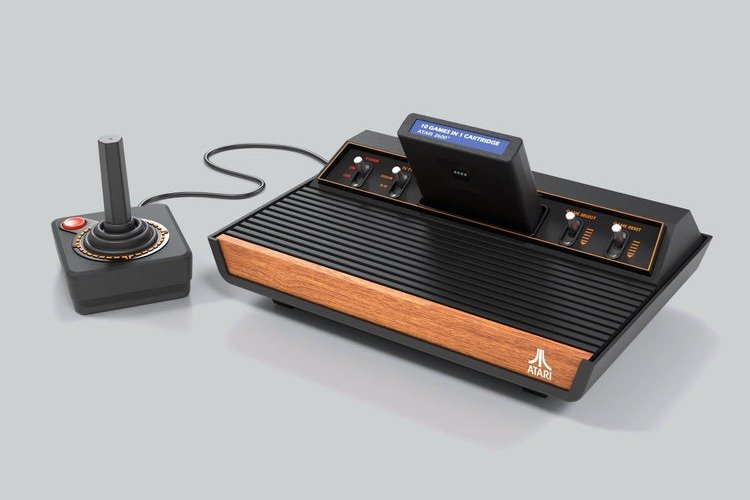
Long before games consoles became sleek black boxes quietly downloading 80GB updates in the corner of the room, there was the Atari 2600.
Wood-effect panelling. Chunky switches. A joystick with one bright red button. Cartridges that made a satisfying clunk when you pushed them into the machine. Games with graphics so simple that a single square could represent a person, a tank, an alien, a ball or, if the programmer was feeling particularly ambitious, an entire spaceship.
And somehow, none of that mattered.
The Atari 2600 offered something extraordinary. It brought the excitement of the arcade into the home and made the idea of owning a machine dedicated to playing video games seem completely normal.
For children discovering video games at the end of the 1970s and beginning of the 1980s, that was a very big deal indeed.
This was a time when Space Invaders machines stood glowing in amusement arcades, cafés, bowling alleys and chip shops. Playing usually meant feeding coins into somebody else's machine. The Atari changed that relationship. Suddenly you could have video games attached to the television in your own living room.
No ten-pence pieces required.
Well, apart from the considerable number your parents had probably spent buying the Atari in the first place.
Before the Atari 2600, Home Gaming Was Very Different
The Atari 2600 was launched in the United States in 1977 as the Atari Video Computer System, usually shortened to Atari VCS. The name Atari 2600 became commonly used later, particularly after Atari introduced the newer 5200 console.
It was not the first home video game system, and it was not even the first console to use interchangeable cartridges. What Atari managed to do was turn the cartridge-based games console into a mass-market phenomenon.
That distinction matters.
Earlier home machines often offered variations on the same basic games. You might have tennis, football and squash, but look closely and you were essentially watching a couple of white rectangles knock a square backwards and forwards.
The Atari promised something much broader.
Buy the console, then buy completely different games for it.
Today that sounds so obvious that it barely seems worth mentioning. In the late 1970s, it fundamentally changed what a home games machine could be.
The console itself became a platform rather than a single electronic toy.
And the library kept growing.
The Atari 2600 Looked Like It Belonged in the Living Room
There is something wonderfully of its time about the original Atari 2600 design.
That woodgrain front panel is perhaps the most famous part. Nobody looks at a modern PlayStation and thinks, "This would be improved enormously by making part of it look like a sideboard."
In the 1970s, apparently, this was perfectly sensible.
Televisions had wood-effect cabinets. Stereo equipment came in walnut. Speakers looked like furniture. The Atari fitted right in.
The early machine had six switches across the top, controlling power, television type, difficulty settings and game selection. Later versions simplified the layout, but the basic visual identity remained unmistakable.
There was nothing delicate about it.
You physically pushed switches. You inserted cartridges into the slot. You connected controllers with proper cables. Nothing happened invisibly.
Even turning the Atari on felt like operating machinery.
That tactile quality is a big part of why original hardware still has such appeal. Modern consoles try to disappear into the entertainment centre. The Atari 2600 very much wanted you to know that you were using it.
The Joystick Might Be the Most Recognisable Controller Ever Made
Then there was the controller.
A square black base.
A stiff black stick.
One red button.
That was your lot.
No shoulder buttons. No analogue triggers. No touchpad. No motion sensing. No clickable sticks. No button combinations requiring the manual dexterity of a concert pianist.
Move.
Fire.
The Atari CX40 joystick became one of the defining images of early home gaming. Even people who never owned an Atari often recognise it instantly.
Its simplicity was deceptive.
Because there was only one action button, game designers had to work within severe limitations. Movement and timing became everything. Games could be understood almost immediately, yet mastering them was another matter entirely.
There was also something wonderfully physical about using one.
These were not gentle controllers.
A particularly competitive game could involve gripping the base with one hand while violently hauling the stick around with the other. If the joystick survived several years of siblings playing Decathlon, it deserved some sort of military decoration.
And if somebody pulled the cable too hard, the whole Atari could start creeping towards the edge of the television stand.
Wireless gaming certainly has its advantages.
Atari 2600 Games Turned Tiny Graphics Into Huge Adventures
Look at an Atari 2600 screenshot now and your first reaction may be surprise at just how primitive some of the graphics appear.
The clever part is how little that mattered when you were actually playing.
Games supplied just enough information for your imagination to take over.
A handful of coloured blocks could become an alien invasion. A few horizontal lines could represent an entire battlefield. A crude maze could feel enormous when something was chasing you around it.
The graphics were not trying to recreate reality. They were symbols.
And children were very good at filling in the gaps.
Combat
Combat was supplied with many Atari VCS systems and became one of the console's early signature games.
At its heart, it was two players shooting at one another using tanks, aircraft and other variations on the same basic competitive idea.
It sounds painfully simple now.
It was also brilliant fun.
There was something particularly satisfying about lining up the perfect shot against another player sitting a few feet away. No matchmaking. No usernames. No headset abuse from someone on another continent.
Your opponent was probably your brother, sister, friend or dad, and if they annoyed you, you could simply glare at them across the carpet.
Local multiplayer had consequences.
Space Invaders
The arrival of Space Invaders on the Atari 2600 was enormously important.
Taito's arcade original had become a sensation, and Atari secured the rights to produce a home version for its console. The Atari 2600 release arrived in 1980 and became a major system seller.
It demonstrated exactly what people wanted from a home console.
They wanted the games they recognised from the arcade.
The Atari version could not reproduce the arcade machine perfectly, but that was hardly the point. You could play Space Invaders at home, repeatedly, without having to keep feeding coins into a cabinet.
For many families, that alone made the machine suddenly much easier to justify.
Asteroids
Asteroids was another famous Atari arcade title brought home to the 2600.
Again, the conversion was necessarily simplified. The arcade original used vector graphics, while the home version had to work within the capabilities of the Atari hardware.
But the essential ingredients remained.
Spaceship. Rocks. Shooting. Panic.
That last feature was especially authentic.
There is something timeless about watching a screen gradually fill with objects you should probably have destroyed ten seconds earlier.
Adventure
If there is one Atari 2600 game that shows how much imagination could be squeezed from simple graphics, it is Adventure.
Released in 1980, Adventure cast the player as a small square exploring castles, navigating mazes, collecting objects and dealing with dragons.
Yes, you were a square.
A heroic square, obviously.
But Adventure was hugely influential. It offered exploration rather than simply asking the player to chase a high score, and it contained one of gaming's earliest famous hidden secrets.
Designer Warren Robinett secretly placed his name inside the game because Atari did not publicly credit individual programmers at the time. Reaching it involved performing a peculiar sequence of actions and carrying a tiny hidden object to the correct place.
That secret became famous as an early example of what would later be called an Easter egg.
It is a wonderfully Atari story. Limited technology, inventive programming and somebody finding a way around the rules.
Pitfall! Showed What the Atari Could Really Do
By the early 1980s, outside developers were producing games for the Atari 2600, and one company in particular would become enormously important.
Activision.
It had been formed by former Atari programmers who wanted recognition and greater rewards for their work. Activision became the first major independent developer creating games for another company's console.
Its cartridges were distinctive, often featuring colourful labels and polished presentation, but the games themselves were what really stood out.
And few stood out more than Pitfall!
Released in 1982, Pitfall! placed you in control of Pitfall Harry as he ran through jungle scenes, swinging over hazards, jumping across crocodiles, avoiding snakes and collecting treasure.
For Atari hardware, it looked astonishingly smooth.
Even today there is something immediately appealing about it. Harry's running animation gives the game a sense of momentum that many earlier console titles lacked.
It also introduced countless children to one of gaming's most important lessons.
That crocodile definitely looked far enough away.
It was not.
Pac-Man and the Danger of Expectation
Of course, not every arcade conversion worked quite so well.
The Atari 2600 version of Pac-Man, released in 1982, has become infamous.
The arcade game was already a cultural phenomenon, so bringing Pac-Man home should have been one of Atari's easiest victories.
The problem was that the 2600 version looked and played noticeably differently from the arcade original. The maze was altered, ghosts appeared to flicker because of technical compromises, and the overall experience disappointed many players expecting something closer to the machine they knew.
The game still sold in enormous numbers, but its reputation has never really recovered.
And yet there is something strangely lovable about Atari Pac-Man now.
Once the expectation of arcade accuracy disappears, it becomes a fascinating piece of gaming history. You can almost see the programmer wrestling with hardware never designed for a game like Pac-Man and somehow forcing it to work anyway.
It is not the version anyone would choose today.
But it is very Atari.
Playing an Atari Was a Social Event
One detail that is easily forgotten about early home gaming is how public it was.
The Atari was usually connected to the family television.
That meant playing it required negotiation.
You were not simply launching a game in your bedroom whenever you fancied. Depending on the household, you might be competing with the evening news, Coronation Street, Match of the Day or whatever else the adults considered mysteriously more important than helping a square tank shoot another square tank.
Once permission was granted, the ritual began.
Television tuned correctly.
Console switched on.
Cartridge inserted.
Joystick cable stretched across the floor.
Then everybody gathered around.
Even single-player games often acquired an audience. Someone would sit nearby offering advice. Someone else would insist they could do better. Eventually the controller would be passed around.
High scores mattered because they belonged to actual people you knew.
There were no global leaderboards, achievement notifications or automatically recorded clips.
If you claimed you had achieved an incredible score while nobody else was there, suspicion was entirely justified.
Those Cartridges Were Part of the Experience
Atari cartridges are wonderfully substantial things.
They are not simply storage media. They feel like objects.
The labels carried illustrations that often promised worlds far more detailed than anything the console could display. This was not dishonesty so much as collaboration between artwork and imagination.
The picture on the box established the fantasy.
The game supplied the moving pieces.
Your brain did the rest.
Cartridge collections also had their own peculiar rituals.
You would pull one from the shelf, examine the label, push it into the console and hope everything worked.
Sometimes it did not.
So you took it out and tried again.
Maybe you wiped the contacts.
Maybe you performed whatever entirely unscientific procedure your household believed revived cartridges.
The important thing was that games were physical possessions. You could line them up. Lend them to friends. Swap them. Discover one in somebody else's house and immediately demand to know whether it was any good.
Owning ten games felt like having a library.
Atari 2600 Advertising Sold the Future
Atari's advertising helped turn video games into desirable consumer products rather than strange electronic curiosities.
The company pushed the idea that arcade-style entertainment could now belong in the home. Advertisements showed families gathered around televisions, controllers in hand, enjoying this exciting new form of entertainment together.
That promise was powerful because arcades already had cultural weight.
Arcade machines were exciting precisely because most people did not own anything like them.
Atari's message was essentially: now you can.
Of course, the reality involved considerably more blocky graphics than the fantasy suggested.
But if you were nine years old, the distinction hardly mattered.
The television was responding to you.
That still felt futuristic.
Atari in Britain Faced Some Serious Competition
The Atari 2600 is often discussed through an American lens, but the British experience of early gaming was slightly different.
By the early 1980s, the UK was developing an extraordinary home computer scene.
Machines such as the ZX Spectrum, Commodore 64 and BBC Micro became hugely significant. They could play games, but parents could also be persuaded that they were educational and would definitely help their children learn programming.
This was an extremely useful argument.
Whether the child subsequently spent six hours playing Jet Set Willy was a separate issue.
Home computers also benefited from games distributed on cassette tape, which could be much cheaper than console cartridges.
As a result, British gaming culture became heavily computer-focused.
The Atari 2600 still mattered, but it shared British homes and shop shelves with an increasingly crowded selection of alternatives.
That makes memories of the console slightly different in the UK. For some families it was their main games machine. For others it belonged to a friend, cousin or neighbour and became something you encountered during visits.
Either way, that joystick tended to leave an impression.
The Atari 2600 Was Technically Limited, Which Made Developers More Creative
The machine's longevity is remarkable when you consider the technology inside it.
The Atari VCS had been designed in the 1970s for relatively straightforward games. Yet programmers kept finding ways to make it do things its creators could scarcely have anticipated.
This required extraordinary ingenuity.
Developers worked with tiny amounts of memory and severe graphical restrictions. Rather than relying on powerful hardware, they used clever timing tricks, reused visual elements and carefully constructed each television frame.
The best Atari 2600 games are therefore interesting not simply as games, but as examples of programming under extreme constraint.
There was nowhere for bad design to hide.
You could not compensate for weak gameplay with photorealistic graphics, cinematic cut-scenes or fifty hours of recorded dialogue.
The basic idea had to work.
That is why many Atari games still make sense within seconds.
Move the paddle.
Shoot the alien.
Avoid the obstacle.
Beat the other player.
Everything else is refinement.
ET and the Great Video Game Crash
No story about the Atari 2600 can completely avoid E.T. the Extra-Terrestrial.
The game was developed extremely quickly for the 1982 Christmas market and has since become one of the most notorious releases in video game history.
Its reputation has sometimes been exaggerated into the claim that a single bad game destroyed the entire video game industry.
Reality was much more complicated.
The North American market had become flooded with consoles and games of wildly varying quality. Retailers were left with excess stock, consumer confidence weakened and the industry entered a major downturn in 1983.
E.T. became a convenient symbol of that collapse rather than its sole cause.
The story became even more legendary because unsold Atari products were buried at a landfill site in New Mexico. For years this was treated almost like gaming folklore, until an excavation in 2014 uncovered cartridges and other Atari material there.
The amusing thing is that E.T. itself is not some supernatural object capable of destroying businesses merely by being inserted into a console.
It is confusing, awkward and deeply flawed.
But judged as a piece of history, it may now be one of the most interesting Atari cartridges of all.
Why the Atari 2600 Still Feels Special
Modern gaming is spectacular.
We have enormous virtual worlds, astonishing graphics, online multiplayer, surround sound and processors performing calculations that would have seemed absurd when the Atari was designed.
Yet the Atari 2600 still has an appeal that technological progress cannot replace.
Part of that is nostalgia, obviously.
If you remember one from childhood, switching on an Atari can instantly bring back details that have nothing to do with frame rates or resolution.
The television set.
The carpet.
The sound of the joystick.
The games stacked nearby.
Who you played with.
The excitement of getting a new cartridge.
But nostalgia is not the whole explanation.
The games are wonderfully immediate.
There is almost no barrier between deciding to play and actually playing.
Choose cartridge. Switch on. Start.
No installation.
No account login.
No patch notes.
No season pass.
No 14-page privacy agreement.
You are playing within seconds.
There is something rather refreshing about that.
Collecting the Atari 2600 Today
The Atari 2600 remains popular with retro gaming collectors, partly because the system has such a huge and varied software library.
Original consoles survive in significant numbers, although condition varies enormously. Some machines have spent decades boxed away in lofts, while others clearly survived years of vigorous childhood use.
Collectors often seek particular hardware revisions, boxed systems, unusual controllers and specific cartridge releases.
The cartridges themselves range from extremely common games to genuinely scarce titles.
Condition matters too. A complete game with its original box and manual is naturally more desirable to many collectors than a loose cartridge with a battered label.
For others, none of that matters.
They simply want a working Atari, a joystick and a pile of games they remember.
That is arguably the nicest way to collect retro hardware anyway. Not as museum pieces, but as machines that still have something to do.
Modern televisions can make connecting original equipment slightly more complicated than it once was, particularly if they lack the connections expected by older consoles. Enthusiasts therefore use a variety of adapters, converters, modifications and period-correct displays.
For the full experience, though, there is something particularly appropriate about seeing Atari graphics glowing from an old CRT television.
You do not need perfect pixels.
Perfect pixels rather miss the point.
The Console That Helped Define Home Gaming
The Atari 2600 belongs to a period when video games were still inventing the rules.
Genres were forming. Controller conventions did not yet exist. Developers were discovering what people enjoyed and what home hardware could realistically achieve.
Some experiments succeeded brilliantly.
Others gave us Atari Pac-Man.
But the machine's influence is difficult to overstate.
The basic idea that you could own a console and build a collection of completely different games around it became the foundation of the modern games industry.
Sony, Nintendo and Microsoft consoles are vastly more sophisticated, but the underlying relationship is familiar.
Buy the machine.
Choose the games.
Make the system your own.
The Atari 2600 helped establish that model for millions of players.
More Than a Collection of Blocks and Beeps
Perhaps the nicest thing about returning to the Atari 2600 is realising how little technology is actually required to create a memorable game.
The graphics can be crude.
The sound can consist largely of beeps, buzzes and electronic thumps.
The controller can have one button.
None of those things prevent a good game from being exciting.
For anyone who grew up with one, the Atari 2600 also represents a very particular moment in technological history. Computers and electronic entertainment were entering ordinary homes, but they still felt new enough to be slightly magical.
Turning on a television and controlling something on the screen was exciting in itself.
The Atari 2600 helped turn that excitement into an industry, but its legacy is more personal than that. It is the memory of cartridges lined up beside the television, of wrestling with that stiff joystick, of taking turns with friends and of discovering that the arcade was no longer somewhere you had to visit.
For the first time, a little piece of it was sitting under the television.
And it had fake wood on the front.
If you enjoy revisiting the machines, games and gadgets that made technology feel exciting, join RetroWins or sign up to stay in the loop for more retro technology stories and nostalgia.






