
There was a time when taking your music with you required slightly more planning than tapping Spotify and putting your phone in your pocket.
First, you needed batteries. Then you needed a cassette. Preferably several cassettes. Then you had to decide which tapes deserved the limited space in your jacket, school bag or suspiciously bulky cassette carry case. Finally, you plugged in a pair of foam-covered headphones and hoped nobody had borrowed the tape you actually wanted.
It sounds inconvenient now. It probably was inconvenient then.
We absolutely loved it.
The best retro cassette players from the 1980s turned recorded music into something personal and portable in a way that previous generations had never experienced. Suddenly your bedroom stereo could come with you. Albums became travelling companions. Mixtapes became social currency. Bus journeys acquired soundtracks.
And while Sony's Walkman became so dominant that its name was routinely used for almost any portable cassette player, the decade produced an enormous range of machines from Sony, Aiwa, Panasonic, Toshiba and others.
Some were tiny. Some sounded superb. Some were bright yellow and apparently designed to survive an expedition through the Amazon, despite spending most of their lives travelling between a teenager's bedroom and the local newsagent.
Here are some of the cassette players that made portable music in the 1980s so memorable.
The Sony WM-2 Walkman
If you wanted a single machine that captures the moment the Walkman went from clever invention to cultural phenomenon, the Sony WM-2 would be a very strong candidate.
The original TPS-L2 had arrived in 1979 and established the basic idea. The WM-2 followed in 1981 and refined it into something smaller, neater and much closer to the Walkman people picture when somebody mentions the word today.
Sony itself credits the WM-2 with greatly increasing the Walkman's popularity, and its design introduced the front-mounted control arrangement that became closely associated with later models.
It looked fantastic.
The cassette window sat proudly in the middle, surrounded by purposeful controls and lettering. There was none of the visual anonymity that modern electronics often strive for. You could see what the thing did just by looking at it.
More importantly, using one felt mechanical.
Press play and something actually moved. Press stop and you felt the button release. Fast forward produced that wonderfully urgent whirring sound as two little reels spun behind the plastic window.
Even the process of opening the player and inserting a cassette had a satisfying sequence to it.
Door open.
Tape in.
Door shut.
Click.
Music.
There was no loading animation. No software update. No forgotten password.
For many people, this is the archetypal early 1980s Walkman, and surviving examples have become desirable precisely because they combine that unmistakable period look with genuine historical significance.
Sony WM-20 and WM-10: When Small Became a Selling Point
One of the great obsessions of 1980s electronics manufacturers was making things smaller.
Not necessarily easier to use. Not necessarily harder to lose.
Just smaller.
Sony's WM-20, introduced in 1983, was a particularly impressive example. Sony described it as its first Walkman reduced to roughly cassette-tape size.
That was quite a trick because, inconveniently, the machine still had to contain an actual cassette.
The clever solution was an expanding case. Without a tape inserted, the player could shrink down impressively. Insert the cassette and the body extended to accommodate it.
It is exactly the sort of engineering flourish that makes 1980s Japanese electronics so enjoyable to collect today. Somebody had clearly looked at a perfectly serviceable portable cassette player and decided that what civilisation really needed was a more complicated one that became smaller when you weren't using it.
And they were right.
The closely related WM-10 is another model collectors seek out today, not simply because it plays tapes but because it represents that glorious period when miniature engineering itself was part of the appeal.
Portable electronics were becoming status objects. Slimness mattered. Buttons became smaller. Metal finishes and neat typography made these machines look astonishingly sophisticated next to the chunky cassette recorders many families still had at home.
Owning something this compact genuinely felt futuristic.
Sony WM-DD2: The Walkman Gets Serious
Portable cassette players could be fashionable, but serious hi-fi listeners had an obvious complaint.
Tape speed mattered.
A cheap mechanism could introduce variations that made sustained notes wobble slightly in pitch. Most teenagers listening to Wham! on the bus were unlikely to conduct laboratory measurements, but better cassette mechanisms could genuinely be heard.
Sony's DD series attacked this problem with its Disc Drive system, which linked the motor closely to the capstan flywheel to produce more stable playback.
The WM-DD2 arrived in 1984 and added Dolby B noise reduction to the formula.
This was the Walkman growing up.
Instead of simply being a convenient little gadget, models like the WM-DD2 demonstrated that portable cassette playback could be taken seriously as audio equipment.
There is something particularly appealing about that ambition now.
Today we expect a tiny digital player to reproduce music perfectly well. In the cassette era, getting excellent sound out of a machine running from batteries while physically dragging magnetic tape past a playback head required an extraordinary collection of miniature mechanical parts.
You could hear the mechanism working because there really was a mechanism working.
That distinction is a large part of the appeal of vintage cassette equipment today.
A restored WM-DD2 is not interesting because it is more convenient than a smartphone. Obviously it isn't.
It is interesting because it is a beautifully engineered solution to a problem that no longer exists.
Which, for a certain type of retro technology enthusiast, makes it almost irresistible.
Sony Sports Walkman WM-F5: The Yellow One
Few portable cassette players scream "1980s" quite as loudly as a yellow Sony Sports Walkman.
The WM-F5 was Sony's first Walkman specifically developed for outdoor use. Sony dates it to 1983, and its impact-resistant ABS body, sealed controls and splash-resistant construction established the visual language that would continue through later Sports models.
Most importantly, it was yellow.
Not tasteful champagne.
Not executive graphite.
Yellow.
Proper, unapologetic, can-see-it-from-the-other-side-of-the-swimming-pool yellow.
The colour eventually became so closely associated with Sony's Sports range that it is difficult to see one today without immediately thinking of the 1980s and 1990s.
The design made practical sense. These machines were intended for active use, and the casing was considerably more rugged than the increasingly delicate slimline Walkmans being developed elsewhere in Sony's range.
A contemporary UK Hi-Fi Choice review praised the WM-F5's simplicity while noting its relatively bulky construction and 332g weight.
But subtlety was never really the point.
The Sports Walkman looked like equipment.
Rubber-sealed controls, chunky plastic, visible fasteners and bright colouring made it seem ready for considerably more adventurous circumstances than most owners were ever likely to encounter.
A Sports Walkman clipped to a belt suggested that at any moment you might go windsurfing.
In reality, you were probably walking to WHSmith.
It did not matter.
Sony WM-101: Welcome to the Gumstick Battery
By the middle of the decade, manufacturers were fighting another enemy: batteries.
Traditional AA cells worked brilliantly, but they took up space. If portable cassette players were going to keep becoming thinner, something had to change.
Sony's WM-101, introduced in 1985, was the company's first Walkman designed to use the slim rechargeable battery format commonly remembered as the gumstick battery.
This allowed the body to become elegantly thin without abandoning proper cassette playback.
For anyone who mainly remembers later 1980s and early 1990s personal stereos, this is where the familiar premium Walkman shape really begins to emerge.
The chunky plastic bodies of earlier machines increasingly gave way to smooth metal cases, tiny switches and controls arranged with almost obsessive neatness.
These were objects you wanted to own before you had even pressed play.
There was also something satisfyingly advanced about rechargeable batteries at the time. Rechargeable consumer electronics were hardly new, but a proprietary slim battery felt vastly more sophisticated than opening the back of a player and dropping in two Duracells.
Of course, several decades later the humble AA battery has one enormous advantage.
You can still buy one.
Anyone collecting vintage Walkmans soon discovers that yesterday's brilliant proprietary power solution can become today's late-night hunt through obscure enthusiast forums.
Such is progress.
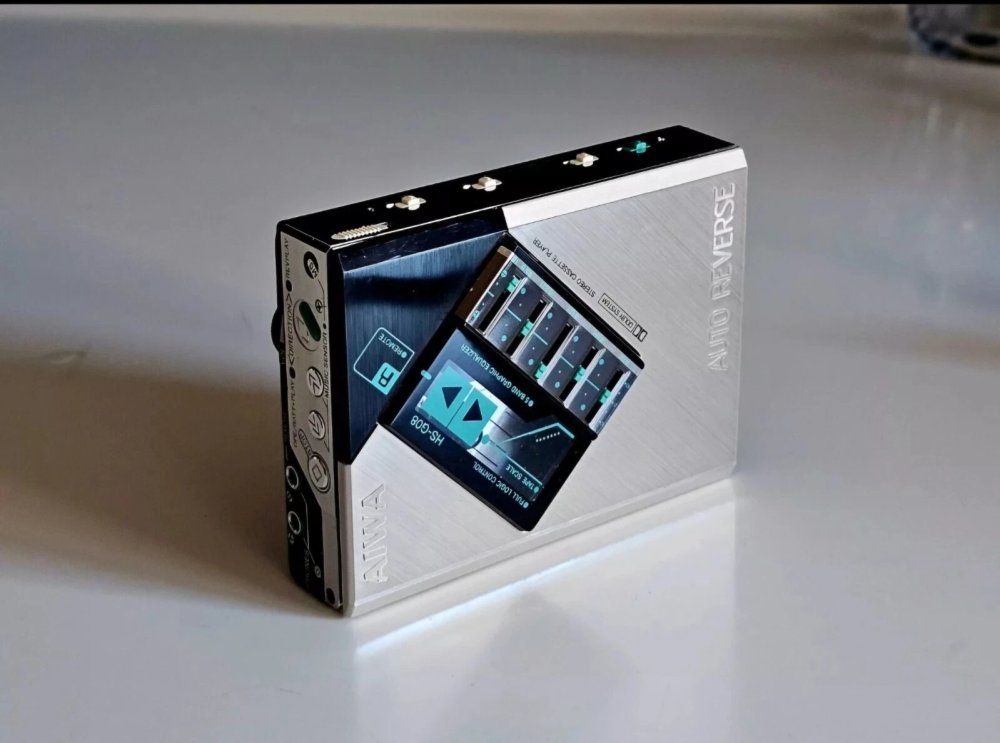
Aiwa's Personal Stereos: The Other Name Worth Remembering
Sony might have owned the word Walkman, but it certainly did not have the personal stereo market entirely to itself.
Aiwa became one of the most respected alternatives, particularly among buyers who cared about sound quality and engineering rather than simply having the Sony badge.
That distinction matters because nostalgia has a habit of simplifying history.
Mention portable cassette players now and almost everything becomes "a Walkman". Back then, plenty of people owned personal stereos from Aiwa, Panasonic, Toshiba, Sanyo, Sharp and countless cheaper brands.
Some were excellent.
Aiwa in particular developed a reputation for making impressively compact, feature-packed cassette players, and its machines remain highly regarded among portable audio collectors.
They also trigger a slightly different sort of nostalgia.
Having the latest Sony was one thing. Having an Aiwa could feel like knowing something your mates didn't.
Perhaps somebody's older brother had one. Perhaps your dad chose it after spending far too long comparing specifications in an electronics catalogue. Perhaps you bought one because it offered more features for the same money.
Either way, the personal stereo boom was much bigger than one brand, even if Sony supplied the name everybody remembers.
Panasonic Personal Cassette Players
Panasonic was another enormous presence in 1980s consumer electronics.
Televisions, portable radios, cassette recorders, boomboxes and personal stereos carrying the Panasonic name were everywhere, and the company's portable cassette equipment covered everything from fairly substantial recorders to increasingly slim personal players.
This mattered in British homes because portable cassette culture was not solely about owning the fanciest machine available.
A personal stereo was a realistic birthday or Christmas present.
It was something you saw in Argos catalogues.
Something you stared at through the glass in an electrical shop.
Something you might save for.
And once enough manufacturers entered the market, portable music stopped being an exotic idea and became normal.
That change was enormous.
Within a few years, teenagers wearing headphones in public went from novelty to everyday sight.
The technology became part of growing up.
The Cheap Personal Stereo You Actually Owned
There is a slight danger with any list of the best retro cassette players from the 1980s.
We end up remembering the glamorous ones.
The beautifully engineered Sony. The high-end Aiwa. The gleaming metal machine that now sells to collectors for considerably more than anyone's mum would have paid for it in 1986.
But millions of people experienced portable cassette music through something far less prestigious.
The generic personal stereo.
Black plastic body.
Brightly coloured buttons.
Possibly "STEREO" written somewhere in lettering large enough to be read from space.
Headphones that appeared to have been engineered specifically to become uncomfortable after eleven minutes.
It may have come from Boots, Argos, Dixons, Woolworths or a catalogue. It may have been made by a brand that disappeared before the decade was over.
And you loved it.
This is one of the funny things about retro technology. The machine that produces the strongest memories isn't necessarily the objectively best one.
If your first personal stereo was a £20 plastic brick with enormous play and stop buttons, that is the machine capable of transporting you straight back to your childhood.
You remember lying on the bed listening to it.
You remember taking it on holiday.
You remember batteries dying halfway through a song and the singer gradually descending into what sounded like an existential crisis.
You remember discovering that rewinding consumed precious battery power, which led to one of the great improvised accessories of the cassette era.
The pencil.
Mixtapes Made the Cassette Player More Than a Gadget
The cassette player itself was only half of the experience.
The other half was the tape.
A cassette could be an album bought from Our Price or Woolworths, but it could also be something completely personal.
Mixtapes were handmade playlists before playlists became infinitely editable.
Choosing the songs mattered because space was limited. A C90 gave you roughly 45 minutes on each side, and suddenly track selection became a minor exercise in logistics.
Would that final song fit?
Could you squeeze another three-minute track onto Side A?
Was it worth risking five minutes of blank tape?
Then there were compilations recorded from records, borrowed cassettes or the radio.
Anyone who taped the charts will remember the concentration required.
Finger hovering over record.
Song begins.
Press.
DJ starts talking before the final chorus has properly finished.
Rage.
There are entire generations who cannot hear certain old songs without mentally expecting a radio presenter to interrupt the ending.
Portable cassette players gave those homemade collections a purpose. You could carry your music into the outside world, and because you had created the tape yourself, it genuinely felt like yours.
A streaming playlist containing 700 songs is vastly more powerful.
It somehow feels less precious.
The Headphones Deserve Their Own Mention
Modern headphones are engineering marvels.
Noise cancellation, Bluetooth, spatial audio, microphones, touch controls, batteries lasting for hours.
1980s personal stereo headphones offered another groundbreaking feature.
Foam.
Lots of foam.
Usually orange, black or dark blue, wrapped around tiny circular speakers attached to a lightweight metal headband.
They leaked sound enthusiastically. Bass response was sometimes more of a rumour than an audible phenomenon. If the foam pads survived long enough, they eventually started disintegrating into mysterious black crumbs.
Yet the lightweight headphones supplied with early Walkmans were crucial to the whole idea.
Sony's original concept worked because portable stereo headphones had become light enough to make listening on the move genuinely practical.
And there was a wonderful intimacy to them.
Put those headphones on and your surroundings suddenly gained a soundtrack.
Walking became different.
Sitting in the back of the family car became different.
Waiting for a bus became different.
That seems completely ordinary now. In the early 1980s, it was revolutionary.
Then There Was Auto-Reverse
The greatest technological problem facing humanity in the cassette age was eventually solved.
Having to turn the tape over.
Auto-reverse meant reaching the end of Side A and, instead of removing the cassette, flipping it around and pressing play again, the machine could simply play the other side.
Magic.
At least it felt like magic.
Higher-end portable players gradually accumulated functions like auto-reverse, Dolby noise reduction, metal tape compatibility, radio tuners, electronic controls and remote functions.
Sony's WM-7, introduced in 1982, was an early example of just how sophisticated the format could become, combining auto-reverse and Dolby B with electronic controls.
The humble pocket cassette player was becoming a miniature hi-fi system.
Naturally this meant more buttons.
And more tiny labels.
And occasionally staring at the machine wondering why it had suddenly decided to play the tape backwards from the direction you expected.
Still, progress has its price.
Why 1980s Cassette Players Feel So Different Today
A modern phone is technologically superior to every personal cassette player on this page by an absurd margin.
It holds more music.
It sounds cleaner.
It has no wow and flutter.
It does not chew your favourite album and leave eighteen inches of magnetic tape hanging from the mechanism like electronic spaghetti.
Yet a cassette player gives you something a phone doesn't.
Physical involvement.
You choose one tape.
You put it into the machine.
You press a button that physically moves something.
You hear the mechanism engage.
You listen.
Skipping songs is possible, but annoying enough that you often don't bother. There is no algorithm suggesting another artist halfway through. No notification appears over the chorus. There are no messages, feeds or apps waiting behind the music.
For forty-five minutes, the cassette has one job.
So do you.
It is easy to romanticise inconvenience, and nobody seriously needs to rewind their music with a pencil in 2026.
But the limitations of cassette created a very particular form of listening.
Music required just enough effort to feel deliberate.
Collecting Retro Cassette Players Today
Interest in vintage portable cassette equipment has grown considerably, helped by the wider revival of physical media and 1980s nostalgia.
The attraction is obvious.
These machines are small enough to display, mechanically fascinating and closely tied to music, fashion and industrial design. A bright yellow Sports Walkman or beautifully preserved metal Sony looks good even when it isn't playing anything.
But buying one requires some caution.
Cassette players contain moving parts, and moving parts age.
Drive belts perish or stretch. Rubber pinch rollers harden. Battery compartments corrode. Lubricants dry out. Certain mechanisms develop faults specific to their design.
A player advertised as "powers on" is therefore not necessarily a player that works properly.
The motor spinning is the beginning of the investigation, not the end.
For anyone who actually wants to use vintage cassette equipment rather than simply display it, a professionally serviced example can make much more sense than gambling on an untouched machine found at the back of somebody's loft.
There is also considerable satisfaction in rescuing one.
Fit a new belt, clean the tape path, insert a cassette and hear music emerge from a machine that may have been silent for thirty years, and suddenly the technology stops being a museum piece.
It works again.
That is a lovely thing.
The Best Retro Cassette Players From the 1980s Were About More Than Sound
The greatest personal cassette players of the 1980s were impressive pieces of engineering, but specifications only explain part of their appeal.
A Walkman changed where music belonged.
Before portable cassette players became commonplace, listening was largely connected to places. The record player in the lounge. The cassette deck in the bedroom. The radio in the kitchen. The enormous stereo system your dad had arranged into a tower and forbidden anybody else to touch.
The personal stereo detached music from the room.
Suddenly it belonged to the listener.
That idea seems completely natural now because we have spent decades living with it. Earbuds and smartphones are simply the latest descendants of the same change.
But the best retro cassette players from the 1980s preserve the moment when portable personal music still felt new.
The Sony WM-2 captured the early Walkman boom. Tiny models such as the WM-20 showed how quickly miniaturisation was progressing. DD machines pushed portable cassette sound towards serious hi-fi territory. The yellow Sports Walkman turned rugged personal audio into an unmistakable piece of 1980s design.
And somewhere beneath all those celebrated models sits the slightly battered personal stereo many of us actually owned, complete with worn buttons, uncomfortable headphones and a battery cover held on with tape.
Perhaps that is the one that matters most.
Because retro technology is rarely just about owning the "best" machine.
It is about remembering where you were when you pressed play.
If old Walkmans, forgotten gadgets, classic computers and the technology of the 1980s are your sort of thing, join RetroWins or sign up to stay in the loop for more retro technology stories, memories and wonderfully unnecessary old electronics.






