
The Best Tabletop Electronic Games of the 1980s
Before home computers took over the spare bedroom and games consoles colonised the space beneath the television, there was another kind of electronic entertainment vying for our attention. It sat on the dining table, swallowed batteries at an alarming rate and made noises that could probably be heard three houses away.
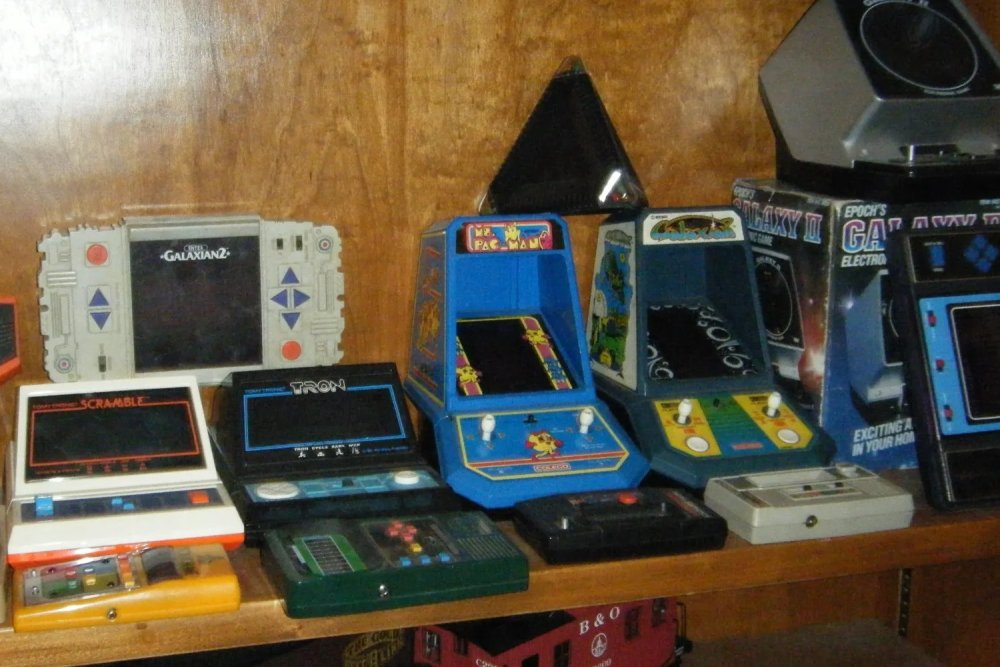
The best tabletop electronic games of the 1980s were strange, colourful machines that occupied the space somewhere between arcade cabinet, toy and games console. They usually offered one game, one display and absolutely no possibility of downloading anything else. If you got bored with it, tough. You were going to play it again anyway.
For British children in the early 1980s, names such as Grandstand, Tomy and Epoch carried serious weight. A tabletop electronic game was an impressive Christmas present, particularly if its box showed spaceships, explosions and glowing futuristic graphics bearing only a passing resemblance to what actually appeared on the screen.
Switch one on today and the illusion is wonderfully primitive. Spaceships are assembled from a few glowing lines. Explosions sound like somebody attacking a biscuit tin with an electric toothbrush. Yet put the lights down, lean towards that little fluorescent display and something peculiar happens.
It still feels brilliant.
When having an arcade machine at home almost seemed possible
Arcades in the early 1980s were magical places precisely because the technology inside them seemed completely beyond anything most families could have at home.
Space Invaders, Galaxian, Scramble, Pac-Man and their contemporaries had colourful graphics, proper cabinets, joysticks, glowing screens and sound effects loud enough to compete with several dozen other machines doing exactly the same thing.
Then electronic manufacturers started producing miniature games that looked suspiciously like tiny arcade cabinets.
They weren't really arcade machines, of course. They couldn't reproduce scrolling backgrounds or armies of independently animated enemies. Their displays were built around fixed electronic elements, often LEDs or vacuum fluorescent displays, commonly abbreviated to VFD.
But that hardly mattered.
A chunky plastic machine with a joystick, fire buttons and glowing aliens was sitting in your bedroom.
That was enough.
Many British tabletop games were sold under the Grandstand name, with Grandstand licensing machines originally produced by Japanese manufacturers including Epoch and Tomy. Its early 1980s line-up included Astro Wars, Munchman, Scramble, Caveman, Alien Attack, Firefox F-7 and The Big Game: Soccer.
It became one of those brands that seemed to appear every Christmas.
And some of its games have become genuine retro classics.
Grandstand Astro Wars
If there is one machine that represents the glory days of British tabletop electronic gaming, Astro Wars has an extremely strong claim.
Released in the UK by Grandstand in 1981, Astro Wars originated as Epoch's Galaxy II, also sold as Super Galaxian in Japan. The British version became one of Grandstand's best remembered electronic games.
And just look at it.
Astro Wars wasn't some discreet little grey box. It looked like somebody had shrunk an arcade cabinet and redesigned it after watching a particularly exciting episode of Buck Rogers.
The sloping cabinet contained a vivid VFD display, surrounded by glorious early 1980s space artwork. You peered down into it while controlling your tiny fighter at the bottom of the screen.
The game itself involved several phases of alien attack, shooting enemies, avoiding incoming fire and eventually attempting a docking sequence for bonus points.
That docking sequence is exactly the sort of detail people remember decades later.
Astro Wars had that wonderful characteristic shared by many great electronic games. Mechanically it was simple, but getting properly good at it became an obsession.
You learned patterns. You learned timing. You discovered exactly how long you could leave something before moving. The machine couldn't surprise you in the way a modern game can, so the challenge became mastering its rules.
And then trying to beat your own score.
Again.
And again.
And once more because that last go didn't count.
Grandstand Scramble
Grandstand's Scramble, released in 1982, was another superb attempt to recreate the feeling of an arcade game using electronics that were dramatically less capable than an arcade machine.
The original Konami Scramble was a scrolling shoot 'em up. The Grandstand version obviously couldn't reproduce the arcade game in full, but it captured enough of the idea to make the connection obvious.
You piloted your craft, fired at airborne threats and dropped bombs onto ground targets. A printed industrial landscape beneath the electronic display helped create scenery that the electronics themselves couldn't generate. Better still, the machine had a proper joystick along with separate missile and bomb controls.
This was important.
Half the pleasure of these things came from the hardware.
Buttons needed to be pressed. Switches clunked into position. Joysticks physically moved.
A touchscreen could reproduce the game today without difficulty, but it couldn't reproduce the experience of sitting at a plastic control panel and feeling as though you had been entrusted with an extremely small military spacecraft.
Scramble also demonstrated one of the clever tricks used by VFD games. Fixed elements could be illuminated selectively, rapidly changing which parts of the display were visible and creating the impression of considerably more movement than the hardware really contained.
As children, naturally, we didn't care how it worked.
It glowed.
That was the important bit.
Grandstand Munchman
There was absolutely no mystery about what Munchman was trying to evoke.
Pac-Man fever had escaped from the arcades and was rampaging through popular culture. If something could be given a maze, a hungry character and a few pursuing enemies, somebody was going to do it.
Grandstand's Munchman arrived in the UK in 1981 and was based on Tomy's Puckman tabletop game.
It couldn't provide anything like the fluid maze of Namco's arcade original, but that wasn't really the point. Here was a colourful, dedicated electronic game that brought some of that maze-chasing excitement home without requiring a television, computer or console.
Munchman also belongs to that lovely period when manufacturers were still working out what a home video game should actually look like.
Modern games hardware tends to become invisible. A controller is ergonomically designed to serve hundreds of games.
A tabletop game was the opposite.
The entire object was part of the game.
The artwork, control panel, shape of the cabinet and glowing display all worked together. Put Munchman next to Astro Wars and there was no attempt to pretend that these were generic computing devices.
They were toys.
Very sophisticated toys, admittedly.
But gloriously toy-like all the same.
Grandstand Caveman
Some retro games survive in people's memories partly because they were good and partly because they were completely ridiculous.
Grandstand Caveman fits both categories.
Released in Britain in 1982, Caveman was another Tomy-designed tabletop game distributed by Grandstand.
Instead of yet another anonymous spaceship, Caveman gave you prehistoric peril. Its theme alone made it stand out among the endless invasion fleets and laser battles of the period.
That mattered more than you might imagine.
Dedicated electronic games had very limited animation, so theme had to do an enormous amount of work. The plastic case, printed graphics and little illuminated characters encouraged your imagination to fill in everything the electronics couldn't show.
A handful of glowing shapes became a dangerous prehistoric landscape.
And somehow we accepted this immediately.
Nobody sat in front of Caveman complaining about draw distances or texture resolution.
You knew what was happening because the box had already told you.
Grandstand Firefox F-7
By 1983, tabletop electronic games had become increasingly elaborate, and Firefox F-7 is one of the finest examples of where the technology eventually reached.
Grandstand released Firefox F-7 in the UK in 1983. The game originated with Epoch and appeared under several different names internationally.
It is a magnificent object.
The casing alone looks wonderfully serious, like a control console removed from an especially low-budget science fiction film. The display creates an impressive sensation of depth, and the whole machine seems determined to convince you that something enormously important is happening behind that smoked plastic screen.
This was the secret of the best tabletop games.
They didn't simply present graphics.
They presented theatre.
A darkened room helped enormously. Suddenly those fluorescent shapes appeared to hang inside the cabinet rather than sit on a display. Reflections and layered artwork could make a relatively simple electronic screen seem surprisingly deep.
Firefox F-7 arrived near the end of the period in which these large dedicated VFD machines felt like cutting-edge home entertainment.
Home computers were rapidly becoming more capable. The ZX Spectrum and Commodore 64 could load thousands of different games. Consoles would eventually provide arcade-style experiences far beyond anything a fixed-display tabletop machine could offer.
The dedicated electronic game was heading towards obsolescence.
But it went out looking spectacular.
Invader From Space
You cannot discuss the best tabletop electronic games of the 1980s without encountering something inspired by Space Invaders.
Grandstand's Invader From Space, released in 1980, was among its early tabletop machines. Players shot descending enemies and could hit a saucer for bonus points, with multiple skill levels available.
The appeal is easy to understand.
Space Invaders had established one of gaming's fundamental pleasures: something is coming towards you, so shoot it before it gets here.
There wasn't much need for a manual.
Electronic versions stripped that idea back even further. Rows of fixed lights became enemies. Another light represented your weapon. A simple beep meant something had been destroyed.
The imagination supplied everything else.
One particularly authentic feature of early electronic games was their attitude towards volume control.
Often there wasn't much of one.
The electronic beeps and buzzes were designed to announce themselves proudly to everybody in the house. Invader From Space has acquired a particular reputation among collectors for its enthusiastic sound.
Parents must have loved it.
Especially at seven o'clock on Boxing Day morning.
Entex Space Invader
Grandstand wasn't alone in trying to shrink the alien invasion into something that would fit on a table.
Entex Space Invader, released in 1980, used an LED display and required six AA batteries.
Six.
That detail alone feels wonderfully authentic.
Battery consumption was simply part of owning electronic toys during this period. A major gaming session could become an unexpected test of the household's supply of Duracells.
There would be frantic searching through drawers.
Remote controls would suddenly become tempting sources of emergency power.
Somewhere, a parent would produce four ancient batteries of completely different brands and insist that they "should have something left in them".
The spectacular arrival of rechargeable batteries in sufficient quantity could transform a household economy.
Entex's game deserves remembering because it captures how manufacturers tried to turn an arcade phenomenon into something achievable with contemporary consumer electronics. You weren't getting the original Space Invaders.
You were getting its essence.
And at the time, that felt astonishing.
The Big Game: Soccer
Not everything involved spaceships.
Grandstand's The Big Game: Soccer appeared in Britain in 1981 and was based on Epoch's Exciting Soccer Game.
Electronic football games had an interesting problem.
Football is fluid. Players move everywhere. The ball travels in countless directions. Positions constantly change.
Early electronic displays were not particularly good at "everywhere".
So manufacturers translated football into something electronics could manage, reducing the sport into fixed movements and tactical reactions.
It didn't look remotely like watching Match of the Day.
Yet somehow, once the game started, the imagination took over.
That ability to accept abstraction is something early gamers became exceptionally good at. A flashing line wasn't really a footballer, any more than three illuminated segments were really an alien spacecraft.
But once you started playing, they were.
Modern games spend enormous resources trying to make virtual worlds indistinguishable from reality.
Early electronic games achieved much the same psychological trick with about twelve glowing shapes and a beep.
Simon
Not every electronic game of the period tried to recreate an arcade.
Simon took the opposite approach.
The concept was wonderfully simple. Four large coloured buttons lit up in an increasingly long sequence accompanied by tones. Your job was to repeat the sequence correctly.
That's it.
No aliens. No football. No spaceships.
Yet Simon became one of the most recognisable electronic games of its era.
Its brilliance came from taking something electronics did particularly well, lights and sounds, and turning those limitations into the entire game.
Simon also had enormous spectator value.
Somebody would begin confidently.
Red. Blue. Red. Green.
Easy.
A few rounds later they were staring at the machine with the facial expression of somebody trying to remember a telephone number while simultaneously defusing a bomb.
Everybody else watched silently.
Then came the inevitable wrong button.
Disaster.
This was social gaming before anybody called it social gaming.
You passed the machine around the room. People watched each other's attempts. Scores and sequences became miniature family records.
There was no online leaderboard because your leaderboard was sitting on the sofa.
Electronic Battleship
Then there was Electronic Battleship, which managed to make a traditional board game feel like military command technology.
Battleship itself needed no electronics. Pencil, paper and two reasonably trustworthy people were enough.
Electronics nevertheless made it vastly more exciting.
Suddenly there were buttons, coordinates, sound effects and a machine acknowledging what you were doing.
This was a recurring theme in 1980s toys. Add electronics to something familiar and it immediately became futuristic.
Ordinary Battleship involved calling out "B7".
Electronic Battleship made B7 sound as though a missile had just been launched from a nuclear submarine.
The gameplay may have remained fundamentally similar, but the ceremony changed completely.
And ceremony mattered.
Why VFD displays looked so good
One reason these games remain visually appealing is the technology behind many of their displays.
Vacuum fluorescent displays produced wonderfully bright glowing colours, often blues, greens, reds and oranges against a dark background.
Unlike later LCD handhelds, which could look rather flat unless the lighting was good, a VFD machine generated its own light.
In the right surroundings it looked fantastic.
Manufacturers then became clever with mirrors, printed backgrounds, transparent overlays and cabinet design. The electronic elements might technically exist on a fairly simple display, but the player could perceive something much richer.
That explains why photographs sometimes fail to capture these machines properly.
You need to see one operating.
Better still, see one operating in a slightly darkened room.
Suddenly it makes sense.
The packaging was half the experience
Then there were the boxes.
1980s electronic toy packaging understood the assignment.
If the actual game contained three spaceships, the packaging might show an intergalactic battle involving several thousand spacecraft, exploding planets and a hero who appeared to have wandered in from a completely unrelated science fiction film.
Everything looked enormous.
Everything looked dangerous.
Everything appeared to be happening at once.
The box was selling your imagination as much as the electronics inside it.
Christmas made this particularly effective. A large Grandstand box beneath the tree looked substantial. It wasn't a floppy cassette case or a tiny cartridge.
It looked like serious hardware.
Opening it revealed moulded polystyrene, instructions, plastic bags and, eventually, the machine itself.
Then came the most important question.
"Batteries included?"
Usually followed by disappointment.
Tabletop games versus home computers
The tabletop electronic game's biggest weakness was obvious even at the time.
It only played one game.
Once machines such as the ZX Spectrum, Commodore 64 and BBC Micro became common in British homes, the economics changed dramatically.
A home computer could play arcade games, adventures, racing games, platformers and countless things nobody had even thought of when Astro Wars appeared.
Software arrived on inexpensive cassettes.
One machine could become dozens of different machines.
There was no sensible way for dedicated electronic games to compete with that versatility.
Yet something was lost as well.
A Spectrum game was software running on a general-purpose computer.
Astro Wars was Astro Wars.
The shape of the cabinet, the joystick, the screen, the artwork and the buttons existed for that particular experience.
Nothing needed configuring.
Nothing needed loading.
No tape failed at the four-minute mark.
You flicked the switch and played.
In that respect, these games now seem strangely modern.
Why people collect them today
Surviving tabletop electronic games have become wonderfully evocative pieces of 1980s technology.
Collectors are interested in condition, working displays, original battery covers, boxes, instructions and accessories. Battery compartments deserve particularly close inspection because forgotten batteries and thirty or forty years of corrosion are not ideal companions.
The displays themselves are a huge part of the attraction.
A working VFD game still has visual presence. Place one on a shelf switched off and it's an interesting retro object.
Switch it on and it comes alive.
There is also something satisfying about collecting machines that are genuinely different from one another.
A row of cartridges can contain completely different games, but the cartridges themselves look broadly similar.
A collection containing Astro Wars, Scramble, Caveman and Firefox F-7 looks like somebody has assembled the control room of a tiny and slightly confused spaceship.
Which is surely better.
Why the best tabletop electronic games of the 1980s still work
Nobody could reasonably argue that these machines offer greater technical sophistication than modern games.
Your phone could emulate the underlying gameplay without noticing the workload.
But that comparison misses almost everything that made them special.
The best tabletop electronic games of the 1980s were physical experiences.
You sat over them.
You pushed chunky buttons.
You heard their electronic chirps.
You watched fluorescent spaceships appear from the darkness.
You tried to beat a score written on a scrap of paper.
And because each machine could do only one thing, you often became remarkably good at that one thing.
There was no enormous games library waiting to distract you. No updates. No notifications. No achievements appearing in the corner of the screen.
Just you, the machine and another attempt to get through that irritating bit where you always lost your last life.
For anyone who grew up with them, seeing one again can produce that instant jolt of recognition that retro technology does better than almost anything else.
You remember the artwork.
You remember the sound.
You remember exactly where somebody in your family kept it.
And you might even remember being told to turn the blasted thing down.
That's why these odd little machines still deserve celebrating. They represent a moment when bringing electronic gaming into the home still felt futuristic, and manufacturers compensated for limited technology with imagination, colourful design and enormous amounts of plastic.
Astro Wars might not look much like an arcade machine now.
In 1981, sitting in front of one could make you feel like you owned one.
And sometimes memory doesn't need anything more sophisticated than that.
If this has brought back a few forgotten Christmas mornings, battery hunts and glowing spaceships, join RetroWins or sign up to stay in the loop for more stories about classic technology, gadgets, games and the wonderfully strange electronics we grew up with.






