
BigTrak: The Programmable 1980s Toy That Felt Like the Future
There were toys in the 1980s, and then there were toys that appeared to have arrived from somewhere else entirely.
BigTrak belonged firmly in the second category.
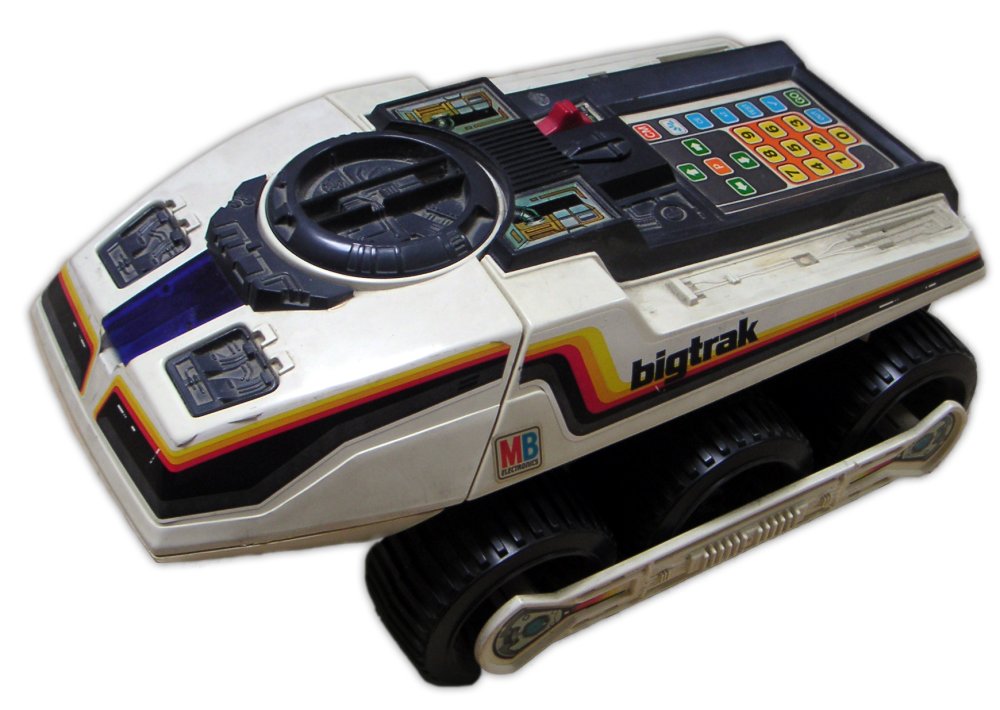
It had six wheels, a futuristic white body, a keypad on its back and what looked suspiciously like a laser cannon poking out of the front. You didn't push it along the carpet making engine noises. You programmed it.
For a child surrounded by Matchbox cars, Action Man figures and plastic tanks that relied entirely on the motive power of your own hand, BigTrak seemed almost impossibly sophisticated. You punched instructions into its keypad, pressed GO, and watched it trundle off across the living-room carpet under its own control.
Sometimes it followed your carefully planned route beautifully.
Sometimes it drove directly into a chair leg.
Both outcomes were entertaining.
Released by Milton Bradley in 1979 and becoming part of the wave of electronic toys that helped define the early 1980s, BigTrak was a programmable six-wheeled vehicle capable of storing a sequence of up to 16 commands. The British version came in that wonderfully space-age white plastic that made it look less like a military vehicle and more like something NASA might have misplaced.
For thousands of children, it provided a first encounter with something resembling computer programming, long before most homes contained a computer.
Not that we thought of it like that.
We thought we had a robot tank.
And frankly, that was much better.
BigTrak Arrives From the Future
To understand why BigTrak made such an impression, you have to remember what the technological landscape looked like when it appeared.
Home computers were only just starting to make their way into ordinary British houses. The ZX Spectrum was still a few years away. Smartphones belonged in science fiction. Remote-controlled toys existed, but even those felt fairly exotic.
Most toys did exactly what you physically made them do.
BigTrak was different because you could give it instructions and then stand back.
The original vehicle was created by Milton Bradley in 1979. Underneath its plastic shell sat a Texas Instruments TMS1000 microcontroller, from the same general family of chips used in other pioneering electronic products of the period. The machine stored a sequence of instructions entered through the keypad on top, then carried them out one after another.
It sounds laughably simple now.
It absolutely did not feel simple then.
You weren't holding a controller and steering it around. BigTrak was apparently thinking for itself.
Of course, it wasn't really thinking. But try explaining the distinction to an eight-year-old watching a plastic space tank make a left turn because they told it to ten seconds earlier.
This was witchcraft with D batteries.
The British BigTrak Looked Brilliant
British children received a particularly good-looking version.
The American Big Trak was grey, while the UK and European model was predominantly white and carried the lower-case "bigtrak" branding. There were also differences in the keypad design.
The white version was absolutely perfect for the period.
It had exactly the sort of design that late 1970s and early 1980s science fiction had persuaded us represented the future. White moulded plastic. Dark windows. Angular panels. Chunky black wheels. Bright controls.
It looked like a cross between a Moon rover, an armoured personnel carrier and something that might appear briefly in the background of Blake's 7.
The six-wheel layout helped enormously. A conventional four-wheeled car would have looked too ordinary. Six wheels meant exploration vehicle.
And then there was the front-mounted "photon beam".
Calling a light a photon beam is one of those wonderful bits of toy marketing that deserves respect.
Technically, yes, light consists of photons, so you could argue that Milton Bradley was being admirably precise.
Emotionally, however, this was clearly a laser cannon.
That was how it mattered.
You could program BigTrak to drive across hostile living-room territory, stop at the edge of the rug and fire its weapon at whatever unfortunate object had been nominated as the enemy base.
Frequently a waste-paper basket.
Possibly your sister's Sindy house.
International diplomacy was difficult in the 1980s.
Programming BigTrak Was the Whole Point
The clever thing about BigTrak was that driving around wasn't really the game.
Programming it was.
The keypad allowed you to enter movement instructions including forward, reverse, left and right, along with commands such as HOLD and FIRE. The machine could remember up to 16 commands before executing them in sequence.
There was no screen.
No map.
No graphical interface.
No helpful animated character explaining that perhaps you had forgotten to close a bracket.
You entered the instructions and pressed GO.
At that moment, your entire program became physically visible.
If you had calculated everything correctly, BigTrak followed the route you intended.
If you hadn't, it headed somewhere else.
Measuring the Living Room in BigTrak
This was where things became surprisingly serious.
Moving BigTrak around accurately meant thinking about distance and direction in advance.
You might decide that it needed to travel forward from the sofa, turn right near the television, continue towards the fireplace and then fire.
So you entered the sequence.
Forward.
Distance.
Right.
Turn amount.
Forward.
Distance.
Fire.
GO.
BigTrak began moving.
Immediately you realised that your understanding of distance was hopeless.
The turn happened too soon.
It missed the fireplace completely.
A few seconds later, your futuristic robotic assault vehicle disappeared underneath an armchair.
This is where BigTrak quietly taught children something useful.
You tried again.
You adjusted the numbers.
You worked out that a particular journey across the carpet required roughly this many units forward and that a corner needed approximately this amount of turning.
Then you refined it.
Without anybody announcing that there was an educational component involved, you were experimenting with sequencing, measurement, debugging and cause and effect.
Today's educational toys would probably put all of that on the box in large friendly letters.
BigTrak simply let you discover it while attempting to blow up the drinks cabinet.
There Was No Screen to Tell You What You'd Done Wrong
One of BigTrak's most charming limitations was its complete lack of a display.
The programming happened entirely through the keypad. There was no LED readout showing your sequence of commands and no convenient way to glance back through a program in the modern sense.
That gave the GO button enormous dramatic power.
Once you'd entered your route, there was an element of faith involved.
Press it.
See what happens.
This is something modern technology has largely removed.
If you program a robot today using a tablet or laptop, you can often see the route on screen. Sensors may detect obstacles. Software can provide immediate feedback. Some devices can even correct their course.
BigTrak knew nothing about your coffee table.
The coffee table was your problem.
Its world consisted primarily of instructions.
Drive forward.
Turn.
Drive backwards.
Pause.
Fire.
There were no cameras analysing the room. It wasn't building a three-dimensional model of your house. It wouldn't recognise the cat.
If the cat was in the route, negotiations would need to take place separately.
The Magnificent Noise of Mechanical Progress
Memories of old technology are rarely just visual.
They involve sound.
The clunk of a cassette deck button.
The screech of a Spectrum loading screen.
The motor inside a Scalextric car.
And BigTrak had its own mechanical presence.
This wasn't some silent modern gadget gliding effortlessly around the floor. Motors and gears were involved. Wheels moved. Plastic rattled. Things happened.
That was part of the appeal.
You could hear your program taking place.
BigTrak was physical computing before anybody in the house would have dreamed of using a phrase like "physical computing".
A command wasn't represented by a little animation moving around a tablet screen. It resulted in a sizeable plastic vehicle actually moving across the carpet.
There is something deeply satisfying about that.
A computer program suddenly had weight.
And wheels.
The Carpet Was BigTrak's Natural Habitat
BigTrak looked as if it had been designed to explore the surface of an unexplored planet.
In practice, most missions involved navigating a British living room.
The terrain was surprisingly challenging.
Carpet.
Rugs.
Chair legs.
Door frames.
Slippers.
Copies of the Radio Times.
Occasionally a younger sibling.
You could construct routes between furniture, perhaps setting out objects as checkpoints or targets.
This was where BigTrak became more than a demonstration toy.
You started inventing missions.
Perhaps it had to leave the "base" underneath the dining table and travel into the hallway.
Perhaps it had to negotiate a route between piles of books.
Perhaps the photon cannon had to fire at exactly the right moment.
You could make the task as elaborate as your patience allowed.
And because BigTrak didn't know where it was, accuracy mattered.
The difference between an impressive autonomous mission and a six-wheeled machine repeatedly attempting to push through the skirting board could be one slightly inaccurate command.
Then There Was the BigTrak Trailer
As if owning a programmable futuristic vehicle wasn't enough, there was an optional trailer.
The BigTrak Transport could be attached behind the vehicle and incorporated into programs. The trailer could carry objects and dump its contents when commanded.
This dramatically expanded the possibilities.
BigTrak was no longer merely an armed planetary exploration vehicle.
It was now a logistics company.
You could send it across the room carrying cargo and program it to deposit the load at its destination.
What cargo?
That was entirely up to the operator.
Toy soldiers.
Marbles.
Building bricks.
Possibly one biscuit, although this was unlikely to receive official parental approval.
The trailer turned BigTrak into something closer to an automated delivery vehicle, which feels oddly contemporary now.
The remarkable thing is that modern technology companies are still spending enormous amounts of money trying to perfect autonomous machines that transport objects from one location to another.
We were doing it on Axminster carpet decades ago.
Admittedly, Amazon's current delivery robots probably collide with fewer sideboards.
BigTrak Was Secretly Teaching Programming
One reason BigTrak has retained its reputation is that it introduced programming ideas without presenting them as programming lessons.
You entered a set of instructions.
The instructions were executed in order.
If the result wasn't correct, you changed the instructions.
That is programming in a wonderfully tangible form.
BigTrak also included a repeat instruction, allowing parts of a sequence to be repeated. Its command system has often been compared with the basic principles behind turtle-style programming, where instructions move an object through physical or graphical space.
None of this required a monitor.
There was no keyboard in the traditional computer sense.
There wasn't even any code visible on a screen.
Yet the basic mental process was there.
Plan.
Enter instructions.
Run.
Observe.
Correct.
Run again.
Plenty of children who eventually encountered BASIC on the ZX Spectrum, BBC Micro or Commodore 64 had already experienced a primitive version of this logic through toys.
BigTrak made programming feel less abstract because every instruction resulted in something happening in the room.
FORWARD 5 wasn't a concept.
The tank drove across your carpet.
Get it wrong and the consequences were extremely clear.
The Timing Could Hardly Have Been Better
BigTrak appeared at exactly the right moment.
The late 1970s and early 1980s were full of excitement about electronics, computers, robots and space.
Microprocessors were beginning to escape from laboratories and businesses and appear in everyday consumer products.
Electronic games were becoming increasingly sophisticated.
Arcades were booming.
Star Wars had made futuristic machinery enormously appealing.
Home computers were preparing to transform British childhood.
Suddenly electronics didn't just mean a television or radio belonging to your parents.
Electronics could be yours.
Toys such as BigTrak, Simon and electronic handheld games helped establish the idea that the really exciting toys now required batteries.
Lots of batteries.
So many batteries.
Battery manufacturers must remember the 1980s with tears of gratitude.
BigTrak itself required separate power for its electronics and motors, using a 9-volt battery for its microcontroller circuitry and four large batteries for the motors.
That meant there was always the possibility of hearing the dreaded sentence:
"We haven't got any batteries."
A sentence capable of ruining Christmas morning faster than almost anything else.
The Advert Made It Look Incredibly Sophisticated
BigTrak was perfect for television advertising because the product provided its own demonstration.
Show a child entering commands.
Show the vehicle moving independently.
Show it turning.
Fire the photon beam.
Job done.
You immediately understood why it was exciting.
Period advertising naturally presented BigTrak as a futuristic machine rather than a small computer science lesson, and that was exactly the right approach.
Children weren't asking their parents for an educational programmable vehicle.
They wanted the space tank.
The educational element sneaked in afterwards.
This is probably why some of the best technological toys of the era worked so well. They didn't constantly congratulate themselves for being educational.
They were simply fun enough that you wanted to figure out how they worked.
BigTrak Versus a Modern Robot Toy
Put an original BigTrak beside a modern programmable robot and the technological difference is enormous.
Today's machine might have Bluetooth, smartphone control, multiple sensors, rechargeable batteries, obstacle detection, LEDs, an app and perhaps some form of graphical programming environment.
BigTrak had a keypad.
Yet that limitation is precisely what still makes it interesting.
The relationship between instruction and result was incredibly direct.
You didn't spend twenty minutes pairing it with Wi-Fi.
There wasn't an account to create.
Nobody asked for your email address.
There was no firmware update.
No app announced that your operating system was no longer supported.
You turned BigTrak on and pressed buttons.
More importantly, you had to understand what you wanted the machine to do before you started.
Modern devices often compensate for mistakes.
BigTrak faithfully performed them.
There is educational value in owning a robot willing to demonstrate exactly how badly you estimated the location of the sofa.
Why We Remember BigTrak So Fondly
Nostalgia often attaches itself to objects that felt unusually important when we first encountered them.
BigTrak was one of those.
It wasn't simply another vehicle.
It suggested something about where technology was going.
Robots were coming.
Computers were coming.
Machines were going to understand instructions and perform tasks for us.
The future would involve entering commands into electronic devices and watching them do our bidding.
For once, childhood expectations weren't entirely wrong.
Look around a modern house.
Robot vacuum cleaners navigate rooms autonomously.
Smart speakers respond to instructions.
Cars can park themselves.
Warehouses contain fleets of automated vehicles shifting goods from one place to another.
Children program robots in school.
BigTrak was crude compared with any of these technologies, but the underlying thrill is recognisable.
You tell a machine what to do.
The machine does it.
That first experience can feel magical.
BigTrak Became One of Those Toys You Never Quite Forgot
Some childhood toys disappear almost completely from memory until somebody shows you a photograph.
BigTrak tends to trigger instant recognition.
The white shell.
Those six black wheels.
The keypad.
The front cannon.
You see one and suddenly remember a particular carpet.
A particular Christmas.
A particular friend's house.
Perhaps you wanted one but never owned it.
That can make the nostalgia even stronger.
Every generation has toys that existed slightly above normal purchasing territory. The things you studied in catalogues and circled enthusiastically in the hope that somebody important would notice.
BigTrak was certainly capable of occupying that position.
If your friend had one, you wanted to see it working.
If you owned one, you wanted to demonstrate it.
Ideally using a program complicated enough to suggest that you were some kind of robotics genius.
The fact that the demonstration might end with BigTrak stuck against a cupboard was not relevant.
Collecting BigTrak Today
Original BigTrak vehicles are now firmly part of the retro technology collecting world.
That creates the usual challenges associated with buying electronic toys that are more than four decades old.
A cosmetically tidy example isn't necessarily a working one.
Battery compartments matter enormously. Old batteries left inside vintage electronic toys can leak and cause serious corrosion. Motors, wiring, switches, gears and other components may also have suffered from age, storage or enthusiastic childhood use.
Missing battery covers and accessories can make otherwise good examples less complete.
Then there is the trailer, which naturally adds another piece of ageing electromechanical equipment to inspect.
For collectors seeking an original BigTrak, condition therefore matters beyond the colour of the plastic.
Does it power up?
Does the keypad respond correctly?
Do both driven wheels behave properly?
Will it turn?
Does the light operate?
Does it actually retain and execute a sequence of commands?
A beautiful non-working example may still make a superb display piece, but there's an extra pleasure in seeing a genuine vintage machine execute another living-room mission.
A licensed BigTrak replica was also released in 2010, styled closely after the original British version, so buyers specifically seeking a 1970s or 1980s original should make sure they know which version they're looking at.
Why BigTrak Still Matters
BigTrak occupies an interesting little junction in the history of toys and computers.
It was a toy vehicle, certainly.
It was also a programmable machine.
It was a robot, at least in the broad childhood understanding of the word.
And it arrived just before computers became an ordinary part of British childhood.
That makes BigTrak feel like a preview of what was coming.
Soon children would be typing programs into Spectrums, BBC Micros and Commodore 64s.
Soon programming would become something you could genuinely do in your bedroom.
BigTrak offered a wonderfully physical version of that idea first.
There was no virtual cursor tracing a route across a screen.
Your program drove across the floor.
If you'd entered it correctly, it navigated the furniture and fired its photon beam right on cue.
If you'd entered it incorrectly, Britain's most advanced domestic robot slowly rammed itself into the sofa.
Either way, you immediately wanted another go.
A Little White Tank From Tomorrow
Looking at an original BigTrak today, it's easy to see everything it couldn't do.
Sixteen commands isn't many.
It couldn't genuinely understand its surroundings.
There was no proper display.
Its navigation relied on you getting the numbers right.
Compared with modern robotics, it was extraordinarily primitive.
But that misses what made it special.
BigTrak didn't need to be genuinely intelligent.
It only needed to make a child believe, for a few minutes on the living-room floor, that they were controlling something from the future.
And it did that brilliantly.
For many people who grew up around the beginning of the home-computer revolution, BigTrak remains one of those unforgettable pieces of 1980s technology. Part toy, part robot, part programming lesson and part six-wheeled menace to household furniture.
Press the buttons.
Plan the route.
Press GO.
Then hope you've measured the distance to the coffee table correctly.
If stories like this bring back memories of the gadgets, computers and electronic toys you grew up with, join RetroWins or sign up to stay in the loop. There is plenty more classic technology and nostalgia still waiting to be powered up.






