
There was a period in the 1980s when the future did not involve a glass slab in your pocket, artificial intelligence or a fridge connected to Wi-Fi. The future was much simpler.
The future was having a calculator on your wrist.
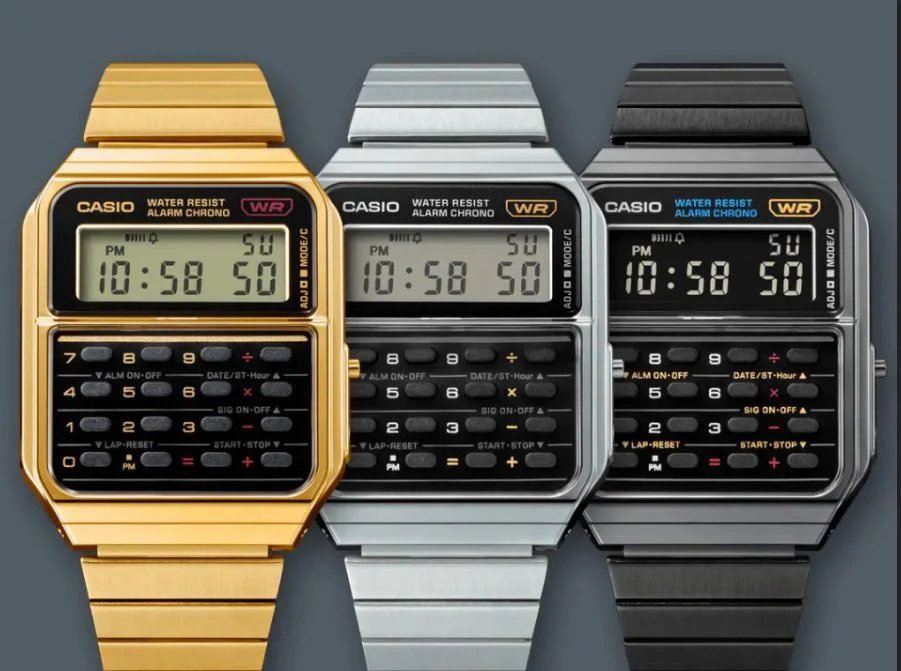
Casio calculator watches managed to make something as ordinary as arithmetic feel impossibly advanced. They took the familiar digital watch, already quite exciting in its own right, squeezed a tiny keypad underneath the display and gave an entire generation the opportunity to walk around looking as though they had been issued with equipment from a secret government laboratory.
Never mind that most of us were using this extraordinary technology to type 80085 into a calculator.
That wasn't the point.
The point was that your watch had buttons. Lots of buttons.
And in the 1980s, more buttons nearly always meant better technology.
The 1980s obsession with putting computers into everything
To understand why Casio calculator watches felt so exciting, you have to remember what computers represented at the beginning of the 1980s.
They were not yet invisible appliances quietly running everything around us. Computers were exciting objects in their own right.
Home computers such as the ZX Spectrum, BBC Micro and Commodore 64 were arriving in British bedrooms. Electronic games were becoming affordable. Digital watches were replacing traditional hands with mysterious glowing numbers. Calculators had gone from expensive office equipment to something children carried around in their school bags.
Technology suddenly seemed to be shrinking.
Casio was particularly good at this.
The Japanese company had built its reputation around calculators before moving into electronic watches during the 1970s. In February 1980, it released the C-80, its first calculator-style wristwatch. The C-80 could perform the four basic arithmetic operations with results of up to eight digits, using a miniature keypad positioned beneath the display.
Look at one today and it is wonderfully obvious what Casio was trying to do.
Take calculator.
Make calculator tiny.
Attach strap.
Job done.
Except technologically, of course, making the thing small enough to sit comfortably on somebody's wrist was rather more impressive than that sounds.
Casio calculator watches looked gloriously complicated
Part of the appeal was visual.
A normal watch had a face and perhaps one or two buttons.
A Casio calculator watch looked like mission control.
Above the keypad sat the digital LCD display. Below it were rows of tiny numbers and mathematical symbols. Around the edges were additional controls for changing modes, setting alarms and operating the stopwatch.
To adult eyes, it may have looked slightly ridiculous.
To a child in 1984, it looked magnificent.
You could glance down at your wrist and see something that resembled a miniature computer terminal.
It was the same reason stereo systems looked better with spectrum analysers, equaliser sliders and flashing LEDs. Technology was supposed to advertise itself. Nobody wanted minimalism. Nobody wanted one tasteful multifunction button.
Give us seventeen buttons and make at least six of them confusing.
The calculator watch absolutely understood the assignment.
Actually pressing the buttons was another matter
There was, admittedly, one slight drawback to having a calculator the size of a watch.
Human fingers remained inconveniently human-sized.
The buttons on many Casio calculator watches were tiny, meaning calculations required rather more concentration than using a normal desktop calculator. You generally pressed them with the tip of a fingernail rather than confidently hammering away with your fingertips.
This became part of the experience.
Using one wasn't simply a matter of entering 47 multiplied by 18. You carefully positioned your finger, pressed the 4, checked the display, moved across to 7, checked again, found the multiplication button and hoped you hadn't accidentally entered something completely different.
Casio's original C-80 even incorporated what the company called its Finger Touch System. The circuitry was designed to determine which key you probably intended to press if your finger caught more than one at once.
In other words, Casio realised that humans were going to struggle with the buttons before the watch had even left the factory.
That somehow makes it better.
The school playground appeal was enormous
For children and teenagers, Casio calculator watches occupied a particularly attractive position somewhere between useful educational equipment and forbidden gadget.
Technically, it was a calculator.
You needed calculators for maths.
Therefore, surely wearing one to school was simply evidence of your dedication to education.
This argument was not necessarily accepted by teachers.
Particularly because the wearer had usually spent more time demonstrating their watch to the person at the next desk than doing any actual mathematics.
Owning one gave you a small amount of technological status. Somebody would notice it, ask to see it, then immediately want to press the buttons.
There was an unspoken hierarchy to digital watches generally.
Having an LCD watch was good.
Having one with a stopwatch was better.
Having an alarm made it more interesting.
Having multiple alarms, strange modes or databank functions pushed you further up the ladder.
But a watch with an actual calculator keypad on the front was unmistakable.
You did not have to explain that yours was the clever watch.
Everyone could see it.
The calculator wasn't necessarily what made it brilliant
One of the strangest things about remembering Casio calculator watches is how little actual calculating many owners probably did with them.
Yes, the function worked.
Yes, it could genuinely be useful.
But if you needed to work something out properly, there was usually a larger calculator nearby that was dramatically easier to operate.
The appeal was that you could calculate something on your wrist.
This distinction mattered enormously in 1980s technology.
Plenty of gadgets were exciting because of what they allowed rather than what anybody regularly did with them.
Your stereo had recording facilities you rarely used.
Your video recorder could supposedly be programmed to record something three days later, although successfully achieving this required the skills of a NASA flight controller.
Your digital watch might have several modes you never completely understood.
Features were exciting.
The calculator watch gave you an entire additional capability sitting underneath the time, and therefore felt like genuine technological progress.
Casio kept making watches cleverer
The calculator watch fitted into a wider Casio philosophy during the decade.
The company wasn't content with making watches that merely told you what time it was.
Why should it be?
In 1984, Casio released the CD-40 Databank, which could store names or telephone numbers. Casio describes this period as part of its attempt to turn the wristwatch into an "information device on the wrist". The CD-40 became a major success, with Casio reporting sales of six million units during its first five years.
That phrase, information device on the wrist, sounds remarkably familiar now.
Modern smartwatches display messages, appointments, weather forecasts, maps, heart rate data and notifications.
Casio was exploring the same basic idea decades earlier using a tiny monochrome LCD screen and whatever electronics could be squeezed into a plastic case.
Calculator watches sat right in the middle of that experimentation.
Later Casio models would store telephone numbers, perform scientific calculations and offer increasingly elaborate combinations of functions.
There was always the tantalising possibility that the next Casio would somehow contain even more technology than the last.
The Casio CA-53W became the calculator watch people picture
Mention Casio calculator watches today and there is a good chance the watch somebody imagines looks like the CA-53W.
Black resin case.
Black strap.
Rectangular LCD.
Four rows of tiny calculator buttons.
Almost aggressively practical styling.
The CA-53W arrived in 1988 as a successor to the earlier CA-50 and has proved remarkably long-lived. Its basic appearance is so closely associated with the calculator watch idea that it now looks less like an old gadget and more like the default shape a calculator watch is supposed to be.
It is not elegant in the traditional watchmaking sense.
Nobody designed it to resemble a piece of jewellery.
It looks like electronic equipment.
That is precisely why it works.
The little labels were part of the magic
Look closely at one and there is information everywhere.
Numbers. Arithmetic symbols. Mode labels. Function markings. Text explaining what different buttons do.
This dense little grid of controls is pure 1980s Casio.
Modern electronics go to extraordinary lengths to hide their complexity. Buttons have disappeared. Interfaces change depending on what you are doing. Entire devices can appear to be featureless sheets of glass.
A calculator watch does the opposite.
Everything is right there.
You can see the functions.
You can see the keypad.
It doesn't pretend not to be a machine.
Then there was Back to the Future
Few things could make a piece of 1980s technology seem cooler than appearing on the wrist of Marty McFly.
Calculator watches became closely associated with the Back to the Future films, although the exact models are often muddled together. Marty wore the Casio CA-50 in the original film era, with the closely related CA-53 style becoming part of the wider association with the sequels and the franchise. The connection has remained powerful enough for Casio to continue celebrating calculator watches through official Back to the Future products decades later.
It was the perfect pairing.
Marty McFly already represented the kind of 1980s teenager who seemed surrounded by exciting technology. He had the skateboard, the headphones, the video camera and, fairly inconveniently, access to a time-travelling DeLorean.
Of course he had a calculator watch.
The amusing thing is that from the perspective of 1985, the watch itself already looked futuristic.
The film's imagined 2015 gave us hoverboards, self-lacing trainers and flying cars.
Reality gave us smartphones, social media and people photographing their dinner.
Perhaps the calculator watch was the healthier timeline.
Owning one felt like having secret technology
Part of the nostalgia surrounding these watches comes from their personal nature.
A home computer sat on a desk.
A Walkman went in your pocket or clipped to your belt.
A games console belonged to the television.
The watch came with you everywhere.
That made it feel different.
You strapped it on before school and it remained there all day. You checked it constantly. You fiddled with the settings. You demonstrated the calculator. You occasionally triggered the alarm without remembering how you'd done it.
And then there was that unmistakable digital watch beep.
Those tiny electronic beeps were everywhere in the 1980s.
Watches beeped.
Microwaves beeped.
Calculators beeped.
Arcade machines beeped considerably more enthusiastically.
A digital watch alarm going off during a quiet lesson was therefore one of the era's more recognisable moments. Somewhere in the room, a Casio would announce that it was exactly 11:37 for reasons nobody could explain.
The owner would then desperately press buttons until it stopped.
It was futuristic without being expensive or inaccessible
The cleverest thing about Casio's digital watches was that they brought electronic novelty within reach of ordinary people.
You didn't need a laboratory.
You didn't need access to an office computer.
You didn't even need to understand how the electronics worked.
You could buy a little piece of the future and wear it on your wrist.
That democratisation of technology happened repeatedly during the 1980s.
Home computers brought programming into bedrooms.
Portable cassette players took music outside.
Electronic games brought arcade-style entertainment into homes and cars.
Digital watches turned electronic timekeeping into an everyday object.
The calculator watch went one step further. It suggested that technology could become genuinely personal and portable, with multiple functions following you around throughout the day.
The idea seems obvious now.
It wasn't then.
Casio calculator watches versus a modern smartwatch
Put a calculator watch next to an Apple Watch or another modern smartwatch and the comparison is almost comical.
The modern watch has a high-resolution colour touchscreen, wireless connectivity, satellite positioning, health sensors, downloadable apps and enough computing power to embarrass entire rooms full of old computers.
The Casio has some numbers and very small buttons.
And yet the Casio has one major advantage.
You immediately understand what it is.
There are no software updates. No notification settings. No account to create. No app demanding permission to know your location. No little red circle announcing that another seven things require your attention.
You look at it.
It tells you the time.
You press the calculator buttons.
It calculates things.
This simplicity has become strangely appealing.
Technology has become vastly more capable since the 1980s, but it has also become more demanding. Your smartwatch would quite like you to stand up now. Your phone has sixteen notifications. Three applications need updating. Something somewhere would like you to accept some cookies.
The Casio calculator watch asks nothing of you.
Apart from reasonably accurate fingernail placement.
Why the design still works
Retro technology can age in two very different ways.
Some products look old because their designers were trying desperately to appear contemporary.
Others become classics because their design was completely honest about what the product was.
Casio calculator watches belong firmly in the second category.
The rectangular case makes sense.
The LCD makes sense.
The grid of buttons makes sense.
The resin strap makes sense.
Nothing is pretending to be anything else.
That functional appearance has become fashionable again precisely because it is so recognisable.
It is the same reason old mechanical keyboards, cassette decks and chunky hi-fi equipment have regained appeal. Physical controls communicate purpose.
A button is a button.
You know where it will be tomorrow.
The strange pleasure of technology that does one thing well
Perhaps this explains why old Casios remain so satisfying to use.
We have become accustomed to devices being replaced rather than simply owned.
Phones become obsolete.
Applications stop supporting older hardware.
Batteries deteriorate.
Operating systems change.
Cloud services disappear.
A simple digital Casio belongs to a different philosophy.
Its ambitions are modest, but it fulfils them extremely well.
It does not need to become anything else.
There is something comforting about putting on a watch whose basic interface would have made perfect sense forty years ago.
It feels like reconnecting with an era when electronic products were still objects rather than services.
You bought them.
You learned their buttons.
They became yours.
Why Casio calculator watches are still collectible
For collectors of 1980s technology, calculator watches tick several boxes at once.
They are unmistakably of their era.
They are relatively small and easy to display.
They connect directly with the history of personal electronics.
And unlike many pieces of retro technology, versions of the classic Casio calculator watch design remain genuinely wearable.
Original vintage models naturally attract enthusiasts, particularly unusual variants and examples in good condition. Packaging, manuals and original straps can add to the appeal for serious collectors.
But you don't necessarily need to hunt down an untouched 1980s example to enjoy the experience.
The continuing availability and popularity of calculator-style Casios means the design has never completely disappeared.
That is quite an achievement.
Think of how many supposedly futuristic gadgets from the 1980s vanished within a few years.
The calculator watch somehow survived.
They captured what was exciting about 1980s technology
The best retro technology does more than remind us of an old product.
It reminds us how technology used to feel.
Casio calculator watches arrived during a period when electronics seemed capable of becoming more surprising every year.
First your watch displayed numbers.
Then it had an alarm.
Then a stopwatch.
Then somebody put a calculator into it.
Soon watches were storing telephone numbers and other information.
Where was all this going?
From the perspective of a child looking at the gadget counter in an electronics shop, almost anything seemed possible.
That feeling is harder to recreate now.
Modern technology is objectively astonishing, but we are surrounded by so much of it that astonishment doesn't last very long. A new device can contain billions of transistors and still inspire little more than a shrug because the camera is apparently 12 per cent better.
A calculator watch needed far less technology to create far more theatre.
You strapped it onto your wrist and immediately felt approximately 38 per cent more intelligent.
Possibly 52 per cent if you knew how to set the alarm.
A tiny computer from a more optimistic electronic age
Casio calculator watches were never really tiny computers in the modern sense, of course.
But that isn't how they felt.
They felt like evidence that computers were escaping from desks and gradually finding their way into everyday life.
You could wear one.
You could show it to your friends.
You could use it during maths.
You could spend ten minutes entering an unnecessarily complicated calculation simply because doing arithmetic on your wrist remained more entertaining than using the perfectly good calculator sitting directly in front of you.
Most importantly, they captured the particular optimism of 1980s electronics.
Technology was becoming smaller, cheaper, cleverer and increasingly personal. Nobody quite knew where it would lead, which made every strange new gadget feel like another glimpse of the future.
More than four decades after Casio released its first calculator-style watch, the idea still raises a smile.
Casio calculator watches are awkward, charming, instantly recognisable and gloriously unnecessary in a world where almost everyone carries a vastly more powerful computer in their pocket.
And somehow that makes wearing one even better.
If stories like this have sent you rummaging through drawers looking for forgotten gadgets, join RetroWins or sign up to stay in the loop for more classic technology, electronic oddities and nostalgia from the years when a few tiny buttons could make the future feel incredibly close.






