
There are certain computers that belong to computing history, and then there are computers that belong to people's childhoods.
The Commodore 64 managed to be both.
For millions of people growing up in the 1980s, the C64 was not simply a beige box containing 64 kilobytes of memory. It was a games machine, a programming laboratory, a music player, an occasional homework tool and, depending on the patience of whoever was trying to load a cassette, a surprisingly effective test of family relationships.
Introduced by Commodore in 1982, the Commodore 64 became one of the defining home computers of the decade. It competed with machines including the ZX Spectrum, BBC Micro, Amstrad CPC and Atari 8 bit range, but somehow developed an identity entirely of its own.
Part of that came from its technical abilities. Part came from the enormous software library. And part came from the simple fact that once somebody in your circle owned a Commodore 64, you seemed to become aware of them everywhere.
Bedrooms. Living rooms. Computer shops. School friends' houses. The classified pages of computer magazines. Plastic boxes full of cassettes with handwritten labels.
For a machine designed more than four decades ago, it has proved remarkably difficult to forget.
The Commodore 64 Arrives
Commodore unveiled the C64 at the Consumer Electronics Show in January 1982 and began selling it later that year.
Its name was refreshingly straightforward. You were getting a Commodore computer with 64KB of RAM.
Today, 64KB sounds almost comically tiny. A photograph from a modern smartphone can consume dozens of times that amount without anybody noticing. In the early 1980s, however, putting 64KB into an affordable home computer was impressive.
The C64 was built around the MOS Technology 6510 processor and, crucially, included custom chips that gave it capabilities well suited to games and entertainment.
Its VIC-II graphics chip supported sprites, scrolling and colourful graphics. Its SID sound chip became particularly famous, capable of producing music and effects with a character that remains instantly recognisable.
Those specifications mattered, but Commodore's bigger achievement was turning them into a computer that ordinary families could actually buy.
This was the era when the phrase "home computer" still felt slightly futuristic. Nobody was entirely sure what these machines were supposed to become.
Were they educational tools?
Games machines?
Business computers?
Electronic encyclopaedias of the future?
The answer, particularly if you were twelve, was obvious.
Games.
A Computer That Looked Like a Computer
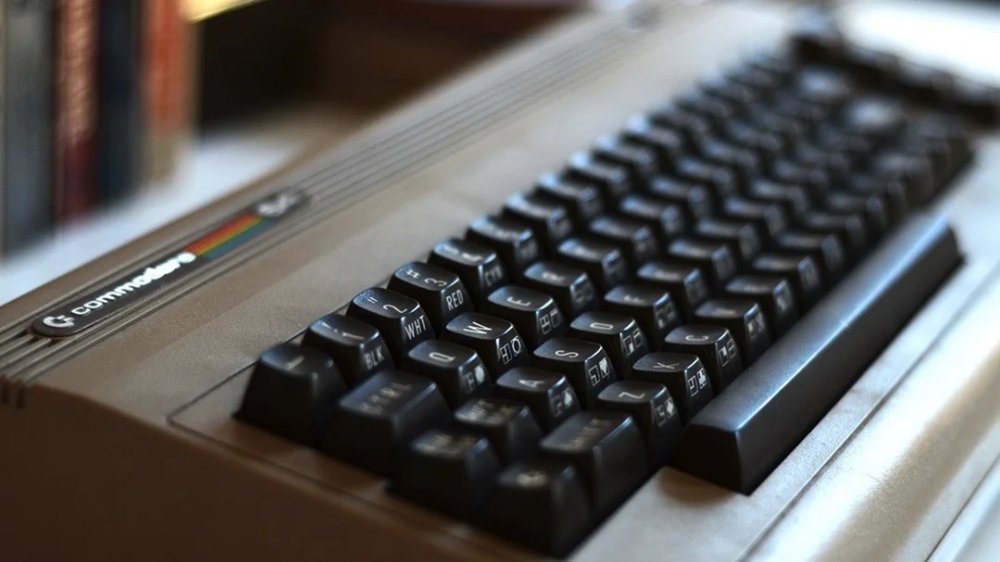
Early Commodore 64s used what enthusiasts often call the breadbin case, a rounded beige design inherited from Commodore's earlier VIC-20.
And it looked magnificent.
Not magnificent in a sleek, minimalist, aluminium sort of way. Nothing about it whispered.
The Commodore 64 sat on the desk like a substantial piece of electrical equipment. The keyboard and computer were combined into one reassuringly chunky unit. The keys had proper travel. The case had weight. Cables emerged from various directions.
It looked serious enough that parents could plausibly convince themselves they were buying something educational.
This was an extremely useful characteristic of 1980s home computers.
"You'll be able to learn programming on it" was probably responsible for an extraordinary number of machines entering British homes shortly before somebody loaded International Soccer.
The C64's keyboard also contained all sorts of symbols and labels that made it appear wonderfully complicated.
There were function keys. Commodore symbols. Graphics characters. A RUN/STOP key. A RESTORE key.
Even turning it on felt like operating machinery rather than waking a modern appliance.
Then came that screen.
READY.
Switch on a Commodore 64 and you were greeted by one of the most recognisable sights in home computing.
A blue screen.
Not Microsoft's terrifying version. This was a friendly blue screen.
At the top sat the familiar message:
COMMODORE 64 BASIC V2
Then the amount of available BASIC memory.
And finally:
READY.
A blinking cursor waited underneath.
That single word captured something modern computing has largely lost. The computer was genuinely waiting for you to tell it what to do.
There was no desktop. No app launcher. No notifications. No account login. No six pop ups asking whether you would accept cookies, enable location services or subscribe to a newsletter.
Just:
READY.
Of course, many owners responded to this invitation to explore the limitless possibilities of computing by typing something roughly like:
LOAD"*",8,1
Or perhaps by attaching a cassette deck and beginning an entirely different ritual.
The Datasette Experience
For many British Commodore 64 owners, games came on cassette.
This meant using Commodore's Datasette, a dedicated cassette drive that connected to the computer.
You inserted the tape, rewound it to roughly the right place and entered the appropriate loading command.
The computer would then tell you:
PRESS PLAY ON TAPE
And you did.
Then you waited.
And waited.
Possibly made a drink.
Possibly read the cassette inlay again.
Possibly stared at the screen as though intense concentration might encourage the software to arrive more quickly.
Cassette loading was one of those technological inconveniences that somehow became part of the pleasure. The process built anticipation in a way that selecting a game from a digital library never can.
Some games included colourful loading screens, giving you something to look at while the computer steadily dragged the program into memory.
Others used distinctive loading sounds and flashing borders.
And then there was always the possibility that, after several minutes of waiting, something had gone wrong.
Nothing teaches emotional resilience quite like reaching the end of a cassette only to discover that your game has not loaded.
You rewound the tape.
Adjusted something.
Tried again.
Perhaps lowered the volume of conversation in the room, despite there being absolutely no technical reason why this would help.
Eventually, if the computer gods were satisfied, the title screen appeared.
Victory.
Floppy Disks and the Legendary 1541
Not everybody used tapes.
The Commodore 1541 floppy disk drive offered a much faster and more flexible way to store and load software than cassette, although "faster" requires some historical perspective.
The 1541 was not exactly a lightweight peripheral. It was a substantial piece of hardware with its own processor and electronics, and it could look almost as formidable as the computer itself.
It was also expensive enough that many UK households stuck with cassettes.
Owners who did have disk drives gained access to a different experience. Games could contain more data and loading became more practical, particularly once software developers introduced fast loaders that worked around the notoriously slow standard disk transfer system.
For many young owners, though, floppy disks retained an almost professional mystique.
A cassette was familiar. Everybody understood cassettes.
A floppy disk looked like something from an office of the future.
Why the Commodore 64 Was Such a Brilliant Games Machine
The Commodore 64's reputation rests heavily on games, and with good reason.
Thousands of commercial titles were released for the system during its lifetime, covering practically every genre the industry could invent.
Arcade conversions sat alongside original games, adventures, strategy titles, simulations, platformers and wonderfully strange experiments that could only have emerged from the early home computer era.
The machine's hardware gave developers some genuinely useful tools.
Sprites Made Things Move
The VIC-II graphics chip could display hardware sprites, allowing moving objects to be handled more efficiently than on some competing machines.
This helped the C64 produce smooth animation and scrolling when developers knew how to exploit the hardware.
Games such as Uridium, Impossible Mission, The Last Ninja and Turrican demonstrated what talented programmers could squeeze from the machine.
And squeeze is exactly the right word.
The real magic of 8 bit computing was not simply what the machines could officially do. It was watching programmers discover things they apparently should not be able to do.
As the years passed, developers became increasingly clever.
Graphics improved. Scrolling became smoother. Music became more elaborate. Tricks were discovered that pushed the hardware far beyond what early software had suggested was possible.
Owning a home computer through the 1980s meant watching the same machine apparently become more powerful without anybody replacing the machine.
Then There Was the SID Chip
If the Commodore 64 has a secret weapon, it is probably sound.
The MOS Technology 6581 Sound Interface Device, usually known simply as SID, gave the machine a musical personality unlike almost anything else in home computing.
It offered three sound voices with programmable waveforms, filters and other controls that talented musicians could exploit to astonishing effect.
For C64 owners, this meant games could have actual memorable soundtracks rather than a handful of bleeps accompanying the action.
Composers including Rob Hubbard, Martin Galway and Ben Daglish became famous among players. You might buy a game partly because you had heard how good the music was.
Rob Hubbard's music for titles such as Monty on the Run and International Karate became deeply associated with the machine.
Martin Galway's work included memorable scores for games such as Rambo: First Blood Part II and Wizball.
The extraordinary thing is how distinctive SID music remains today.
Hear a few seconds of the right tune and an entire room can suddenly reappear in your memory.
A portable television.
A joystick.
A stack of tapes.
Perhaps somebody telling you dinner is ready when you have just reached the difficult bit.
The SID chip has since acquired a life far beyond the original computer. Musicians and enthusiasts still use SID hardware and emulations because that slightly gritty, electronic sound is not merely obsolete technology.
It has become an instrument.
Joysticks, Broken Joysticks and the Art of Waggling
You cannot properly discuss the Commodore 64 story without discussing joysticks.
The C64 had two joystick ports and supported Atari standard controllers, which meant owners had plenty of options.
Some joysticks were sturdy.
Some claimed to be sturdy.
Some survived approximately seventeen minutes of Daley Thompson's Decathlon.
Sports games of the era frequently involved rapidly moving a joystick left and right to make an on screen athlete run faster. It seemed perfectly reasonable at the time.
The consequences for joystick hardware were predictable.
Microswitches clicked furiously. Suction cups gradually stopped suctioning. Plastic creaked. Adults elsewhere in the house wondered why computing sounded like somebody dismantling furniture.
Models such as the Competition Pro became favourites partly because they felt capable of surviving the punishment.
The joystick itself became inseparable from the home computer experience.
One hand on the stick. One finger hovering over the fire button. Cable stretched across the carpet.
No wireless pairing.
No charging.
No firmware updates.
Just plug it in and destroy your friend at International Karate+.
The C64 Versus the ZX Spectrum
In Britain, the Commodore 64 could never exist in isolation because there was another computer everywhere.
The ZX Spectrum.
The Spectrum was cheaper, enormously popular and supported by a huge UK software industry. Its compact rubber keyed design was about as far removed from the C64's sturdy keyboard as two contemporary home computers could be.
Arguments about which machine was better became part of playground culture.
Spectrum owners pointed to their enormous games library, distinctive British software scene and lower price.
Commodore owners could point towards hardware sprites, smoother scrolling, superior sound and graphics that did not suffer from the Spectrum's infamous colour clash in quite the same way.
None of this tended to produce sensible, balanced discussion among ten year olds.
Computer ownership was tribal.
If your family owned a C64, the C64 was obviously superior.
If your family owned a Spectrum, the Spectrum was obviously superior.
If somebody owned an Amstrad CPC, both groups temporarily suspended hostilities.
Looking back, the rivalry was one of the best parts of the era. These machines had genuine personalities. Games had to be adapted to dramatically different hardware, so comparing versions could become part of the fun.
You did not simply own a computer.
You belonged to it.
The Software Shops and Magazine Culture
Being a Commodore 64 owner involved far more than sitting at the computer.
There was an entire culture around it.
Newsagents carried shelves of computer magazines with brightly coloured covers promising new games, programming tips, reviews, cheats and astonishing revelations about upcoming hardware.
Titles including Zzap!64 became institutions in their own right.
Reviews mattered because buying a full priced game represented a serious investment for a young player. A glowing magazine review could suddenly create an urgent need to own something you had not known existed twenty minutes earlier.
Later, magazines increasingly included cover tapes packed with demos, utilities and complete games.
There was something gloriously exciting about buying a magazine and receiving actual software attached to the front.
Computer shops had their own atmosphere.
Rows of cassette cases.
Boxes behind glass.
Game artwork that often promised far more visual excitement than an 8 bit computer could possibly deliver.
You would pick up a cassette and study the screenshots on the back repeatedly, attempting to determine whether the game was worth several weeks of saved pocket money.
It was slower than browsing an online store, obviously.
It was also much more difficult to accidentally acquire forty games and never play any of them.
The Budget Game Revolution
One of the C64's great strengths in Britain was the enormous market for inexpensive games.
Publishers such as Mastertronic helped popularise budget software, making games available for just a few pounds.
Suddenly buying a computer game did not always require a birthday, Christmas or extensive negotiations with parents.
You could walk into a shop with pocket money and leave with something new to play that afternoon.
Quality varied enormously.
That was part of the adventure.
Sometimes you discovered something brilliant.
Sometimes you discovered precisely why it cost £1.99.
But budget software encouraged experimentation. You played strange games because the artwork looked interesting. You took chances on titles you had never seen reviewed. Collections gradually formed.
Plastic cassette cases filled drawers, shelves and boxes.
Even now, discovering a pile of original C64 tapes can trigger the peculiar urge to start reading labels one by one.
Typing Programs Into the Commodore 64
Parents who bought home computers for educational reasons were not entirely fooling themselves.
Children really did learn things.
The Commodore 64 started directly in BASIC, meaning programming was sitting there waiting from the moment the machine switched on.
Computer magazines and books printed program listings that owners could type manually.
Sometimes these were short.
Sometimes they stretched across multiple pages and seemed designed specifically to test whether a child could maintain concentration without making a single typing error.
You entered line after line:
10 PRINT "HELLO"
20 GOTO 10
And suddenly the computer was doing something because you had told it to.
That was enormously empowering.
Soon people experimented.
Changed numbers.
Altered colours.
Made rude words appear repeatedly on the television.
Civilisation advanced.
Longer programs were less forgiving. One mistyped character could leave you searching desperately through hundreds of lines for the error.
But that frustration taught an important lesson about computers.
They were understandable.
You could command them. Break things. Fix things. Discover why something worked.
Modern computers are vastly easier to use, but much of their machinery is deliberately hidden. The C64 did not hide very much at all.
The blinking cursor practically invited interference.
Loading Games Was Part of the Occasion
Modern gaming is extraordinarily convenient.
Choose a title. Download it. Start playing.
Updates may occasionally interrupt the process, but compared with cassette software the friction is tiny.
Yet that convenience has removed something.
On the Commodore 64, playing a game could become an event before the game had even begun.
You selected the tape.
Found the correct side.
Rewound it.
Typed the loading command.
Pressed play.
Waited.
Watched the loading screen.
Listened.
Hoped.
The delay created anticipation.
Perhaps nostalgia has polished away some of the irritation. Nobody standing beside a failed cassette load in 1987 was thinking, "I hope one day I can relive this beautiful ritual."
But the ritual became attached to the memory.
The inconvenience gave the activity edges.
You remember putting a cassette into a Datasette in a way nobody remembers tapping an icon.
The Commodore 64 in British Bedrooms
Like many home computers, the C64 often lived in whatever space a family could spare.
Sometimes that meant the living room television.
This arrangement required negotiation.
Computer time potentially meant somebody else losing television time, which could become particularly controversial once programmes started.
Other C64s migrated upstairs and became the centrepiece of a child's bedroom.
The setup might consist of the computer, Datasette, joystick, cassette boxes and a portable television sitting on a desk that had theoretically been purchased for homework.
That little collection of equipment could swallow entire weekends.
Friends came round with games.
Two player sessions became noisy.
People swapped tips that were either amazingly useful or completely untrue.
Rumours spread before the internet could instantly destroy them.
Games felt larger because information about them was scarce.
Finding a hidden feature genuinely felt like discovering something.
The Games We Still Associate With It
Trying to define the Commodore 64 through a handful of games is nearly impossible because the library was so vast.
But certain titles remain deeply associated with the system.
The Last Ninja combined striking graphics, music and an unusual isometric perspective.
Impossible Mission gave players digitised speech, including the famous opening command to "Stay a while, stay forever!"
Paradroid offered intelligent science fiction action aboard a spaceship full of hostile robots.
Wizball was gloriously strange.
California Games brought surfing, BMX riding and other events into countless homes.
International Karate+ became a multiplayer favourite.
Bubble Bobble, Ghosts 'n Goblins, Commando, Boulder Dash, Maniac Mansion, Elite, The Sentinel and countless others occupied enormous amounts of young lives.
And then there were the games that were objectively less celebrated but which somebody personally adored.
Those are often the ones nostalgia preserves most strongly.
The game you played repeatedly because it was one of only six you owned can mean more than the masterpiece you discovered thirty years later through emulation.
How the Commodore 64 Took Over
The machine's success did not come from one single advantage.
Commodore controlled much of its own chip production, which helped it compete aggressively on price.
The computer reached mass market retailers rather than remaining confined to specialist computer shops.
Its capabilities attracted game developers.
More software made the computer more attractive.
More owners encouraged more software.
The cycle reinforced itself.
Commodore also sold the machine for an extraordinarily long time by computing standards. Various revisions appeared, including the redesigned Commodore 64C, but compatibility kept the platform alive.
By the late 1980s, newer 16 bit machines such as the Commodore Amiga and Atari ST were demonstrating where home computing was heading.
The C64 carried on regardless.
That longevity meant siblings could inherit machines. Second hand systems remained useful. Games continued appearing years after competing technology had moved ahead.
The Commodore 64 became less like a product generation and more like part of the furniture.
The C64C and the Changing 1980s
In 1986 Commodore introduced the Commodore 64C.
Internally it remained compatible with the familiar C64, but externally it looked far more modern, with a lighter coloured, flatter case that resembled Commodore's newer machines.
The transformation perfectly captures changing computer design during the decade.
The original breadbin C64 belongs visually to the early 1980s, all chunky curves and brown function keys.
The C64C looks towards the late 1980s, when computers were becoming sleeker and more consciously designed as complete systems.
People tend to have strong preferences between them.
For some, the breadbin is the Commodore 64.
For others, childhood memories belong entirely to the C64C.
Both are unmistakably products of their moment.
Why We Remember the Commodore 64 So Fondly
Nostalgia is rarely about specifications.
Nobody lies awake longing for 64KB of RAM.
What people remember is everything that surrounded the machine.
The click of a joystick.
The sound of SID music.
The blue BASIC screen.
Waiting for tapes.
Computer magazines on the floor.
Handwritten labels.
Arguments over whose turn it was.
The excitement of a new game.
Discovering that entering a few lines of BASIC could make something happen on the screen.
That entire experience arrived at a particular moment in technology.
Computers were advanced enough to be exciting but still simple enough to feel understandable.
A child could own a C64 without knowing exactly how everything worked, yet still form a fairly direct relationship with the machine.
You switched it on and there was BASIC.
No layers of accounts and services stood between you and the hardware.
If you wanted entertainment, you loaded it.
If you wanted to program, you typed.
If you wanted to experiment, nothing stopped you.
The Commodore 64 Today
More than forty years after its introduction, the Commodore 64 still has an active enthusiast community.
Original machines are collected, repaired and restored. Modern replacement power supplies, storage devices and video solutions can make vintage hardware easier and safer to use.
Devices that emulate disk drives can load software from modern storage while retaining the experience of using the original computer.
There are also modern recreations and emulation options for people who want the software without maintaining ageing electronics.
Perhaps most impressively, programmers and artists continue creating new C64 software.
The demoscene has spent decades demonstrating visual and audio techniques that seem absurdly ambitious for hardware designed in the early 1980s.
This is one reason the machine remains fascinating even after the nostalgia has been removed.
The C64 is a fixed target.
Its hardware does not become more powerful.
So progress comes from understanding it better.
Forty years later, people are still finding cleverer ways to make the same little beige computer perform tricks.
Collecting a Commodore 64
For retro computing enthusiasts, the C64 is an attractive machine to collect because there is so much associated hardware and software.
There are multiple computer revisions, disk drives, Datasettes, joysticks, cartridges, printers, boxed games, manuals and magazines.
Condition varies wildly.
Machines spent years in lofts, cupboards and garages. Plastic can discolour. Keyboards accumulate decades of grime. Power supplies age.
Anyone planning to use original hardware should research the condition of the power supply in particular. Original C64 power supplies have a reputation for failing in ways that can damage the computer, so many enthusiasts use modern replacements.
Then there is the software.
Collecting original Commodore 64 games can quickly become a hobby of its own, particularly once nostalgia starts whispering that you absolutely need the exact cassette edition you owned when you were eleven.
You do not.
Obviously.
But you probably will buy it anyway.
The Strange Difference Between Retro and Modern Computing
Put a Commodore 64 beside a modern computer and the comparison becomes almost ridiculous.
A modern phone contains computing power that would have seemed like science fiction to the engineers of the early 1980s.
Screens are vastly better.
Storage is practically limitless.
Games contain entire worlds.
Music can reproduce actual orchestras rather than using three synthesised voices.
Everything happens instantly.
And yet the Commodore 64 can still hold your attention.
Partly that is nostalgia, but not entirely.
Old computers are tactile.
They have limitations you can understand.
Software feels connected to hardware.
Loading a game is an identifiable process rather than an invisible sequence happening somewhere behind an animated icon.
The constraints give the machine character.
Nobody describes a new laptop as having a distinctive loading sound.
Nobody becomes emotionally attached to the error message displayed by their streaming app.
The C64 had rough edges, and somehow those rough edges became memories.
The Computer That Refused to Disappear
The Commodore 64 did not take over the 1980s because it was perfect.
It was slow in places. Cassette loading could be maddening. Disk access could be painfully sluggish without clever software. BASIC offered surprisingly little direct support for the machine's impressive graphics and sound hardware, forcing programmers to use PEEKs and POKEs for many advanced features.
None of that stopped people loving it.
Instead, those quirks became part of the personality of the machine.
The C64 arrived when home computing still felt like an adventure. Families were bringing computers into their homes without really knowing what they would eventually become. Children were learning programming almost by accident because BASIC happened to appear when the machine switched on. Musicians were turning a sound chip into something nobody had anticipated. Programmers were finding increasingly ridiculous ways to squeeze better games from fixed hardware.
And millions of people were simply having fun.
That might be the most important part of the Commodore 64 story.
Technology often becomes less interesting as it becomes more seamless. The C64 was never seamless. It required involvement.
You plugged things into it. Typed commands into it. Waited for it. Swapped tapes. Moved joysticks. Read manuals. Entered listings from magazines. Learned its peculiar language.
You participated.
Perhaps that is why a blue screen containing the word READY. can still produce such an immediate reaction all these years later.
The computer really was ready.
And so were we.
For more stories about classic computers, forgotten gadgets and the technology that made the 1980s so much fun, join RetroWins and sign up to stay in the loop.






