
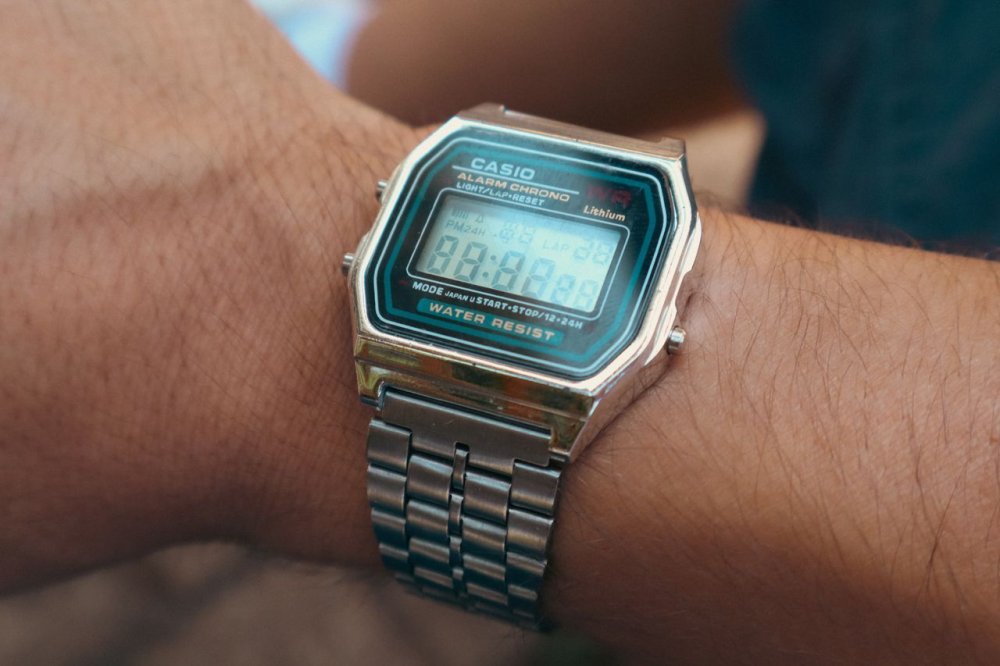
There was a time when being able to look at your wrist and see 12:47 glowing back at you felt like evidence that the future had arrived.
Not a pair of hands pointing vaguely towards some numbers. Actual digits. Electronic digits.
For anyone growing up in Britain during the late 1970s and 1980s, the digital watch occupied a peculiar place somewhere between useful everyday object, miniature computer and playground status symbol. You might have been standing in a draughty school corridor wearing a nylon coat and carrying a battered exercise book, but if your wrist could beep on the hour, you were living in tomorrow.
Digital watches were everywhere during the 1980s. Casio became almost inseparable from the idea, but Seiko, Timex, Pulsar and countless cheaper brands filled jewellers, catalogues and market stalls with watches offering alarms, stopwatches, illuminated displays and, increasingly, features of wonderfully questionable usefulness.
For a generation becoming fascinated by home computers, electronic games, calculators and anything involving an LCD screen, the digital watch was irresistible.
And unlike most exciting new technology, you could actually wear it to school.
The Digital Watch Made Time Look Futuristic
Mechanical watches had existed for generations. They were familiar, respectable and, from a child's perspective, not terribly exciting.
Then digital watches appeared.
Instead of interpreting two hands rotating around a dial, you simply looked down and there it was:
10:32
That alone felt modern.
Early electronic watches had emerged commercially during the 1970s, initially using LED displays that required a button press because the illuminated digits consumed too much power to remain permanently visible. LCD technology soon made continuously displayed digital time practical, and by the beginning of the 1980s digital watches were becoming affordable enough to move far beyond the luxury market.
This was crucial.
The technology stopped being something you saw in magazine adverts and started becoming something your mate at school actually owned.
Suddenly the future cost roughly the amount your parents might conceivably spend on a birthday present.
Digital displays were appearing everywhere at the time. Calculators had them. Alarm clocks had them. Video recorders had them. Hi-fi systems had them. Microwave ovens increasingly had them.
Numbers glowing or appearing electronically behind a dark plastic window became part of the visual language of modern technology.
Putting that display on your wrist made it personal.
Why Everyone Wanted a Digital Watch
The appeal of a digital watch in the 1980s was not simply that it told the time differently.
It did things.
That distinction mattered enormously.
An ordinary watch was a watch. A digital watch was a gadget.
Even quite basic models often included a calendar, alarm, stopwatch and tiny light. More advanced models offered multiple alarms, countdown timers, dual time zones or increasingly elaborate calculator functions.
Every additional button suggested hidden possibilities.
You would press one and the date appeared.
Press another and seconds started counting upwards.
Press something else and the display illuminated in the dark.
This was extraordinary stuff when you were eight.
Modern smartphones contain technology of almost unimaginable complexity, but most of it is hidden behind polished interfaces. A 1980s digital watch proudly displayed its complexity through tiny buttons labelled MODE, START, STOP and LIGHT.
You had to operate it.
That made owning one feel satisfying in a way that went beyond simply using it to find out whether you were late for tea.
The Hourly Beep
Anyone who remembers digital watches in school probably remembers the beep.
Many watches could be set to emit a short electronic chirp every hour. Exactly why we considered this desirable is difficult to explain now, but desirable it absolutely was.
At 11:00, somewhere in the classroom:
beep
Then another.
Then another from somewhere across the room.
Teachers must have loved them.
The hourly signal turned the humble wristwatch into a tiny electronic participant in daily life. Lessons, television programmes, football in the park and family dinners were periodically interrupted by a cheerful little acknowledgement that another hour had passed.
And naturally, nobody could remember how to turn the feature off.
The Light Button
The illumination function deserves its own recognition.
Pressing the light button in broad daylight achieved almost nothing, yet we did it constantly.
In darkness, however, the display came alive.
Early watch lights were hardly dazzling. You often had to hold the button while tilting the watch at precisely the right angle, but that only added to the appeal.
Checking your digital watch underneath the bedcovers felt vaguely like operating military equipment.
It was completely unnecessary.
That was part of the fun.
Casio Became the Digital Watch King
Plenty of manufacturers produced digital watches, but few names became as closely associated with them as Casio.
Casio already had considerable expertise in electronic calculators, which made the move into watches a natural one. By the 1980s, the company was producing an enormous variety of digital models, from simple everyday watches to devices packed with increasingly adventurous features.
For many British children, a black or silver Casio became the default image of what a digital watch looked like.
Small rectangular LCD display.
A few buttons around the case.
Flexible resin strap or shiny metal bracelet.
Tiny lettering explaining functions you had probably forgotten how to use.
They were practical, relatively inexpensive and remarkably durable.
Most importantly, they looked properly technological.
Even today, classic Casio models still look unmistakably like products of the electronic age. They belong to the same visual universe as pocket calculators, early home computers and portable cassette players.
The design was not pretending to be jewellery.
It looked like equipment.
The Casio Calculator Watch Was Something Else Entirely
Then came the calculator watch.
This was digital watch obsession reaching its natural conclusion.
Why merely know the time when you could also perform arithmetic using buttons approximately the size of breadcrumbs?
Casio and other manufacturers produced calculator watches throughout the 1980s, and they quickly became some of the most memorable wearable gadgets of the decade.
The concept was irresistible.
A calculator.
On your wrist.
Nobody seriously needed one there, which somehow made it even more desirable.
The tiny keypad usually demanded fingernails rather than fingertips, and entering anything complicated could become an exercise in patience. That did not matter.
You could calculate things without taking a calculator out of your school bag.
That was enough.
The Playground Potential
Calculator watches had an obvious appeal in school.
They were technology you could legitimately wear into a classroom.
This immediately raised fascinating possibilities.
Could you use it during maths?
Would the teacher notice?
Was it technically cheating if the calculator happened to be attached to your arm?
The answer generally depended on the teacher.
There was also a social hierarchy to these things.
Having a digital watch was good.
Having one with an alarm was better.
Having a stopwatch added sporting credibility.
Having a calculator watch suggested you had somehow acquired access to technology normally reserved for NASA.
Even if the most demanding calculation you ever performed was working out how many packets of Space Raiders you could buy with your pocket money.
Digital Watches Fitted Perfectly Into the 1980s
The timing could hardly have been better.
Britain in the 1980s was experiencing an explosion of affordable personal electronics.
Children were growing up with ZX Spectrums, Commodore 64s, BBC Micros, electronic handheld games, personal stereos and programmable toys.
Buttons were exciting.
Screens were exciting.
Beeps were exciting.
Anything described as "electronic" immediately became more interesting.
The digital watch condensed all of that into something small enough to strap onto your wrist.
It shared the same aesthetic as the decade's other technology: black plastic, metallic finishes, tiny LCD displays and mysterious abbreviated functions.
Even the lettering looked futuristic.
MODE.
ALARM.
CHRONO.
LIGHT.
RESET.
Four small buttons could make you feel as though you were configuring the flight computer on a space shuttle.
The Argos Catalogue Effect
For British children, discovering technology often involved an important publication that deserves recognition alongside the great computing magazines of the era.
The Argos catalogue.
Digital watches looked magnificent in it.
Page after page offered products arranged neatly with numbers beside them, allowing you to compare features, prices and designs with the seriousness normally associated with major industrial purchasing decisions.
You might never actually receive the watch.
That was almost beside the point.
You could still choose one.
There were sleek silver models, black plastic sports watches, watches with multiple displays and chunky devices featuring enough buttons to suggest they could remotely control a nuclear submarine.
Catalogues turned product browsing into entertainment.
Birthdays and Christmas created opportunities for prolonged research.
You could study the possibilities for weeks.
By the time December arrived, you probably knew the catalogue number.
Setting One Was Usually Far Harder Than It Looked
Of course, owning a digital watch meant eventually having to set it.
This could expose an uncomfortable truth.
Nobody really understood what the buttons did.
Digital watch interfaces were compact because they had to be. A watch might have four buttons controlling ten functions, which meant commands were hidden behind combinations of short presses, long presses and sequences that nobody could remember.
You would hold MODE.
The seconds started flashing.
Press something else.
Now the minutes were flashing.
Press the wrong button.
You were suddenly changing the month.
Eventually you would reach the correct time and then accidentally advance it by another hour.
At this stage, the traditional solution was to find whichever adult still had the instructions.
If the instructions had disappeared, the watch could remain permanently seven minutes fast until the battery needed changing.
The Annual British Summer Time Ritual
Then came the clocks changing.
Twice a year, millions of digital watches needed intervention.
Analogue watches simply required turning a crown.
Digital watches demanded that you rediscover a control system you had last used six months earlier.
There was always the temptation to leave it wrong and mentally add or subtract an hour.
This worked surprisingly well until someone asked you the time.
Stopwatches Turned Everything Into an Event
The stopwatch function also changed childhood behaviour.
Anything could now be timed.
Running from one lamppost to another.
Cycling around the block.
Holding your breath.
Tidying your bedroom.
How quickly someone could eat something they probably should not have been eating quickly.
The fact that your watch could measure hundredths of a second created an entirely unjustified sense of scientific precision.
Nobody needed to know that a friend had reached the garden gate in 8.47 seconds.
But once the technology existed, it seemed irresponsible not to measure it.
Stopwatches transformed ordinary activities into experiments.
They gave digital watches something analogue watches rarely offered children: interaction.
The Alarm Was Tiny but Powerful
Digital watch alarms were rarely subtle.
A tiny piezoelectric speaker produced a high pitched series of electronic beeps that could sound surprisingly insistent in a quiet room.
Setting the alarm felt like programming.
You chose the hour.
Then the minutes.
Then waited.
Later, the watch erupted into life and you experienced the satisfaction of having successfully instructed a machine to do something in the future.
This sounds trivial now.
At the time, it was exciting.
Home computers offered the same basic pleasure. You pressed keys, gave instructions and the machine responded.
A digital watch offered a miniature version of that relationship.
Unfortunately, the alarm could also be set accidentally.
Nothing made you question your technical abilities quite like a watch beginning to beep enthusiastically at 3:17 in the afternoon for reasons you could not explain.
Digital Watches Were Made to Be Shown Off
Unlike most gadgets, watches were visible.
Your games console stayed at home.
Your television stayed in the living room.
Your ZX Spectrum probably lived beside a small portable telly with an alarming number of cables behind it.
But your watch went everywhere.
That made it social.
Friends compared them.
You showed people the stopwatch.
You demonstrated the alarm.
If you had a calculator model, you performed calculations nobody had requested.
Some watches became conversation starters simply because they looked unusual.
Digital watches also represented a rare category of children's technology that could plausibly be justified to parents as practical.
"I need to know the time" sounded considerably more responsible than "I need another electronic gadget."
Then Digital Watches Became Increasingly Ridiculous
Once manufacturers realised people wanted features, an entertaining technological arms race followed.
Digital watches appeared with calculators, databanks, multiple time zones, games and various specialist functions.
Casio famously produced watches capable of storing telephone numbers and other small pieces of information. Others incorporated remote control functions or increasingly elaborate displays.
Some ideas were genuinely useful.
Others existed largely because engineers had discovered they could fit them inside a watch.
This is one of the most charming things about 1980s consumer electronics.
There was a willingness to experiment.
Products did not always need to solve major problems.
Sometimes the pitch was simply:
"Look what this does."
And that was enough.
The Cheap Digital Watch Was Part of the Story Too
Not every digital watch was a Casio or Seiko.
Far from it.
Markets, seaside shops, petrol stations and discount stores sold inexpensive digital watches that offered varying levels of reliability.
Some seemed to have been designed around the principle that more buttons automatically meant more technology.
Packaging promised alarms, lights and impressive sounding functions.
Straps could feel suspiciously temporary.
Buttons might require considerable determination.
Water resistance was occasionally best regarded as theoretical.
But these watches mattered.
They made the technology accessible.
You did not necessarily need an expensive model to experience the thrill of having digital time on your wrist.
And when a cheap watch eventually stopped working, the most obvious solution was often not replacing the battery.
It was getting another watch.
The Strap Was Always Part of the Experience
Anyone who owned a digital watch probably remembers the strap almost as much as the display.
Black resin straps were everywhere.
They were flexible, practical and initially seemed indestructible.
Eventually, however, years of bending could produce cracks near whichever hole you used every day.
Metal bracelets offered a different experience entirely.
They looked wonderfully sophisticated but occasionally developed an appetite for arm hair.
Somewhere between fashion accessory and minor torture device, they gave the wearer a distinctly grown up appearance.
Adjusting one could require removing tiny links, usually involving a parent, a small screwdriver and an increasing amount of frustration.
Still, once fitted, it looked fantastic.
The Battery Seemed to Last Forever
Compared with modern smartwatches, one of the most striking things about traditional digital watches is how little attention they demanded.
You did not charge them every night.
There was no dock.
No cable.
No battery percentage permanently hovering in the back of your mind.
You simply wore the watch.
Quartz digital watches could typically run for years on a small button cell, depending on the model and how heavily functions such as illumination were used.
Eventually the display might start fading or the watch would stop entirely.
Then someone replaced the battery and normal service resumed.
Modern technology is incomparably more powerful, but the idea of owning an electronic device that quietly works for years without needing daily charging now seems strangely luxurious.
Then the Mobile Phone Changed Everything
Digital watches did not disappear, but their role changed.
By the late 1990s and 2000s, mobile phones increasingly became the default way many people checked the time.
Why glance at your wrist when the device in your pocket already displayed the hour?
For a while, wristwatches in general seemed less essential.
Then smartwatches arrived and made the wrist interesting again.
Today's devices can receive messages, track exercise, measure heart rate, make payments, navigate streets and communicate with satellites.
Compared with that, a classic Casio displaying hours, minutes and seconds should feel hopelessly primitive.
Oddly, it does not.
If anything, the simplicity has become part of the attraction.
Why Classic Digital Watches Still Look Good
One reason vintage style digital watches remain popular is that the design has aged remarkably well.
A simple rectangular LCD watch still looks functional rather than outdated.
The technology is visible, understandable and pleasantly modest.
It does not demand your attention.
It does not vibrate because somebody has liked a photograph.
It does not announce that you should stand up.
It does not show headlines.
It tells you the time.
Perhaps the date.
Maybe it beeps.
That is about it.
After decades of devices becoming progressively more complicated, the uncomplicated digital watch feels refreshing.
Casio continues to sell designs closely associated with its classic digital style, while vintage examples from Casio, Seiko and other manufacturers attract collectors interested in the history of wearable electronics.
Some collectors chase unusual models or rare functions.
Others simply buy the watch they remember having when they were twelve.
Nostalgia is powerful like that.
The Digital Watch Was Our First Wearable Technology
Long before anyone used the phrase "wearable technology", millions of people were already wearing it.
That is perhaps why the digital watch in the 1980s remains so memorable.
It was personal technology before personal technology became ordinary.
Your watch belonged specifically to you.
You learned its controls.
You chose whether the hourly chime was active.
You set the alarm.
You timed things.
You pressed the light button unnecessarily.
It travelled everywhere with you.
There was also something optimistic about it.
Digital watches belonged to an era when electronics still carried a whiff of possibility. Adding a screen to something made it seem more advanced. Giving an object buttons made it more interesting.
Nobody looked at a calculator watch and complained that it did not integrate with their calendar.
They looked at it and thought:
That's a calculator.
On a watch.
Brilliant.
We Expected the Future to Look Like This
Perhaps that is the real reason digital watches trigger so much nostalgia.
They were tiny pieces of the future that actually arrived.
Not the flying cars or robot servants promised by science fiction, admittedly.
Instead we got a small LCD screen strapped to our wrist that beeped every hour and occasionally required five minutes of button pressing when British Summer Time ended.
But it genuinely felt futuristic.
A good digital watch captured everything exciting about 1980s technology. It was affordable, tactile, slightly nerdy and full of functions you could demonstrate to other people.
You interacted with it rather than simply wearing it.
And for thousands of British children staring through jewellers' windows or repeatedly examining the same page of the Argos catalogue, owning one felt like joining the electronic age.
Modern technology can do vastly more.
Yet somehow, receiving your first digital watch and discovering that it had a stopwatch, an alarm and a tiny glowing light could feel more exciting than installing another hundred apps ever will.
That little LCD display did not need to change your life.
It just needed to beep.
And preferably do it exactly on the hour.
If stories like this have you remembering forgotten gadgets, bedroom technology and the electronics you desperately wanted growing up, join RetroWins or sign up to stay in the loop for more retro technology stories and nostalgia.






