
There are certain names that dominate any conversation about British home computers of the 1980s. ZX Spectrum. Commodore 64. BBC Micro. Amstrad CPC.
Then, somewhere near the back of the classroom, quietly getting on with things while everyone else argues about colour clash and sprites, sits the Dragon 32.
For anyone who owned one, though, there was nothing particularly obscure about it. The Dragon 32 was your computer. It was the machine connected to the family television. It was the reason a perfectly innocent cassette recorder suddenly became an essential piece of computer equipment. It was where you typed BASIC programs, waited for games to load and discovered that computers could be simultaneously fascinating, infuriating and completely irresistible.
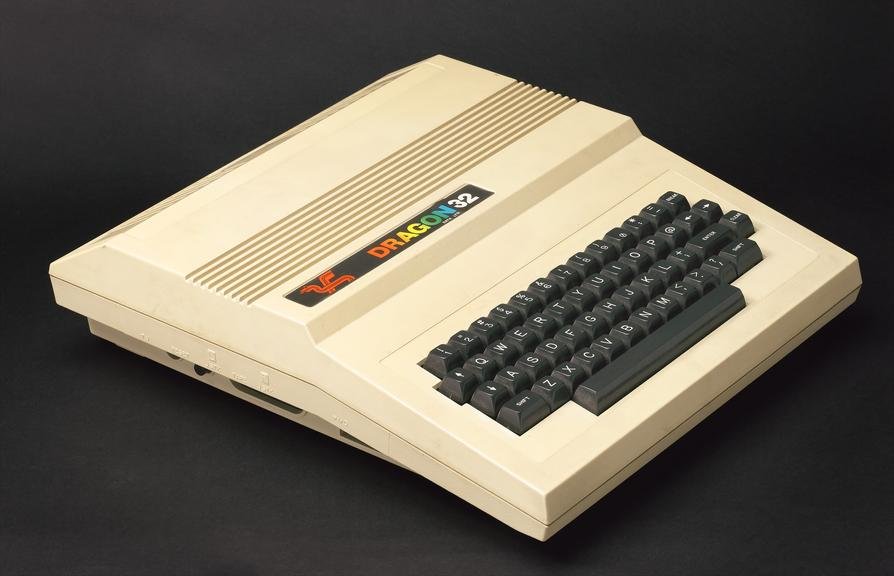
Released in Britain in August 1982, the Dragon 32 arrived at exactly the moment when home computing was exploding. It had 32K of RAM, a proper full-size keyboard, a capable Motorola processor and the sort of chunky beige case that immediately suggested Serious Computing Business.
And, unlike most of the machines fighting for space in British bedrooms, the Dragon 32 came from Wales.
It may never have achieved the legendary status of the Spectrum or Commodore 64, but Britain's other 1980s home computer deserves to be remembered.
Quite a lot of us do.
The Dragon 32 Arrives in 1982
The timing could hardly have been more dramatic.
The Dragon 32 appeared in August 1982, only months after Sinclair had launched the ZX Spectrum and at roughly the same time that the Commodore 64 was beginning its own journey towards becoming one of the most successful home computers ever made.
Suddenly computers were everywhere.
Not actual computers, necessarily. Most households still didn't have one. But adverts for them appeared in newspapers and magazines. Electronics shops had mysterious demonstrations running in their windows. Television programmes were talking about computers. Schools were buying them.
Parents were being informed that their children absolutely needed a computer for educational purposes.
Children, naturally, were mostly thinking about games.
Into this frenzy came the Dragon 32 at £199.50 including VAT. It was manufactured by Dragon Data in South Wales, originally connected with the toy manufacturer Mettoy. The production machines were developed with engineering assistance from PA Technology in Cambridge, and the project had originally carried the wonderfully unassuming codename "Pippin".
"Pippin 32" probably wouldn't have had quite the same playground presence.
Dragon sounded much better.
The name also gave the machine an unmistakably Welsh identity. There was something rather satisfying about a British home computer boom containing a machine called the Dragon that was actually being produced near Port Talbot.
The Dragon 32 Looked Like a Proper Computer
Put a Dragon 32 beside an early ZX Spectrum and the difference in philosophy is obvious.
The Spectrum was tiny, black and futuristic, with its strange rubber keyboard and rainbow stripe. It looked like something that had fallen out of a spaceship.
The Dragon 32 looked like equipment.
Its broad cream and brown case contained a full travel keyboard with individual keys. There was space around everything. It looked sturdy. You could imagine somebody using it to calculate payroll, control a nuclear power station or organise the nation's railway network.
In reality, somebody was probably typing:
10 PRINT "PAUL IS ACE"
20 GOTO 10
That keyboard mattered, though.
Anyone who learned BASIC on an early home computer will remember how much typing was involved. Programs weren't things you simply downloaded. Magazines printed pages of code and expected you to type them in manually, preferably without making a single mistake in 200 lines of apparently meaningless punctuation.
A decent keyboard was therefore more than a luxury.
The Dragon's was one of its genuine strengths.
It also gave the machine a slightly grown-up quality. Parents could plausibly convince themselves they had purchased a useful educational computer rather than an unusually elaborate mechanism for keeping their children upstairs.
What Was Inside the Dragon 32?
The Dragon 32 used a Motorola 6809E processor running at roughly 0.89 MHz and, as its name suggests, came with 32K of RAM. The 6809 was a respected processor with some advanced features for an 8-bit CPU, although raw processor capability wasn't necessarily what decided the home computer wars.
Software mattered.
Graphics mattered.
Games mattered enormously.
The Dragon was closely related architecturally to the Tandy TRS-80 Color Computer, usually known as the CoCo. Both machines used a similar Motorola-based design, although they weren't simply the same computer wearing different plastic.
For the person opening one on Christmas morning, none of this was especially important.
What mattered was what happened when you plugged it into the television.
Like most home computers of its generation, the Dragon normally borrowed the household TV as its display. This arrangement created one of the great domestic negotiations of the 1980s.
You wanted to use the computer.
Someone else wanted to watch television.
There was only one television.
Civilisations have gone to war over less.
The Dragon did also provide composite video output, which could give a cleaner picture if you had suitable equipment, although dedicated monitors were far less common in ordinary homes because they added considerably to the cost.
For most owners, the television was perfectly adequate.
Assuming nobody wanted to watch Dallas.
Loading Games From Cassette
Of course, switching the Dragon 32 on was merely the beginning.
Now you had to load something.
For most owners that meant cassette tape.
Computer cassettes remain one of those experiences that younger people can understand intellectually without ever truly appreciating emotionally.
You put the tape into the recorder. You rewound it. You typed the appropriate command. You pressed play.
Then you waited.
And listened.
The noises produced by computer data on cassette sounded as though two fax machines were having a furious argument inside a modem.
There would be screeching, buzzing and strange electronic tones while the tape counter slowly moved forwards.
This could take several minutes.
If everything worked, a game eventually appeared.
If it didn't, you adjusted the volume and tried again.
Maybe the tape head needed cleaning.
Maybe the volume was slightly too high.
Maybe it was slightly too low.
Maybe the cassette recorder simply disliked you personally.
Loading software was not an invisible background operation. It was an event.
Modern games can quietly download tens of gigabytes while you make a cup of tea. With a Dragon 32, you were emotionally invested in every squeal coming from that cassette recorder.
There was always that glorious moment when the loading finished successfully.
And the considerably less glorious moment when it didn't.
The Dragon 32 and BASIC
Games may have supplied much of the excitement, but one of the great differences between computers then and computers now was how quickly they encouraged you to start programming.
Switch on a modern laptop and you enter an operating system designed to keep the machinery hidden.
Switch on many 1980s home computers and you were effectively dropped into BASIC.
The machine sat there waiting for instructions.
So you gave it some.
Usually terrible ones.
You learned PRINT. You discovered GOTO. You made your name appear repeatedly down the screen. Then you added colours, loops, random numbers and perhaps an extremely crude game involving something represented by an asterisk.
The Dragon came with Microsoft-derived BASIC, and programming became a major part of the experience for many owners.
This mattered far more than anyone realised at the time.
A whole generation became comfortable with computers because there was very little separating "using" the computer from "programming" it.
Curiosity naturally led you deeper.
What does this command do?
Can I make that move?
Can I change the colour?
Can I make a game?
Why does it say SYNTAX ERROR when I have quite clearly typed everything correctly?
You learned something else too: computers are pedantic.
A missing character that no human being would care about could bring your glorious 45-minute programming project to an immediate halt.
Typing Programs From Magazines
Computer magazines were another enormous part of the Dragon 32 experience.
Before the internet, magazines weren't merely something you read about computers. They were one of the primary ways computer owners discovered new things to do with them.
They contained tutorials, reviews, hints, advertisements, technical advice and, most memorably, program listings.
Whole pages of them.
The arrangement now sounds faintly absurd. A magazine printed a computer program on paper. You bought the magazine, sat at your Dragon and painstakingly typed the entire thing back into a computer.
This was considered entertainment.
And somehow it was.
There was genuine anticipation involved. The listing might produce a game, an animation or some clever utility. You could see the result waiting on the other side of all that typing.
The danger was making a mistake somewhere around line 370.
You would run your masterpiece.
Nothing.
Or worse, something happened that very clearly wasn't supposed to happen.
Then began the debugging process, which usually involved comparing dozens of lines against increasingly crumpled magazine pages.
It could be maddening.
But the satisfaction when a program finally worked was extraordinary.
You hadn't merely installed it.
You had built it.
The Dragon 32's Graphics Problem
The Dragon 32 had plenty going for it, but there was one area where trouble was brewing.
Graphics.
The machine's display hardware could produce useful graphics modes, including a 256 by 192 resolution mode, but its colour capabilities were restrictive compared with some increasingly flashy rivals. Its highest resolution graphics mode used two colours, while lower resolution graphics could offer four.
That became increasingly important as the British home computer market evolved.
When families first started buying computers, the ability to programme one at home was remarkable enough.
Then everyone saw better games.
Suddenly smooth animation, colourful graphics and arcade-style experiences became major selling points.
The Commodore 64 had hardware sprites and excellent sound.
The Spectrum accumulated an enormous games library.
The Dragon could certainly play games, and plenty were released for it, but it gradually became harder to compete against systems attracting ever larger communities of developers and publishers.
The strange thing about home computers is that technical superiority in one area rarely guarantees commercial success.
You can have a sophisticated processor.
But if your friend has 400 games and you have 40, your friend is probably feeling quite pleased with his purchasing decision.
Dragon 32 Games Had Their Own Character
The Dragon's software catalogue was nowhere near as vast as the Spectrum's, but it was far from barren.
Hundreds of Dragon titles appeared over its lifetime, including arcade games, adventures, educational programs, utilities and conversions. The Centre for Computing History's archive contains a sizeable selection from publishers such as Microdeal, Salamander Software, Dragon Data itself and others.
For Dragon owners, the smaller library could actually make individual games feel more memorable.
You didn't have thousands of titles instantly available.
Games were things you found.
Perhaps you saw one advertised in a magazine. Perhaps a local computer shop stocked it. Perhaps a friend had a copy.
Then there was the packaging.
Proper cassette cases. Cover artwork that sometimes promised substantially more excitement than the game could realistically deliver. Instruction sheets. Screenshots. Bold claims.
A game might occupy only a few kilobytes, but your imagination supplied everything that wouldn't fit into memory.
That was one of the secret ingredients of 1980s computing.
The graphics showed you just enough.
Your brain did the rest.
Analogue Joysticks and Other Dragon Oddities
The Dragon also had analogue joystick interfaces, which set it apart from many contemporary home computers using simpler digital joystick controls. The same ports could support other devices, including light pens.
The joysticks themselves had that unmistakably early-80s appearance. Functional, chunky and considerably less concerned with ergonomics than modern controllers.
Nobody was talking about haptic feedback.
You had a stick.
You had buttons.
Off you went.
The machine was also fairly expandable by home computer standards, with connections for peripherals including printers and cartridges. Disk storage became available too, although cassette remained the reality for the majority of home users.
A disk drive in the early 1980s was the sort of thing you looked at in a computer magazine and imagined owning if one day you became extremely wealthy.
For most families, buying the computer itself had already been a significant expense.
The Dragon 64 Followed
In 1983, Dragon Data introduced the Dragon 64.
Unsurprisingly, it offered 64K of RAM rather than 32K, along with additions including an RS-232 serial interface and support for the OS-9 operating system.
By then, however, the home computer market was moving at terrifying speed.
This is something that can be difficult to appreciate when looking back.
We now think of the Spectrum, Commodore 64, BBC Micro and Dragon 32 as machines from roughly the same era.
At the time, a year could make an enormous difference.
Prices changed.
New computers appeared.
Memory increased.
Software libraries expanded.
Yesterday's exciting new machine could suddenly find itself competing with something cheaper, more colourful or better supported.
The market was becoming brutal.
For a While, Dragon Data Was Flying
The Dragon 32 was not an immediate failure. Quite the opposite.
By spring 1983, around 40,000 Dragon 32 machines had reportedly been sold, and Dragon Data had significantly expanded production in Wales. Major retailers including Boots, Dixons and Comet stocked the computer.
For a period, things looked remarkably promising.
Dragon Data moved into a larger manufacturing operation near Port Talbot and increased production.
Unfortunately, the combination of intense competition, financial pressures and weaknesses in the Dragon's position eventually caught up with the company.
The home computer market didn't politely settle down and allow everybody a comfortable share.
It became a price war.
Sinclair was particularly aggressive. Commodore had enormous resources. Acorn had a strong position in education through the BBC Micro. Amstrad would soon arrive with machines bundled with their own monitors, making the whole package much simpler for buyers.
Dragon Data simply didn't have the same room for manoeuvre.
The company went into receivership in 1984, bringing the Dragon's brief period as a mainstream British home computer to an end.
Brief, but certainly not insignificant.
The Computer You Had Was Better Than the Computer You Didn't
Looking back at 1980s computing tends to turn everything into a league table.
Which machine was fastest?
Which had the best graphics?
Which had the best sound?
Which had the best games?
Those questions are interesting, but they aren't really how nostalgia works.
If your family owned a Dragon 32, the important fact was that you had a computer in your house.
That was astonishing.
You could switch on an electronic machine and type instructions into it.
You could create things.
You could play games.
You could make noises appear from nowhere.
You could spend an afternoon trying to understand why a program wasn't working, only to discover you'd typed the letter O instead of the number 0.
That machine became part of your childhood.
People rarely become nostalgic about specifications.
They become nostalgic about Saturday afternoons.
About the television in the corner.
About the cassette recorder next to the computer.
About computer magazines lying open on the floor.
About somebody shouting that they wanted the telly back.
About discovering that one tiny change to a BASIC program suddenly made something completely different happen.
The Dragon 32 offered all of that.
Why the Dragon 32 Gets Forgotten
Part of the reason the Dragon has slipped from mainstream memory is simple: the machines that survived longer accumulated bigger cultural footprints.
The ZX Spectrum ended up with thousands of games.
The Commodore 64 became an international phenomenon.
The BBC Micro became permanently associated with British schools.
Later, the Amstrad CPC developed another enormous community.
The Dragon's commercial life was much shorter.
There was less time to build the mythology.
But that arguably makes it more interesting today.
The Dragon 32 represents the wonderfully chaotic period before the winners of the British home computer battle had become obvious.
In 1982, nobody knew how things would turn out.
There were machines from Sinclair, Acorn, Commodore, Atari, Oric, Jupiter, Dragon and numerous others all competing for attention.
Computer shops could look like exhibitions of mutually incompatible futures.
Each machine had its own keyboard.
Its own BASIC.
Its own software.
Its own peculiarities.
Buying one was almost like choosing a tribe.
And once your parents had spent £200 on one, you were definitely staying in that tribe.
The Dragon 32 as a Collectible Today
More than four decades later, the Dragon 32 has developed exactly the sort of appeal that once-obscure home computers deserve.
It isn't merely an old computer.
It is a physical piece of British computing history.
The chunky case, brown keyboard, Dragon branding and unmistakable early-1980s styling make it immediately distinctive. Put one next to a modern laptop and the two devices barely seem to belong to the same category.
That is part of the charm.
Modern technology is designed to disappear.
Processors are hidden. Storage is invisible. Software updates itself. Data lives somewhere called "the cloud", which is a remarkably fluffy name for several enormous buildings full of servers.
The Dragon 32 hides almost nothing.
The computer is the keyboard.
Programs live on tapes.
Commands appear on the screen.
If something happens, there is usually a fairly direct relationship between something you typed and what the machine just did.
For collectors and retro computing enthusiasts, that simplicity makes these machines enormously satisfying to use again.
The experience hasn't been replaced by modern computing because modern computing isn't trying to provide the same experience.
Britain's Other Home Computer Deserves Another Look
The Dragon 32 didn't win the home computer war.
That's precisely why it deserves remembering.
History naturally concentrates on winners, but nostalgia is much messier than history.
Childhood memories don't care about market share.
If there was a Dragon 32 under your television, then the Spectrum was somebody else's computer.
Your Dragon was where games came from.
It was where you learned commands.
It was where you discovered that cassette tapes could contain something other than music.
It was where computers stopped being mysterious machines belonging to banks, universities and science-fiction films and became something you could actually touch.
For a short period in the early 1980s, a computer built in Wales stood on British shop shelves alongside some of the machines that would go on to define an era.
The Dragon 32 may now be Britain's "other" 1980s home computer, but for the people who owned one, it was never an also-ran.
It was the computer.
And hearing its name again might just have brought back a beige keyboard, a squealing cassette and an evening spent waiting patiently for something wonderful to appear on the family television.
If that stirred a few memories, join RetroWins or sign up to stay in the loop for more classic technology, forgotten gadgets and nostalgia from the days when 32K sounded like quite a lot of memory.






