
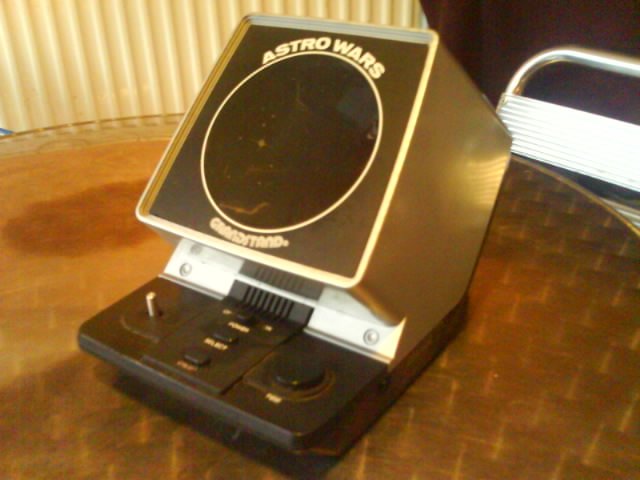
There are certain pieces of 1980s technology that only need to appear in a photograph to trigger an entire chain of memories. The ZX Spectrum. A Sony Walkman. A BigTrak. And, sitting somewhere between a toy spaceship and a miniature arcade cabinet, Grandstand Astro Wars.
If you had one, you probably remember the shape before you remember anything else. That chunky black plastic body. The sloping controls. The little hooded screen at the back, glowing mysteriously from inside. It looked wonderfully serious, like a piece of equipment that had somehow escaped from the bridge of a low-budget science fiction film.
Then you switched it on.
Beep. Beep. Bleep. Flash.
Suddenly the dining table was no longer the dining table. Earth was under attack, alien fighters were descending towards you, and civilisation apparently depended upon a child with one small joystick and a fire button.
Released in 1981, Grandstand Astro Wars became one of the most memorable tabletop electronic games of its era. It was produced under licence from Japanese manufacturer Epoch, whose versions of the hardware appeared under names including Super Galaxian and Galaxy II. The British Grandstand version is the one many UK players remember.
More than four decades later, its glowing display and frantic electronic noises remain instantly recognisable.
When an Arcade Machine in Your Bedroom Seemed Like the Future
To understand why Grandstand Astro Wars made such an impression, you have to forget almost everything that surrounds gaming today.
There was no Nintendo Switch lying on the sofa. No Xbox connected to a huge television. No phone containing thousands of downloadable games. For most children, playing the latest arcade games meant physically going somewhere that had arcade machines.
That might have meant an amusement arcade on holiday, a leisure centre, a café, a bowling alley or the corner of some wonderfully questionable establishment where adults smoked beside fruit machines.
Arcade cabinets felt like serious technology. They were huge, colourful and noisy, with glowing screens and controls designed to withstand enthusiastic abuse.
Having anything even vaguely resembling that experience at home was exciting.
Tabletop electronic games filled that gap beautifully.
They did not attempt to be general-purpose games consoles. You bought the machine and that was the game. No cartridges. No downloads. No updates. No thirty-minute installation followed by a 14GB patch.
Astro Wars played Astro Wars.
That was the deal.
And nobody felt cheated by it.
Grandstand Astro Wars Looked Brilliantly Important
Part of Astro Wars' appeal was simply the machine itself.
Unlike the flatter handheld electronic games that would become increasingly common during the decade, Astro Wars had the appearance of a miniature arcade cabinet.
The controls sat at the front of a wedge-shaped body, while the display was positioned higher up beneath a dark surround. At approximately 21cm deep and 16cm wide, it was compact enough to move around the house but substantial enough to feel like a proper machine rather than a little pocket toy.
Put one on a desk in a child's bedroom in 1981 and it looked like technology.
Proper technology.
Its dark casing helped too. There was nothing particularly cuddly about Astro Wars. It did not look as though it wanted to teach you spelling or arithmetic. It looked as though somewhere inside there might be a small nuclear reactor.
Even the name was magnificent.
ASTRO WARS.
Not "Space Game".
Not "Alien Blaster".
Astro Wars sounded enormous. Galaxies were probably involved. Perhaps several.
There were actually two familiar Grandstand casing variants, with earlier machines displaying the Astro Wars name in red lettering and later versions using white.
Either version has enormous nostalgic pulling power today.
That Glowing Vacuum Fluorescent Display
The real magic happened when you turned the machine on.
Astro Wars used a vacuum fluorescent display, usually shortened to VFD. It is the same broad display technology many people will remember from old stereos, video recorders and electronic equipment with brilliantly bright glowing numbers.
In Astro Wars, it created a colourful illuminated battlefield filled with spaceships, missiles and scoring information.
Compared with modern graphics, of course, the images were extremely simple.
That hardly mattered.
In a dim bedroom, the display looked fantastic.
This is something photographs never quite capture. VFD games had a particular luminous quality. The graphics seemed to float inside the machine rather than simply appear on the surface of a screen.
You could see little glowing formations of enemy craft suspended against the darkness. Your own ship sat waiting below them. Missiles flashed between positions.
There was depth and theatre to it.
Your imagination supplied the rest.
Modern games can render entire planets, realistic faces, weather systems and spaceships containing individually modelled screws. Astro Wars needed a handful of glowing shapes and some aggressive beeping.
Somehow, your brain happily turned that into an interplanetary war.
How Grandstand Astro Wars Actually Played
Astro Wars was essentially a fixed-screen space shoot 'em up.
You controlled your Earth ship at the bottom of the display, moving left and right while firing at enemy spacecraft above. Alien fighters attacked from their formation while missiles travelled towards you.
Simple enough.
Except the game kept changing the situation.
Astro Wars featured several phases of play, including attacks involving alien fighters, warships and command ships, followed by a docking sequence that could earn bonus points. The game then cycled through its stages again as you attempted to build a larger score.
The controls were beautifully simple
There was no tutorial required.
You moved left.
You moved right.
You fired.
That was more or less everything you needed to know.
The little digital joystick controlled horizontal movement while the fire button dealt with the important business of defending Earth.
There were four selectable difficulty levels. At the lower settings, enemy fighters attacked one at a time. Higher settings increased the speed or allowed two fighters to attack simultaneously.
You could therefore make Astro Wars considerably more unpleasant for yourself once you became confident.
Which, naturally, you did.
Nobody in the 1980s spent weeks carefully progressing through beginner modes.
You played the easier setting until you became reasonably competent, then immediately selected something harder and discovered that you were not remotely as good as you thought.
Then came the docking sequence
For many former Astro Wars owners, this is one of the bits that really unlocks the memories.
After surviving the shooting stages, you could reach a docking manoeuvre in which timing became the challenge. Successfully completing it earned additional points.
It changed the rhythm completely.
One moment you were hammering the fire button at descending aliens. The next you were concentrating intensely on lining things up properly.
For a game with such limited hardware, there was a surprising sense of progression.
It was not simply the same row of enemies repeating endlessly.
There was always another bit to reach.
The Soundtrack Was Mostly Beeping, Obviously
We should discuss the sound.
Astro Wars did not have orchestral music.
Hans Zimmer was not involved.
Instead, it communicated through the electronic vocabulary available to early 1980s games: bleeps, buzzes, firing noises and alarms.
And it was glorious.
Electronic games of this period had a wonderful inability to be subtle. The objective was not to create realistic sound. The objective was to make absolutely sure everybody elsewhere in the house knew somebody was playing an electronic game.
The noises became part of the experience.
You recognised when something had gone wrong before consciously looking at the display. Certain sounds meant danger. Others meant success.
The machine even rewarded players who reached its maximum score of 9,999 points with a special electronic victory tune.
Getting there was another matter entirely.
Batteries: The Hidden Cost of Childhood Entertainment
Like many portable electronic marvels of the period, Astro Wars required batteries.
Four C cells, specifically, although the machine could also run from a 6V mains adaptor.
C batteries were not the sort of thing children casually produced from a drawer.
You generally had to request them from an adult.
This introduced an unofficial extra stage to Astro Wars:
Phase Five: Persuade Dad That The Batteries Really Are Flat.
Anyone who grew up with battery-hungry toys will recognise the domestic negotiations involved.
"They can't have run out already."
"They have."
"I only put those in last week."
"That was ages ago."
It was never ages ago.
There was also the universal childhood experiment of removing batteries, rearranging them, rubbing the ends on your jumper and putting them back in, as though you possessed knowledge of electrical engineering that had somehow escaped Panasonic.
Occasionally you got another three minutes of life and considered this proof that the technique worked.
Grandstand Was Everywhere in Early 1980s Electronic Gaming
Astro Wars was not an isolated Grandstand product.
The Grandstand name appeared on a whole range of electronic games familiar to British children during the early 1980s, often through licensing arrangements with overseas manufacturers.
Machines such as Munchman, Scramble, Caveman and Firefox F-7 joined Astro Wars in bringing miniature electronic arcade-style experiences into British homes.
Grandstand became one of those names that seemed synonymous with electronic entertainment.
The interesting part is that many children had little idea where these games really came from.
Nobody was discussing Japanese licensing agreements in the playground.
You knew what Grandstand was.
You knew your mate had Astro Wars.
You knew somebody else's cousin supposedly had Scramble.
That was enough.
The Playground Status of Having One
Owning a desirable electronic game in the early 1980s gave you a temporary but significant advantage in the complicated economy of childhood.
If someone brought something new round, everybody wanted a go.
"Just one life."
That was the official agreement.
It was almost never honoured.
There was always someone who somehow remained alive for fifteen minutes while everybody else waited impatiently.
Then came the delicate question of whether you were allowed to take the machine home.
Borrowing expensive electronic toys between houses involved levels of diplomacy normally associated with international treaties.
Your parents might allow it.
Their parents might not.
Battery ownership had to be established.
Protective cases rarely existed, so the machine would probably travel wrapped in a jumper inside a plastic carrier bag.
If you owned Astro Wars yourself, however, there was another pleasure: becoming genuinely good at it.
Because there was only one game inside the machine, you learned it completely.
You recognised patterns.
Your reactions improved.
You knew when to move.
Scores mattered because everybody was playing exactly the same thing.
There were no achievements or online leaderboards. You simply remembered the number.
And naturally, if a sibling beat it while nobody else was watching, the score was regarded with deep suspicion.
Why Such Simple Games Were So Addictive
On paper, there is not much to Astro Wars.
Move.
Fire.
Dodge.
Repeat.
Yet simplicity was one of its strengths.
There was virtually no barrier between switching the machine on and playing.
Within seconds, something was happening.
The games were short enough that losing immediately encouraged another attempt rather than making you switch off.
One more go.
Then another.
Then one absolutely final attempt.
This is supposedly the last go because dinner is ready.
You then hear your name being shouted from downstairs.
That immediacy still works today.
Modern gaming has achieved extraordinary things, but it has also accumulated menus, accounts, downloads, settings, subscriptions, online services and endless digital housekeeping.
Astro Wars asks remarkably little of you.
Put batteries in.
Turn it on.
Save Earth.
The Packaging Was Part of the Experience
The box mattered in the 1980s.
Before you had YouTube videos, gameplay trailers or hundreds of online reviews, packaging had to do an enormous amount of work.
Electronic toys were presented as extraordinary futuristic machines.
Artwork showed blazing space battles. Typography looked suitably technological. Words such as "electronic", "computer" and "arcade" carried genuine excitement.
The Astro Wars packaging promised arcade-style space combat involving attacking fighters, warships and command ships, along with the challenge of docking your spacecraft.
To a child staring at the box in a catalogue or shop, this sounded spectacular.
You were not analysing the distinction between glowing fixed display elements and true arcade graphics.
You saw spaceships.
You saw buttons.
You saw the word "electronic".
Christmas list updated.
Christmas Morning Technology
Astro Wars belongs particularly comfortably in memories of Christmas.
Large electronic games had tremendous present-opening theatre.
The box was substantial.
There were instructions.
There might be batteries to find.
Adults became involved in setting it up.
Then came that magnificent moment when it was switched on for the first time.
Christmas morning in the 1980s often had its own soundtrack. Electronic beeping from new toys mixed with television, wrapping paper being ripped apart, somebody trying to assemble something incorrectly and an adult asking where the tiny screwdriver had gone.
Astro Wars fitted perfectly into that world.
And unlike toys that were interesting mainly because they were new, it had genuine staying power.
There was always another score to beat.
Astro Wars Versus Modern Gaming
Trying to compare Astro Wars directly with a modern game is slightly ridiculous.
Technically, there is no contest.
A cheap modern smartphone possesses computational abilities that would have seemed supernatural in 1981.
Yet that is exactly why machines such as Grandstand Astro Wars remain fascinating.
They show how little technology is actually required to create a compelling game.
Astro Wars did not need a giant world.
It did not need dialogue.
It did not need cinematic sequences.
It needed understandable rules, responsive controls, escalating difficulty and a scoring system.
The limitations actually sharpened the experience.
You knew exactly what you were trying to do.
And when you failed, there was nobody else to blame.
No network lag.
No dodgy matchmaking.
No controller firmware.
That alien hit you because you moved the wrong way.
Deal with it.
Why Grandstand Astro Wars Is Collectible Today
Astro Wars has become highly desirable among collectors of vintage electronic games, particularly in the UK.
Part of the attraction is obvious. It is a superb display piece.
Even switched off, it has that unmistakable early electronic-game aesthetic. Put it beside a ZX Spectrum, early Walkman or other 1980s technology and it immediately looks at home.
A working example is better still because the VFD display is such an important part of the experience.
These displays use a sealed vacuum tube, and physical damage to that component can permanently stop it working. Old machines can also suffer from battery leakage and dirty control contacts after decades in cupboards, lofts and garages.
Completeness also matters to collectors.
Original boxes, instruction manuals and intact battery covers tend to make surviving examples more appealing.
But there is something particularly satisfying about finding a slightly worn one.
A few marks on the joystick.
Tiny scratches on the plastic.
Evidence that someone actually spent hours defending Earth with it.
These were toys, after all. They were meant to be played.
The Strange Power of Seeing One Again
Perhaps the most interesting thing about Astro Wars today is what happens when somebody encounters one after decades.
Recognition can be instant.
You might have forgotten the name.
You might not have thought about the machine since about 1986.
Then you see that black case and glowing display and suddenly an entire room comes back.
The carpet.
The television.
The furniture.
The sound.
The person you used to play against.
That is what makes retro technology so interesting.
The specifications are only part of the story.
A VFD display is technically fascinating, but that is not usually why someone smiles when they see Astro Wars.
They are remembering where they were when that display mattered to them.
A Perfect Example of Early 1980s Technology
Grandstand Astro Wars arrived during a fascinating moment.
Home computers were beginning to transform what electronic entertainment could be. Arcade gaming was exploding. Dedicated electronic games were becoming increasingly sophisticated.
For a brief period, tabletop machines occupied a wonderful middle ground.
They were more substantial than pocket games, far cheaper and smaller than real arcade machines, and much simpler than computers.
Astro Wars captures that era perfectly.
Its designers worked within severe technological limits and produced something distinctive, tactile and immediately entertaining.
No software updates have improved it.
There has never been an Astro Wars season pass.
The graphics remain exactly as crude and brilliant as they were in 1981.
And that is precisely how they should remain.
Grandstand Astro Wars Still Has Something Modern Games Cannot Recreate
There is no sensible argument that Astro Wars is technologically superior to modern gaming.
Of course it isn't.
But technology and affection are different things.
Grandstand Astro Wars represents an era when electronic entertainment still felt slightly mysterious. A glowing screen inside a plastic box could feel genuinely futuristic. Electronic noises were exciting simply because a toy was making them.
Most importantly, the gaps in the technology left space for imagination.
Those glowing shapes really were attacking spacecraft because you decided they were.
The little plastic machine really was your command console.
And for ten minutes after school, Earth genuinely did need saving.
That is why Grandstand Astro Wars remains such a powerful piece of British retro gaming nostalgia. It was simple, noisy, beautifully limited and enormously good fun.
If seeing Astro Wars again has just unlocked a cupboard full of memories you had completely forgotten about, join RetroWins or sign up to stay in the loop. There are plenty more classic gadgets, computers, toys and pieces of retro technology still waiting to be switched back on.






