
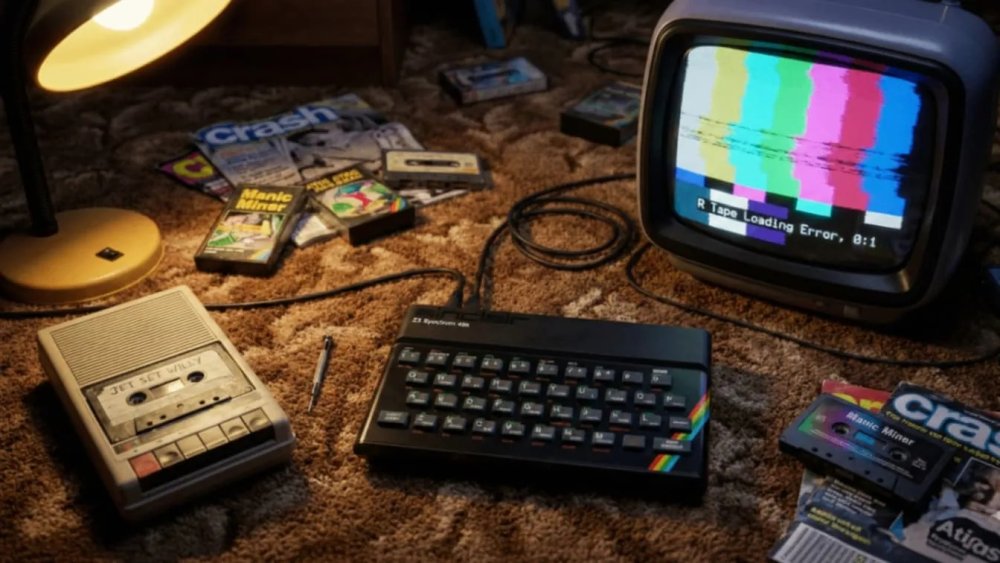
There are certain sounds that can transport you back decades before your brain has quite worked out what is happening.
The click of a cassette deck button. The clunk as it locks into place. A few seconds of silence. Then that noise.
Screeeeeeeeeee... chk-chk-chk-chk... eeeeeeeeeee... BRRRRRRRRRR...
To anyone walking into the room today, it would sound as though the computer had suffered some sort of catastrophic electronic breakdown. To a generation of British kids, it meant only one thing.
A game was loading.
Loading a computer game from cassette was slow, temperamental and spectacularly inefficient by modern standards. It could take several minutes. Sometimes it would fail. Sometimes you would spend ages staring at the screen only to discover that the tape volume was wrong, the cassette head needed adjusting or the universe had simply decided you weren't playing Jet Set Willy that afternoon.
And somehow, despite all of that, it was brilliant.
Perhaps not brilliant in the conventional engineering sense. Nobody today would seriously suggest replacing an SSD with a C90 cassette and a portable tape recorder. But as an experience, loading games from cassette had something that modern gaming has largely lost.
Anticipation.
When Computer Games Came on Tape
For many British homes in the 1980s, the cassette wasn't just something you used for recording the Top 40 from Radio 1.
It was also software storage.
Home computers including the ZX Spectrum, Commodore 64, Amstrad CPC and BBC Micro could load programs from ordinary compact cassettes. Instead of music, the tape contained computer data encoded as audio signals.
That is why, if you ever made the mistake of playing a game cassette through a normal stereo, you got that unforgettable barrage of electronic screeching.
To the computer, those sounds represented information.
To your parents, they represented a compelling reason to shut your bedroom door.
Cassette storage made enormous sense at the time. Tape recorders were already common, cassettes were cheap, and software publishers could produce games on a physical format that ordinary families understood.
Walk into WHSmith, Boots, John Menzies or a local computer shop during the 1980s and you could find racks of cassette games in plastic cases. Some full-price releases came in smart packaging with glossy artwork and chunky instruction manuals. Budget games might hang from displays costing £1.99, £2.99 or similar pocket-money prices.
Software suddenly felt wonderfully attainable.
You could walk into town with a few quid and return home carrying an entirely new world in a small plastic box.
Admittedly, you then had to persuade the computer to load it.
The Ritual of Loading a Computer Game From Cassette
Modern games often begin with a process that is technically far more complicated yet somehow much less interesting.
Click an icon. Wait for a launcher. Download an update. Accept something. Sign into an account. Download another update. Wonder why a game occupying 97GB needs a further 14GB before you can look at its title screen.
Cassette loading was primitive, but it was wonderfully physical.
You took the cassette out of its case.
You placed it into the recorder.
You rewound it.
You typed whatever command your computer required.
Then you pressed PLAY.
On a ZX Spectrum, generations of owners became intimately familiar with:
LOAD ""
There was something pleasingly mysterious about those empty quotation marks. You might have been eight years old and had absolutely no idea what computer programming actually involved, but typing LOAD "" made you feel faintly like somebody at NASA.
Then came the moment of commitment.
Press PLAY on tape.
Hit ENTER.
And hope.
The ZX Spectrum Loading Screen Experience
Spectrum owners got one of the most memorable loading sequences of the era.
First came the coloured borders.
The distinctive red and cyan stripes appeared around the edge of the screen as the computer detected the incoming data. The noises changed pitch and rhythm as different sections of the program loaded.
You didn't need to understand any of it.
You simply learned what normal looked and sounded like.
If the border was doing the right thing and the tape was producing its usual electronic shriek, everything was fine.
Probably.
Then, if the game had one, the loading screen slowly began appearing.
This was where cassette loading became something approaching theatre.
Instead of instantly displaying a polished splash screen, the image could reveal itself progressively as the data came in. You watched artwork emerge line by line, wondering how closely the actual game would resemble the spectacular scene depicted on the screen.
Usually, the answer was "not very closely".
The loading artwork might show a muscular space warrior battling an enormous alien beneath a sky full of explosions.
Ten minutes later you were controlling a yellow square.
Nobody complained.
Much.
Waiting Made the Game Feel More Important
This is perhaps the strangest thing about loading computer games from cassette.
The waiting helped.
Not always, obviously. If you had been waiting eight minutes and the computer suddenly announced a loading error, the waiting absolutely did not help.
But when everything worked, those minutes between choosing a game and actually playing it created anticipation.
You couldn't casually bounce between ten different titles.
Choosing a game involved a small commitment.
You picked the cassette. You loaded it. You waited. You watched the screen. You listened.
By the time the title screen finally appeared, you were ready to play it.
That made games feel like events.
Compare that with a modern collection containing hundreds of instantly accessible titles. There is a peculiar paralysis that comes from having everything available immediately. You scroll through menus, open something, play for ninety seconds, close it, browse another list and somehow end up watching YouTube instead.
In the cassette era, you had already invested seven minutes in this game.
You were playing it whether you liked it or not.
We All Became Amateur Cassette Engineers
The real veterans of cassette gaming didn't merely know how to load games.
We knew how to troubleshoot them.
Without realising it, entire generations of children became specialists in analogue data recovery.
Game won't load?
Check the volume.
Try turning the volume up.
Now turn it down.
Try 7.
No, 6.
Maybe 6.5.
Rewind the tape and try again.
Clean the tape heads.
Try the other cassette recorder.
Stand completely still.
Do not breathe near the computer.
And, for certain machines and tape decks, there was the mysterious business of azimuth adjustment.
This meant adjusting the alignment of the cassette player's tape head, often using a tiny screwdriver. People who had never successfully assembled an Airfix kit suddenly found themselves performing precision adjustments to magnetic audio equipment because Football Manager refused to load.
There was usually a magical position where everything worked.
Move the screw half a millimetre either side of it and civilization collapsed.
Naturally, once you had finally found the perfect setting, somebody would use the recorder to play a music cassette and ruin it.
The Tape Counter Was Surprisingly Important
Anyone who owned compilations or cassettes containing several games may also remember another essential piece of technology.
The tape counter.
Three little mechanical digits that seemed incredibly sophisticated at the time.
If a cassette contained multiple programs, you might be instructed to rewind the tape and then fast-forward to a particular counter position before loading the next game.
This required trust.
The instruction sheet might tell you that Game B began around 147.
So you sat there watching:
STOP.
There was no file browser. No graphical menu. No search function.
You navigated software by physically moving magnetic tape past a playback head and watching a plastic counter rotate.
And we thought computers were the future.
To be fair, they were.
They were just taking a slightly scenic route.
Loading Errors Were Part of the Experience
Then came the phrase nobody wanted to see.
R Tape loading error
For Spectrum owners in particular, few combinations of letters could produce such immediate despair.
The real cruelty was that the error often appeared after you had already waited several minutes.
A game failing instantly would have been almost considerate.
Instead, cassette software liked to build your confidence first.
Everything looked fine.
The border flashed.
The loading screen appeared.
The tape continued turning.
You began thinking about the game.
Perhaps you even wandered downstairs for a drink.
Then you returned to find the computer sitting there smugly displaying an error message.
Back to the beginning.
Rewind.
Adjust volume.
Press PLAY.
Try again.
There is an argument that this was dreadful user experience.
There is also an argument that repeatedly trying to load a £2.99 computer game taught British children more about persistence than an entire shelf of motivational books ever could.
The Strange Beauty of Loading Screens
Loading screens deserve far more affection than they usually receive.
On limited 8-bit machines, artists could create surprisingly striking images using relatively modest resolutions and restricted colour palettes.
These images often served several purposes.
They reassured you that something was happening.
They helped build atmosphere before the game started.
And most importantly, they gave you something to stare at while several minutes of furious electronic noise filled the room.
Some became almost as memorable as the games themselves.
There was also a wonderful mismatch between illustrated artwork and actual gameplay throughout the 1980s.
Cassette covers and loading screens had no obligation whatsoever to represent what the computer could realistically display.
Box art might promise chrome spaceships, terrifying monsters, cinematic explosions and impossibly detailed fantasy landscapes.
Then the game loaded and a small character made of twelve pixels walked into a wall.
It didn't matter.
Your imagination filled in the missing detail.
Perhaps that is one reason those games remain so vivid in people's memories. The computer provided the framework. Your brain did a surprising amount of the graphics processing.
The Noise Was Horrible, Yet We Miss It
It is difficult to explain cassette data noise to somebody who never experienced it.
Calling it "a screech" doesn't really capture it.
There were different layers to the sound.
Steady tones.
Rapid pulses.
Bursts of static-like noise.
Changes in pitch that instinctively told experienced users that another part of the program was being read.
You could sometimes tell when something didn't sound right.
You had effectively learned to recognise the sound of software.
There aren't many modern equivalents.
Nobody listens to the activity inside an NVMe drive and thinks, "Ah yes, that's definitely the level data loading."
The cassette made invisible digital activity audible.
The computer was doing something, and you could hear it happening.
It sounded appalling.
We loved it.
Bedrooms Became Computer Rooms
Loading games from cassette also belongs to a particular picture of British childhood.
A small portable television on a desk or chest of drawers.
A ZX Spectrum, Commodore 64 or Amstrad CPC squeezed in front of it.
A cassette recorder alongside.
Wires everywhere.
A box or drawer full of tapes.
Game cases stacked untidily nearby.
Perhaps a joystick with suction cups that had stopped sticking properly about six months earlier.
This wasn't a sleek entertainment system.
It was a little electronic workshop.
Using a home computer required interaction with the machinery itself.
You connected things. You typed commands. You loaded programs. You adjusted tape decks. You occasionally stared helplessly at incomprehensible error messages.
You were always slightly aware that a computer was a machine.
Modern devices work hard to hide their machinery from us. Interfaces are smooth. Storage is invisible. Software installs itself. Files live somewhere mysterious called "the cloud".
An 8-bit computer made almost no attempt to hide anything.
Here is the computer.
Here is the cassette.
Here is the cable joining them.
Here is the command you type.
Now listen to six minutes of screaming electricity.
Multi-Load Games Tested Friendships
As games became more ambitious, some required additional sections to be loaded from tape during play.
This was known as multi-load, and it represented both technological ingenuity and psychological warfare.
You might complete a level only to be told to load the next section.
Out came the cassette again.
Press PLAY.
Wait.
Depending on the game, you might need to load different levels or areas individually because the entire program couldn't fit into the computer's available memory at once.
It allowed developers to create experiences bigger than the machine could otherwise accommodate.
Technically clever.
Emotionally devastating when you just wanted to continue playing.
Still, there was a peculiar satisfaction in reaching a new section and hearing the tape start again. It made progress feel tangible.
You hadn't simply reached Level 2.
You had earned access to another physical section of the cassette.
Rewinding Was a Skill
Another sentence that would confuse anyone born into streaming media:
"Don't forget to rewind the game."
Failing to rewind a cassette created an entirely unnecessary problem for your future self.
You would come back the next day, type the loading command, press PLAY and get nothing useful because the tape was still sitting somewhere near the end.
So you pressed STOP.
Then REWIND.
And waited.
Some tape decks were impressively quick. Others sounded as though they were dragging the cassette backwards using elastic bands.
There was also the eternal temptation to judge when it had reached the beginning by listening to the motor.
Experienced users knew the change in sound.
Then came the satisfying CLUNK as the mechanism stopped.
Ready.
The Pencil Trick Had Its Place Too
The humble pencil was an essential cassette accessory.
If tape had become loose inside the shell, you inserted a pencil into one of the cassette reels and wound it back manually.
Not every pencil worked equally well.
The classic hexagonal wooden pencil was ideal because its edges could catch the teeth inside the spool.
A round pen was useless.
This was practical knowledge.
Children knew this.
Adults knew this.
Entire households understood that pencils had two jobs:
Writing.
Repairing the music and software industry.
A particularly unfortunate cassette could also produce the horror known to anyone who used tapes regularly: magnetic tape spilling out of the shell.
At that point, loading the game became the least of your concerns.
Cheap Games Made Experimentation Possible
The cassette wasn't merely nostalgic packaging. Its low production cost helped create a huge market for affordable software in Britain.
Budget labels became enormously popular during the 1980s, selling games at prices that children could realistically save for or buy with pocket money.
That mattered.
You didn't always need Christmas or a birthday to get a new computer game.
Sometimes you could simply buy one.
And because the financial risk was relatively small, people tried strange things.
A game didn't necessarily need a gigantic advertising campaign or a famous franchise behind it. A colourful cassette cover and an interesting description could be enough to earn your money.
Sometimes you discovered a gem.
Sometimes you discovered something so baffling that you still couldn't explain what you were supposed to do forty years later.
Both experiences were part of the fun.
Cassette Games Felt Like Objects
Physical games still exist, of course, but software itself increasingly feels detached from physical ownership.
Cassette games were unmistakably objects.
They had weight, albeit not much.
They had artwork.
They had labels.
They had cases that cracked.
They had instruction sheets that became permanently folded in the wrong places.
They could be lent to friends.
They could disappear into somebody else's bedroom for six months.
You could line them up on shelves and browse them visually.
Even the cassette itself developed a personality.
Some tapes were reliable.
Others were cursed.
You knew which ones needed the volume turned slightly higher. You knew which game always loaded first time and which required negotiation with supernatural forces.
Owning software meant owning a physical thing with quirks.
That relationship is difficult to reproduce with a download sitting silently in a digital library.
Why Loading Games From Cassette Seems Better in Memory
Nobody needs to pretend cassette loading was actually superior technology.
It wasn't.
Modern storage is faster, more reliable and vastly more convenient.
If somebody announced tomorrow that every PlayStation game would now take nine minutes to load from magnetic tape, there would not be widespread celebration.
Nostalgia can polish rough edges.
We remember the excitement more strongly than the frustration.
We remember the loading screen appearing, not necessarily the three failed attempts that preceded it.
But that doesn't mean the affection is imaginary.
Loading computer games from cassette genuinely changed the rhythm of playing them.
There was a beginning to the experience.
Choose the game.
Open the case.
Put the tape in.
Rewind.
Type the command.
Press PLAY.
Listen.
Watch.
Wait.
Play.
Those steps created a boundary between deciding to play something and actually playing it.
The delay increased anticipation because there was nothing else to do except focus on what was coming.
Modern technology has worked extremely hard to remove waiting from our lives.
Mostly, that is excellent.
But anticipation turned out to be quite enjoyable.
Modern Retro Gaming Removes the Inconvenience
Ironically, it has never been easier to play old cassette games without using a cassette.
Emulators and modern hardware solutions can load classic 8-bit software almost instantly. Flash storage, SD card interfaces and recreated systems can hold enormous libraries that would once have required shelves full of tapes.
From a practical perspective, this is wonderful.
You can explore hundreds of games without adjusting tape heads, rewinding anything or spending half your evening looking for Side B.
Yet instant loading subtly changes the experience.
Something that once felt like opening a little portal into another world becomes another item in a menu containing thousands of choices.
Convenience wins.
Ceremony loses.
That is probably why some enthusiasts still enjoy using original hardware and real cassette tapes.
They aren't doing it because it is efficient.
They are doing it because inefficiency is part of the memory.
Original Cassette Games Have Become Collectable
Old computer games have also become increasingly interesting as physical artefacts.
Collectors look for original releases, unusual editions, complete packaging and games connected with particular machines, developers or publishers.
The packaging itself is often half the attraction.
Those beautifully optimistic illustrations.
The screenshots.
The logos.
The breathless descriptions promising unprecedented arcade excitement.
The instruction manuals explaining controls that you immediately forgot.
A complete cassette game can capture the design language of its era in a way that a downloaded ROM never quite can.
It belongs next to the machine.
Put an original Spectrum beside a row of colourful cassette cases and the whole thing suddenly looks right.
The objects complete each other.
We Didn't Know We Were Experiencing a Transitional Technology
Perhaps the most fascinating thing about cassette software is that it existed at a strange point in technological history.
The compact cassette was fundamentally an analogue audio format developed years before the home computer boom.
Yet British microcomputers turned it into digital storage for software.
It was familiar technology being pushed into an entirely different job.
Later came floppy disks, cartridges, optical discs, hard drives, solid-state storage and downloads.
Each step made accessing software quicker and easier.
Cassette loading belonged to a period when digital technology was becoming part of everyday family life, but still relied on decidedly mechanical processes.
You could literally watch your software moving from one reel to another.
There was something wonderfully understandable about that.
Why Loading a Computer Game From Cassette Was Somehow Brilliant
So why do people remember it with such affection?
Because the inconvenience was mixed with excitement.
Because that terrible noise meant something good was about to happen.
Because loading screens became part of the game rather than an obstacle before it.
Because we learned the peculiar habits of our computers and cassette recorders.
Because getting a game working occasionally felt like an achievement in itself.
Most importantly, because loading a computer game from cassette forced us to wait.
And while few people genuinely want loading times back, there was something rather lovely about sitting in front of a television, watching coloured borders flash around the screen and knowing that somewhere inside that furious electronic screeching, a new adventure was slowly making its way into 48K of memory.
When the noise finally stopped and the game appeared, it felt as though something had happened.
Not much, technologically speaking.
A computer had loaded some data.
But to the kid sitting cross-legged in front of the television, it felt much bigger than that.
That cassette had just transformed the machine in the bedroom into a racing circuit, a football pitch, a spaceship, a dungeon or an entirely new world.
All you had to do was wait for it.
And occasionally rewind and try again.
If memories like LOAD "", flashing borders and cassette decks full of mysterious electronic noise still make you smile, join RetroWins or sign up to stay in the loop for more stories celebrating the gadgets, computers and technology we still haven't quite managed to forget.






