
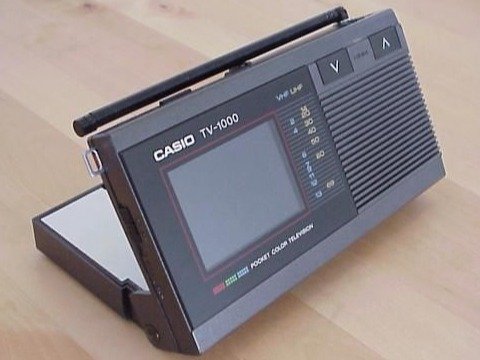
There was something wonderfully futuristic about pocket TVs in the 1980s.
Television was supposed to live in the corner of the sitting room. It was big, heavy, usually wood-effect, and connected to an aerial that appeared to have been installed during a thunderstorm. You watched whatever happened to be on, when the broadcasters decided it was on, and if somebody wanted to change channel they often had to physically get out of the chair.
Then along came a tiny television you could hold in your hand.
Suddenly, the idea was that you could watch TV in the garden, in the car, at the football, on holiday, in your bedroom or, theoretically at least, almost anywhere else you fancied.
It sounded magnificent.
The reality involved a very small screen, an aerial that needed constant negotiation, batteries disappearing at an alarming rate and a picture that could dissolve into static because somebody three streets away had opened a garage door.
None of this made pocket TVs less exciting.
If anything, it made them more memorable.
When Television Finally Escaped the Living Room
Portable televisions existed long before the 1980s, but there was a considerable difference between a portable television and something you could reasonably describe as a pocket TV.
A portable television might still resemble a small piece of furniture.
You could carry it, certainly, but usually with both hands and a facial expression suggesting you had immediately regretted the decision.
Pocket TVs promised something different.
These were miniature television receivers designed to be carried around. Some were genuinely small enough to fit into a large coat pocket. Others stretched the definition of "pocket" in the same way that certain 1980s portable stereos stretched the definition of "portable".
The important thing was the idea.
Television no longer had to be attached to a particular room.
For a generation already being introduced to Walkmans, handheld electronic games, calculators, portable radios and increasingly compact gadgets, this felt like another piece of the future arriving early.
The 1980s loved miniaturisation.
If somebody could take an object that normally occupied half a cabinet and shrink it until it ran on batteries, somebody would buy it.
Preferably in silver.
Pocket TVs Were Proper Science Fiction Gadgets
It is difficult to explain now just how futuristic a television in your hand seemed.
Today, somebody can watch a live football match on a phone while standing in a supermarket queue and barely consider the technology involved.
In the 1980s, television was still strongly associated with a physical set and a fixed aerial connection.
A pocket TV therefore felt slightly impossible.
The concept appeared to belong alongside video phones, robot servants and cars with talking dashboards.
You extended a telescopic aerial, turned a tuning wheel and somehow BBC One appeared on a screen not much bigger than a playing card.
That was enough.
Never mind that the image occasionally looked as though BBC One was being transmitted from another planet.
It was television.
In your hand.
The Tiny Screen Was Part of the Appeal
Modern television manufacturers compete to sell increasingly enormous screens.
Pocket TVs went enthusiastically in the opposite direction.
Many models used miniature cathode ray tube displays, essentially shrinking traditional television technology into a much smaller package. Later portable televisions increasingly used LCD technology, which allowed manufacturers to make devices thinner and more practical.
But those early tiny CRT screens had tremendous character.
The picture could be surprisingly sharp when reception was good, although "when reception was good" was doing a fair amount of work in that sentence.
Watching anything visually complicated could become an exercise in interpretation.
Footballers became moving clusters of pixels and light.
Newsreaders were recognisable mostly because they stayed in roughly the same place.
Film credits could become theoretical.
Yet the smallness itself was fascinating.
You found yourself staring into this miniature television world simply because it existed.
It was the same pleasure people later got from miniature camcorders, tiny mobile phones and portable CD players. There was something satisfying about seeing familiar technology squeezed into an improbably small object.
The 1980s Pocket TV Ritual
Owning one was only half the experience.
Actually getting it to display something was the ritual.
First came the aerial.
Usually telescopic, often surprisingly long, and apparently capable of detecting the precise moment you stopped paying attention so it could poke you in the face.
You extended it fully.
Then turned it.
Then tilted it.
Then moved the television six inches to the left.
The picture improved.
You let go.
The picture disappeared.
So you moved your hand back.
Perfect.
You were now part of the aerial system.
This was completely normal.
Tuning Was an Art Form
There was no neat electronic programme guide displaying rows of channels.
Many pocket TVs relied on manual tuning controls.
You slowly adjusted a small wheel or slider until something emerged from the snow.
A voice.
A shape.
A horizontal band of vaguely human activity.
Keep turning.
Too far.
Go back.
There.
Don't touch anything.
Finding a channel felt less like selecting television and more like intercepting a transmission from a secret government facility.
And because terrestrial television in Britain offered only a handful of channels for most of the decade, finding one felt surprisingly rewarding.
You were not browsing endless content.
You were hunting BBC One.
Britain Only Had Four Channels, Which Helped
For much of the 1980s, British viewers had BBC One, BBC Two and ITV, with Channel 4 joining the line-up in November 1982.
That was it.
Four channels.
Which was quite convenient if your television required you to manually tune through the broadcast spectrum.
There were no streaming services, no catch-up platforms and no library containing ten thousand programmes you might theoretically watch but somehow never do.
Television was an appointment.
If something started at 7.30, you watched it at 7.30.
Missed it?
Bad luck.
Perhaps somebody recorded it on VHS, assuming they understood the timer.
That made the ability to carry a television around genuinely useful.
A pocket TV could mean not missing something simply because you were away from the main set.
At least, that was the theory.
The Casio Pocket TV Became an 80s Icon
Few companies embraced the 1980s portable gadget boom quite like Casio.
Casio already seemed capable of putting electronics into virtually anything. Watches, calculators, keyboards and electronic games all carried the name, so miniature televisions fitted perfectly.
Casio released a range of portable televisions during the decade, and the brand became closely associated with the pocket TV idea.
Models such as the Casio TV-10, introduced in the early 1980s, helped establish the familiar formula: compact casing, small monochrome screen, tuning controls and telescopic aerial.
Later Casio models used colour LCD screens, pushing the idea even further.
Colour television you could carry around felt properly extravagant.
The Casio styling helped too.
Buttons.
Sliders.
Tiny printed labels.
Silver or dark plastic.
Extendable aerials.
Everything about them looked technological.
A pocket television sitting on a bedside table looked like equipment belonging to somebody who understood electronics, even if its owner was mainly using it to watch cartoons.
Sony Had Its Own Vision of Portable Television
Sony was another company obsessed with making technology smaller.
The Walkman had already transformed portable music, so miniature televisions fitted naturally into the same philosophy.
Sony produced compact portable televisions under the Watchman name, beginning in the early 1980s.
The Watchman range became perhaps the most recognisable rival to Casio's pocket televisions.
Some models looked wonderfully strange.
Rather than resembling a conventional television that had simply been shrunk, Sony experimented with upright designs where the screen occupied one section of a tall handheld case.
They looked like equipment from the future.
Or possibly something a detective in a 1980s American television programme would use to monitor a surveillance operation.
Either way, they were desirable.
The Watchman name itself was perfect. It sounded clever, portable and distinctly electronic.
Owning One Felt More Impressive Than Using One
This was true of an extraordinary amount of 1980s technology.
The dream was often better than the practical experience.
You imagined taking your pocket TV everywhere.
Long journeys would never be boring again.
You could sit outside and watch television.
You could follow important sporting events while away from home.
You could retreat to your bedroom and watch programmes without negotiating with the rest of the family.
Then you discovered several minor complications.
Reception.
Battery life.
Screen size.
Sound.
Comfort.
The requirement to sit in precisely the correct position without moving your wrist.
Still, none of that really mattered.
You owned a television small enough to carry.
That was the important bit.
Batteries: The Great 1980s Hidden Cost
Battery-powered technology was brilliant until you became responsible for supplying the batteries.
Anyone who grew up with electronic toys, personal stereos or handheld games will recognise the problem immediately.
Christmas morning:
"IT TAKES BATTERIES."
Excellent.
"DO WE HAVE BATTERIES?"
Silence.
Pocket televisions added themselves enthusiastically to the household battery economy.
Depending on the model, several AA batteries might be required, and running a television receiver continuously was not exactly gentle on them.
Rechargeable batteries existed, of course, but they were nowhere near as universally convenient as modern lithium-ion technology.
So portable entertainment often involved calculating whether the remaining batteries were sufficiently alive to survive the programme you wanted to watch.
You became surprisingly skilled at battery triage.
These two are definitely dead.
That one might have another half-hour in it.
Try swapping them around.
Now squeeze the battery cover.
There. Picture.
Technology.
Reception Could Turn Into Performance Art
Analogue television reception was never entirely predictable.
Even full-sized portable televisions with larger aerials could struggle in certain rooms.
Shrink the aerial and move the entire television around constantly and things became more entertaining.
A perfect image could become rolling interference simply because somebody moved.
Standing near a window might help.
Going upstairs might help.
Holding the TV above your head might help.
Touching the aerial often helped for reasons that seemed mysterious when you were ten.
Occasionally the picture would be excellent until you placed the television somewhere comfortable.
Clearly comfort interfered with radio frequencies.
People developed preferred locations.
The corner of the bedroom.
The kitchen windowsill.
A particular chair.
A slightly ridiculous position near the back door.
Once you found a strong signal, you remembered it.
Bedrooms Were Where Pocket TVs Really Made Sense
For younger owners, the great attraction was independence.
The family television was shared territory.
Parents controlled it.
Siblings fought over it.
The remote control, if there was one, represented political power.
A pocket TV offered escape.
You could have television in your bedroom without requiring a second full-size set.
This became increasingly common as smaller portable televisions became affordable, but pocket models added another layer of novelty because they could be hidden away easily.
Watching television in bed suddenly felt wonderfully decadent.
Especially if you were supposed to be asleep.
The volume would be turned barely above silence.
The screen glowed underneath the duvet or beside the bed.
Every footstep on the landing caused immediate panic.
Switch off.
Hide television.
Pretend to be unconscious.
Parents somehow remained suspicious.
They Were Made for Sport
One of the strongest practical arguments for portable television was sport.
The idea that you could keep watching an important match while away from the main television was genuinely appealing.
Manufacturers often promoted portable viewing around sporting events and outdoor use.
And for certain occasions, pocket televisions really did come into their own.
You might see somebody following cricket, tennis, racing or football on a tiny screen while somewhere else entirely.
The visual experience was hardly cinematic, but live sport does not always need to be.
Sometimes you just need to know what is happening.
Admittedly, on a tiny monochrome display, identifying exactly who was happening could be harder.
But hearing the commentary and seeing enough of the action still felt miraculous.
Portable Television Was Also a Holiday Gadget
British holidays in the 1980s involved a substantial amount of improvisation.
Caravans.
Camping.
Guest houses.
Holiday parks.
Long car journeys.
Weather that had confidently ignored the brochure.
Portable technology helped.
A radio, Walkman or pocket television could turn an otherwise uneventful evening into something much more tolerable.
There was also something particularly satisfying about watching familiar television somewhere unfamiliar.
A tiny screen showing the BBC from a caravan or tent somehow made the device feel even cleverer.
Of course, reception in remote areas could turn the whole thing into an experiment.
But again, that was part of the experience.
The Sound Wasn't Exactly Home Cinema
Tiny television meant tiny loudspeaker.
Nobody bought a pocket TV for its audio performance.
Speech was the priority, and the built-in speaker generally did the job.
Headphone sockets were particularly useful because they made private viewing possible and helped reinforce the personal nature of the device.
This was television becoming individual.
That was a significant change.
Traditional family television had been communal.
Everybody gathered around the same screen.
Portable televisions, like the Walkman with music, allowed media to become personal.
Your programme.
Your screen.
Your headphones.
Your little electronic bubble.
That idea would eventually become completely normal.
At the time, it still felt unusual.
Colour Pocket TVs Felt Like Another Leap Forward
Monochrome pocket television was impressive enough.
Colour made the concept seem even more futuristic.
LCD technology gradually made colour portable televisions increasingly practical during the 1980s and into the 1990s.
Early colour LCD screens were nowhere near modern display standards.
Viewing angles could be narrow.
Colours could look slightly strange.
Movement was not always handled elegantly.
But technical shortcomings mattered less when the basic achievement was so impressive.
It was a colour television small enough to hold.
Again, the object itself was part of the entertainment.
You showed people.
"Look at this."
And they did.
Because a tiny colour television was absolutely something worth looking at.
Pocket TVs Were Perfect 1980s Catalogue Material
These gadgets also belonged naturally in the world of mail-order catalogues.
Anyone who remembers spending far too long browsing Argos catalogues will understand the appeal.
Portable electronics pages were dangerous territory.
Personal stereos.
Clock radios.
Electronic organisers.
Calculators.
Binoculars.
Shortwave radios.
And somewhere amongst them, the tiny televisions.
You might never actually receive one, but that did not stop you studying the photograph.
Dimensions were examined.
Features compared.
Prices mentally negotiated with parents.
Christmas possibilities assessed.
Pocket TVs photographed beautifully because their appeal was instantly understandable.
It is a television.
Look how small it is.
No further explanation required.
The Dream Was Bigger Than the Screen
What made pocket TVs so memorable was not necessarily how often people used them.
It was what they represented.
Freedom from the fixed television.
Miniaturisation.
Personal technology.
Media becoming portable.
The same broad technological movement gave us the Walkman, Game Boy, portable CD player and eventually the mobile phone.
Pocket television belongs somewhere on that evolutionary path.
The implementation was limited by the technology of the time, but the instinct behind it was completely correct.
People wanted their entertainment with them.
Manufacturers just had to work out the best way to provide it.
Then the Technology Around Them Changed
Pocket TVs faced several problems as technology moved forward.
Portable games became better.
Laptops and portable media devices emerged.
Mobile phones became increasingly capable.
Digital television replaced analogue broadcasting.
Eventually smartphones combined television, video, games, music, communication and the internet in one device.
The dedicated pocket television gradually stopped making sense.
Why carry a separate television when the screen already in your pocket can stream practically anything?
There was also a more fundamental problem.
Traditional pocket TVs depended on terrestrial broadcast reception.
Once television distribution changed, many old analogue sets became dramatically less useful for their original purpose.
In the UK, the analogue television network was progressively switched off between 2007 and 2012.
A beautifully preserved 1980s pocket TV may therefore still function electrically while being unable to receive modern UK terrestrial television broadcasts without additional equipment and conversion.
Which is slightly sad.
But also extremely retro.
Modern Phones Fulfilled the Pocket TV Promise
The funny thing is that the original idea eventually succeeded completely.
Manufacturers promised television anywhere.
We now have it.
Not approximately.
Not while standing next to a window with an aerial extended.
Actually anywhere.
Live television.
Entire series.
Films.
Sport.
YouTube.
News.
All on a screen vastly superior to anything a 1980s pocket television could display.
A modern smartphone makes even the best colour pocket TV look extraordinarily primitive.
Yet somehow the old technology still feels more exciting.
Partly because modern devices hide their complexity.
A phone just works.
Pocket televisions made receiving a broadcast feel tangible.
Extend aerial.
Find signal.
Tune frequency.
Adjust picture.
Success.
You had participated in the process.
There is something satisfying about that.
Why Pocket TVs Are Collectible Today
Vintage portable televisions have become appealing collectables, particularly models from well-known manufacturers such as Casio and Sony.
They are compact enough to display easily, immediately recognisable as products of their era and full of classic electronics styling.
Packaging can add significantly to the nostalgic appeal.
A boxed pocket TV with its original foam inserts, manuals and accessories looks like a perfect time capsule from an electronics department circa 1985.
Condition varies considerably.
Battery compartments are particularly worth inspecting because forgotten batteries can leak and cause corrosion.
Aerials can be damaged or missing.
LCD displays can deteriorate.
Controls may become temperamental.
Old CRT units contain high-voltage circuitry, so internal repairs are best approached with appropriate knowledge rather than enthusiastic screwdriver optimism.
For many collectors, though, full modern functionality is not really the point.
The object tells the story.
There Is Something Delightfully Honest About Them
1980s pocket TVs promised more than the technology could comfortably deliver.
That is part of their charm.
They did provide portable television.
Technically.
But you had to cooperate.
You had to find reception.
You had to conserve batteries.
You had to accept the tiny picture.
You had to ignore the occasional interference.
Modern technology is designed to remove friction.
Old technology often required participation.
That creates memories.
Nobody nostalgically remembers their phone connecting automatically to Wi-Fi.
But people remember turning an aerial while somebody shouted:
"STOP! GO BACK! THERE!"
That is an experience.
Pocket TVs Captured the Optimism of 1980s Electronics
There was enormous confidence in consumer electronics during the decade.
Everything was going to become smaller, smarter and portable.
Some ideas succeeded immediately.
Others took several attempts.
Some disappeared completely.
Pocket television sits beautifully between those categories.
The original products ultimately became obsolete, but the central idea turned out to be absolutely right.
People wanted screens they could take anywhere.
They wanted personal entertainment.
They wanted television freed from the living room.
The engineers simply had to work with the technology available at the time.
And considering those limitations, what they produced was remarkable.
A Tiny Window Into the Future
Looking at a vintage pocket TV now, it can seem almost comically limited.
A tiny screen.
A handful of channels.
Manual tuning.
An aerial.
No recording.
No pause button.
No streaming.
No apps.
No internet connection.
Yet put yourself back into the 1980s and the whole thing changes.
This was television you could carry.
For a child staring at one through the glass of an electronics shop, that was enough to make it one of the most desirable gadgets imaginable.
And for those who actually owned one, the imperfections have become part of the memory.
The hiss.
The static.
The tuning wheel.
The telescopic aerial.
The excitement when the picture suddenly became clear.
Pocket TVs never delivered television anywhere quite as effortlessly as the adverts suggested, but they gave us a convincing glimpse of where technology was heading.
Today we barely think twice about watching television on something in our pocket.
Back then, it felt like the future.
And perhaps that is why these strange little screens remain so appealing. They remind us of a time when making technology smaller could make it feel completely new again.
For more forgotten gadgets, classic electronics and memories from the technology we grew up with, join RetroWins or sign up to stay in the loop for more retro stories and nostalgia.






