Remember These? 40 Pieces of 1980s Technology We Thought Were Amazing
There was something wonderfully optimistic about 1980s technology. Everything beeped, flashed, whirred, clicked or required an instruction manual the size of a telephone directory. Manufacturers seemed absolutely convinced that the future had arrived, even if that future involved spending ten minutes rewinding a cassette with a pencil.
Technology was becoming affordable enough to creep into ordinary British homes. Computers appeared in bedrooms. Electronic games replaced some of our plastic toys. Music escaped the living room and followed us around on headphones. Televisions gained remote controls. Telephones started losing their wires. Even watches suddenly wanted to be calculators.
Looking back from an age of smartphones, streaming and instant everything, much of this stuff seems absurdly limited. At the time, though, it was magnificent.
Here are 40 pieces of 1980s technology that once seemed impossibly clever.
The home computers that changed everything
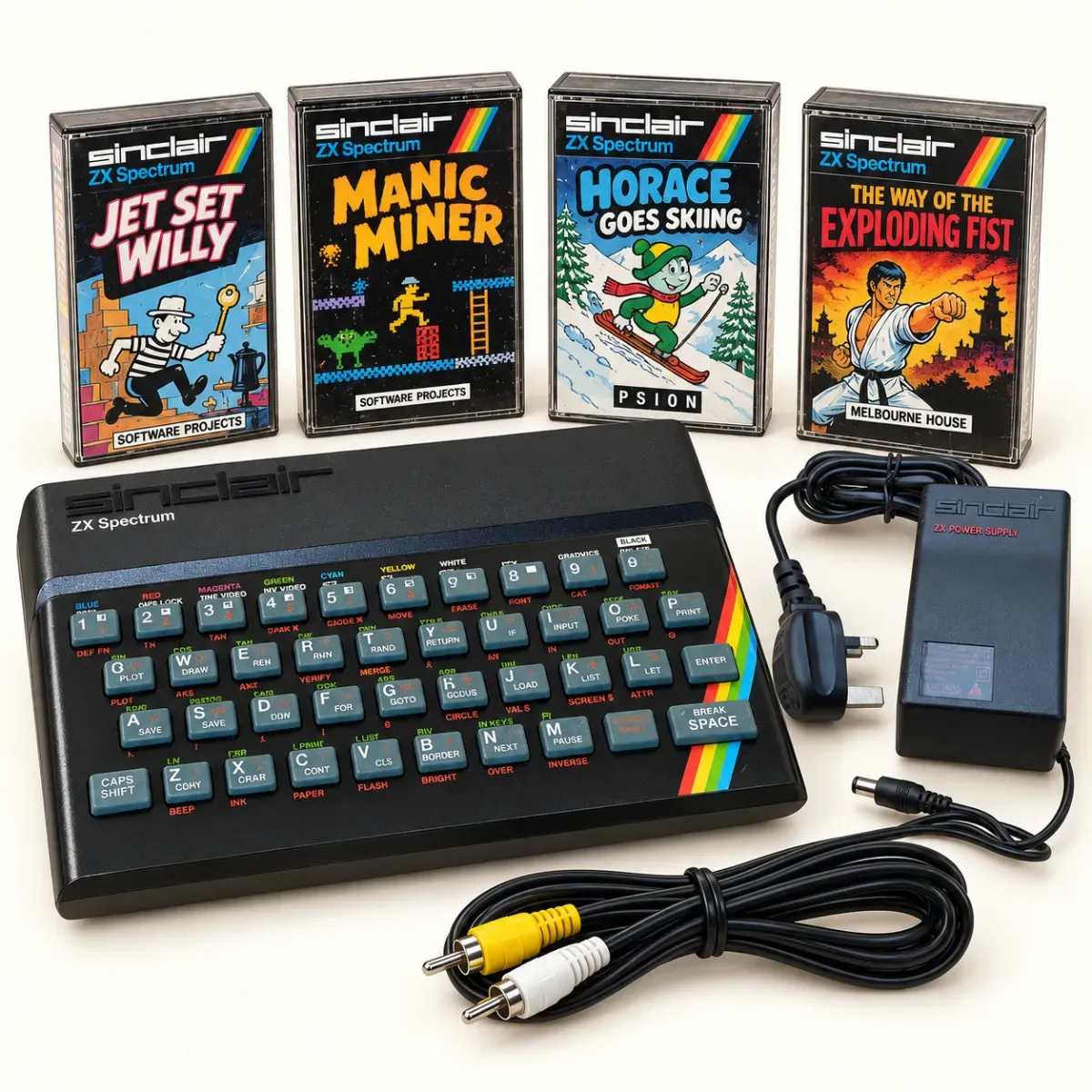
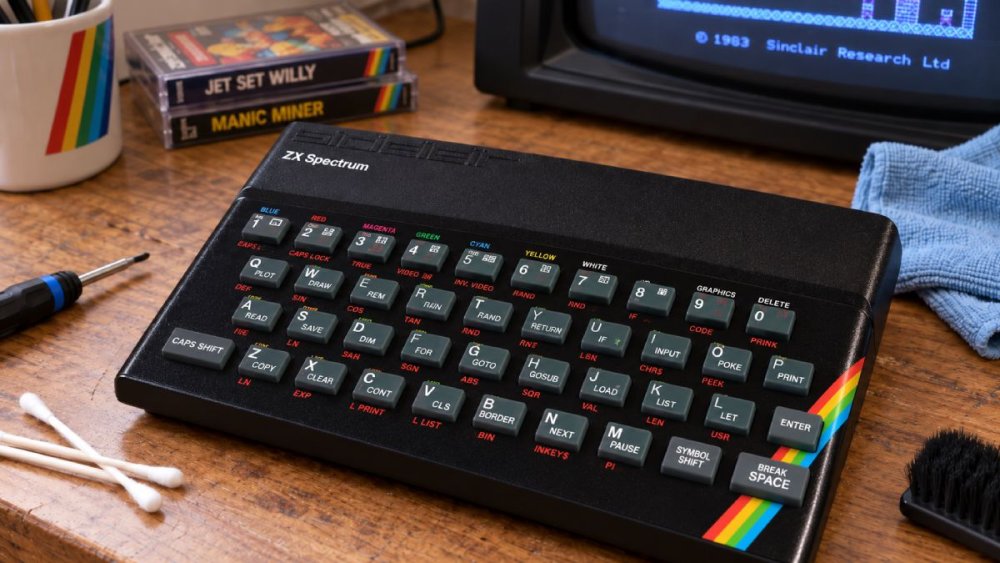
1. Sinclair ZX Spectrum
For millions of Britons, the ZX Spectrum wasn't merely a computer. It was the machine that introduced an entire generation to computing.
The little black box with its rainbow stripe arrived in 1982 and somehow managed to become both an educational tool and an extremely effective method of avoiding homework.
Its rubber keyboard was strange even then. Games loaded from cassette, producing several minutes of screeching electronic noise while coloured bars danced around the television screen. If the loading failed near the end, you learned some surprisingly adult vocabulary.
Yet once a game finally appeared, none of that mattered.
Jet Set Willy, Manic Miner, Chuckie Egg, Knight Lore and hundreds of others turned the Spectrum into one of the defining pieces of British 1980s technology.
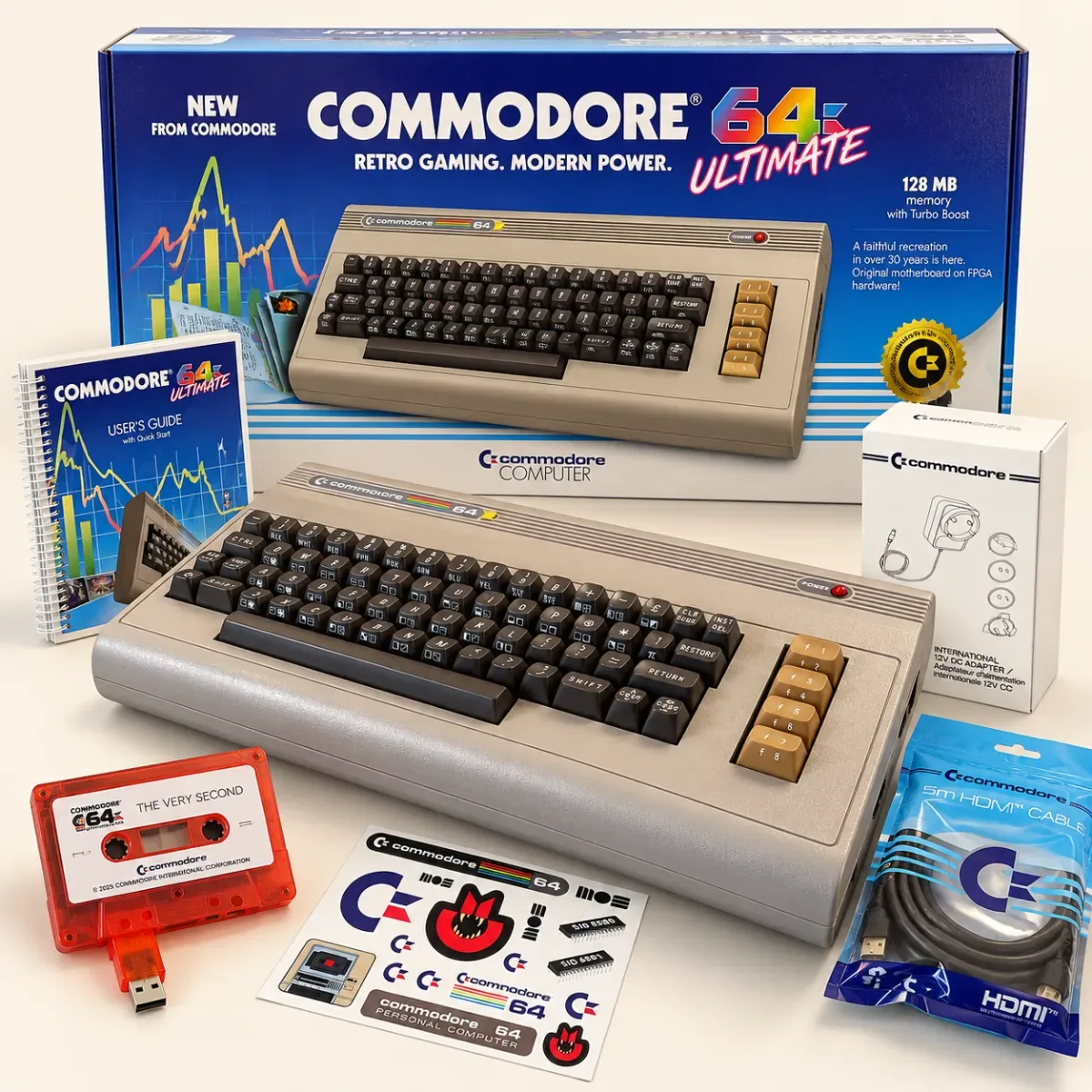
2. Commodore 64
If your mate had a Commodore 64 while you had a Spectrum, the argument could occupy an entire school lunch break.
Released in 1982, the C64 had impressive graphics and, particularly, sound capabilities for a home computer of its era. Its SID sound chip helped give C64 games a musical character that owners still rave about.
It was chunky, beige and looked considerably more serious than Sinclair's tiny machine.
The cassette loading experience was still familiar to British users, though, complete with waiting, uncertainty and the knowledge that somebody touching the tape deck could potentially ruin everything.
3. BBC Micro
The BBC Micro had a completely different atmosphere.
This was the computer that seemed to belong to schools.
You would gather around one in a classroom while somebody lucky enough to have been selected actually operated it. The rest of you provided useful technical advice from behind, usually involving suggestions to play a game instead.
Developed by Acorn as part of the BBC's Computer Literacy Project, the BBC Micro became enormously influential in British education.
It also gave many children their first encounter with BASIC programming.
Typing something like:
10 PRINT "HELLO"20 GOTO 10
and watching the screen fill with HELLO felt suspiciously like becoming a computer genius.
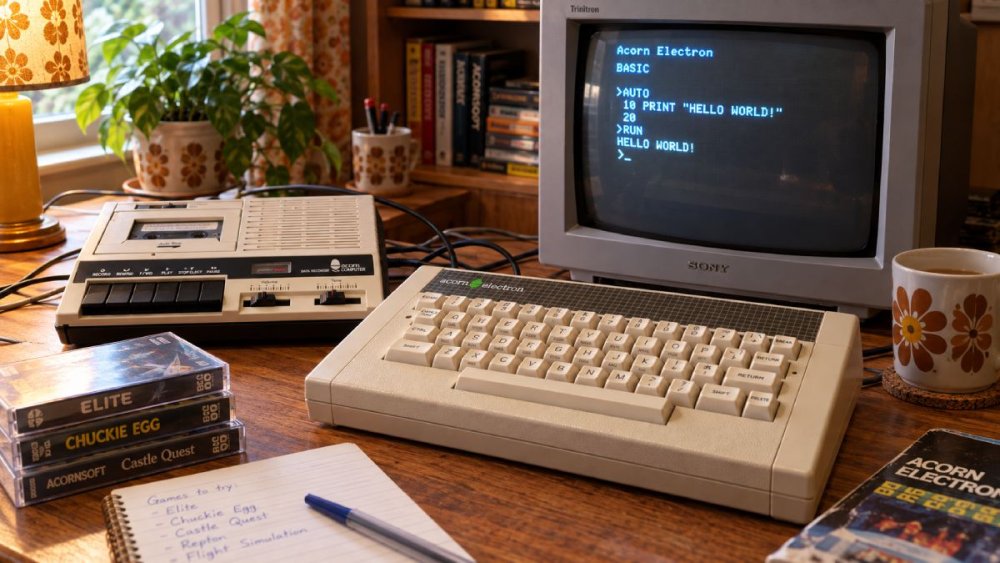
4. Acorn Electron
The Electron was Acorn's attempt to bring some of the BBC Micro experience into a cheaper home machine.
To children, the crucial detail was that it could play games.
The keyboard felt pleasingly substantial, the machine looked suitably technical, and owning one meant another set of playground allegiances to defend.
It never reached Spectrum or Commodore levels of dominance, but it remains deeply nostalgic for those who grew up with one.
5. Amstrad CPC 464
Then came Alan Sugar's Amstrad CPC 464.
One of its great attractions was simplicity. Instead of buying a computer and then discovering you needed a cassette recorder and something suitable to display it on, the CPC 464 came as a much more complete package, with a built-in cassette deck and dedicated monitor options.
That coloured keyboard is instantly recognisable today.
For many families, it looked reassuringly like you were buying a proper computer rather than an experimental electronic toy.
Naturally, the children mainly wanted it for games.
6. Commodore Amiga 500
The Amiga 500 arrived in 1987 and felt like the next generation had suddenly turned up early.
Compared with many earlier home computers, its graphics and sound could seem astonishing.
Games such as Lemmings would eventually become strongly associated with the Amiga era, while paint programs, music software and demos showed that this was much more than another games machine.
The Amiga also looked cooler. Less like a mysterious box connected to a television, more like an actual futuristic computer.
For many people it marks the point where home computing began moving beyond the charmingly blocky world of the early 1980s.
1980s technology that took over the living room
7. VHS video recorder
Few machines changed family television habits as dramatically as the video recorder.
Suddenly you could record a programme and watch it later. That sounds painfully ordinary now, but it was revolutionary.
Unfortunately, programming a VCR was itself an intelligence test.
There were flashing clocks, tiny buttons, mysterious timer modes and instruction manuals nobody wanted to read.
Entire families ended up with VCR displays blinking 00:00 indefinitely.
Still, being able to rent a film from the local video shop on Friday night made the machine indispensable.
8. Betamax recorder
Before VHS won the videotape format battle, there was Betamax.
Sony introduced Betamax before VHS appeared, and the two formats spent years competing for space beneath televisions.
To consumers, this created the unfortunate possibility that your family would choose the format none of your friends used.
Betamax ultimately lost the mass-market battle, making surviving machines and tapes particularly interesting pieces of retro technology today.
If your parents backed Betamax, you may still feel the need to explain that it wasn't because they were foolish.
9. Ferguson Videostar
For many British households, the words Ferguson Videostar summon immediate memories.
These VHS machines became a familiar sight beneath televisions, with rows of physical buttons and the sort of sturdy appearance that suggested they might survive a small explosion.
Using one involved genuine mechanical activity. Press eject and the cassette compartment opened. Push in the tape. Press play. Hear the machine clunk into action.
Modern streaming is more convenient, certainly.
It isn't nearly as satisfying.
10. Teletext
Teletext somehow managed to make a television feel interactive without actually being interactive in any modern sense.
BBC Ceefax and ITV's Oracle delivered news, weather, sport, television listings, holiday offers and other information through gloriously chunky coloured text.
You entered a three-digit page number and waited.
Sometimes the page appeared immediately.
Sometimes you stared at the number in the corner while it cycled through what felt like every other page in existence.
Football scores via Teletext became an institution in their own right.
11. Television remote controls
There was a time when changing television channel involved physically walking across the room.
Then remote controls became increasingly common and humanity immediately decided standing up was an unreasonable hardship.
Early television remotes could be wonderfully chunky, with a comparatively tiny number of buttons.
No voice control. No Netflix shortcut. No menu system requiring a degree in software engineering.
Just the astonishing ability to change channel without leaving the sofa.
Luxury.
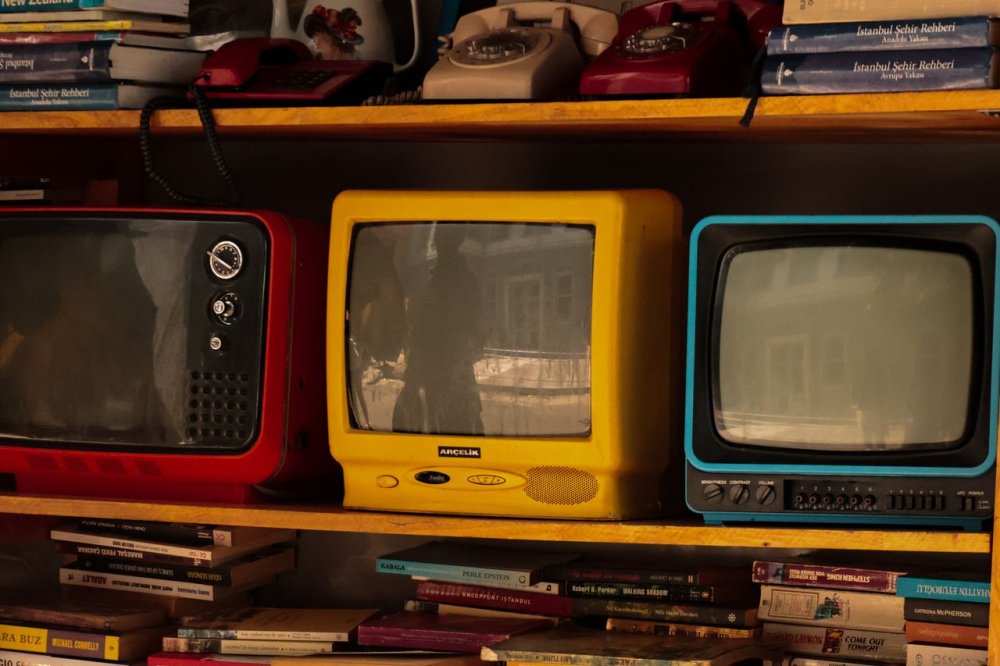
12. Portable televisions
A tiny portable television in the bedroom was serious status.
These sets often had small screens, telescopic aerials and manual tuning controls. Reception could range from acceptable to what appeared to be a snowstorm filmed through a net curtain.
You learned that moving the aerial three millimetres could transform a barely visible picture into another, slightly less barely visible picture.
But it was television.
In your room.
That was all that mattered.
Music suddenly became portable
13. Sony Walkman
Few products represent 1980s technology better than the Sony Walkman.
Portable cassette players existed in numerous forms, but Sony's Walkman became the cultural icon.
For the first time, recorded music felt truly personal. Put on lightweight headphones, press play and disappear into your own soundtrack.
Of course, cassette tapes brought complications.
They tangled. They stretched. Batteries died. Album sides ended at inconvenient moments.
But walking around while listening privately to your own music felt incredibly modern.
14. Personal stereo clones
Not everybody owned an actual Sony Walkman.
Most of us simply called virtually any portable cassette player a Walkman anyway.
Shops were full of alternatives, ranging from respectable branded machines to suspiciously lightweight plastic models that seemed to consume AA batteries faster than they played tapes.
Some had radio tuners. Some had graphic equalisers. Some had enormous buttons that could practically be operated while wearing boxing gloves.
All made music portable.
15. The boombox
At the opposite end of portable audio was the boombox.
These were not designed to disappear discreetly into a coat pocket.
They were designed to announce themselves.
Large speakers, twin cassette decks, radio tuners, graphic equalisers and forests of buttons made the bigger machines look like portable command centres.
A double cassette deck also unlocked an important teenage technology: copying tapes.
Possibly a friend's album.
Possibly the Top 40 from the radio.
Possibly with the DJ talking over the first five seconds of your favourite song.
16. Hi-fi separates
A proper home hi-fi system could be magnificent.
Amplifier. Tuner. Cassette deck. Turntable. Speakers. Perhaps a graphic equaliser with enough sliders to make you feel like a recording engineer.
Even better if everything came in a matching stack.
The ultimate version lived inside a glass-fronted cabinet.
You didn't simply listen to music with one of these. You operated equipment.
17. Graphic equalisers
Did most teenagers genuinely understand what every frequency slider did?
Probably not.
Did that stop us adjusting them into dramatic curves and convincing ourselves the music sounded better?
Absolutely not.
Graphic equalisers were irresistible because they made audio visible.
Add glowing LEDs and the whole thing felt wonderfully professional.
18. Compact Disc players
Compact Disc technology arrived during the 1980s promising cleaner digital audio and freedom from crackles, tape hiss and rewinding.
Early CD players were expensive enough to feel properly exotic.
The discs themselves were part of the attraction. Shiny, futuristic and apparently handled using only the outer edges, as though touching the playing surface might trigger a national emergency.
Watching the track number appear instantly after pressing a button felt extraordinary after years of winding tapes forwards and backwards.
19. Sony Discman
If the Walkman liberated the cassette, portable CD players eventually tried to do the same for the Compact Disc.
Sony introduced its first portable CD player in the mid-1980s, and the Discman name became widely recognised.
Early portable CD listening came with one important rule: try not to move too enthusiastically.
Before sophisticated anti-skip systems became widespread, a sudden knock could interrupt playback.
Still, portable digital music was another glimpse of the future.
Electronic toys every child wanted
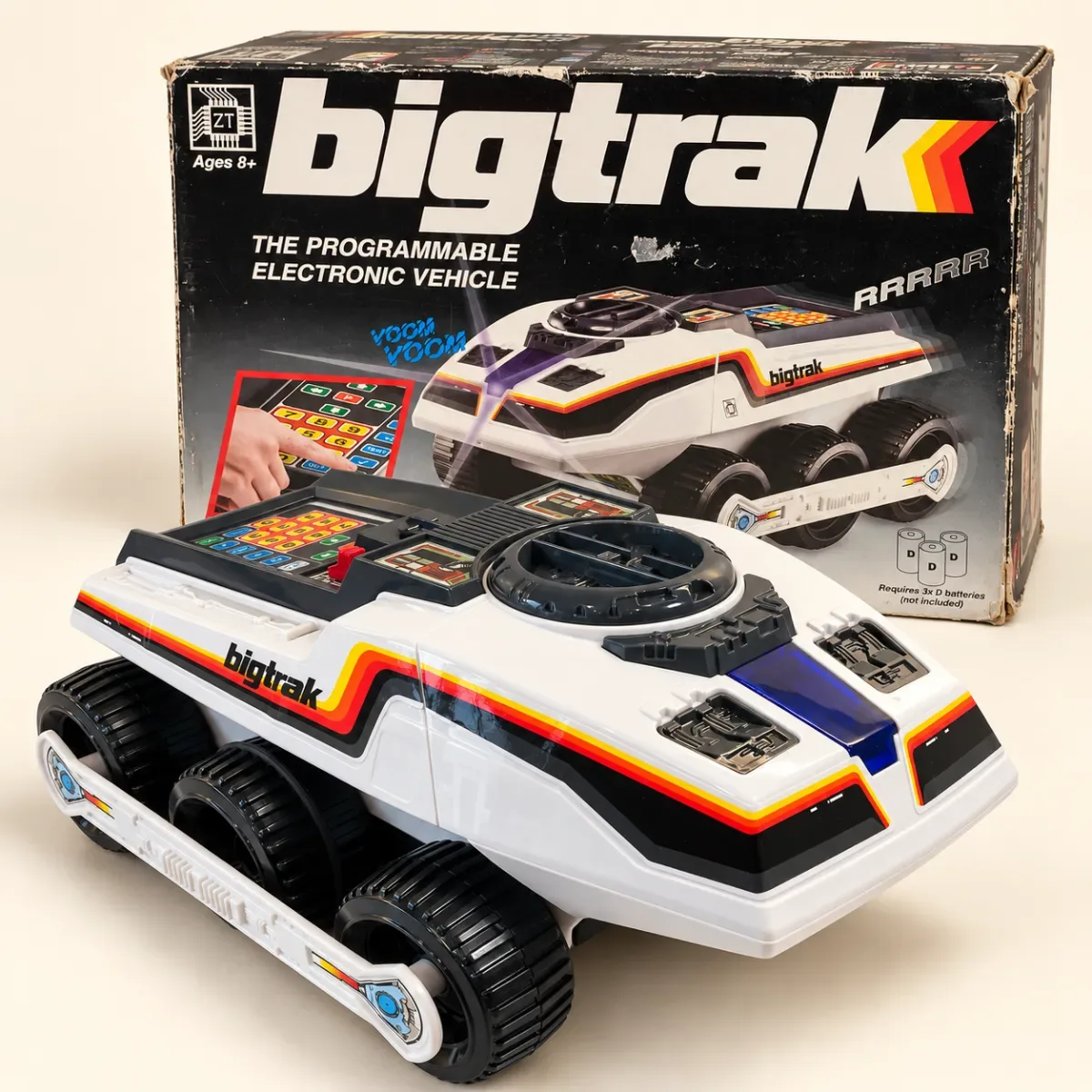
20. BigTrak
BigTrak looked like somebody had borrowed a vehicle from a low-budget science-fiction film.
The six-wheeled programmable electronic toy had a keypad on top allowing you to enter movement instructions.
Forward. Turn. Fire.
Then you pressed go and hoped your carefully calculated route didn't result in it driving directly into the settee.
The brilliant part was that BigTrak made programming feel like play.
It didn't matter that your mission involved crossing the lounge carpet rather than exploring Mars.
This was a robot vehicle under your command.
21. Speak & Spell
Texas Instruments' Speak & Spell occupies a strange place in childhood memory.
It was educational, certainly.
It was also slightly unsettling.
The synthetic voice had an electronic quality that made ordinary spelling exercises sound as though they were being administered by a robot teacher from the future.
With its bright case, chunky buttons and distinctive speech, it became one of those products you can almost hear merely by seeing a photograph.
22. Grandstand Astro Wars
Electronic tabletop games were enormously exciting before home computer games became sophisticated.
Grandstand Astro Wars was one of the stars.
Its upright cabinet, glowing display and built-in controls gave children the illusion of owning a miniature arcade machine.
By modern standards the action was extremely simple.
At the time, the flashing lights and electronic noises were enough to make it feel spectacular.
Finding a clean working example today can awaken memories remarkably quickly.
23. Grandstand Firefox F-7
Grandstand produced several memorable electronic games, and Firefox F-7 was another gloriously futuristic creation.
These weren't portable in the Game Boy sense. They sat on tables and demanded your full attention.
The styling was half the appeal.
Space-age graphics, controls and glowing displays made the machines look like equipment you might reasonably expect to find aboard a spaceship.
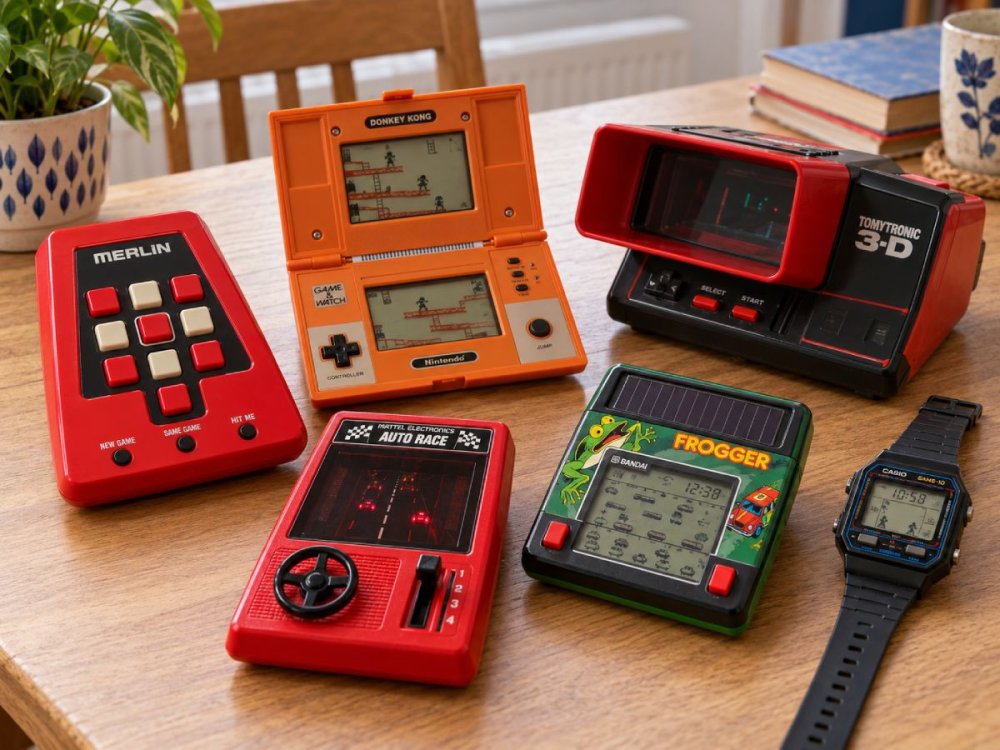
24. Tomytronic 3D
Tomytronic games took a different approach.
Instead of looking at a screen held in your hands, you wore the game like a pair of oversized futuristic binoculars.
Inside was the display.
To anybody watching you play, you looked ridiculous.
To the person wearing it, however, it felt fantastically immersive.
Virtual reality it wasn't, but the basic idea of enclosing your view and creating a private electronic world now seems surprisingly forward-looking.
25. Nintendo Game & Watch
Nintendo's Game & Watch handhelds combined simple LCD games with wonderfully clever design.
Many featured characters such as Donkey Kong and Mario long before Nintendo became synonymous with the Game Boy in Britain.
The dual-screen models were especially memorable, folding shut like tiny electronic compacts.
They were portable, instantly playable and didn't require waiting five minutes for a cassette to load.
That alone felt miraculous.
26. Electronic Simon
Simon was beautifully simple.
The machine flashed coloured lights in a sequence, accompanied by tones.
Your job was to repeat the sequence.
Then it got longer.
And longer.
Until your brain apparently decided that remembering whether red came before blue was far beyond human capability.
The concept is still effective because there is virtually nothing to learn. Watch, listen, remember.
Then press the wrong colour and blame somebody for distracting you.
27. Stylophone
The Stylophone actually originated before the 1980s, but plenty remained in circulation and the instrument retained its wonderfully electronic appeal.
You played it using a stylus against a small metal keyboard.
The result was a distinctive buzzing electronic tone that sounded impressively futuristic for such a simple device.
It was the sort of gadget that encouraged five minutes of musical ambition followed by twenty minutes of making strange noises.
Games consoles and handheld marvels
28. Atari 2600
The Atari 2600 helped establish the idea of a games console connected directly to the family television.
Cartridges made changing games wonderfully straightforward compared with cassette-loading computers.
Insert cartridge. Switch on. Play.
Its distinctive joystick, a black stick with one bright fire button, remains one of gaming's most recognisable controllers.
Games were graphically basic, but imagination filled in an enormous amount.
29. Atari 7800
By the later 1980s, the Atari 7800 represented a more advanced generation of Atari console hardware.
It arrived in Europe into an increasingly competitive market, with home computers and Japanese consoles changing expectations quickly.
For retro collectors now, that makes it an interesting snapshot of Atari during a transitional period in gaming.
30. Nintendo Entertainment System
The NES became a global phenomenon and helped turn Nintendo characters into household names.
In Britain, though, the games market of the 1980s was heavily shaped by affordable home computers such as the Spectrum, Commodore 64 and Amstrad CPC, so the NES did not completely dominate childhood in the same way it did in some other countries.
Those who had one, however, got access to games including Super Mario Bros. and The Legend of Zelda.
The rectangular controller itself became an icon.
31. Sega Master System
The Sega Master System found a particularly strong audience in Europe.
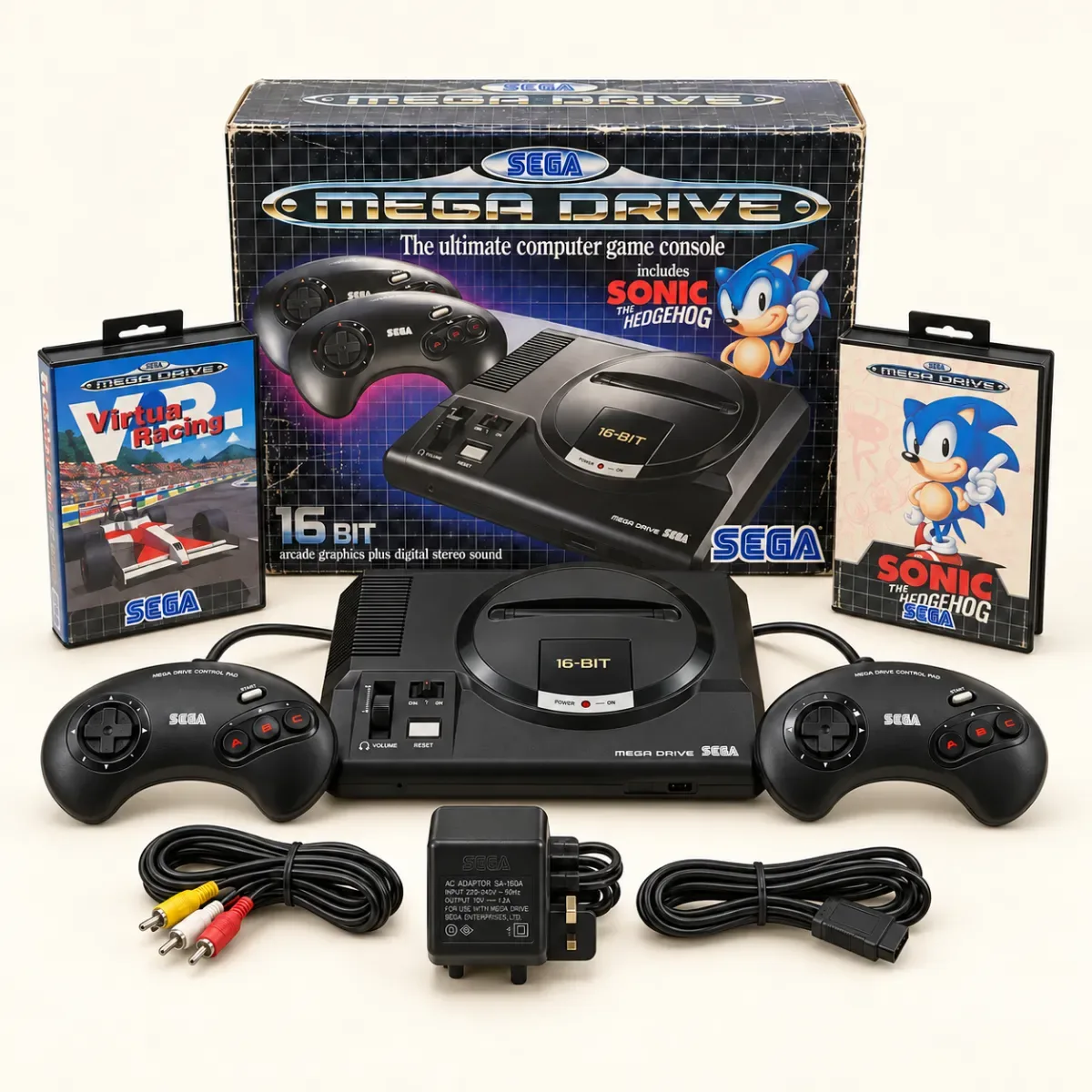
Its sharp black styling looked distinctly modern, while games such as Alex Kidd and later Sonic titles helped establish Sega in British homes.
For children encountering Sega before the Mega Drive era, the Master System was proof that console gaming was becoming seriously competitive with the bedroom computer.
32. Nintendo Game Boy
The Game Boy arrived right at the end of the decade in 1989 and instantly made other handheld games look rather limited.
The screen wasn't colourful. It wasn't even particularly impressive to look at in isolation.
None of that mattered.
It had interchangeable cartridges and proper games.
Most importantly, it had Tetris.
The concept of carrying a genuinely substantial videogame experience around in your hands was hugely compelling.
Gadgets that made us feel like secret agents
33. Casio calculator watch
Nothing said "future executive" quite like a calculator attached to your wrist.
Casio calculator watches were peak schoolyard technology.
Were the buttons tiny?
Yes.
Was performing a calculation slower than simply doing it in your head?
Frequently.
Did any of that matter?
Not remotely.
Your watch could do maths.
Modern smartwatches can take calls, display maps and monitor exercise. Somehow, pressing miniature calculator buttons with a fingernail still feels cooler.
34. Digital watches with alarms
Even an ordinary digital watch once seemed remarkably advanced.
LCD display. Stopwatch. Alarm. A little light that was usually just powerful enough to confirm that your watch did, indeed, have a screen.
The hourly chime was another classic feature.
Some children turned it off.
Others apparently regarded making a tiny electronic beep every single hour as essential public service work.
35. Digital dictionaries and electronic organisers
Long before smartphones swallowed every other gadget, manufacturers produced dedicated electronic devices for individual tasks.
Electronic dictionaries, databanks and organisers promised to put useful information in your pocket.
Tiny keyboards allowed you to enter telephone numbers, appointments or words.
They could be fiddly, but there was something very appealing about storing information electronically rather than writing it in a battered address book.
36. Cordless telephones
A telephone without a cable connecting the handset to the wall felt astonishing.
You could wander around while talking.
You could sit somewhere comfortable.
You could even take the phone into another room.
The freedom seems laughably modest now, but cordless phones changed the domestic telephone from a fixed household object into something personal and mobile.
Signal quality could be temperamental, batteries could run down, and some handsets were enormous.
We loved them anyway.
37. Answering machines
Before voicemail, an unanswered telephone call simply vanished into history.
Answering machines changed that.
You recorded an outgoing message onto a cassette or built-in recording system, then callers could leave messages when you were out.
Recording the family greeting could become an unexpectedly stressful performance.
"Hello, we're not available..."
No. Too formal.
"Hi..."
No.
Start again.
For businesses and households alike, the answering machine was genuinely transformative.
Cameras, camcorders and instant memories
38. Polaroid instant cameras
Polaroid instant photography had existed well before the 1980s, but instant cameras remained magical technology throughout the decade.
Take a photograph and, rather than sending a film away for processing, the picture appeared in your hand shortly afterwards.
Watching an image gradually reveal itself never became boring.
The photographs were expensive enough that you didn't waste them casually, which also meant every badly framed thumb, closed eye and accidental photograph of the carpet felt like a minor financial disaster.
39. 35mm compact cameras
For everyday family photography, compact film cameras became increasingly convenient.
You still had to think before pressing the shutter.
A roll might give you 24 or 36 exposures. You couldn't inspect the shot afterwards. There was no delete button.
Then came the mysterious period between handing the film in for processing and discovering what you'd actually photographed.
Every packet of developed prints contained surprises.
Some pleasant.
Some blurred.
Some featuring a mysterious finger across the lens.
40. Home video camcorders
Home video cameras gave ordinary families the power to produce moving pictures of their own lives.
Early camcorder equipment was much bulkier than today's phones, but that hardly reduced the excitement.
Birthdays, Christmas mornings, holidays and school events could suddenly be preserved with sound and movement.
The resulting footage had its own unmistakable character: camera wobble, abrupt zooming, muffled conversation and somebody inevitably saying, "Is it recording?"
Decades later, those imperfect tapes can be far more valuable to a family than almost any technically perfect smartphone video.
Why 1980s technology felt so exciting
Looking through these 40 pieces of 1980s technology, one thing stands out. Individual gadgets used to do individual jobs.
A Walkman played your tapes.
A camera took photographs.
A Game & Watch played one game.
A calculator watch performed calculations.
A VCR recorded television programmes.
A home computer was one of the few objects that hinted at the convergence we take for granted today, but even computers remained physically distinctive machines with their own personalities, sounds, keyboards and limitations.
Now almost all of those functions live inside one anonymous rectangle in your pocket.
That's obviously more convenient. Few sensible people would genuinely choose to return to rewinding cassettes, waiting for Spectrum games to load or discovering two weeks after a holiday that half their photographs were blurred.
But convenience has removed some of the ceremony.
Opening a cassette case, placing the tape in a deck and pressing the heavy mechanical play button was an activity.
Choosing a record was an activity.
Loading a videogame was an activity.
Taking a photograph was a decision because every exposure cost money.
Even recording television required sufficient planning to locate the Radio Times and attempt another negotiation with the VCR timer.
Technology demanded more patience, but perhaps that also made each successful result feel more satisfying.
The strange pleasure of collecting old technology
Another reason these machines remain fascinating is their physical character.
Modern electronics are often deliberately minimalist. Black screen, smooth case, very few visible controls.
Retro gadgets took the opposite approach.
Buttons everywhere.
Switches.
Sliders.
Knobs.
Keypads.
Cassette doors.
Cartridge slots.
Telescopic aerials.
Coloured keys whose purpose was completely mysterious until you found the manual.
A device could often be recognised instantly from across the room.
That makes 1980s technology particularly enjoyable to collect and display. A ZX Spectrum doesn't merely represent an old computer. It represents loading screens, bedroom gaming, computer magazines, copied program listings and arguments about whether the Commodore 64 was better.
A Walkman means mixtapes, batteries and foam-covered headphones.
A VCR means Friday nights at the video shop.
The object is only part of what you're collecting. The memories come attached.
Remember when technology still felt like magic?
Perhaps that's what separates the best retro technology from the gadgets surrounding us now.
We expect modern devices to perform miracles.
A phone can recognise your face, translate languages, stream virtually any song ever recorded, guide you across a continent and make a video call to the other side of the world. If an app takes four seconds to open, we become irritated.
In the 1980s, the bar for technological astonishment was rather different.
A watch that could divide numbers was amazing.
A toy that spoke was amazing.
A computer displaying eight colours on the television was amazing.
A machine that recorded Coronation Street while you were out was bordering on witchcraft.
That sense of discovery is a huge reason 1980s technology remains so enjoyable today. These gadgets weren't merely tools. They were little glimpses of what we imagined the future might become.
Some led directly to the technology we now use every day.
Others became glorious evolutionary dead ends.
We remember both kinds just as fondly.
If any of these brought back memories of bedrooms filled with cassette tapes, blinking LEDs, tangled cables and electronic beeps, join RetroWins or sign up to stay in the loop for more retro technology stories, forgotten gadgets and nostalgia from the era when the future came with a plug, a keypad and usually six AA batteries.