
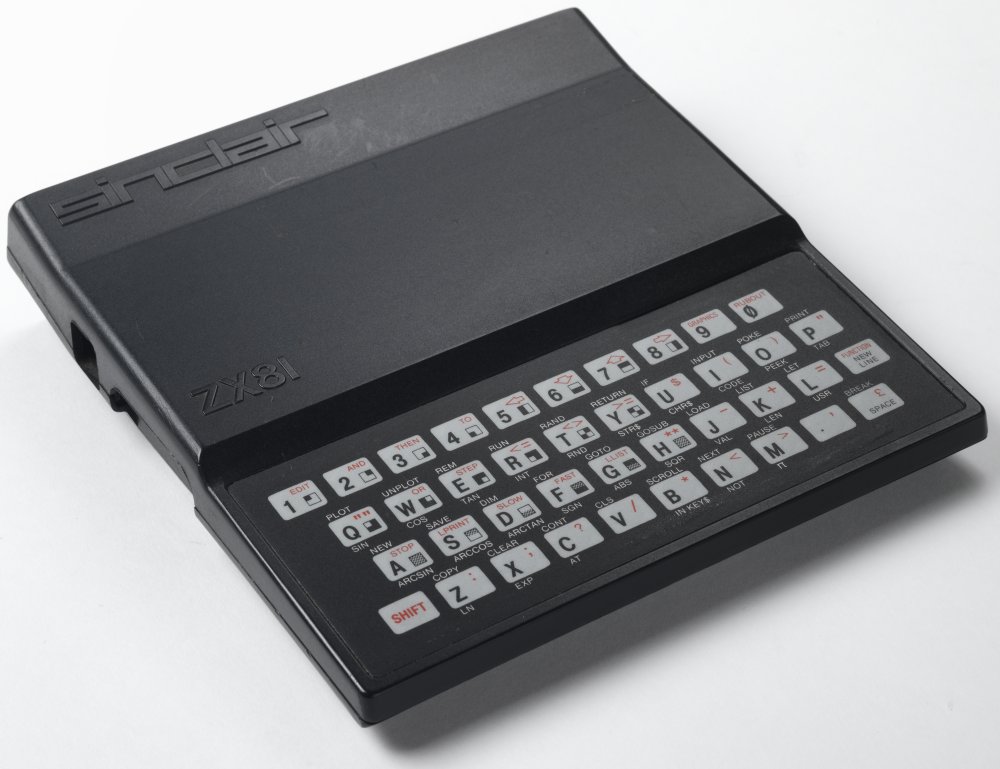
Before home computers became colourful, noisy and capable of filling entire afternoons with games, there was the Sinclair ZX81.
It was small. It was black and white. It had a keyboard that barely deserved the name. It came with just 1KB of RAM, which is now such a tiny amount of memory that it sounds like somebody has accidentally left a few letters off the specification.
And yet the ZX81 was one of the most important computers Britain ever produced.
Launched in 1981, the Sinclair ZX81 helped turn computing from an expensive hobby for electronics enthusiasts into something ordinary families could realistically have at home. It appeared in bedrooms, living rooms, classrooms and, crucially, on the shelves of WHSmith.
For a generation of British children and adults, it wasn't simply a cheap computer. It was their first computer.
And once you had one sitting underneath the family television, even with its peculiar keyboard and microscopic amount of memory, the future suddenly felt as though it had arrived.
Britain Before the Sinclair ZX81
It is difficult to appreciate quite how exotic the idea of owning a computer still seemed at the beginning of the 1980s.
Today we carry several computers around without thinking about it. Your phone has vastly more processing power than machines that once filled rooms. Your television is a computer. Your car is full of them. Even the washing machine has somehow become clever enough to complain about Wi-Fi.
In 1981, things were rather different.
Computers belonged to businesses, universities, laboratories and the sort of people who owned soldering irons voluntarily.
Home computers existed, of course, but they weren't yet everyday household objects. Machines such as the Apple II and Commodore PET had already shown what personal computing could become, while British enthusiasts had machines such as the Acorn Atom available to them.
The problem was price.
Sir Clive Sinclair's great trick was not inventing the home computer. It was working out how brutally inexpensive one could be made.
His ZX80 had already caused a stir in 1980 by bringing a complete computer below the psychologically important £100 mark.
Then came the machine that really opened the door.
The Sinclair ZX81 launched on 5 March 1981 and was sold for £69.95 fully assembled, or £49.95 as a kit for anyone feeling particularly confident with a soldering iron. It used a Z80A processor running at 3.5MHz, contained 8KB of ROM and arrived with that astonishing 1KB of RAM.
That price changed everything.
The Sinclair ZX81 Looked Like the Future
Even now, the ZX81 is a wonderfully distinctive little object.
Designed by Rick Dickinson, its low black wedge-shaped case looked remarkably sophisticated for something built to such a tight budget. The machine was only about 17 centimetres wide and weighed around 350 grams.
There was no bulky separate keyboard unit, no monitor and no disk drive. You connected it to a television.
Placed beside some of the beige office equipment of the period, the ZX81 looked almost futuristic.
Then you touched the keyboard.
That membrane keyboard
Anyone who ever used a ZX81 remembers the keyboard.
Mostly because calling it a keyboard was rather generous.
Instead of conventional moving keys, the ZX81 used a flat membrane surface divided into printed squares. Pressing a letter offered practically no physical feedback at all.
Touch typing was not really an option. Typing with confidence was not really an option.
Typing involved staring intently at your finger, pressing firmly and then checking the television to make sure the computer had actually noticed.
For prolonged programming sessions it was approximately as comfortable as entering a novel into a microwave oven.
Yet the strange keyboard became part of the ZX81's identity.
Each key was also surrounded by BASIC commands and functions. Rather than typing whole programming keywords letter by letter, the ZX81's BASIC system allowed many commands to be entered using single keystrokes depending on the current input mode.
So one little key might contain a letter, a number of keywords, a mathematical function and enough tiny printing to make you wonder whether Sinclair expected every owner to keep a magnifying glass nearby.
It looked bewildering at first.
Then, slowly, it started to make sense.
1KB of RAM, Somehow
The most famous Sinclair ZX81 specification remains its standard memory.
One kilobyte.
Not one megabyte.
Not one gigabyte.
One kilobyte.
There are photographs on modern websites larger than the entire standard working memory of a ZX81 by a factor of several thousand.
Yet people wrote actual programs with it.
You could type BASIC listings, perform calculations, create simple games and experiment with graphics. Every byte mattered, so programming naturally encouraged ingenuity.
There was no casually importing a 40MB software library because you couldn't be bothered writing twelve lines of code yourself.
You learned to be economical.
Variables mattered. Program structure mattered. Sometimes individual characters mattered.
For children encountering programming for the first time, this limitation had an unexpected advantage. The machine was comprehensible.
You could sit down with the manual, type a few commands and immediately change something on the screen.
There wasn't an operating system, twelve background processes and an account registration screen standing between you and the computer.
You switched it on and there it was.
A little cursor waiting for instructions.
The Television Became a Computer Monitor
One of Sinclair's cleverest cost-saving decisions was making use of equipment people already owned.
Instead of requiring a dedicated monitor, the ZX81 connected to an ordinary domestic television using its RF output.
That meant the family TV suddenly became part of your computer setup.
This created a particular domestic ritual familiar to many early home computer owners.
First, negotiate access to the television.
Then plug in the computer.
Tune the television if necessary.
Sit inconveniently close to the screen because the cable arrangement dictated where everything had to go.
Begin programming.
Then, at some point, somebody would want to watch television again.
Early British home computing involved a surprising amount of diplomacy.
The picture itself was monochrome, generally appearing as black characters and graphics against a white background. Colour would have to wait for machines such as the ZX Spectrum.
There was no sound either.
By later standards, the whole experience should have been desperately dull.
It wasn't.
The thrill came from control.
Until then, television was something broadcast at you. Suddenly this familiar box in the corner of the living room was displaying something because you had instructed it to.
That distinction was enormous.
Programming Was the Main Event
For many ZX81 owners, programming wasn't an optional technical activity hidden somewhere behind the entertainment.
Programming was what owning a computer meant.
You bought computer magazines and books containing pages of BASIC listings, then manually typed them into the machine.
Sometimes the program would be short.
Sometimes it would stretch across several pages.
You would enter line after line:
10...
20...
30...
40...
Eventually, after what felt like several geological periods, you typed RUN.
Nothing happened.
Or rather, something happened, but it wasn't what the magazine promised.
Welcome to programming.
You then started hunting through the listing for the mistyped character that had ruined your evening.
Perhaps line 230 contained a zero where there should have been the letter O. Perhaps line 470 had vanished entirely. Perhaps you had entered something incorrectly twenty minutes ago and only just discovered the consequences.
It could be infuriating.
It was also educational in a way that few modern consumer devices are.
When the program finally worked, you hadn't simply launched somebody else's software. You had physically constructed it, character by character.
Even when you didn't understand every line, you had participated in making the machine do something.
That encouraged experimentation.
Change a number.
Run it again.
Change another number.
What does that do?
Before long, copying programs could turn into modifying programs, and modifying programs could turn into writing your own.
A surprising number of later programmers and technology professionals began with exactly that process.
The 16K RAM Pack Changed Everything
For serious ZX81 ambitions, 1KB didn't last long.
Sinclair offered a 16KB RAM Pack that plugged into the expansion connector at the rear of the machine.
Suddenly, you had sixteen times the memory.
Sixteen kilobytes!
Luxury.
The 16K expansion opened the door to much more ambitious programs and became an important part of ZX81 ownership. Sinclair User magazine was already running features devoted to what owners could do with 16K machines by 1982.
Unfortunately, the RAM Pack also produced one of the most infamous quirks in British computing.
RAM Pack wobble
The expansion unit projected from the back of the ZX81 and its connection could be somewhat temperamental.
A small movement could interrupt contact.
The computer would crash.
Your program could disappear.
The technical term for this phenomenon became "RAM Pack wobble", although owners may occasionally have used stronger terminology.
Imagine spending an hour entering a program from a magazine, carefully checking every line, and then somebody nudges the table.
Gone.
The entire thing.
Modern computers spend enormous amounts of engineering effort protecting users from data loss. Cloud backup, autosave, recovery systems, redundant storage.
The ZX81's data protection strategy was closer to: "Nobody touch the table."
Owners devised solutions involving sticky tape, Velcro and whatever else might persuade the RAM Pack to remain exactly where it was.
The fragility somehow makes the memories stronger.
People don't fondly recall computers because everything worked perfectly. They remember the peculiar little rituals required to make them behave.
Saving Programs to Cassette Tape
If typing the same program repeatedly didn't appeal, the ZX81 could save software to ordinary cassette tape.
Again, this was wonderfully practical.
Cassette recorders were already common household equipment, so Sinclair didn't need to provide an expensive dedicated storage device.
You connected a tape recorder to the computer, inserted a cassette and saved your program as audio.
Today, we expect storage to be silent, invisible and practically instantaneous.
Cassette storage was none of those things.
You had cables.
Volume levels.
Tape counters.
Waiting.
And faith.
Loading software meant playing the recorded data back into the computer and hoping everything was correctly aligned.
The process made data feel oddly physical.
Your program existed as a strange electronic noise stored magnetically on a piece of tape.
You could hold it.
You could label it.
You could accidentally record over it.
There was something satisfying about a drawer full of cassettes containing software you had written, copied or bought.
It was less convenient than clicking an icon, obviously.
But considerably more memorable.
Games on the ZX81 Had to Use Their Imagination
Nobody bought a ZX81 expecting arcade-perfect graphics.
That was fortunate.
Graphics were monochrome and extremely limited. Sound was absent. Memory was tiny.
Yet developers still produced games.
Chess programs appeared. Adventure games appeared. Racing games appeared. Flight simulation appeared.
Most relied heavily on imagination.
A handful of blocky characters could become a spaceship.
A crude collection of lines might represent a road.
You supplied the missing detail yourself.
This sounds like a weakness, and technologically it certainly was, but there was an interesting quality to early games like these. Because the graphics provided so little information, the player's imagination had to do considerably more work.
A modern racing game can render individual raindrops, reflections in polished bodywork and the stitching on a driver's gloves.
An early computer game might give you three white blocks and ask you to accept that one was a Ferrari.
And you did.
Happily.
The ZX81 Reached the High Street
Perhaps the most important part of the Sinclair ZX81 story wasn't hidden inside the machine at all.
It was where you could buy one.
The ZX81 became available through WHSmith, putting a home computer into a familiar mainstream retailer rather than restricting it to specialist electronics suppliers and mail order adverts.
That mattered enormously.
Computers suddenly appeared beside products ordinary families already understood.
You could walk into town and see one.
Parents could look at it.
Children could point at it repeatedly.
Computing started becoming normal.
The Centre for Computing History describes the ZX81 as the first cheap mass-market home computer available through high street stores such as WHSmith, and notes that more than 1.5 million machines were sold.
That scale helped create something much larger than one successful product.
It created an audience.
Once enough people owned affordable computers, magazines became viable. Software companies appeared. Peripheral makers found customers. Clubs formed. Books were published. Children started swapping programs and discussing computers at school.
An ecosystem was forming.
The Bedroom Programmer Arrives
One of the defining stories of British technology in the 1980s was the rise of the bedroom programmer.
Young people began writing games at home, sometimes alone and sometimes with friends, before selling them through small software publishers or building companies of their own.
The ZX81 helped establish the conditions that made this possible.
It didn't require an expensive computer laboratory.
You could learn on the television in your bedroom.
Or the living room, assuming nobody wanted to watch Nationwide.
The machine invited curiosity.
You weren't merely allowed to program it. Programming was one of the main reasons it existed.
The boundary between user and creator was unusually thin.
That feels quite different from much modern consumer technology.
Today's devices are immensely powerful but often deliberately sealed away from their inner workings. You download finished applications created by distant companies and interact with carefully designed interfaces.
The ZX81 effectively arrived saying: here is BASIC. Have a go.
For some owners, that invitation changed their lives.
Sinclair's Obsession With Doing More for Less
The ZX81 represented a very particular British approach to technology.
Sir Clive Sinclair was fascinated by miniaturisation and affordability. His companies repeatedly tried to make existing technologies smaller, cheaper or accessible to a wider audience.
Sometimes this philosophy produced brilliant products.
Sometimes it produced machines with certain... compromises.
The ZX81 sits very much in the successful category.
Its extraordinary simplicity was deliberate.
Sinclair reduced the number of major chips dramatically compared with the ZX80, using a custom Ferranti ULA to consolidate much of the supporting logic. Sinclair's marketing made much of the reduced chip count, and the resulting design allowed the computer to be manufactured cheaply.
That ruthless engineering economy explains almost everything about the machine.
The membrane keyboard.
The tiny case.
The minimal memory.
The domestic television output.
Cassette storage.
Each decision shaved cost from the product until home computing became affordable to a much larger audience.
Luxury was sacrificed for accessibility.
It worked.
Then the ZX Spectrum Arrived
The ZX81's period at the cutting edge was inevitably brief.
Home computing moved extraordinarily quickly in the early 1980s.
In 1982 Sinclair launched the ZX Spectrum.
Suddenly Sinclair owners had colour graphics, more memory and a keyboard that, while still distinctly Sinclair-like, at least featured actual moving rubber keys.
Games became dramatically more sophisticated.
The Spectrum went on to become one of the defining British computers of the decade and, for many people, it completely overshadowed its predecessor.
That is understandable.
The Spectrum is easier to remember as an entertainment machine because its games were more colourful, more varied and more culturally visible.
But the ZX81 laid much of the groundwork.
Without huge numbers of people discovering affordable home computing through machines such as the ZX81, the explosive success of later British micros becomes harder to imagine.
The ZX81 was the opening act.
And occasionally the opening act is the bit that changes everything.
What Owning a ZX81 Actually Felt Like
Specifications only explain so much.
The emotional memory of these machines is usually attached to ordinary moments.
The box arriving.
Unpacking the tiny computer and being surprised by how little there was to it.
Trying to find the correct television channel.
The first cursor appearing.
Typing something from the manual.
Seeing your name appear repeatedly across the screen because you had written a tiny loop.
The peculiar pressure required by the membrane keyboard.
The cassette recorder beside the television.
Books filled with program listings.
A parent cautiously asking what exactly the computer was for.
Not knowing the answer but being completely certain it was important.
That last part was especially powerful.
Home computers arrived surrounded by possibility.
People didn't yet know exactly what computers would become.
Would they run the household?
Would everyone work from home?
Would children learn entirely through computers?
Would paper disappear?
Some predictions were right.
Some were hilariously optimistic.
But simply owning a computer felt like participating in the future.
And the Sinclair ZX81 made that feeling available for £69.95.
Why the Sinclair ZX81 Still Matters
Look at a ZX81 now and its limitations are almost comical.
A cheap digital watch probably contains technology that would astonish its designers.
Yet comparing raw performance misses the point entirely.
The ZX81 mattered because of accessibility.
It lowered the barrier between ordinary people and computing.
You didn't need institutional access.
You didn't need thousands of pounds.
You didn't even need a dedicated monitor.
You needed a television, a willingness to learn and enough patience to deal with a keyboard that sometimes required the finger pressure of a Victorian doorbell.
More than 1.5 million machines were sold, an enormous number for the period.
Behind that figure were individual first experiences.
First programs.
First games.
First mistakes.
First moments of understanding that a computer wasn't simply a mysterious machine operated by experts.
You could tell it what to do.
That idea is arguably more important than any individual ZX81 specification.
Collecting a ZX81 Today
The Sinclair ZX81 is now a highly recognisable piece of British computing history.
Its compact size means it also makes a particularly satisfying retro display piece. Even somebody who hasn't seen one for decades can usually recognise that distinctive black wedge and printed membrane keyboard immediately.
Collectors naturally value complete examples with original packaging, manuals and accessories, while the infamous 16K RAM Pack adds another layer of period authenticity.
Working examples can still be used with suitable equipment, although connecting early computers to modern displays is not always quite as straightforward as plugging in an HDMI cable and carrying on.
There is also something appealing about seeing a ZX81 operating again.
Not emulated.
Not recreated in a browser.
The actual machine.
That tiny cursor on a television screen has a surprising ability to transport somebody straight back to 1981.
A Tiny Computer With a Huge Legacy
The Sinclair ZX81 wasn't luxurious and it certainly wasn't powerful.
Its keyboard was awkward. Its graphics were crude. Its standard memory allocation sounds almost fictional today. Expanding that memory introduced the possibility that somebody walking too enthusiastically past the table could wipe out your afternoon's work.
But none of that prevented it becoming enormously influential.
In fact, some of those limitations are precisely why people remember it.
The Sinclair ZX81 arrived at the moment computers were beginning their journey from specialist equipment to everyday household objects. It made programming affordable, understandable and available to families across Britain.
For thousands of future programmers, engineers, game developers and technology enthusiasts, it provided the first opportunity to sit in front of a screen and make a computer obey an instruction they had written themselves.
Forty-five years later, that little black box still represents something exciting.
Not computing as a finished product, polished and hidden behind touchscreens.
Computing as discovery.
A machine you were expected to explore, experiment with, occasionally crash and eventually understand.
That is why the ZX81 deserves far more than a footnote before the Spectrum. It helped start Britain's home computing revolution, one wobbly RAM Pack at a time.
For more stories about the computers, gadgets and technology that made the past considerably more interesting, join RetroWins or sign up to stay in the loop for your next dose of retro nostalgia.






