
You can forget what something looked like. You can forget exactly where it sat in the house, what year you got it or even what eventually happened to it.
But a sound can sit quietly in your brain for forty years and then suddenly come roaring back.
The 1980s were particularly good at this. Technology was noisy. Computers beeped, printers screamed, cassette decks clunked, televisions crackled and electronic toys announced themselves to the entire house. Nothing seemed particularly interested in operating discreetly.
Some of the most memorable sounds of 1980s technology were not even intended to be entertaining. They were simply the noises machines made while doing their jobs. Yet today they can be more evocative than photographs.
Hear the right electronic squeal and suddenly you are nine years old again, sitting cross-legged in front of a television, waiting for a game to load and desperately hoping nobody switches on the vacuum cleaner.
Here are ten sounds that can transport you straight back to the 1980s.
1. The ZX Spectrum Loading Screech
There are noises, and then there is the sound of a ZX Spectrum loading a game from cassette.
If you grew up with a Spectrum, you probably do not need it described. Your brain has already started playing it.
First came the steady introductory tone. Then the angry electronic scratching, shrieking and buzzing as data travelled from cassette tape into the computer.
To anybody unfamiliar with home computers, it sounded as though the Spectrum was receiving an urgent fax from another galaxy.
To us, it sounded like entertainment approaching.
The noise that taught us patience
Loading games could take several minutes. There was no progress bar telling you that everything was definitely fine. You listened.
Experienced Spectrum owners became amateur sound engineers.
The correct noises were reassuring. The wrong ones could make your stomach drop.
Sometimes the familiar screech would continue apparently normally, only for the computer to produce an error at the end. You would adjust the cassette player's volume, rewind the tape carefully and try again.
Some machines and games were fussier than others. Certain cassette players seemed to possess a mystical sweet spot somewhere between volume six and seven.
The loading screen helped. Developers often displayed colourful artwork while the game loaded, giving you something to stare at while the tape performed its electronic ritual.
Modern games can install tens of gigabytes while barely making a sound. Technically, this is better in every conceivable way.
Emotionally, however, watching a percentage counter crawl from 63 to 64 per cent cannot compete with five minutes of electronic screaming followed by the glorious appearance of the game.
2. The Commodore 64 SID Chip
If the ZX Spectrum is remembered for its loading noises, the Commodore 64 is remembered for what happened after the game loaded.
Its SID sound chip gave the machine a musical identity unlike almost anything else in the home computer market.
The C64 could produce remarkably rich electronic music for the period. It buzzed, pulsed, warbled and growled its way through games with a character that still makes instantly recognisable listening today.
When game music became something you actually noticed
For many children in the 1980s, computer game music was one of their first regular encounters with electronic music.
You might have had pop music playing downstairs on Radio 1, but upstairs the Commodore was generating something completely different.
Games such as Monty on the Run, The Last Ninja and countless others became associated with their music as much as their graphics.
Composers including Rob Hubbard and Martin Galway became famous within gaming circles because they managed to squeeze extraordinary results from limited hardware.
This is part of what makes C64 music so memorable. It was not attempting to reproduce a full orchestra realistically. It had its own sound.
Today's machines can reproduce almost any instrument convincingly. The Commodore 64 could not.
So programmers worked with what it could do, and the limitation became a style.
Decades later, you can hear a few seconds of SID music and immediately know where it came from.
3. The Dot Matrix Printer Grinding Into Action
Few pieces of office equipment have ever sounded as determined as a dot matrix printer.
Printing something in the 1980s was not an invisible background task.
Everybody knew.
The print head would begin hammering rapidly against the ribbon while the paper advanced through the machine with mechanical precision.
ZZZZZZZZZT.
Pause.
ZZZZZZZZZT.
Pause.
Then another line.
And another.
Printing as a household event
If your family had a home computer and printer, the arrival of a dot matrix machine felt impressively serious.
You could now produce letters.
Documents.
Banners.
Possibly a school project featuring several different fonts that you considered the absolute pinnacle of publishing.
The paper itself added to the experience. Continuous stationery arrived in long folded stacks, complete with perforated strips along both sides containing tractor-feed holes.
After printing came the satisfying job of tearing those side strips away.
There was also the wonderful ability to print enormous banners across multiple sheets of paper, which meant that at some point in the 1980s somebody in Britain almost certainly spent twenty minutes printing:
HAPPY BIRTHDAY DAD
in letters large enough to be seen from space.
Compared with today's near-silent laser and inkjet printers, dot matrix machines were hilariously theatrical.
You did not print a document.
You commissioned an industrial process.
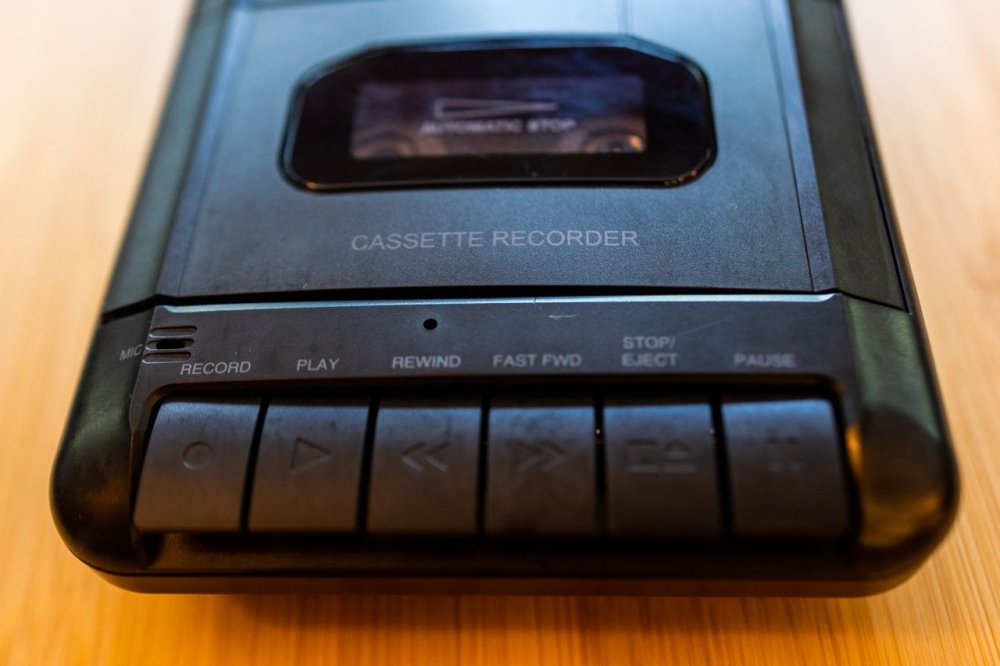
4. The Cassette Deck Clunk
Before touchscreens made controls disappear into sheets of glass, technology had buttons.
Proper buttons.
And few buttons felt more committed to their job than those on a cassette recorder.
Press Play and there was a reassuring mechanical clunk.
Press Stop and another clunk released the mechanism.
Fast Forward produced its own whirring sound. Rewind did the same in the opposite direction, accompanied by the sight of one cassette spool rapidly growing while the other shrank.
The physical sound of music
The cassette deck was full of noises that became part of listening to music.
The snap of the cassette case opening.
The little click as the tape dropped into position.
The lid closing.
The Play button locking down.
Even before the music started, you had already interacted with half a dozen pieces of plastic and machinery.
Recording introduced another ritual.
On many cassette decks, Record and Play had to be pressed together. There was something wonderfully serious about this. Recording was apparently so dangerous that two controls had to be activated simultaneously.
Then came the nervous wait beside the radio, finger hovering over the controls, hoping the DJ would stop talking before the song began.
Of course, he frequently did not.
Somewhere in an attic today there are thousands of 1980s mixtapes preserving the final three seconds of a Radio 1 presenter telling us what was coming up after the news.
5. The Television Turning On
Modern televisions are remarkably uneventful.
You press a button. A flat rectangle wakes up.
An old CRT television made considerably more of an entrance.
There was the solid click of the power switch, followed by an electrical hum and that distinctive moment as the picture tube came to life.
The image did not always appear instantly. The set seemed to gather itself.
Then, when you switched it off, the picture could collapse rapidly into a tiny glowing spot before disappearing.
The background hum of the living room
Televisions also had a physical presence that modern sets lack.
They were deep, heavy boxes. Many were covered in imitation woodgrain or dark plastic. Buttons lived on the front, sometimes behind a little flap.
Remote controls existed, of course, but plenty of homes still operated the television using the youngest available family member.
"Turn it over."
So you got up.
Walked across the room.
Pressed the channel button.
Then walked back.
Four channels did at least mean the journey was relatively manageable.
CRT televisions also produced a high-frequency whine that younger ears could often hear clearly. You could sometimes enter a room and know the television was on before seeing the screen.
Combined with the glow of the tube and the slight smell of warm electronics, it created one of those sensory memories that is difficult to explain to anybody who grew up entirely with flat screens.
6. The Game & Watch Beep
Nintendo's Game & Watch machines proved that you did not need sophisticated sound to create something unforgettable.
A few electronic beeps were enough.
These handheld games used simple LCD displays and equally simple audio. Characters jumped, caught, dodged and moved while tiny piezoelectric bleeps marked the action.
There was not much tonal variety.
There did not need to be.
Tiny machines that demanded total concentration
Game & Watch titles were beautifully focused.
You were usually performing one repetitive task, but the speed gradually increased until your fingers and brain could no longer keep up.
Every movement had its little electronic acknowledgement.
Bleep.
Bleep.
Bleep.
MISS.
The simplicity made the sound incredibly effective. There was no soundtrack disguising what was happening. Each beep became part of the rhythm of play.
Game & Watch units also had another trick: the alarm clock.
The clue was in the name. These were not merely games. They were watches too, complete with alarm functions.
For children accustomed to toys being toys, the idea that your electronic game could also tell the time felt surprisingly sophisticated.
Today original Game & Watch machines have become highly collectable, and Nintendo has repeatedly revisited the concept.
Yet the original versions still possess something special. Their tiny electronic chirps belong perfectly to the era that created them.
7. Speak & Spell Talking to You
Texas Instruments' Speak & Spell looked like something halfway between a toy, a computer and equipment issued to a junior astronaut.
The bright case, keyboard and electronic voice made it instantly distinctive.
And that voice is impossible to forget.
Speak & Spell used speech synthesis to say words aloud, allowing children to practise spelling and language skills.
By modern standards the speech was robotic.
In the late 1970s and 1980s, it felt astonishing.
A machine that actually spoke
It is easy to forget how unusual synthesised speech once seemed.
Today phones, cars, televisions and smart speakers speak constantly. Sometimes you wish they would stop.
Back then, having a plastic machine on your lap say recognisable words felt like encountering the future.
The slightly artificial pronunciation actually made it more memorable.
Speak & Spell did not sound human, but it sounded close enough to be fascinating.
It also had something many educational toys struggle to achieve: children actually wanted to use it.
Part of the appeal was simply pressing buttons to hear what the strange electronic voice would say next.
It became such a recognisable piece of technology that its look and sound escaped the world of educational toys entirely. Speech synthesis of this kind became part of the broader cultural image of what computers were supposed to sound like.
If you hear that clipped electronic voice today, it does not merely sound retro.
It sounds specifically like somebody's 1980s bedroom.
8. The Electronic Telephone Ring
The traditional British telephone bell had already spent decades demanding attention before electronic ringtones began appearing more widely.
The older mechanical ring was wonderfully uncompromising.
BRRING BRRING.
BRRING BRRING.
Everybody in the house heard it.
By the 1980s, newer electronic telephones started introducing different tones and designs, but the telephone still occupied a completely different social role from today's personal mobile.
One phone, one household
For many families, the telephone belonged to the house rather than an individual.
It might sit in the hall, lounge or on a little telephone table apparently designed for no other purpose.
When it rang, somebody had to answer it without knowing who was calling.
Imagine explaining that to somebody raised on smartphones.
No caller display.
No text beforehand.
No silent mode.
No ability to stare at the screen and think, "Absolutely not."
You simply answered.
Teenagers faced an additional challenge. If somebody you fancied rang the house, there was every possibility that your mum or dad would answer first.
Privacy involved stretching the telephone cord into another room and hoping nobody picked up an extension.
The sound of the telephone ringing could therefore mean almost anything: grandparents, friends, work, school, somebody selling double glazing or romantic disaster.
That uncertainty gave the ring a power modern notifications rarely possess.
9. The VCR Loading a Tape
Putting a VHS cassette into a video recorder was another wonderfully mechanical experience.
You pushed the cassette into the slot and, after a certain point, the machine took over.
Whirr.
Clunk.
The tape disappeared.
Inside the machine, a surprisingly complicated collection of motors, rollers and heads prepared the tape for playback.
From the outside, it felt almost ceremonial.
The soundtrack to Friday night
For many British households, the VCR transformed television.
You could record programmes while you were out.
You could rent films.
You could watch things again.
You could also accidentally record over something your dad had been saving for three months, which introduced another sort of excitement.
Video rental added its own physical rituals. The chunky VHS case. The illustrated cover. The trip home with a film everybody had agreed on.
Then came the VCR noises.
Tape in.
Play.
Rewind.
Fast Forward.
Eject.
Rewinding a full VHS cassette could make the machine sound as though it was preparing for take-off.
And if you rented videos, there was the familiar expectation that the previous customer should rewind the tape before returning it.
"Be kind, rewind" was not just a cute phrase. Starting a film and discovering the tape sitting at the end credits meant several minutes of mechanical punishment before movie night could begin.
Streaming is infinitely easier.
But Netflix has never made a satisfying clunk when you choose a film.
10. The Arcade Machine Attract Mode
The final entry is not one machine but an entire wall of them.
Walk into a busy amusement arcade in the 1980s and you were hit by a sound that is almost impossible to reproduce properly today.
Dozens of arcade cabinets were running simultaneously.
Electronic jingles.
Laser blasts.
Explosions.
Engine noises.
Synthesised voices.
Coin sounds.
Game-over music.
Every machine was effectively shouting:
PLAY ME.
The glorious noise of the arcade
Arcade games were designed to attract attention even when nobody was playing them.
Their attract modes cycled through demonstrations, title screens and bursts of audio intended to lure passing customers.
When dozens of cabinets were packed together, the result was magnificent chaos.
Add the sound of coins dropping into slots, buttons being hammered and joysticks clicking, and you had one of the defining soundscapes of 1980s gaming.
Seaside arcades added another layer entirely.
There might be fruit machines nearby, mechanical amusements, change machines, flashing lights and somebody's chips getting cold on a ledge because Out Run had suddenly become much more important.
Home computers eventually offered increasingly convincing arcade-style experiences, but going to an actual arcade felt different.
The machines were enormous compared with your television at home. The graphics often looked spectacular. The controls were built into the cabinet.
Most importantly, every credit cost real money.
That concentrated the mind wonderfully.
You did not casually abandon a game because you were slightly bored. You had just put 20p into it.
You were committed.
Why the Sounds of 1980s Technology Stay With Us
One thing connects almost all these memories: older technology announced what it was doing.
Mechanical parts moved. Speakers beeped. Motors spun. Relays clicked. Tape mechanisms clunked.
You could often understand a machine through its noises.
A cassette deck sounded different when rewinding.
A printer changed rhythm when it reached another line.
A computer loading from tape gave you audible clues about whether anything useful was happening.
A VCR physically pulled the cassette from your hand.
Modern technology tends to remove these signals.
Solid-state storage has replaced spinning disks and moving tape. Touchscreens have replaced mechanical switches. Streaming has replaced cassette and video transport mechanisms. Phones use artificial clicks and vibrations because the underlying hardware makes almost no meaningful noise at all.
From an engineering point of view, this is progress.
Nobody sensible wants their laptop to produce a five-minute electronic shriek before opening a spreadsheet.
But something has been lost.
The sounds gave machines personality.
A Spectrum did not sound like a Commodore 64. A dot matrix printer could never be mistaken for a cassette deck. An arcade cabinet had its own collection of effects designed to pull you across a noisy room.
Even faults had sounds.
A cassette being eaten.
A tape slowing ominously.
A VCR mechanism struggling.
The moment a computer loading tone suddenly changed in a way you knew was definitely not good.
You learned the language of your machines.
Technology Was Something You Could Hear Working
Perhaps that is why these sounds of 1980s technology remain so powerful.
They were part of the experience rather than something carefully engineered out of it.
The technology of the 1980s asked more from us. Games loaded slowly. Music needed rewinding. Television happened according to schedules. Printing one page could temporarily drown out conversation.
Yet those inconveniences created rituals, and rituals create memories.
The ZX Spectrum loading noise meant a game was coming.
The cassette clunk meant music was about to start.
The VCR whirr meant movie night.
The arcade cacophony meant you had arrived somewhere exciting with a pocket containing just enough change to make several extremely important decisions.
You rarely hear those noises in everyday life now.
But they have not completely disappeared.
Visit a retro computer event, switch on an old cassette deck or walk into an arcade filled with original hardware and something strange happens. A noise you have not consciously thought about for decades suddenly feels completely familiar.
Your brain recognised it before you did.
And for a few seconds, it is 1986 again.
If you enjoy stories about forgotten gadgets, classic computers and the technology that made growing up in the 1980s rather more interesting, join RetroWins or sign up to stay in the loop for more retro technology stories and nostalgia.






