
There were plenty of electronic toys in the 1980s that made noises. Some beeped. Some squealed. Some produced a collection of vaguely musical tones that could test the patience of even the most devoted parent.
Then there was Speak & Spell.
Speak & Spell actually talked to you.
Not particularly naturally, admittedly. Its voice sounded as though a schoolteacher had somehow been trapped inside a calculator and was communicating through a badly tuned radio. But that was precisely what made it brilliant.
For children growing up in the 1980s, the bright red Texas Instruments Speak & Spell felt astonishingly futuristic. You pressed a button, a machine said a word, you typed your answer and it told you whether you were right.
Today, when you can have a perfectly natural conversation with a phone, that sounds laughably ordinary. Back then, having a plastic box sitting on the carpet actually speak was bordering on science fiction.
And somehow, decades later, you can still hear that voice.
What Was Speak & Spell?
Speak & Spell was an electronic educational toy created by Texas Instruments and first introduced in 1978. It was designed primarily to help children practise spelling, with the machine speaking words aloud for the player to enter using its keyboard.
Its arrival was significant for reasons that went well beyond children's toys. Speak & Spell was an early mass-market application of sophisticated digital speech synthesis technology, using electronics to generate speech rather than simply playing back recordings from tape or another mechanical medium.
That technical achievement probably meant very little when you were eight years old.
What mattered was that the red thing talked.
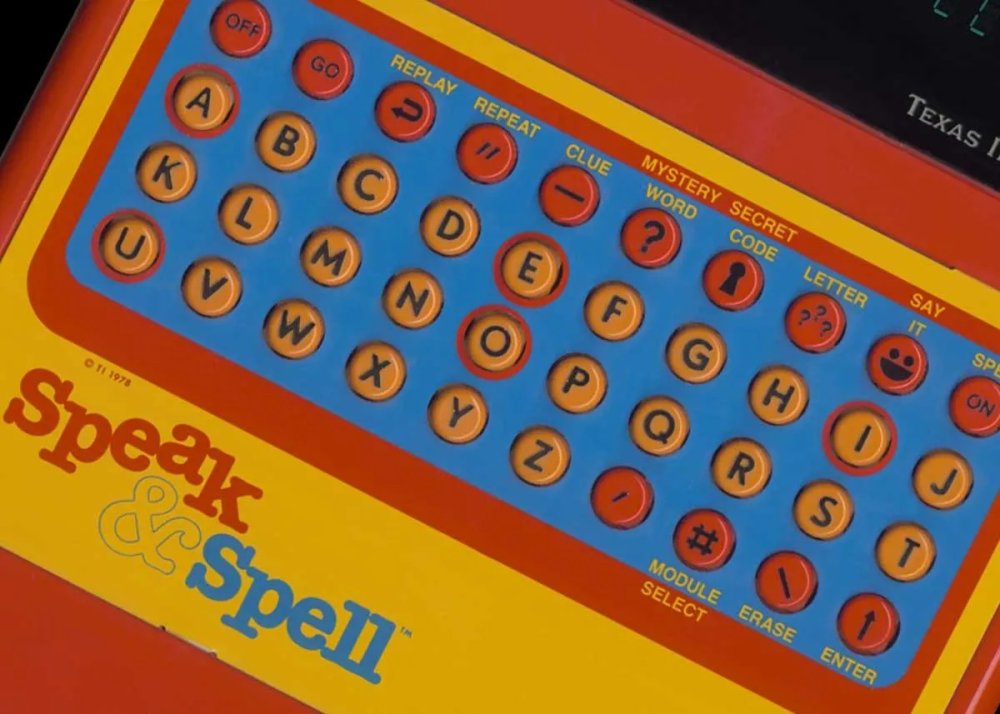
The classic Speak & Spell was immediately recognisable. There was the chunky red plastic casing, the little display towards the top, the large speaker grille and the unmistakable keyboard beneath it.
It looked halfway between a toy computer and a piece of industrial equipment somebody had accidentally painted red.
And that was part of the appeal.
This was the era when computers still looked like computers. Buttons were physical. Speakers were visible. Displays were small enough that every character felt precious. You could understand roughly what each section of the machine was there to do simply by looking at it.
Speak & Spell wasn't pretending to be anything else.
It was a machine, and machines were exciting.
The Voice That Nobody Forgot
You could probably show a photograph of Speak & Spell to someone who owned one and get an immediate reaction.
Play them the voice and the memories come back even faster.
The synthetic speech is one of the defining sounds of 1980s childhood technology. It was understandable, but unmistakably artificial. Words emerged in a clipped electronic drawl, with strange stresses and pauses that made ordinary vocabulary sound faintly threatening.
A perfectly innocent spelling exercise could suddenly sound as though you were receiving instructions from the computer controlling a secret underground bunker.
This was not an accidental side effect of cheap audio playback. Generating intelligible speech electronically was a serious engineering challenge at the time. Texas Instruments used speech synthesis technology that modelled characteristics of human speech while requiring far less storage than keeping conventional recordings of every word. The original machine could work with hundreds of words despite the severe memory limitations of late 1970s electronics.
Of course, none of that concerned the average child.
We just knew it sounded weird.
And naturally, once the educational possibilities had been explored for approximately seven minutes, the obvious next task was to discover how ridiculous you could make it sound.
That particular instinct appears to be hard-coded into children.
When Educational Toys Actually Felt Exciting
The words "educational toy" can strike fear into a child's heart.
They often suggest an object bought by an optimistic relative who believes you would genuinely prefer practising multiplication to receiving something with lasers, spaceships or wheels.
Speak & Spell somehow escaped that problem.
Yes, it wanted you to learn spelling. There was no hiding the fact. Its intentions were clearly educational.
But it did the teaching using technology that was exciting enough to compensate.
That distinction mattered.
You weren't simply completing an exercise sheet. The machine was interacting with you. It spoke. You responded. It checked the answer and reacted.
That feedback loop seems completely normal now, but it felt fresh when home electronics were still finding their way into children's everyday lives.
Electronic toys had begun doing something more interesting than merely flashing lights and producing noises. They were starting to respond.
Speak & Spell felt almost intelligent.
Obviously it wasn't sitting there contemplating the mysteries of consciousness while waiting for you to spell "because". Its capabilities were extremely narrow. But to a child encountering speech synthesis for the first time, the distinction wasn't terribly important.
The box knew words.
That was enough.
Using a Speak & Spell in the 1980s
There was a wonderfully deliberate quality to using old electronic toys.
Nothing happened in the background. There were no notifications, updates, accounts, subscriptions or requests for permission to access your contacts.
You switched the thing on.
It made a noise.
You started pressing buttons.
That was basically the entire onboarding process.
With Speak & Spell, the machine would give you words to spell and you entered them using the keyboard. The small display provided visual feedback while the electronic voice handled the spoken side of proceedings.
The original machine was designed around a vocabulary of commonly misspelled words, turning spelling practice into something closer to a game than a conventional lesson.
The keyboard was part of the experience
Anyone raised entirely on glass touchscreens may struggle to appreciate how satisfying physical buttons used to be.
Speak & Spell's keyboard invited pressing.
This was not delicate precision engineering. You weren't composing a novel on it. It was a child's interface designed to withstand repeated prodding while sitting on the floor.
That physicality is an important part of why old toys trigger such strong memories.
You remember how they felt.
You remember the pressure required to activate a key. You remember the plastic. You remember the little screen changing. You remember holding the machine with one hand while stabbing impatiently at the letters with the other.
Modern interfaces are infinitely more capable, but almost everything happens on the same smooth rectangle.
Old electronics had texture.
And then there were the mistakes
The educational bit also gave Speak & Spell an unusual power relationship.
The machine was judging you.
Get the spelling right and all was well.
Get it wrong and that electronic voice was there to let you know.
There is something particularly humiliating about being corrected by a red plastic box.
Especially when you were absolutely certain you had got the word right.
Even more especially when your brother or sister was watching.
Speak & Spell Was Properly Futuristic Technology
It's easy to underestimate the technical importance of Speak & Spell because we now encounter synthetic voices everywhere.
Cars talk.
Televisions talk.
Sat-navs talk.
Phones can read entire books aloud.
Your washing machine can probably communicate with the internet for reasons nobody has satisfactorily explained.
In 1978, putting recognisable electronically generated speech into a relatively compact consumer product was a very different proposition.
Speak & Spell emerged from Texas Instruments' research into speech synthesis. Its technology used digital signal processing techniques to reproduce speech from compact digital information, rather than relying on stored conventional audio recordings. Its speech technology later received recognition from the IEEE as an engineering milestone.
That makes the humble red spelling toy considerably more important than it first appears.
Millions of children encountered advanced speech technology without having the slightest idea that they were doing so.
It was simply the thing on the bedroom floor asking them to spell words.
That is often how genuinely transformative technology enters everyday life. Not with a lecture about processors or algorithms, but disguised as something fun.
The Red Plastic Design Became an Icon
Speak & Spell could probably have been beige.
Thankfully, it wasn't.
The bold red casing is inseparable from the product's identity. It gave the machine enormous visual presence, especially in an era when many electronic devices appeared determined to explore every possible shade between brown and grey.
Against that backdrop, Speak & Spell looked cheerful and modern.
The layout was gloriously functional.
Display at the top.
Speaker where you could see it.
Controls beneath.
Keyboard occupying much of the lower section.
Nothing was hidden because there was nowhere to hide anything.
Compare that with modern technology, where designers work extremely hard to make the technology itself disappear. Buttons are removed. Speakers vanish into tiny slots. Ports are concealed. Interfaces become blank black sheets of glass.
Speak & Spell celebrated the fact that it was electronic.
You could see where the sound came from.
You could see where the words appeared.
You could see exactly which buttons you were pressing.
It looked like equipment.
For a child in the early 1980s, that was far more exciting than sleek minimalism.
The Cartridge Slot Made It Feel Like a Computer
Another particularly clever feature was the ability to expand the system using interchangeable learning modules.
This was a familiar concept in the emerging world of video games, where cartridges transformed a console into something new simply by plugging in another piece of plastic. Speak & Spell used a related idea for additional educational content, with ROM-based modules extending what the machine could do.
That made it feel less like a fixed electronic toy and more like a little platform.
You owned the machine, but there was always the possibility of adding something else.
To an adult, this was expandable educational content.
To a child, it was cartridges.
Cartridges automatically made anything approximately 34 per cent more exciting.
There was something wonderfully substantial about them. You physically changed what a machine could do by inserting another object into it.
No downloads. No menus. No licence agreements.
Push cartridge into slot. Machine now knows new things.
Perfect.
A Very American Toy That Fitted British Childhood Surprisingly Well
Speak & Spell was created by an American technology company and its character was unmistakably American, particularly its electronic voice.
Yet it became familiar in British homes too, sitting comfortably alongside the other imported technology filling children's bedrooms during the period.
That was increasingly normal during the 1980s.
A British child's collection of technology might contain a Japanese cassette player, an American electronic learning toy, a British home computer and a television assembled from components that had travelled halfway around the planet.
Nobody thought much about it.
The toys simply became part of childhood.
Speak & Spell fitted particularly well into that world because it occupied a strange middle ground between toy and computer.
British children were becoming increasingly comfortable with keyboards by the early 1980s. Home computers such as the ZX Spectrum, BBC Micro and Commodore 64 were turning typing into something children actually wanted to do.
Suddenly a keyboard didn't automatically mean office work.
A keyboard could mean games.
A keyboard could mean programming.
A keyboard could mean making something happen on a screen.
Speak & Spell benefited from exactly that sense of possibility.
It Was Part Toy, Part Teacher, Part Robot
One reason Speak & Spell remains so memorable is that it never sat neatly in one category.
It wasn't quite a computer.
It wasn't exactly a game.
It wasn't simply a toy.
And although it was educational, it didn't resemble traditional educational material.
It was all of those things at once.
That ambiguity made it interesting.
Parents could justify buying it because it taught spelling.
Children could enjoy it because it was an electronic gadget that talked.
Toy companies have been attempting to achieve that perfect combination ever since.
Make something parents think is good for children while ensuring children don't immediately recognise the educational ambush.
Speak & Spell pulled it off better than most.
Then E.T. Made It Even More Famous
Speak & Spell gained an enormous piece of popular culture immortality through E.T. the Extra-Terrestrial.
In the 1982 film, components from a Speak & Spell are used as part of E.T.'s improvised communication device for contacting home.
For anyone who already owned one, seeing that familiar red machine involved in alien telecommunications was spectacular.
Apparently it wasn't just for spelling after all.
It could phone space.
This was exactly the sort of thing children needed to see.
A toy appearing in a hugely popular film could instantly acquire another layer of magic, especially before films could be endlessly replayed online within minutes of release.
Objects on screen became objects of fascination.
And Speak & Spell already looked sufficiently unusual to pass as part of improvised extraterrestrial technology without much help.
Even today, its association with E.T. is one of the reasons people who never actually owned a Speak & Spell still recognise it.
The Strange Afterlife of the Speak & Spell Voice
The story could easily have ended when the original Texas Instruments era of Speak & Spell finished in the early 1990s.
Instead, the machine developed a second life.
Its peculiar electronic speech became interesting precisely because technology had moved on.
Once realistic digital audio became commonplace, that unmistakably artificial voice stopped sounding like an imperfect attempt at realism and started becoming a character in its own right.
Musicians and electronics enthusiasts discovered that children's talking toys could be modified to produce unusual sounds. Speak & Spell became particularly associated with circuit bending, where electronic devices are deliberately altered to make noises their designers never intended.
This feels entirely appropriate.
The machine spent its first life teaching children to spell.
Its retirement involved being rewired to make deranged electronic noises.
We should all hope for such an interesting second career.
Why Speak & Spell Feels So Different From Modern Educational Technology
A modern equivalent of Speak & Spell would be vastly more capable.
It could recognise speech.
It could contain an effectively unlimited vocabulary.
It could adapt lessons to individual children.
It could pronounce words naturally in multiple languages.
It could connect to online services, track progress and display colourful animations on a high-resolution touchscreen.
Technically, there is no contest.
Emotionally, things become more complicated.
Speak & Spell had limitations you could understand.
Its entire world existed inside the machine.
There was a fixed selection of activities. The display could only show so much. The voice had its peculiar character. The keyboard was the keyboard.
And because those limitations were consistent, you got to know the device.
That is something many people miss about old technology.
We didn't merely use it. We learned its personality.
You knew exactly how your cassette deck behaved when a tape was beginning to drag.
You knew which part of a joystick needed extra pressure.
You knew how long your computer took to load a particular game.
And you knew the peculiar rhythms of the Speak & Spell voice.
Imperfection creates memories.
Why Original Speak & Spell Toys Are Collectible Today
It isn't difficult to understand why original examples have become desirable pieces of retro technology.
First, they look fantastic.
A classic red Speak & Spell sitting on a shelf is unmistakably a product of its period. You don't need to explain what decade it came from.
Second, working examples provide something static collectables cannot.
They perform.
Switch one on and the memory is immediately stronger because sound is such a powerful trigger. Seeing an old toy is nostalgic. Hearing one can transport you straight back to a particular room.
Original packaging and accessories can naturally make surviving examples more appealing to collectors, as can good cosmetic condition. Working electronics matter too, especially with devices that may now be several decades old.
Speak & Spell also has broader appeal than many childhood toys because it occupies several collecting categories at once.
It interests toy collectors.
It interests retro computing enthusiasts.
It interests people fascinated by electronic music and speech synthesis.
It interests anyone building a collection of iconic 1970s and 1980s technology.
And, of course, it interests people who simply see one and immediately think, "I had one of those."
Sometimes that is the strongest collecting motivation of all.
There Really Was Nothing Else Quite Like It
Plenty of toys are remembered because they were popular.
Speak & Spell is remembered because it was distinctive.
The colour.
The shape.
The keyboard.
The little display.
The speaker.
And above everything else, that voice.
It belongs to a particular period when consumer electronics still felt slightly mysterious. The machines around us were becoming clever enough to surprise us, but not so advanced that their abilities seemed routine.
A toy saying a word aloud was an event.
A computer producing speech was something you showed another person.
Technology hadn't yet become invisible background infrastructure. It still had the ability to make a room stop and pay attention.
Speak & Spell arrived at exactly the right moment.
Speak & Spell Still Sounds Like the Future We Imagined
The amusing thing about old visions of the future is that they rarely resemble the future we actually get.
We expected talking computers, and we certainly got them.
We just didn't expect the talking computer to live inside a thin glass rectangle containing our banking app, family photographs, railway tickets, newspaper, camera, record collection and an endless supply of videos of dogs refusing to get into baths.
The future imagined by Speak & Spell was much more charming.
Computers would talk, certainly, but they would still have enormous buttons.
They would have visible speakers.
They would come in bright red plastic.
And presumably they would spend much of their processing power checking children's spelling.
Perhaps that future wasn't quite as efficient.
It looked a lot more fun.
The Talking Red Box We Never Quite Forgot
For something originally intended to teach children how to spell, Speak & Spell achieved an extraordinary amount.
It helped bring advanced speech synthesis technology into ordinary homes. It appeared in one of the defining films of the 1980s. It became a musical curiosity, a collector's item and a design icon.
More importantly, it became part of people's childhoods.
That's why Speak & Spell still matters.
You don't need to remember which words it asked you to spell. You probably don't remember your scores. You may not even remember exactly when you got it.
But you remember the red plastic.
You remember pressing those buttons.
And you definitely remember the voice.
If that has just dragged a forgotten corner of your childhood back into focus, join RetroWins or sign up to stay in the loop for more stories about the gadgets, computers, toys and technology we still haven't quite managed to forget.






