There was a time when getting a computer for Christmas did not mean opening a slim silver laptop, typing in a Wi-Fi password and immediately checking YouTube.
It meant clearing a space beside the television, discovering that nobody could find the aerial lead, arguing about which channel the computer was supposed to be tuned into and then spending several minutes staring at a flashing cursor while someone studied the manual.
Welcome to the wonderfully awkward world of 1980s home computers.
For a generation growing up in Britain, machines such as the ZX Spectrum, Commodore 64 and BBC Micro were our first proper encounter with computing. They were games machines, programming laboratories, homework assistants and mysterious beige or black boxes that seemed capable of almost anything, provided you had sufficient patience and a reliable cassette recorder.
And patience was certainly required.
Games took minutes to load. Software occasionally crashed just as it appeared to be working. Instructions were frequently baffling. Storage came on cassette tapes and floppy disks rather than invisible clouds. Yet somehow none of this made computers less exciting.
It probably made them more exciting.
These are some of the greatest 1980s home computers we remember plugging into televisions, using at school, fighting over with siblings and spending far too many hours playing.
The 1980s Home Computer Revolution
It is difficult to explain to somebody who grew up with smartphones just how futuristic having a computer at home once felt.
Before the home computer boom, computers generally belonged to universities, businesses and the sort of laboratories television programmes depicted as rooms filled with blinking lights.
Then suddenly they were appearing in WHSmith, Boots, Dixons and the pages of mail-order catalogues.
Better still, some were becoming affordable enough that ordinary families could realistically contemplate buying one.
British bedrooms began filling with strange new names: Sinclair, Acorn, Amstrad, Commodore, Atari.
Children who had never previously shown the slightest interest in computer science became extremely knowledgeable about RAM, joysticks and the relative merits of different loading systems.
Admittedly, most of this sudden technical enthusiasm was motivated by a desire to play Manic Miner.
But it still counted.
The great thing about early home computing was that these machines encouraged you to experiment. Turn on many 1980s computers without loading software and you were presented with a programming environment.
There was no desktop.
No app store.
No helpful collection of icons.
Just a flashing cursor sitting there expectantly, almost daring you to do something useful.
And so we did.
Or at least we typed:
10 PRINT "HELLO"
20 GOTO 10
Then watched our television fill with HELLO until somebody told us to stop messing about.
We were practically software engineers.
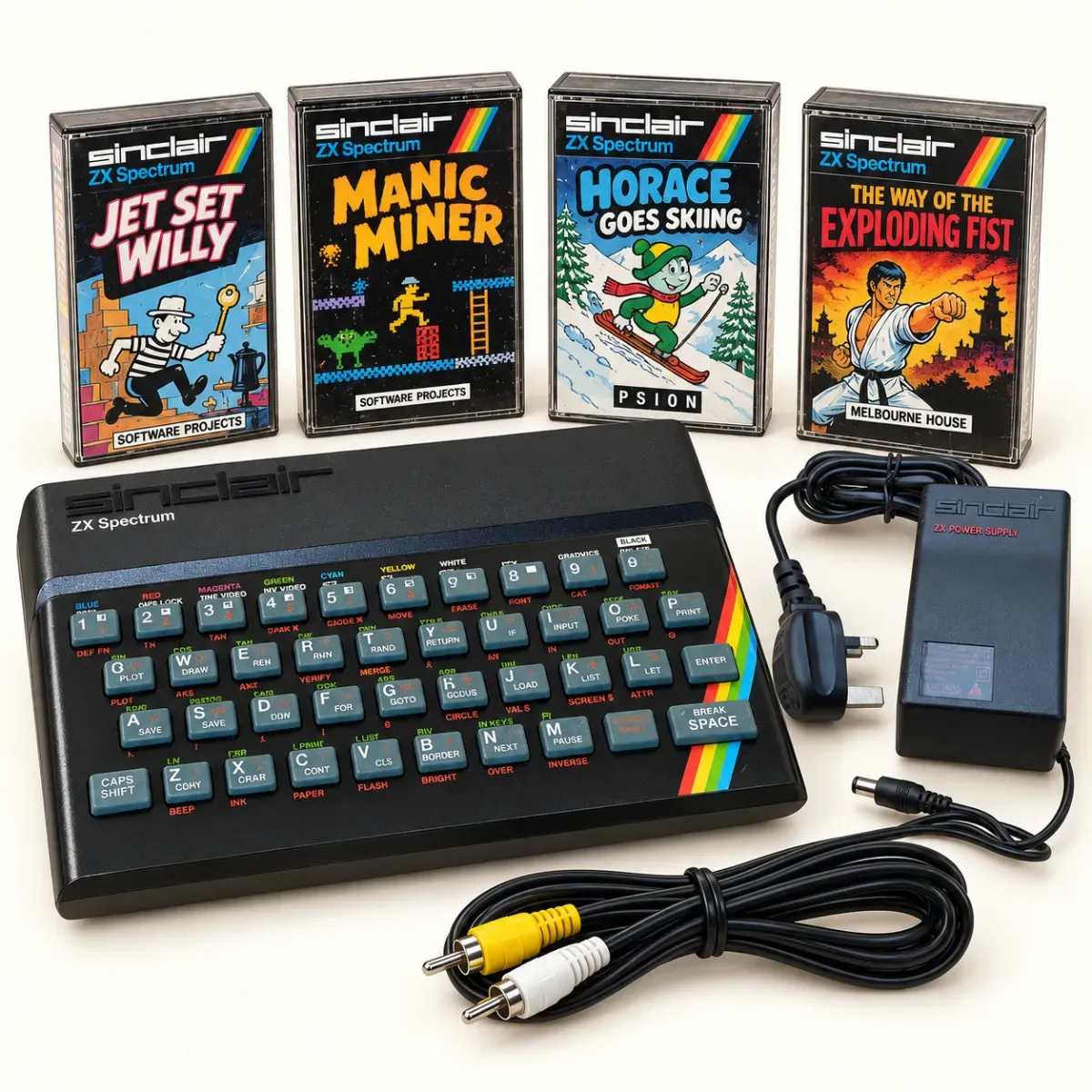
Sinclair ZX Spectrum
Few computers trigger British nostalgia quite like the Sinclair ZX Spectrum.
Released in 1982, the Spectrum became one of the defining British home computers of the decade. Early models came with either 16K or 48K of memory, although it is the 48K machine that many people picture when somebody simply says "Spectrum".
And what a peculiar little machine it was.
Those Famous Rubber Keys
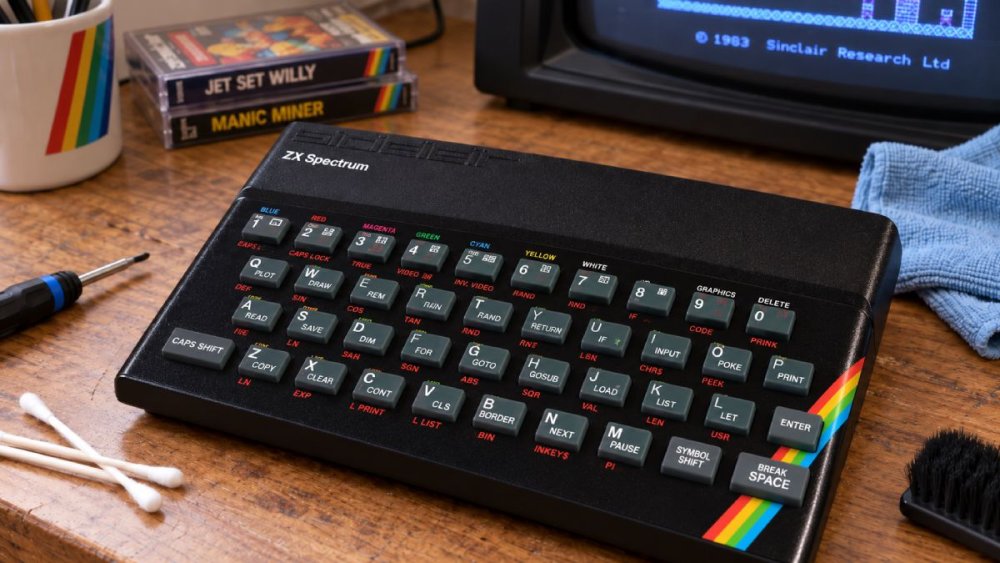
The original Spectrum had a compact black case with tiny grey rubber keys. Even by 1980s standards they were unusual.
Typing anything substantial could feel like trying to write a letter using a calculator covered in Liquorice Allsorts.
The keyboard also contained BASIC programming commands printed around the keys. Rather than typing certain commands letter by letter, you could enter entire keywords using particular key combinations.
It looked completely bewildering at first.
Then, after a few weeks, children somehow knew exactly where everything was.
Modern computers spend enormous effort trying to be intuitive. Spectrum users simply memorised an entire keyboard full of cryptic commands and got on with it.
Waiting For Games To Load
Spectrum software usually arrived on cassette.
This resulted in one of the most distinctive rituals in computing history.
You would put the tape into the cassette player, type the loading command and press play.
Then came the noise.
Screeching, buzzing electronic chaos blasted from the television while coloured loading stripes flickered around the edge of the screen.
It sounded like two fax machines having a furious argument.
Several minutes later, if fortune smiled upon you, the game would appear.
If not, you got an error and started again.
Strangely, the frustration has become part of the nostalgia. Hearing a Spectrum loading sequence today instantly transports many former owners back to sitting cross-legged in front of the family television.
The Games Were Everything
The Spectrum developed an enormous software library.
Jet Set Willy, Manic Miner, Saboteur!, Chuckie Egg, Knight Lore and countless other games became fixtures of British childhood.
Graphically, the Spectrum had its quirks. Its infamous colour attribute system could cause colours from nearby objects to bleed into one another, producing what became known as attribute clash.
At the time it could be irritating.
Today, it is unmistakably Spectrum.
Modern developers deliberately reproduce the effect when creating retro-style games. That is quite an achievement for something that originally existed because of a technical limitation.
Later versions of the Spectrum improved the keyboard and expanded the machine, but the original rubber-key model remains an icon of British computing.
Put one on a table today and almost anybody of the right age will immediately have a story about it.
Commodore 64
If the Spectrum was the archetypal British bedroom computer, the Commodore 64 felt like its slightly more luxurious international cousin.
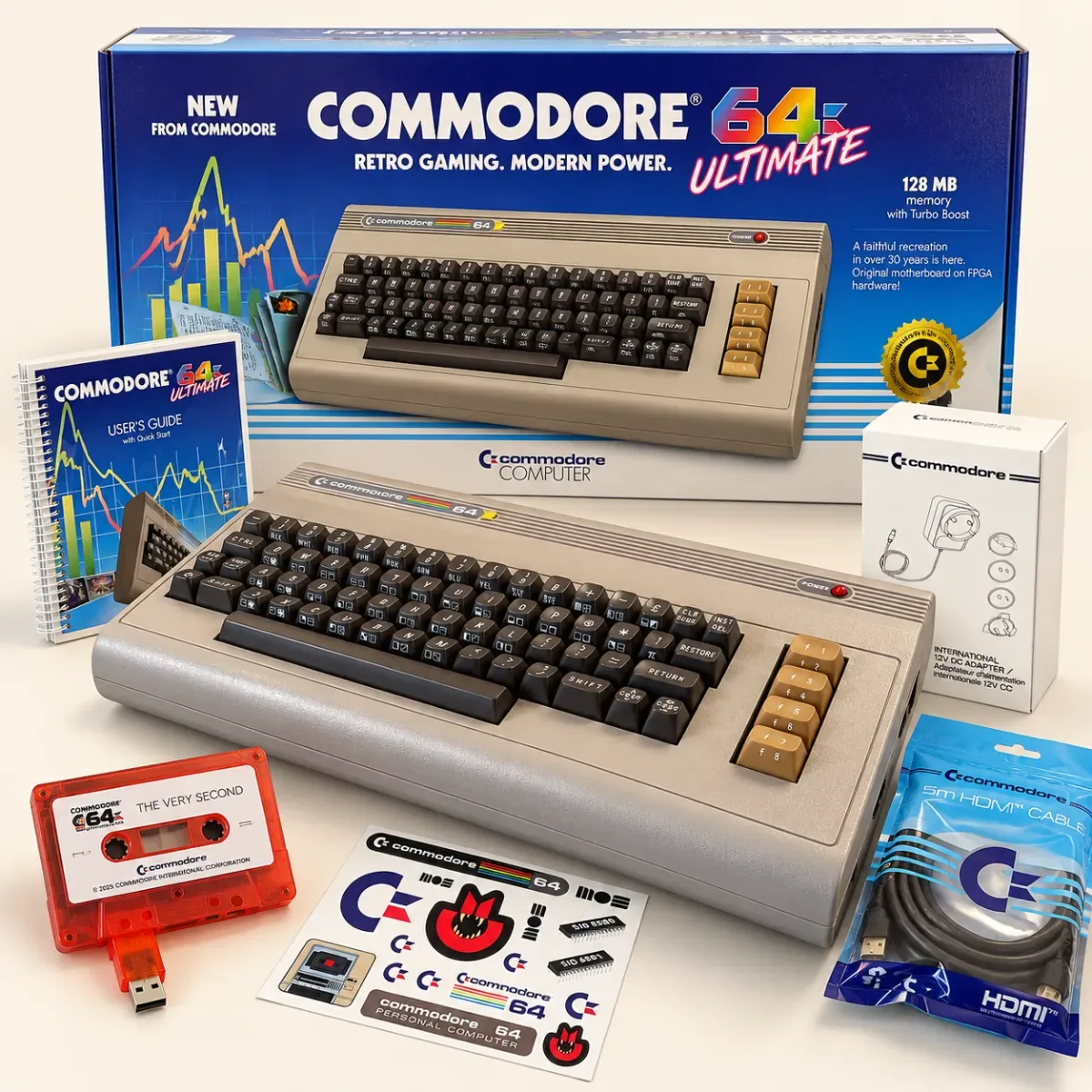
Released in 1982, the C64 offered 64K of RAM, impressive graphics capabilities and, most importantly for many enthusiasts, the wonderful SID sound chip.
Those capabilities gave Commodore games a personality all their own.
That Chunky Bread Bin
Early Commodore 64 machines had a distinctive rounded beige case that earned them the nickname "bread bin".
Compared with the tiny Spectrum, it looked substantial.
This felt like serious equipment.
The keyboard was also a proper keyboard rather than a collection of rubber buttons, which made typing programs considerably more pleasant.
Of course, most children were not lobbying their parents for a Commodore 64 because of its superior typing experience.
They wanted the games.
The Soundtrack Was Half The Experience
The C64 became famous for its music.
Composers and programmers learned to coax extraordinary sounds from the SID chip, creating game music that people still listen to today.
Titles such as International Karate, The Last Ninja and Monty on the Run became memorable partly because of their soundtracks.
C64 music did not merely beep politely in the background.
It had character.
Bass lines buzzed, melodies swooped and electronic drums rattled away while tiny sprites fought, jumped or drove across the television screen.
Decades later, there is an entire community devoted to remixing and preserving Commodore music.
Not bad for sounds produced by a computer with less memory than a small modern photograph.
Cassette Versus Disk
In Britain, many Commodore 64 owners used the Datasette cassette system, which meant another generation became familiar with the joys of long loading times.
Disk drives were available and could be much more convenient, but they were not necessarily something every household owned.
There was therefore plenty of time for tea, arguments or wandering off and forgetting you had started loading anything.
Some games attempted to make the wait more tolerable with loading screens and music.
Today, if Netflix takes five seconds longer than expected to start, we suspect civilisation may be collapsing.
We have changed.
BBC Micro
The BBC Micro occupies a slightly different place in British nostalgia because an enormous number of people first encountered one at school.
You might not have had a BBC Micro at home.
Your school probably seemed to have one.
Sometimes literally one.
A whole class could gather around it while the teacher attempted to demonstrate the thrilling future of computing.
The Computer At The Front Of The Classroom
The BBC Micro was created by Acorn Computers as part of the BBC Computer Literacy Project and first appeared in the early 1980s.
It was considerably more expensive than some rivals, which helped explain why many children knew it primarily from school.
Its sturdy case and excellent keyboard made it feel almost industrial beside machines such as the Spectrum.
BBC BASIC was particularly well regarded, and the computer became an important tool for teaching programming.
For pupils, however, educational respectability was only half the story.
Because the BBC Micro could also play Elite.
Elite Changed What Computer Games Could Be
Released in 1984, Elite was extraordinary.
Instead of offering a simple sequence of levels, it presented the player with a vast space-trading universe. You could buy and sell goods, improve your ship and travel between star systems.
Its wireframe 3D graphics look extremely simple now, but the sense of scale was remarkable.
Elite demonstrated something important about 1980s home computers: imagination frequently mattered more than graphical realism.
You were not looking at a cinematic recreation of space.
You were looking at a handful of white lines.
Yet somehow those lines became spaceships.
For thousands of players, they became an entire universe.
And Then There Was Granny's Garden
If you attended a British primary school during the right period, another title may be permanently lodged somewhere in your memory.
Granny's Garden.
Created for the BBC Micro, it was an educational adventure game involving witches, puzzles and kidnapped children.
For reasons nobody fully understands, British schools collectively decided that children should learn computer skills while being psychologically terrorised by an evil witch.
It certainly made lessons memorable.
Amstrad CPC 464
The Amstrad CPC 464 arrived in 1984 and took a refreshingly straightforward approach to home computing.
Rather than making customers assemble a computer, cassette recorder and suitable television from various corners of the house, Amstrad sold a complete package.
Computer, keyboard, cassette deck and monitor.
Lovely.
Even the cassette recorder was built into the computer itself.
Everything In One Box
For parents who found the emerging home computer market confusing, this was an attractive proposition.
You did not need to work out which tape recorder was compatible.
You did not need to occupy the family television.
The CPC came with its own monitor, available in colour or green screen versions.
That made the entire setup feel wonderfully professional.
A green screen CPC sitting on a desk looked like the sort of machine that ought to be handling payroll for a multinational corporation.
In reality, somebody was probably playing Roland in Time.
An Underrated Games Machine
The Amstrad CPC sometimes gets squeezed out of nostalgic conversations dominated by Spectrum and Commodore owners, but it developed a substantial library of games.
Because many titles appeared across all three platforms, playground arguments inevitably followed.
Spectrum owners insisted their version was best.
Commodore owners mentioned the sound.
Amstrad owners pointed at their monitor and looked smug.
There was no universally correct answer, which is fortunate because those arguments have now been running for approximately four decades.
Later CPC models introduced disk drives and other improvements, but the 464 remains one of the most recognisable computers of the period.
Especially if you can still remember the satisfying clunk of putting a cassette into that built-in deck.
Acorn Electron
The Acorn Electron was intended to bring some of the BBC Micro experience into homes at a lower price.
Released in 1983, it shared similarities with the BBC Micro and could run a selection of software associated with its bigger sibling, although hardware differences meant compatibility was not universal.
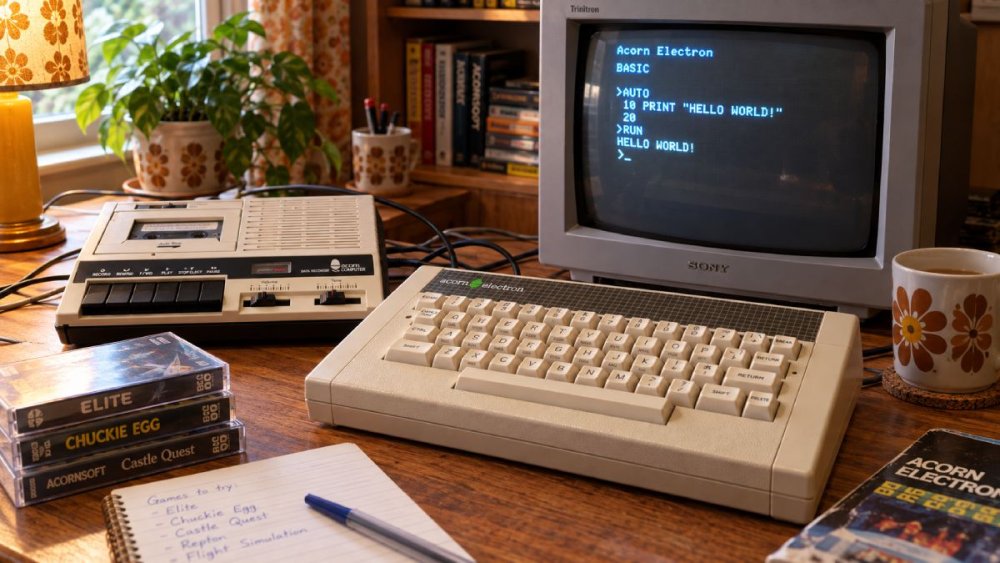
The Electron had an appealingly clean design, with a proper keyboard and a compact case.
It was one of those machines that looked rather sensible.
Possibly too sensible.
While the Spectrum looked like a futuristic toy and the Commodore 64 resembled something stolen from an office, the Electron looked as though it might politely remind you to complete your homework.
Yet it had plenty of fans.
For children familiar with BBC computers at school, having an Electron at home provided a reassuring connection between classroom computing and bedroom gaming.
And, like so many 1980s home computers, it encouraged owners to do more than simply consume software.
The machine sat there waiting to be programmed.
You could buy magazines containing pages of BASIC code, type the whole thing in manually and discover three hours later that you had made a mistake somewhere around line 370.
Finding it was character building.
Apparently.
Atari 8-bit Computers
Atari is usually associated with consoles such as the Atari 2600, but its 8-bit computer family deserves a place in any discussion of classic home computing.
Machines including the Atari 400, Atari 800 and later XL models offered impressive graphics and sound for their time.
The Atari 400 was particularly distinctive because of its flat membrane keyboard.
Calling it a keyboard was generous.
It was technically possible to type on it, in much the same way it is technically possible to eat soup with a fork if you possess enough determination.
The Atari 800 offered a more conventional keyboard and a more expandable design.
These machines never dominated the British home computer market in the way Sinclair and Commodore did, but they developed a loyal following.
Atari's experience in video games was obvious. Games moved smoothly, colours were vibrant and some titles looked remarkably sophisticated beside software running on competing systems.
Owners knew they had something slightly different.
And being the child with the unusual computer occasionally had advantages. Everyone wanted to come round and see it.
Dragon 32
The Dragon 32 is one of those names that can instantly unlock a memory.
Produced in Wales and launched in 1982, it arrived during the wild early years of Britain's home computer boom.
With 32K of memory and a sturdy keyboard, the Dragon looked like a serious piece of equipment.
It was compatible with a range of peripherals and had similarities to the Tandy TRS-80 Color Computer due to shared underlying technology, although the machines were not completely software compatible.
The Dragon never achieved the enormous success of the Spectrum or Commodore 64, but that almost makes surviving examples more interesting now.
If your family owned one, you probably remember being slightly outside the mainstream.
Your friends arrived clutching Spectrum tapes that were completely useless to you.
Magazine racks contained pages and pages devoted to other machines.
You became fiercely defensive.
"Actually, the Dragon is better."
This is how computer tribalism begins.
Sinclair ZX81
Technically, the ZX81 arrived in 1981, before the Spectrum, and it deserves recognition as one of the computers that helped make home computing affordable in Britain.
By modern standards, its specifications sound almost comical.
The standard machine had 1K of RAM.
One kilobyte.
You could comfortably write the contents of its entire standard memory on a few modern social media posts.
Yet concentrating purely on specifications misses the point.
For many owners, the ZX81 was the first computer they had ever touched outside a workplace or educational establishment.
That was astonishing.
The Infamous Wobbly RAM Pack
Owners could expand the machine's memory using an external RAM pack.
Unfortunately, the connection could be temperamental.
Knock the computer, disturb the RAM pack or possibly breathe too enthusiastically nearby and you risked losing your work.
The phenomenon became so notorious that "RAM pack wobble" entered computing folklore.
This should have made people hate the machine.
Instead, many remember it with enormous affection.
Because the ZX81 embodied something magical about the era. It did not give you very much, but what it gave you felt completely new.
You could program a computer.
At home.
On your television.
That was enough.
Apple II
While British bedrooms became battlegrounds for Sinclair, Commodore and Acorn, the Apple II had already established itself as an enormously influential personal computer.
First introduced in the late 1970s, the Apple II family remained important throughout the 1980s.
It was far more expensive than the budget home computers appearing in Britain, so it occupied a different part of the market here.
Still, its influence was enormous.
Apple II computers were used for games, education, programming and business applications. Software such as VisiCalc demonstrated that personal computers could be genuinely useful rather than simply interesting electronic curiosities.
For British children gazing at £100-ish home computers in catalogues, an Apple could seem like something from a more serious computing universe.
It is interesting to look at one today and trace the family tree.
The modern MacBook, iPhone and iPad ultimately belong to a story that includes these comparatively primitive early machines.
Although thankfully Apple no longer expects you to store your apps on floppy disks.
Commodore VIC-20
Before the Commodore 64 became a household name, there was the VIC-20.
Introduced in 1980 and arriving in Britain shortly afterwards, the VIC-20 helped Commodore establish itself in the emerging home computer market.
It had far less memory than the later C64, but this was a period when manufacturers could proudly advertise computers containing amounts of RAM we would now consider insufficient for displaying a restaurant menu.
What mattered was that ordinary people could buy one.
The VIC-20 had a friendly, approachable feel. It connected to a television, accepted cartridges and cassette software, and could be programmed in BASIC.
For some families it was the gateway machine, the computer that arrived before somebody later upgraded to a Commodore 64.
That upgrade felt enormous.
Suddenly there was more memory, better graphics, that superb SID sound and an expanding universe of increasingly ambitious games.
Why Computer Magazines Were Almost As Important As The Computers
Owning a home computer in the 1980s frequently meant buying magazines.
Lots of magazines.
Newsagents carried shelves filled with titles dedicated to specific machines and broader computing interests.
Your monthly magazine might contain reviews, tutorials, news, hints, letters and pages of program listings.
Those listings deserve special recognition.
Before instantly downloading software became possible, magazines literally printed programs on paper.
You typed them yourself.
Sometimes they occupied several pages.
This was fine until you reached the end, typed RUN and received:
SYNTAX ERROR
Wonderful.
You would then compare hundreds of lines against the magazine trying to find the missing comma responsible for destroying your evening.
Yet those listings taught people something.
Even children who only wanted the game were being exposed to programming syntax, variables, loops and logic.
You might start by blindly copying code.
Then you changed a number.
Something happened.
Change another number.
Something else happened.
Before long you understood why.
That accidental route into programming launched plenty of careers.
Playground Piracy And The C90 Cassette
Another authentic feature of 1980s home computers was the mysterious appearance of blank cassette tapes containing suspiciously large collections of games.
The humble C90 became a powerful distribution platform.
A friend knew somebody whose brother had copied something from somebody else.
Soon a cassette arrived with tiny handwritten titles squeezed onto the label.
Nobody had any idea where half the games came from.
Finding the correct program involved using the tape counter, winding backwards and forwards, pressing play and hoping.
Software piracy was a serious issue for publishers, of course, but culturally the swapping of tapes became deeply woven into the home computer era.
Games spread around playgrounds with extraordinary speed.
So did rumours.
"My cousin has a game where you can drive anywhere in Britain."
"He says there's a secret level."
"If you type this code you get infinite lives."
Most of these claims were nonsense.
It was effectively the internet without the useful part.
Joysticks That Could Survive Almost Anything
Modern controllers contain analogue sticks, motion sensors, touchpads, rechargeable batteries and enough electronics to communicate with satellites.
The classic 1980s joystick contained a stick and a button.
Sometimes two buttons, although they often did exactly the same thing.
And it was brilliant.
Names such as Competition Pro and QuickShot became familiar to home computer owners.
The best joysticks felt satisfyingly mechanical. You could hear switches clicking as you moved.
Certain games demanded such frantic movement that playing them looked like an attempt to start an outboard motor.
Daley Thompson's Decathlon became particularly notorious for joystick punishment.
Waggle left.
Waggle right.
Repeat at maximum speed.
Eventually either your athlete crossed the line or the joystick required medical attention.
Why These Old Computers Felt So Personal
Modern technology is enormously more capable than anything available in the 1980s.
That comparison is almost meaningless.
A modern smartphone can perform tasks that would have seemed absurd when the Spectrum appeared.
Yet something about early home computers felt unusually personal.
Perhaps it was because you had to learn their peculiarities.
You knew exactly how your cassette recorder behaved.
You knew which joystick connection was unreliable.
You knew how far to adjust the volume knob to make a difficult game load.
You knew that one particular tape usually failed the first time.
Machines had quirks.
Owners developed rituals.
Even the limitations became familiar.
There was also less separation between the user and the machine. Turn on a Spectrum, BBC Micro or Commodore and programming was sitting right there.
The computer invited experimentation.
Nobody needed to install a development environment or create an online account.
You could simply start typing.
That accessibility helped create an extraordinary generation of bedroom programmers, particularly in Britain.
Small teams and individuals created games that could become national hits.
The British games industry owes an enormous debt to those bedrooms.
Collecting 1980s Home Computers Today
Interest in vintage computers has grown dramatically as the people who originally owned them have reached the age where nostalgia and disposable income occasionally overlap.
A dangerous combination.
One minute you are looking at photographs of your childhood Spectrum.
The next you are explaining to your partner why a 40-year-old computer has arrived in the post.
Collectors seek original machines, boxed examples, peripherals, games, manuals and magazines.
Condition matters, particularly because ageing electronics can develop faults.
Old power supplies, capacitors, cassette mechanisms, keyboards and disk drives may all require attention.
That is part of the appeal for some enthusiasts.
Restoring an old machine combines nostalgia with detective work. Getting one running after decades of inactivity can be enormously satisfying.
Then there is the smell.
Old electronics have a smell.
It is impossible to describe without sounding slightly unhinged, but anybody who collects vintage computers knows exactly what we mean.
Cardboard packaging, warm electronics, ageing plastic and old manuals somehow combine into pure 1983.
Emulation Is Brilliant, But The Hardware Still Matters
You do not actually need an original computer to enjoy most 1980s software today.
Emulators can recreate classic machines with remarkable accuracy.
There are modern recreations, miniature systems and FPGA-based devices too.
They are convenient, reliable and much easier to connect to current televisions.
But original hardware offers something software cannot quite reproduce.
The keyboard.
The loading noises.
The slightly fuzzy picture.
The cassette deck.
The clunk of a power switch.
The sense that this small plastic box really is doing everything itself.
Playing a Spectrum game on a modern computer is entertaining.
Loading that same game from cassette onto an actual Spectrum feels like opening a tiny portal back to childhood.
Admittedly, it is a portal that takes six minutes to open and may display an error when you get there.
Still counts.
The Greatest 1980s Home Computers Were More Than Games Machines
It would be easy to remember these computers purely through their games.
Games were certainly central to their appeal, but the machines represented something bigger.
They put computing into ordinary homes.
They made children curious about programming.
They introduced families to concepts that would later become completely routine.
Files.
Memory.
Software.
Input devices.
Digital graphics.
Computer networks were still exotic to most people, and the idea that one day almost every household object would somehow be connected to the internet would have sounded ridiculous.
Yet the foundations were being laid.
A child sitting in front of a ZX Spectrum typing a BASIC program was learning that computers were not mysterious machines hidden in laboratories.
They were tools.
Better still, they were tools you could control yourself.
Why We Still Love Them
Ask ten people to name the greatest 1980s home computers and you will probably start an argument.
Spectrum owners will defend the Spectrum.
Commodore owners will explain, yet again, why the SID chip settles everything.
BBC Micro fans will mention build quality and BASIC.
Amstrad owners will remind everyone that they got a monitor.
Dragon owners will simply be pleased somebody remembered the Dragon.
There does not need to be a winner.
What makes this era special is the variety.
Computers looked different, sounded different and behaved differently. Each had its own community, magazines, software and personality.
You did not simply own "a computer".
You owned a Spectrum.
Or a Commodore.
Or an Amstrad.
And whichever machine sat beneath your television was obviously the correct one.
Looking back, the inconveniences are some of the things we remember most fondly. Waiting for tapes. Fighting with joysticks. Typing programs from magazines. Watching loading screens. Discovering a new game. Seeing graphics that looked astonishing until somebody from another school claimed their computer could do them better.
The technology was primitive by modern standards.
The excitement was anything but.
Perhaps that is why these machines remain so appealing more than four decades later. They remind us of a period when computers still felt mysterious, slightly unpredictable and full of unexplored possibilities.
And sometimes all it takes is the sight of a rubber-key Spectrum or the sound of a Commodore loading screen to bring the whole lot flooding back.
If stories like these have you thinking about computers you had forgotten for decades, join RetroWins and sign up to stay in the loop. We will be revisiting plenty more classic computers, gadgets, electronic toys and wonderfully unnecessary technology from the era when beige plastic ruled the world.