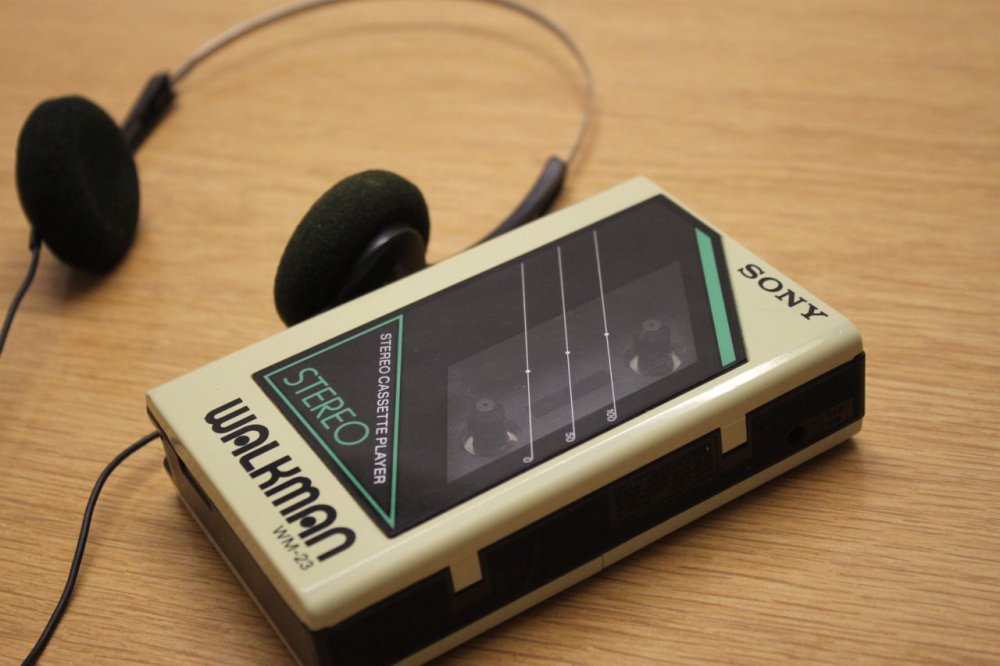
There are certain bits of technology that did more than simply become popular. They changed behaviour.
The Sony Walkman was one of them.
Before portable cassette players became commonplace, listening to music was mostly tied to a location. You had a record player or hi-fi in the living room or bedroom. You might have a radio in the kitchen. There was a cassette player in the car if you were lucky, and probably a bulky radio cassette recorder somewhere in the house with an alarming number of chrome buttons along the top.
Then along came a little box that you could clip to your belt, plug a pair of headphones into and carry around with you.
Suddenly your music could come too.
For teenagers growing up during the 1980s, that was a much bigger deal than it sounds today. We are now used to having tens of millions of songs instantly available from something in our pocket. Back then, taking twelve carefully chosen tracks to the bus stop felt like living in the future.
And it all started with the Sony Walkman.
Before the Sony Walkman, music generally stayed put
Portable radios were nothing new by the end of the 1970s. Transistor radios had already allowed people to carry broadcasts around with them, while portable cassette recorders were widely available.
But they were not quite the same thing.
A radio meant listening to whatever somebody else had decided to broadcast. Portable cassette recorders tended to be designed around recording and playback rather than discreet personal listening. Many were relatively bulky and had built-in speakers.
The idea behind the Walkman was wonderfully straightforward: what if you stripped away the recording equipment, concentrated on good cassette playback and made the whole thing small enough to carry?
Sony launched the original TPS-L2 portable stereo cassette player in Japan in 1979.
It was a distinctive little machine, with a metal case finished in blue and silver, chunky controls and two headphone sockets. That second socket was part of an early idea that portable listening could still be sociable. Two people could plug in their headphones and listen together.
There was even a button that reduced the music level and activated a microphone so the wearers could talk without removing their headphones.
Sony soon discovered something rather important.
People did not particularly mind being antisocial.
Give somebody a favourite cassette and a pair of headphones and they were perfectly happy disappearing into their own little musical world.
A new way of listening had arrived.
The Sony Walkman becomes an icon
The Walkman name eventually became far bigger than one particular model.
Sony produced a huge number of Walkman cassette players over the following years, ranging from fairly basic plastic models to beautifully engineered high-end machines. Some were tiny, some had radios, some offered auto reverse, some were water resistant and others became objects of desire in their own right.
More importantly, "Walkman" became the word many people used for the entire category.
Just as people sometimes called any vacuum cleaner a Hoover, plenty of us called almost any personal cassette player a Walkman regardless of the badge on the front.
There were alternatives from Panasonic, Aiwa, Sanyo, Sharp and numerous other manufacturers. There were also cheaper personal stereos from names that have long since vanished into the great electrical shop bargain bin in the sky.
But Sony owned the idea in the public imagination.
If you wanted the real thing, you wanted a Sony.
That little Walkman logo carried status.
What owning a Walkman actually felt like
Specifications only tell part of the story. The interesting thing about the Sony Walkman was how it fitted into everyday life.
You did not simply own one. You organised things around it.
First came the cassette selection.
If you were going anywhere for more than about twenty minutes, choosing your tapes was practically a logistical exercise. You could not take everything, unless you fancied carrying a plastic carrier bag full of cassettes around town.
So you chose carefully.
Perhaps one album for the outward journey, another for the return. Maybe a compilation tape with your favourite songs recorded from different records. If you were especially organised, you had one of those plastic cassette cases with space for half a dozen tapes.
Then came the batteries.
Portable cassette players ate batteries with an enthusiasm that would now seem slightly alarming. Many used AA batteries, and keeping a fresh pair handy was simply part of the experience.
The moment the batteries began fading was unmistakable.
Your favourite singer suddenly sounded as though they had consumed three bottles of cough medicine. Music slowed down. Pitch dropped. Drums lost their snap.
You might optimistically press play again, as though the batteries had merely needed a short rest.
They had not.
Headphones were part of the revolution
Modern headphones are often substantial things with noise cancellation, wireless connections, touch controls and batteries of their own.
Early Walkman headphones were rather different.
Sony's lightweight stereo headphones were a crucial part of making the concept work. The famous MDR-3L2 headphones associated with the original Walkman were much lighter than the bulky headphones commonly used with home stereo equipment.
That mattered enormously.
You could actually walk around wearing them.
Later designs from Sony and other manufacturers became familiar sights throughout the 1980s. Thin metal headbands, little foam pads over the earpieces and a cable hanging down to your cassette player became part of teenage life.
The foam pads deserve a special mention.
When new, they were soft and comfortable.
After a few years they seemed to undergo some mysterious chemical transformation and gradually disintegrated into black crumbs that attached themselves to your ears.
Still, progress has its price.
The Walkman made music personal
The biggest change was not technological. It was psychological.
The Sony Walkman gave people control over the soundtrack to their surroundings.
A bus journey was no longer merely a bus journey. Put on your headphones and suddenly you were travelling through your own private music video.
Walking to school became more dramatic.
Sitting in the back of your parents' car became considerably more tolerable.
Family holidays acquired soundtracks.
Even staring moodily out of a window could become an event if the right song was playing.
It is difficult to appreciate how novel this was because personal audio is now completely normal. Earbuds are everywhere. People listen to podcasts while shopping, music while exercising and audiobooks while walking the dog.
The Walkman helped establish that behaviour.
For the first time on a mass scale, people could choose exactly what they wanted to hear while moving through public spaces.
Your surroundings were shared.
Your soundtrack was yours.
The cassette was perfectly suited to the 1980s
The Walkman arrived at exactly the right moment because the compact cassette was already deeply embedded in everyday life.
Vinyl records were still the main way many people bought albums, but cassette sales grew enormously during the 1980s.
Cassettes were wonderfully practical.
They were small. They were reasonably robust. You could record onto them. You could use them in the house, in portable players and increasingly in cars.
They were also endlessly troublesome.
Anyone who used cassette players regularly will remember opening the cassette door to discover a horrifying loop of brown tape wrapped around the mechanism.
Out came the cassette.
Usually accompanied by several feet of magnetic tape.
Then came the repair operation.
A pencil was the traditional tool for winding loose tape back into the cassette. Conveniently, the shape of many pencils fitted nicely into the holes in the cassette spools.
There was always that tense moment when you pressed play afterwards.
Would the cassette work?
Would it sound mangled?
Would the player immediately eat it again?
Streaming services have many advantages, but they rarely provide that level of suspense.
The mixtape turned everyone into a curator
The Walkman also benefited from one of the great lost rituals of analogue music: the mixtape.
Creating one took effort.
You had perhaps 45 minutes on each side of a C90 cassette, and every minute mattered.
Songs had to be selected. Their order had to be considered. Track lengths became unexpectedly important because nothing was more irritating than discovering that your final song would not fit.
Sometimes you recorded tracks from vinyl.
Sometimes you copied another cassette.
And sometimes you attempted the most difficult manoeuvre of all: recording songs directly from the radio.
Anyone who did this regularly developed lightning reflexes.
You would sit beside the radio waiting for the song you wanted, fingers hovering over the record and play buttons.
The DJ would finally stop talking.
The opening bars began.
CLICK.
Success.
Then, approximately three minutes later, just before the final chorus had finished:
"And that was..."
Thanks very much.
Another recording ruined by a cheerful radio presenter.
Somewhere in Britain there must be thousands of old tapes containing songs with the first three seconds missing and a DJ talking over the ending.
A Sony Walkman in the school playground
By the mid to late 1980s, personal stereos had become familiar accessories for teenagers.
They appeared in bedrooms, school bags and coat pockets. People swapped tapes, borrowed albums and compared machines.
There was an obvious hierarchy.
A genuine Sony Walkman carried prestige.
A decent Panasonic or Aiwa was respectable.
Some cheaper machines looked convincing enough until you pressed play and discovered that the cassette was apparently being driven by a slightly tired hamster.
There was also the issue of leakage.
Those little foam headphones were not exactly acoustically sealed. Somebody sitting nearby could often hear the distinctive tinny rhythm of whatever you were playing.
On buses and trains, this produced one of the earliest forms of portable audio annoyance.
Every generation invents its own way of irritating fellow passengers.
The 1980s had Phil Collins escaping through foam headphones.
Features became increasingly sophisticated
The original Walkman concept was relatively simple, but manufacturers quickly began adding features.
AM/FM radios became common.
Auto reverse allowed a cassette to play the other side without being removed and turned over manually.
Graphic equalisers appeared on some models, often consisting of tiny sliders that encouraged hours of adjustment despite most users eventually settling on something resembling a shallow V shape.
Dolby noise reduction appeared on better machines to reduce tape hiss when playing appropriately recorded cassettes.
Some Walkman models became remarkably slim. Sony's engineers found increasingly clever ways of shrinking the mechanism, and certain premium players were barely larger than the cassette inside them.
There were also sports models designed for more active use.
Sony's yellow Sports Walkman range became particularly recognisable. The bright cases and rugged styling stood out dramatically from the usual black, grey and metallic electronics of the period.
By then, the personal stereo was no longer one product.
It was an entire category.
Then there was auto reverse
Auto reverse deserves its own moment of appreciation.
Without it, reaching the end of a cassette involved a familiar little ritual.
Click.
Silence.
Remove headphones.
Open cassette door.
Take cassette out.
Turn cassette over.
Put cassette back.
Close door.
Press play.
Once you had a machine that automatically reversed direction at the end of Side A, this suddenly seemed incredibly primitive.
Some models even allowed you to select different playback modes, such as playing both sides once or continuously repeating them.
Of course, continuously repeating a cassette meant that eventually you would know every tiny gap, click and bit of tape hiss between the songs almost as well as the music itself.
There are albums some people still expect to hear with a faint click at exactly the point where their homemade cassette copy changed sides.
Fast forward was an art form
One thing modern listeners will never need to master is cassette navigation.
There was no touchscreen showing a list of tracks.
There was no search box.
There was fast forward.
If you wanted track four, you estimated.
Press fast forward.
Wait.
Stop.
Press play.
Wrong song.
Fast forward again.
Stop.
Play.
Too far.
Rewind.
Play.
Still wrong.
After owning a particular cassette for long enough, you could become surprisingly good at judging how far to wind it. You developed an almost instinctive knowledge of where songs lived on the tape.
Some more advanced cassette players offered features designed to detect gaps between tracks, but for many Walkman owners the humble fast-forward button remained the main navigation system.
Compared with tapping a song title on Spotify, it sounds absurdly inconvenient.
It was.
We still loved it.
Why the Sony Walkman mattered culturally
By the 1980s, the Walkman was more than just another gadget.
It represented independence.
That might sound grandiose for a cassette player, but portable music changed the relationship between young people and entertainment.
A teenager no longer had to negotiate control of the family stereo.
You could listen to your music wherever you wanted.
Parents did not have to hear it.
That alone probably sold a few million personal stereos.
The Walkman also fitted perfectly with the increasing emphasis on fitness and outdoor exercise during the decade. Jogging with headphones became a familiar image, although anyone who tried running with an ordinary cassette player will remember that some machines coped with movement rather better than others.
A particularly enthusiastic stride could produce interesting fluctuations in playback.
Even so, the idea of combining exercise with personal music became firmly established.
Decades later, people still create gym playlists and running playlists.
The technology changed.
The habit remained.
From cassette Walkman to Discman
Technology rarely stays still for long.
Compact discs became increasingly important during the 1980s, offering digital audio without tape hiss, tangled cassettes or gradually degrading recordings.
Sony launched its first portable CD player, the D-50, in 1984. The company's portable CD range later became widely associated with the Discman name.
For a while, cassette Walkmans and portable CD players existed happily alongside one another.
The cassette still had major advantages.
It was smaller, particularly once Walkman designs became extremely compact. You could record onto it. Cassettes were easy to carry. And, crucially for many teenagers, copying music onto blank tapes was cheap.
Portable CD players had their own particular problem.
Skipping.
Walking along with one of the earlier machines required a surprisingly smooth stride unless you fancied your music being periodically interrupted.
Later anti-skip systems improved things enormously, but the humble cassette was surprisingly well suited to being carried around.
The strange pleasure of physical controls
Pick up a cassette Walkman today and one of the first things you notice is the buttons.
Actual buttons.
Play.
Stop.
Fast forward.
Rewind.
Sometimes pause.
They move mechanical parts inside the player, and on many models you can feel and hear the mechanism engaging.
There is something deeply satisfying about it.
Modern technology tries very hard to eliminate friction. A smartphone can summon almost any song ever recorded within seconds.
Objectively, this is miraculous.
But it also means there is very little physical connection between you and the music.
A Walkman made you participate.
You chose a cassette.
You opened the door.
You inserted it.
You pressed play.
You turned the tape over.
You dealt with batteries.
You occasionally performed emergency surgery with a pencil.
None of this was efficient.
That is partly why people remember it.
The joy of the cassette collection
There was another part of Walkman ownership that digital music has largely removed: seeing your music collection.
Cassettes accumulated.
Some were commercial albums with professionally printed inserts.
Others were blanks with handwritten track listings squeezed onto tiny pieces of card.
The handwriting usually became increasingly cramped towards the bottom as you realised you had not left enough room.
Cassette brands themselves became familiar.
TDK.
Maxell.
BASF.
Sony.
Memorex.
You had opinions about them.
There were normal tapes, chrome tapes and metal tapes, with varying formulations and quality levels.
A shoebox full of cassettes could tell the story of several years of musical obsession.
One tape might contain an album copied from a friend. Another might be a radio recording. Another could be a carefully assembled compilation made for a holiday, a party or somebody you fancied.
An MP3 file can contain the same music.
It cannot contain quite the same history.
Why vintage Sony Walkmans are collectible today
Original cassette Walkmans now have a healthy following among collectors and retro audio enthusiasts.
Part of the attraction is nostalgia, naturally.
People often want the exact model they owned, or the slightly better model they wanted but could not afford at the time.
Early Sony models are particularly interesting because of their place in technology history, while certain later premium Walkmans appeal because of their engineering, design and compact size.
Condition matters enormously.
Cassette players contain moving parts, rubber belts and mechanical components that age even when the player has spent years sitting in a cupboard.
A Walkman that looks pristine externally may still need servicing before it will play correctly.
Old belts can stretch, perish or turn into something resembling black chewing gum. Pinch rollers can deteriorate. Contacts can corrode if batteries have been left inside.
That makes properly serviced machines especially appealing.
It also means buying an old Walkman can be slightly more adventurous than buying a modern Bluetooth speaker.
Pressing play for the first time is always a moment of truth.
Why cassette players are interesting again
Cassettes have enjoyed a modest revival in recent years, helped by nostalgia, collectors and younger music fans curious about physical formats.
Nobody sensible is going to argue that cassette tape produces technically superior sound to modern lossless digital audio.
That is not really the point.
Physical media changes how you interact with music.
A cassette asks you to commit to something for a while.
You cannot effortlessly jump between thousands of artists. You put an album on and, quite often, listen to the album.
There is a beginning.
There is an end.
There is even an enforced interval halfway through while you turn the tape over, unless your machine has auto reverse, in which case you may enjoy feeling technologically superior for approximately four seconds.
For people surrounded by screens and endless choice, that limitation can be strangely refreshing.
The Sony Walkman versus your smartphone
Put an original Sony Walkman beside a modern smartphone and the comparison is almost ridiculous.
The phone is smaller than many cassette players while holding access to an almost unimaginable amount of music. It has no moving tape mechanism, no wow and flutter, no rewinding and no AA batteries to replace.
Bluetooth headphones remove the cable.
Streaming removes the cassette.
Search removes fast forward.
Rechargeable batteries remove the weekly hunt through the kitchen drawer for a pair of AAs that might still have some life in them.
By practically every measurable standard, modern portable music is better.
And yet the Walkman remains more memorable as an object.
Nobody is likely to become misty eyed in 2056 remembering exactly which version of a streaming app they used.
But show somebody the Walkman they owned as a teenager and there is a good chance they will recognise it instantly.
They might remember the weight of it.
The click of the play button.
The little window showing the cassette turning.
The headphones.
The tape they played constantly.
Perhaps even the coat pocket they carried it in.
Technology becomes nostalgia when it stops merely performing a function and starts reminding us of who we were when we used it.
The Walkman does that exceptionally well.
How the Sony Walkman changed portable music forever
The Sony Walkman did not just make the cassette portable. It helped establish the idea that entertainment could be personal, mobile and under the listener's control.
That idea runs directly through the portable CD player, MiniDisc, MP3 player, iPod and eventually the smartphone.
The formats changed.
The central idea did not.
Take your music with you.
Listen to what you want.
Create your own soundtrack.
For anyone who grew up with portable cassette players in the 1980s, though, the original experience still has a particular charm.
The Walkman belonged to a time of handwritten mixtapes, foam headphones, record shops, Radio 1 recordings and cassette cases rattling around in bags.
It required considerably more effort than opening an app.
Somehow, that made the music feel a little more precious.
And if you still instinctively think a pencil is a perfectly legitimate piece of audio equipment, you already understand.
For more stories about the gadgets, computers, toys and technology that made the 1980s such a brilliant time to be fascinated by electronics, join RetroWins or sign up to stay in the loop. There is plenty more lurking in the loft.