
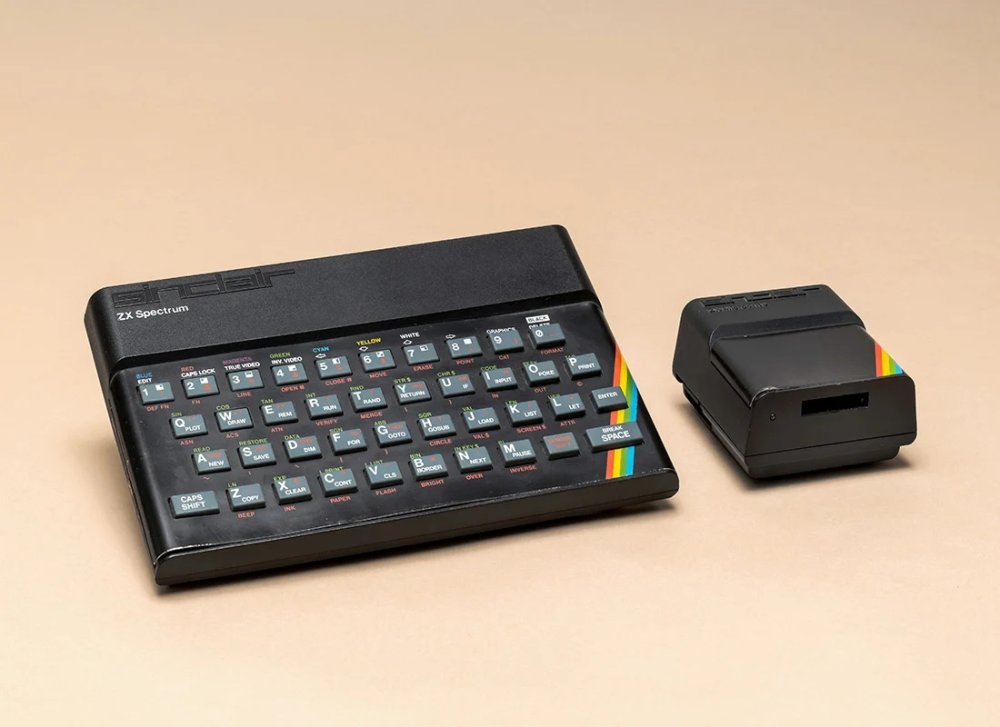
There are computers you remember using, and then there are computers you remember living with. The ZX Spectrum definitely belongs in the second category.
For thousands of British children in the 1980s, it was not simply a computer sitting underneath the television. It was a mysterious black box that could produce entire worlds from a cassette tape, provided you were prepared to wait several minutes, keep everyone away from the volume controls and accept that there was always a reasonable chance the whole thing would end with an error message.
And yet we loved it.
If you grew up with one, there are certain things every ZX Spectrum owner will remember instantly. The rubber keys. The loading noises. The coloured stripes. Games that cost pocket money rather than half a week's wages. Arguments about whether the Commodore 64 was actually better. The peculiar experience of spending longer loading a game than some modern games take to install an update containing several gigabytes of data.
More than 40 years after the original ZX Spectrum arrived in 1982, those memories remain extraordinarily vivid.
Here are some of the things that made owning a Spectrum such a wonderfully strange experience.
That Little Black Computer Under the Television
Before computers became anonymous silver laptops and black rectangles, the ZX Spectrum looked unmistakably like a ZX Spectrum.
The original model was tiny. Its black case, rainbow stripe and distinctive rubber keyboard gave it the appearance of something halfway between serious scientific equipment and a calculator somebody had designed after watching too much science fiction.
It also fitted neatly into the average British living room.
You did not need a dedicated monitor. You connected the Spectrum to the family television, which usually meant temporarily evicting whatever programme somebody else wanted to watch.
This was an era when many households still had one main television. Turning it into a computer therefore required negotiation.
You might technically own the Spectrum, but the television remained contested territory.
Saturday afternoon could suddenly become a battle between playing Manic Miner and somebody wanting to watch Grandstand.
The television also meant sitting surprisingly close to the screen, surrounded by cables, cassette tapes, instruction leaflets and whatever improvised storage system you had developed for your games.
It wasn't elegant.
It was brilliant.
The Rubber Keyboard
No list of things every ZX Spectrum owner will remember could begin anywhere else.
Those rubber keys.
The original Spectrum keyboard has become one of the most recognisable pieces of British computer design ever made. At the time, however, nobody was pretending it was luxurious.
Typing on it felt vaguely like pressing your fingers into a collection of liquorice sweets.
There was almost no reassuring mechanical movement. Each press simply squashed down into the machine.
Experienced users developed a peculiar Spectrum typing technique, applying just enough pressure to persuade the computer that something had happened.
Writing anything substantial was an endurance event.
Of course, ordinary letters were only part of the story.
One Key, About Seventeen Jobs
The Spectrum's BASIC system famously assigned entire commands to keys.
Depending on which mode the computer was in, pressing a single key could produce commands such as PRINT, LOAD, RUN, GOTO or BORDER.
The keyboard therefore looked as if somebody had attempted to print the entire programming manual directly onto it.
Words and symbols were scattered everywhere.
New owners would stare at the keys trying to understand how on earth anyone was supposed to remember it all.
Eventually, something strange happened.
You did remember.
Regular Spectrum users became surprisingly fluent in its peculiar system of keywords, shift modes and symbols. Commands that initially looked impossibly complicated became muscle memory.
Years later, you might completely forget where you left your car keys but still feel that some deeply buried part of your brain knows exactly how to type a Spectrum LOAD command.
LOAD ""
Two words.
Or rather, one word and two quotation marks.
For Spectrum owners, LOAD "" was the gateway to almost everything.
You typed the command, pressed Enter, started the cassette tape and waited for the magic to happen.
Calling the process "loading" hardly captures the ceremony involved.
First came the border.
Then came the noise.
The Loading Noise Nobody Could Forget
Modern computers politely display progress bars.
The Spectrum screamed at you.
Loading software from cassette produced one of the defining sounds of 1980s home computing, a barrage of electronic screeching, buzzing and squawking that sounded like two fax machines having a furious argument inside a washing machine.
To anybody unfamiliar with computers, it sounded as if something had gone catastrophically wrong.
To a Spectrum owner, it sounded like entertainment approaching.
The coloured stripes around the edge of the screen flickered while data travelled from tape to computer.
Sometimes a loading screen gradually appeared, giving you something attractive to stare at while you waited.
And waited.
You became very familiar with waiting.
A big Spectrum game might require several minutes to load, during which touching practically anything felt dangerous.
Do not adjust the television.
Do not knock the cassette recorder.
Do not unplug anything.
Ideally, do not breathe heavily near it.
Because at the end of those minutes, success was not guaranteed.
The Crushing Misery of a Loading Error
Few disappointments in childhood were quite as efficient as waiting several minutes for a Spectrum game to load and then discovering that it hadn't.
Sometimes the tape volume was wrong.
Sometimes the cassette player heads probably needed cleaning.
Sometimes the tape itself had suffered years of abuse.
Sometimes the Spectrum simply appeared to have decided that you were enjoying yourself too much.
Then you started again.
Rewind.
Adjust volume.
Type LOAD "".
Press Play.
Wait.
There was a surprising amount of folk knowledge surrounding Spectrum tape loading. Every household seemed to develop its own preferred volume setting.
"Put it on seven."
"No, this one only loads on six."
"Try eight but turn the tone down."
These instructions were delivered with the confidence of laboratory technicians discussing sensitive scientific equipment.
Nobody really wanted to move a cassette recorder once they had found the perfect setting.
It had achieved equilibrium.
Leave it alone.
The Loading Screen Was Part of the Experience
Because games took so long to load, publishers often gave players something to look at.
Loading screens became miniature works of art.
Artists attempted to recreate elaborate game artwork using the Spectrum's limited display capabilities, sometimes producing remarkably effective results.
You could spend several minutes staring at one image, which meant those pictures became strongly associated with particular games.
In retrospect, loading screens also created anticipation in a way instant downloads rarely do.
You had committed to playing that game.
You had inserted the tape.
You had entered the command.
You had survived the loading noises.
You were not casually abandoning it after 30 seconds because something else appeared in a recommendations feed.
You were playing this game now.
You had invested seven minutes of your life in getting the thing started.
Games in Plastic Cassette Cases
Spectrum software had a physical presence.
Games arrived on ordinary audio cassettes, often inside cases similar to those used for music tapes.
That made them incredibly easy to collect.
Rows of brightly coloured cassette boxes gradually appeared on bedroom shelves, in drawers and scattered around televisions.
Some publishers used chunky cases or elaborate packaging. Others sold budget games in simple cassette boxes for only a few pounds.
The affordability of Spectrum software became an important part of the machine's culture.
Games could be bought with saved pocket money.
Newsagents, computer shops and high street retailers carried racks of them. Budget labels made older or smaller games accessible for pocket-money prices, meaning collections could grow surprisingly quickly.
And because you physically owned the cassette, you handled it constantly.
Take it from the case.
Put it into the recorder.
Rewind it.
Load it.
Remove it.
Put another one in.
That repeated physical interaction helped games become objects rather than simply software.
Finding an original Spectrum cassette today can trigger memories before you've even played it.
Rewinding Tapes With Suspicious Precision
The cassette counter was serious business.
If a tape contained more than one program, you needed to know where things were.
You might scribble numbers onto the inlay card.
Game: 000.
Side B: 147.
Utility program: 236.
The exact system varied, but Spectrum owners quickly learned that randomly pressing Play somewhere in the middle of a cassette was unlikely to end well.
Then came the familiar sequence of buttons.
Stop.
Rewind.
Watch the little reels turn.
Stop again.
Check counter.
Tiny adjustments.
It seems absurdly laborious now, but at the time it was simply how computers worked.
The Agony of Multi-Load Games
Eventually games became larger and more ambitious.
The Spectrum still had the same fundamental limitations, so developers found ingenious ways of squeezing more from it.
One answer was multi-load software.
The game loaded one section initially, then requested additional data later.
This could mean finishing one stage and seeing a message instructing you to load the next part from cassette.
Suddenly the dramatic momentum of your adventure was interrupted by tape management.
Rewind to the correct place.
Press Play.
Listen to another burst of digital shrieking.
Hope it works.
Some games required different sections repeatedly, especially on 48K machines.
You could be fighting aliens one moment and operating a cassette recorder the next.
Strangely, it became normal.
Attribute Clash
Spectrum graphics had character.
Part of that character came from what became known as attribute clash.
The Spectrum's display system allowed colour attributes to be applied to blocks of the screen rather than freely assigning every pixel any colour.
This saved precious memory, but it also meant colourful moving objects could produce unexpected visual effects when they occupied the same area.
Characters might suddenly change colour as they moved past scenery.
Sprites could acquire strange patches.
Two brightly coloured objects meeting could turn into something resembling an explosion in a packet of highlighter pens.
Developers worked around the restriction in increasingly clever ways. Some designed largely monochrome play areas. Others embraced the effect.
As children, many of us didn't care what technical limitation caused it.
That was simply what Spectrum games looked like.
Today it is part of their charm.
Games That Were Absolutely Merciless
Modern games often ease players gently into the experience.
Spectrum games frequently treated you like an intruder who needed to be punished.
Three lives.
Off you go.
Sometimes you had no idea what you were supposed to do.
You walked right.
You died.
You tried again.
You jumped.
You died slightly further to the right.
Progress.
Games such as Manic Miner and Jet Set Willy became legendary partly because of their challenge, but difficulty was widespread throughout the era.
There were no elaborate tutorials explaining every control.
There were rarely automatic checkpoints every few minutes.
Sometimes the instructions consisted of a small piece of folded paper containing enough story to justify why a badly animated blob was pursuing another badly animated blob through a maze.
Then you learned by playing.
And failing.
Repeatedly.
The result was that finally completing a difficult section felt like a genuine achievement.
The Kempston Joystick Question
Not everyone wanted to play using the keyboard.
Joysticks became essential accessories for many Spectrum owners, but connecting one was not always as straightforward as it sounds.
The original Spectrum did not simply provide a universal joystick socket on the side. Various interfaces and standards appeared, with Kempston becoming one of the best known.
Games might ask which control method you wanted:
Keyboard.
Kempston.
Sinclair.
Cursor.
Suddenly launching a game involved a small technical questionnaire.
Using the wrong option produced the wonderfully confusing experience of moving your joystick and watching absolutely nothing happen.
Eventually you discovered the right setting and normal service resumed.
The joysticks themselves varied enormously. Some felt satisfyingly robust. Others seemed capable of surviving approximately one energetic game of Daley Thompson's Decathlon.
Which brings us neatly to another Spectrum memory.
Destroying Your Keyboard Playing Sports Games
Certain games required aggressive alternate key pressing.
This was dangerous.
Sports titles where speed depended on rapidly hammering two controls could transform a quiet family living room into the scene of a minor industrial accident.
Fingers flew.
Keys suffered.
Joysticks rattled violently.
Players discovered increasingly ridiculous techniques for achieving maximum speed.
The Spectrum's rubber keyboard was not designed with elite athletics in mind.
Yet somehow it endured.
Mostly.
Copying Games From Your Mates
Cassette software had another property that became extremely obvious to schoolchildren.
Cassettes could be copied.
Put one tape deck next to another, press the appropriate buttons and suddenly software distribution had become a neighbourhood industry.
School playgrounds developed informal exchange networks.
"I'll copy you Saboteur if you copy me R-Type."
Collections of tapes appeared covered in handwritten labels, often containing several games recorded one after another.
Naturally, copying commercial software without permission was piracy, something publishers were extremely aware of.
Various anti-piracy systems appeared, including code sheets and elaborate instruction-book checks.
Yet for plenty of 1980s children, copied Spectrum tapes were simply another familiar part of the home-computer landscape.
The handwritten cassette containing six mystery games was almost a format of its own.
Whether all six actually loaded was another matter.
Typing Programs From Magazines
The Spectrum wasn't just a games machine.
For many people it provided their first experience of programming.
Computer magazines printed pages of BASIC code that readers could type into their machines.
This required extraordinary patience.
You would sit with a magazine beside you, carefully entering line after line.
10 PRINT...
20 LET...
30 IF...
Hundreds of characters later, you typed RUN.
Nothing worked.
Now came debugging.
Somewhere amongst several pages of code, you had typed 0 instead of O, missed a semicolon or entered the wrong number.
This was frustrating, but it also taught an entire generation something important about computers.
They were not sealed appliances.
You could tell them what to do.
You could change things.
You could build things yourself.
Even if your masterpiece was simply a coloured square wandering around the screen, you had made the square wander around the screen.
That felt astonishing.
Saving Your Own Programs to Tape
Writing a program introduced another anxiety.
You now had something worth preserving.
That meant saving it to cassette.
Blank tapes became computer storage.
You inserted one, wound it to a suitable location and instructed the Spectrum to save your program.
Then came another burst of noise.
Afterwards, the sensible person verified that the program had saved correctly.
The less sensible person assumed everything was fine, switched off the computer and discovered later that several hours of work had vanished into the void.
There was no cloud backup.
There was no automatic version history.
There was you, a cassette and consequences.
Accidentally Pulling the Power Lead Out
The Spectrum's power arrangement did not encourage relaxation.
There was no conventional on/off switch on the original machine. Switching it off generally meant disconnecting the power.
More importantly, the connection could feel alarmingly vulnerable when the machine was surrounded by controllers, cassette leads and family members walking past.
One badly placed hand or foot could end an entire gaming session instantly.
Screen gone.
Progress gone.
Silence.
Everyone froze.
Then somebody said something unsuitable for a child.
The Expansion Connector at the Back
The Spectrum's rear edge connector opened the machine to all kinds of add-ons and interfaces.
It also looked exposed enough to make you slightly nervous about touching it.
Joystick interfaces, printers and other peripherals could connect through the expansion bus.
The ZX Printer was particularly memorable for those who encountered one, using special metallised paper and producing tiny, distinctive printouts.
For many children, though, the Spectrum itself remained the centre of everything.
A few cables, a cassette recorder and a television were enough.
The 48K Badge of Honour
Spectrum ownership came with versions.
The original machine launched in 16K and 48K configurations, but the 48K Spectrum became the model that many people most strongly associate with the early era.
Later came the ZX Spectrum+, with its more conventional keyboard, followed by the Spectrum 128 and subsequent models produced after Amstrad acquired Sinclair's computer business.
Naturally, schoolchildren cared intensely about these distinctions.
Having the newer model mattered.
Having more memory mattered.
Knowing somebody with a Spectrum 128 could provoke genuine technological envy.
But the little rubber-keyed machine retained a special status.
It was the Spectrum people pictured when somebody simply said "Spectrum".
Arguing With Commodore 64 Owners
The great computer rivalries of the 1980s were serious affairs.
At least they were serious if you were nine.
Spectrum owners and Commodore 64 owners could argue endlessly about which machine was superior.
The Commodore had certain technical strengths, particularly in areas such as sound and hardware sprites.
Spectrum owners had an obvious response.
None of that mattered because the Spectrum was clearly better.
Why?
Because it was yours.
Playground debates required no further evidence.
Screenshots in magazines were examined like forensic evidence. Versions of the same game were compared. Loading speeds, graphics, music and colours all became ammunition.
Adults were conducting comparable arguments about cars and football clubs.
Children had home computers.
Some things never change. Today the playground argument has simply evolved into PlayStation versus Xbox, iPhone versus Android and whichever graphics card somebody has just spent an alarming amount of money buying.
Ocean Loading Screens and Famous Publishers
Spectrum owners became familiar with software company names almost as readily as game titles.
Ultimate Play the Game, Ocean, Codemasters, Mikro-Gen, Imagine, Firebird and countless others became part of the landscape.
Packaging styles became recognisable.
You spotted logos in shops.
Certain publishers developed reputations for particular types of games.
Ocean became especially prominent, producing or publishing numerous licensed titles connected to films, television programmes and arcade games.
The 1980s also gave us the wonderful practice of turning almost anything popular into a computer game.
Film doing well?
Make a Spectrum game.
Popular television character?
Spectrum game.
Sports star?
Definitely a Spectrum game.
Quality was variable, but opening a cassette case containing a computer version of something you already loved was exciting in itself.
The Spectrum Version Looked Nothing Like the Arcade Machine
Arcade conversions demanded imagination.
The coin-operated original might have enormous colourful sprites, scrolling backgrounds, elaborate music and dedicated hardware.
Then you loaded the Spectrum version.
Some compromises had occurred.
And yet this rarely mattered as much as you might expect.
Having anything resembling the arcade experience in your bedroom was remarkable.
Your Spectrum did not need to reproduce the arcade cabinet perfectly.
It needed to capture enough of the idea that your imagination could do the rest.
Children were very good at that.
Screenshots on the Box Were Viewed With Suspicion
Game packaging occasionally required careful inspection.
Which machine were those screenshots from?
Spectrum?
Commodore?
Amstrad?
Atari?
A spectacular screenshot on the back of a multi-format release did not necessarily represent what you were about to see.
Seasoned buyers learned to look carefully.
Magazines helped enormously.
Reviews could determine where several weeks of pocket money went, which gave reviewers tremendous power over the average schoolchild's finances.
A high score generated excitement.
A bad review could be devastating if you had already bought the game.
Computer Magazines Were Almost as Important as the Computer
Spectrum culture extended far beyond the machine itself.
Magazines such as Crash, Your Sinclair and Sinclair User became essential reading for enthusiasts.
They contained reviews, previews, tips, maps, letters, programming advice and the particular strain of mischievous humour that British games magazines became famous for.
Later, cover-mounted cassettes made magazines even more irresistible.
A cassette containing playable games, demos or utilities attached to the front of a magazine felt incredibly generous.
The magazine was entertainment for the evening.
The tape could entertain you for days.
For many Spectrum owners, remembering the computer means remembering the magazines too.
Maps Drawn on Graph Paper
Adventure and exploration games encouraged another lost skill.
Making maps.
You might sit beside the television with paper and pencil, drawing rooms, corridors and connections as you explored.
Some magazine guides provided maps. Other times you created your own.
Notes accumulated.
Passwords.
Codes.
Objects.
Directions.
Things to remember.
Gaming could involve paperwork.
There was something satisfying about gradually understanding a digital world that initially felt enormous.
Modern games can display objective markers, maps and glowing arrows showing exactly where to go.
The Spectrum was more likely to let you wander around until you figured it out.
When a Game Felt Enormous Despite Being Tiny
This is perhaps the strangest part of looking back.
ZX Spectrum games were incredibly small by modern standards.
Yet they often felt huge.
Partly this came from childhood imagination. Partly it came from difficulty, which meant a game could take weeks to master even if its actual content was comparatively compact.
Mostly, though, we had different expectations.
A new game was not one disposable item in a library containing hundreds of untouched downloads.
If you bought a game, you played it.
Repeatedly.
You discovered its secrets.
You learned the levels.
You memorised enemy patterns.
You discussed it at school.
You squeezed every possible hour from it because next week's entertainment budget might consist of precisely nothing.
Scarcity gave games weight.
Why ZX Spectrum Owners Remember It So Fondly
The Spectrum was imperfect in almost every measurable way.
It had limited memory.
Its graphics were restricted.
Loading from cassette was slow.
The keyboard was unusual.
Games could be brutally difficult.
Sound on the original models was basic.
Software failed to load.
And somehow almost every one of those weaknesses became part of its personality.
Modern devices work hard to remove friction.
Tap an icon and entertainment appears instantly.
Updates happen automatically.
Progress is saved continuously.
Storage is effectively invisible.
From a usability perspective, this is obviously better.
But friction creates rituals.
Spectrum owners remember LOAD "" because they typed it thousands of times.
They remember cassette noises because every game announced itself with them.
They remember loading screens because they stared at them for minutes.
They remember the keyboard because using it required learning something peculiar.
The limitations made the machine impossible to ignore.
The ZX Spectrum Was More Than a Games Machine
Perhaps the most important thing the Spectrum did was make computing approachable.
Sir Clive Sinclair's machines helped bring affordable home computing to a huge British audience, and the ZX Spectrum became one of the defining computers of that movement.
For many owners, it was their first computer.
They arrived for the games and accidentally learned about programming, memory, files, peripherals and troubleshooting.
Children who simply wanted to play Jetpac found themselves typing BASIC commands.
Some eventually wrote games of their own.
Others moved into computing careers.
Most simply gained an early comfort with technology that would become increasingly important over the following decades.
The Spectrum made computers feel like things ordinary people could own, explore and manipulate.
That mattered.
Why It Is Still Collectible Today
Original ZX Spectrums remain popular with collectors because they represent far more than obsolete hardware.
They are objects loaded with memories.
The rainbow logo alone can transport somebody straight back to a childhood bedroom.
Collectors restore machines, replace worn components, seek out original boxed examples and rebuild libraries of classic software.
Modern hardware has also made using old machines considerably easier. Various contemporary storage devices and video solutions can remove some of the practical headaches while retaining the experience of using original hardware.
Emulation offers another route, allowing thousands of Spectrum titles to run on modern computers and devices.
But there is still something different about seeing the real machine.
Picking it up reminds you how small it was.
Touching those rubber keys brings the memories back immediately.
And somehow the sight of © 1982 Sinclair Research Ltd on a television still makes you want to type one particular command.
LOAD ""
Things Every ZX Spectrum Owner Will Remember Forever
For all the spectacular technology that came afterwards, very few computers inspire affection quite like the Spectrum.
Nobody fondly reminisces about a laptop taking four seconds longer than expected to start.
Spectrum memories are different because the machine demanded participation.
You waited for it.
You fought with it.
You learned its peculiarities.
You developed loading rituals.
You typed programs into it.
You argued about it in playgrounds.
You hammered its keyboard, filled drawers with cassette tapes and occasionally spent ten minutes loading a game only to die within thirty seconds.
And then you loaded it again.
That is why the things every ZX Spectrum owner will remember are often not spectacular technological achievements. They are tiny experiences: coloured loading borders, rubber keys, handwritten cassette labels, magazine cover tapes and that awful moment when the loading noise stopped and you realised something had gone wrong.
The ZX Spectrum was messy, limited, colourful, frustrating and enormous fun.
Which is probably why so many of us would happily plug one in again tomorrow.
If this has stirred up memories of cassette tapes, playground computer wars and afternoons spent waiting for loading screens, join RetroWins or sign up to stay in the loop for more retro technology stories and nostalgia. There is plenty more old tech worth switching back on.






