Long before people argued about PlayStation versus Xbox, iPhone versus Android or which streaming service had ruined television most efficiently, British schoolchildren had already perfected the art of defending a piece of consumer electronics as though the honour of their entire family depended upon it.
The argument was simple: ZX Spectrum vs Commodore 64.
And it was absolutely not simple.
Mention either machine to somebody who grew up in Britain during the 1980s and there is a reasonable chance you'll get an immediate reaction. Spectrum owners will tell you about enormous libraries of games, wonderfully inventive British developers and the peculiar pleasure of coaxing astonishing things out of a machine that seemed held together by rubber keys and optimism.
Commodore 64 owners will probably smile politely before reminding you that their computer had proper hardware sprites, scrolling, considerably better sound and a keyboard that didn't feel like something attached to a calculator.
Then the Spectrum owner will point out that their games cost £1.99.
And suddenly we're back in the playground.
More than four decades later, the argument has never entirely gone away. So, with the benefit of hindsight, ageing eyesight and absolutely no danger of somebody stealing our lunch money, perhaps it's finally time to look again at the great ZX Spectrum vs Commodore 64 battle.
Two Computers That Defined a Generation
The ZX Spectrum and Commodore 64 arrived during an extraordinary period for home computing.
Computers were becoming affordable enough to escape from laboratories, universities and large companies and find their way into ordinary homes. Suddenly, families were buying machines that could be connected to the television and programmed from the living room.
Nobody was entirely sure what they were supposed to do with them.
The adverts promised education, productivity and preparation for an exciting computerised future.
Children mostly wanted to play games.
Parents might have imagined their offspring learning BASIC, becoming computer programmers and securing prosperous careers in Britain's technological future. Instead, little Steven had spent three hours trying to load Manic Miner.
Still, plenty of children really did learn programming because of these machines. Sometimes deliberately. Sometimes because typing programs from magazines was the cheapest way of getting something new onto the computer.
The ZX Spectrum, created by Sinclair Research and launched in 1982, became particularly important in Britain. Small, relatively inexpensive and unmistakably designed by Sinclair, it brought colour home computing within reach of a huge number of families.
The Commodore 64 also appeared in 1982 and became an international phenomenon. Compared with the Spectrum, it felt like a more substantial machine. It had 64KB of RAM, sophisticated graphics hardware for the period and the now legendary SID sound chip.
These weren't simply two computers competing for shelf space.
They became tribes.
ZX Spectrum vs Commodore 64: Pick Your Side
There were practical differences between owning the machines, but playground arguments rarely bothered with calm technical analysis.
You owned a Spectrum.
Therefore the Spectrum was better.
Your friend owned a Commodore 64.
Therefore he was clearly wrong.
This logic was flawless when you were eleven.
The machines even looked sufficiently different to encourage the rivalry.
The ZX Spectrum Look
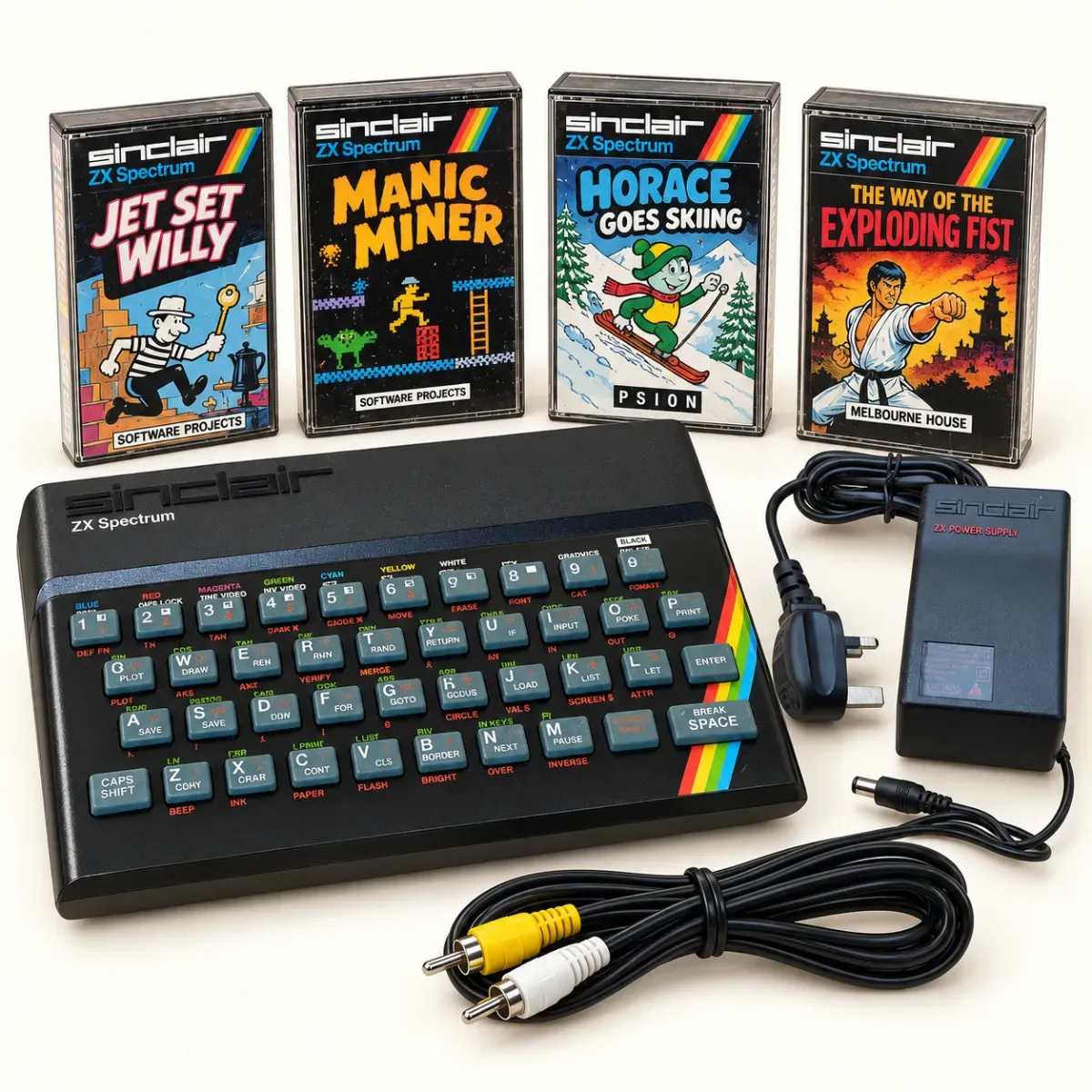
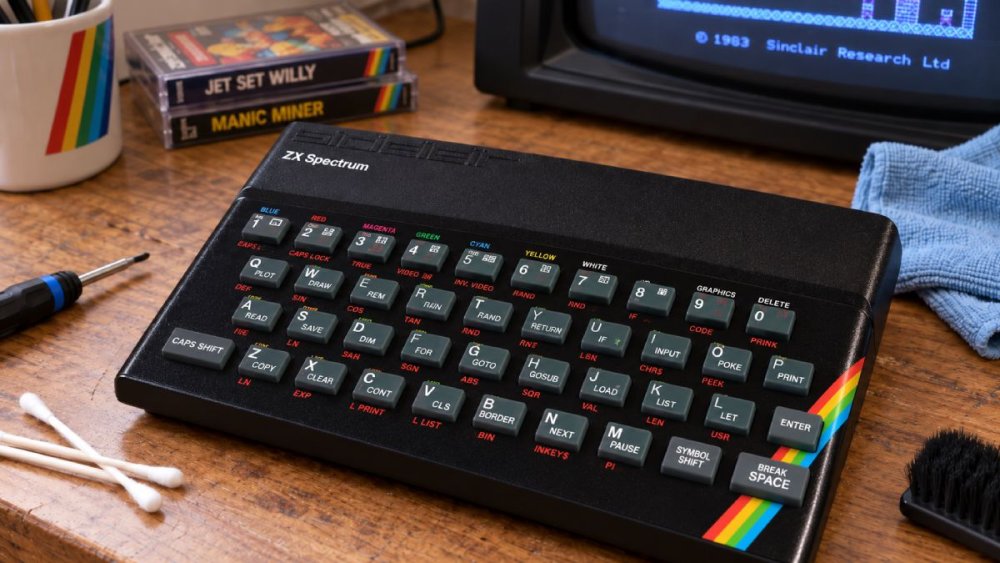
The original ZX Spectrum was tiny.
Even now, seeing one in person can be surprising. Modern photographs somehow make it look larger than it really is. Put an original Spectrum on a desk today and it looks almost impossibly slight for something that helped create an entire generation of British computer enthusiasts.
Then there was the keyboard.
Those little grey rubber keys are inseparable from the Spectrum's identity.
Calling it a keyboard almost feels generous. It was more like a sophisticated rubber membrane with letters printed on it. Each key also performed an intimidating collection of secondary functions, BASIC commands and symbols.
The Spectrum's BASIC system allowed entire commands to be entered with individual key presses. In theory this made programming quicker. In practice it also meant staring at the keyboard trying to remember which combination produced the thing you wanted.
Owners got used to it surprisingly quickly.
Typing on the Spectrum wasn't exactly luxurious, but nobody bought one to write a 40,000-word novel.
Although presumably somebody tried.
The Commodore 64 Look
The Commodore 64 was a different beast entirely.
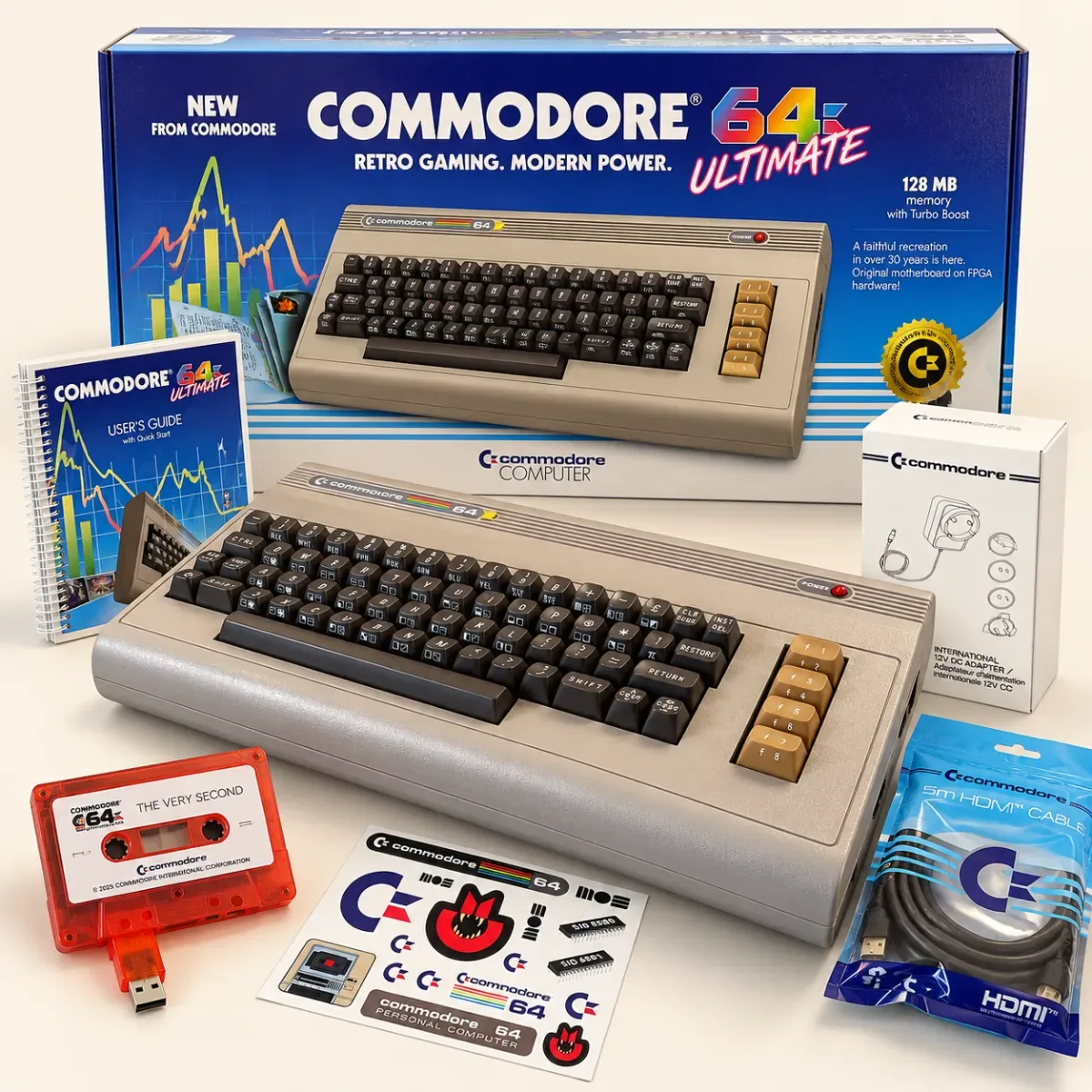
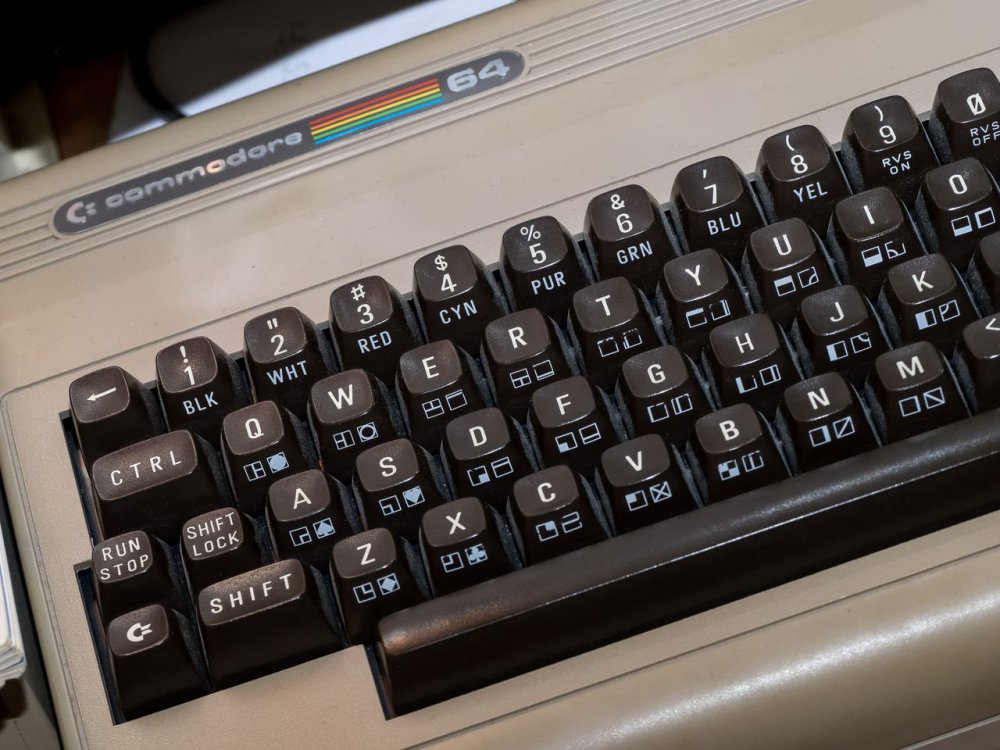
Its chunky beige case earned the affectionate nickname "breadbin", and compared with Sinclair's little black slab it looked enormous.
But it also looked like a proper computer.
The keyboard had full-size moving keys. There were function keys down the side. The machine felt substantial enough to survive prolonged use and possibly a minor household accident.
For a child whose friend owned a Spectrum, that keyboard alone provided considerable ammunition.
"You can't even type properly on yours."
This was devastating playground rhetoric.
Later Commodore 64 models changed the casing, but the original breadbin remains the version many people picture immediately when someone says C64.
The Great Cassette Loading Ritual
Of course, owning either machine often meant owning a cassette recorder.
This is where younger readers accustomed to instant downloads and solid-state storage may need some emotional preparation.
Games could take several minutes to load.
Not install.
Load.
Every time.
On the Spectrum, you would put the cassette into the player, type the appropriate load command, start the tape and wait.
Then came the noise.
Anyone who experienced cassette-based home computing remembers it. A shrieking digital cacophony of tones that sounded like a fax machine having some kind of breakdown.
The Spectrum added its own visual theatre with coloured loading borders flashing around the screen.
Sometimes the loading screen appeared gradually, creating a tantalising preview of what was coming.
You waited.
And waited.
And then...
R Tape loading error
Few combinations of letters have ever produced such immediate despair.
Maybe the volume was wrong. Perhaps the cassette heads needed adjusting. Maybe somebody had accidentally knocked the tape recorder.
Or perhaps the universe simply hated you.
Rewind.
Adjust.
Try again.
Commodore owners weren't immune to cassette-loading purgatory either. The Commodore Datasette used its own specialised system, and loading games could be similarly leisurely.
In both camps, loading became part of the ritual.
Modern technology has removed almost every unnecessary delay from entertainment, which is unquestionably progress. Yet there was something about sitting there watching a loading screen that made finally reaching the game feel like an event.
You'd earned it.
Assuming it loaded.
Graphics: The Spectrum's Colourful Compromise
On paper, the Commodore 64 had a significant graphical advantage.
Its VIC-II graphics chip provided hardware sprites and smooth scrolling capabilities that developers could exploit to produce wonderfully fluid games. Arcade-style action was a natural fit for the machine.
The Spectrum approached graphics rather differently.
Its 256 by 192 pixel display could produce colourful images, but it had a famous limitation commonly known as "attribute clash".
Rather than assigning colours freely to individual pixels, colour information applied to blocks of the screen. When differently coloured moving objects occupied the same area, things could become visually peculiar.
Characters changed colour.
Backgrounds changed colour.
Everything occasionally seemed to be having a small psychedelic episode.
Spectrum developers became remarkably clever at working around this.
Some games deliberately used monochrome play areas. Others designed backgrounds around the limitation. Skilled artists created extraordinarily effective graphics despite the restricted system.
And strangely, attribute clash has become part of the Spectrum aesthetic.
Show a Spectrum owner a screenshot filled with bright cyan, yellow, magenta and black and they won't necessarily see primitive graphics.
They see childhood.
The Commodore 64 Had Sprites, and Wasn't Shy About It
This was where C64 owners became insufferably smug.
The Commodore 64 could display hardware sprites, independent graphical objects that could move smoothly across the screen. Developers could use them for characters, enemies, bullets and other moving elements without relying entirely on tricks in software.
Combined with scrolling capabilities, this helped make the C64 particularly strong at arcade-style games.
Titles could move with a smoothness that Spectrum versions sometimes struggled to match.
Side-by-side comparisons became a favourite battleground.
The Spectrum version might be faster.
The Commodore version might be prettier.
One might have more detailed backgrounds.
The other might have more responsive controls.
And naturally both owners insisted that their version was unquestionably superior.
Nobody ever said:
"Actually, both implementations demonstrate interesting compromises resulting from different hardware architectures."
Because they wanted to continue having friends.
Then There Was the Sound
If the Commodore 64 had one weapon that could end many technical arguments quickly, it was the SID chip.
Designed by Bob Yannes, the Sound Interface Device became one of the most celebrated sound chips in home computing.
It gave the Commodore 64 a distinctive musical personality.
C64 composers such as Rob Hubbard, Martin Galway and Ben Daglish pushed the hardware far beyond what most people would have imagined possible when the computer appeared.
For many owners, the music became as memorable as the games themselves.
You didn't just remember playing a particular title. You remembered its loading music, title theme or in-game soundtrack.
The Spectrum was considerably more limited in its original form.
Early Spectrum sound came from a simple internal beeper.
And "beeper" is an unusually accurate technical description.
Yet developers somehow managed to coax recognisable music and effects from it. Later Spectrum models, including the 128K machines, gained much improved sound hardware based around the AY chip.
But if we're comparing the classic early machines, the Commodore 64 wins the audio round comfortably.
Spectrum loyalists may submit complaints in the usual manner.
The Games Were Everything
Specifications mattered, but the real reason these computers became beloved was software.
Britain developed a booming home computer games industry around machines such as the Spectrum, Commodore 64, BBC Micro and Amstrad CPC.
For Spectrum owners in particular, games seemed to be everywhere.
Newsagents sold computer magazines packed with reviews, screenshots, hints, type-in programs and adverts.
High street shops had racks of cassette games.
And then there were budget releases.
For a few pounds, sometimes less, you could walk into a shop with pocket money and emerge with a completely new game.
It might be brilliant.
It might be terrible.
The cover artwork might bear only a passing relationship to what appeared on screen.
That was part of the adventure.
Spectrum Favourites
The Spectrum became home to an extraordinary catalogue.
Manic Miner and Jet Set Willy are obvious landmarks, filled with surreal rooms, strange enemies and unforgiving platforming.
Knight Lore helped popularise the distinctive isometric style associated with Ultimate Play the Game.
The Great Escape, Head Over Heels, Chuckie Egg, Skool Daze, Ant Attack and countless others became fixtures of British home computing.
There was often a peculiarly British character to Spectrum games.
They could be eccentric, funny, slightly anarchic and occasionally baffling.
A game might involve escaping from school, navigating an enormous mansion, collecting flashing objects or controlling something that looked like it had been designed during a particularly strange tea break.
Nobody seemed worried about creating a global multimedia franchise.
They were making games.
Commodore 64 Classics
The Commodore 64 had an equally formidable catalogue, particularly when arcade action and music were involved.
Games such as The Last Ninja, Impossible Mission, Paradroid, Uridium, International Karate+ and Boulder Dash showed what the machine could do.
There were spectacular conversions, original titles and games that felt designed specifically around the C64's strengths.
And again, those soundtracks mattered.
Sometimes you could leave a title screen running simply because the music was brilliant.
Which, given that you'd just waited several minutes for the thing to load, seemed perfectly reasonable.
Joystick or Keyboard?
Another important difference in the ZX Spectrum vs Commodore 64 experience involved controls.
The Commodore 64 came equipped with joystick ports, making the familiar Atari-style digital joystick a natural choice for games.
And so began another 1980s ritual: destroying joysticks.
Competition Pro sticks became favourites, while cheaper models could gradually become less responsive after enthusiastic sessions.
The Spectrum's original hardware didn't include dedicated joystick ports, so interfaces became common. Different joystick standards and mappings added another small layer of complication.
Of course, plenty of Spectrum owners simply used the keyboard.
QAOP.
If those four letters mean something to you, congratulations, a dormant section of your brain has just been reactivated.
They commonly represented left, right, up and down controls in Spectrum games, often accompanied by another key for fire.
Certain control schemes became muscle memory.
Decades later, you may forget where you put your car keys but still remember how you controlled a computer game in 1985.
The Bedroom Computer Era
Perhaps the biggest thing both machines shared had nothing to do with technical specifications.
They were personal.
A Spectrum or Commodore 64 wasn't necessarily kept in a dedicated office. It might live in a bedroom, dining room or corner of the lounge.
The family television was frequently the monitor.
This created negotiations.
You could use the computer until somebody wanted to watch television.
Sometimes that meant being halfway through something when a parent announced that the news was starting.
There was no suspend mode.
No cloud save.
No quick resume.
Your computer session had simply reached its natural conclusion because Dad wanted to watch Grandstand.
Eventually, some lucky owners acquired their own little portable television.
Suddenly you had a complete personal computing setup.
A small CRT television, computer, cassette deck, power supply, joystick and an increasingly chaotic collection of tapes.
To modern eyes it looks wonderfully improvised.
At the time it felt like mission control.
The Magazine Culture
You couldn't separate 1980s home computers from magazines.
Spectrum owners had titles such as Crash, Your Sinclair and Sinclair User.
Commodore fans had Zzap!64 and other dedicated publications.
These weren't just product catalogues.
They had personality.
Reviews could be funny, opinionated and brutal. Games received enormous coverage. Readers sent letters. Developers became recognisable names. Cover tapes later added even more value, delivering demos and complete games directly with the magazine.
Before widespread internet access, this was the community.
You discovered what was coming next by seeing screenshots in print.
You learned cheats from a tips page.
You might spend weeks staring at an advert for a game before finally seeing it running.
Expectations had plenty of time to ferment.
And sometimes the game you eventually loaded looked nothing like the magnificent painted spaceship attacking an alien planet on the cassette box.
Marketing has always been marketing.
Programming Wasn't Just Something Other People Did
One of the most important differences between this era and modern consumer electronics is how exposed the computer itself felt.
Switch on many home computers and you didn't arrive at an app launcher.
You arrived at a programming environment.
The machine was waiting for instructions.
BASIC was right there.
You could type things and immediately see what happened.
For many children, the first program was something like:
10 PRINT "HELLO"
20 GOTO 10
Then you ran it and watched the screen fill with HELLO forever.
Congratulations. Software development career launched.
Soon somebody discovered they could replace HELLO with something rude.
Software development career temporarily derailed.
Magazines and books encouraged experimentation. Programs were printed across multiple pages and had to be typed manually.
This was character building.
One incorrect number somewhere among hundreds of lines could stop the whole program working.
There was no syntax highlighting, autocomplete or helpful red underline explaining that you'd made an obvious mistake.
You went hunting.
And in doing so, many young users accidentally learned how computers worked.
That accessibility is one reason the Spectrum and Commodore 64 remain so culturally significant. They turned computing from something mysterious into something you could mess around with.
Which Machine Actually Won?
Dangerous territory.
Globally, the Commodore 64 became one of the most successful home computers ever sold and achieved enormous popularity across Europe and North America.
In Britain, however, the ZX Spectrum occupied a particularly special position.
Its comparatively affordable route into home computing helped put computers into a vast number of British households. It also became central to the emerging UK games industry.
So asking who won the ZX Spectrum vs Commodore 64 battle depends on what you're measuring.
Technical capabilities?
The C64 had obvious advantages in areas such as sound, sprites and hardware scrolling.
Affordability and enormous British software culture?
The Spectrum has a powerful case.
Keyboard quality?
Let's not embarrass Sinclair unnecessarily.
Charm?
Draw.
And charm matters more now than it did then.
What Owning One Actually Felt Like
Modern comparisons tend to reduce old computers to processor speeds, memory figures and graphics modes.
That misses most of the experience.
Owning a Spectrum meant piles of cassette boxes, rubber keys, brightly coloured loading screens and hearing that frantic loading noise from across the room.
Owning a Commodore 64 meant the chunky keyboard, brown function keys, distinctive blue BASIC screen and music that could be astonishingly sophisticated for a home computer.
Both involved cables.
Lots of cables.
Both involved waiting.
Both occasionally involved inexplicable failure.
Both could turn an ordinary bedroom into somewhere far more interesting.
And both offered something modern devices rarely provide: a feeling that the machine was understandable.
You could type commands directly into it.
You could open a magazine and enter a program.
You could change something and see what happened.
You weren't merely consuming software through polished interfaces.
You were poking the computer itself.
Why They Still Matter Today
The Spectrum and Commodore 64 aren't remembered simply because people become nostalgic for anything they encountered before developing back pain.
They genuinely mattered.
They introduced millions of people to computing.
They encouraged bedroom programming and helped nurture talent that fed into the British games and technology industries.
They supported enormous software ecosystems.
And they made computing feel exciting.
That excitement is difficult to explain to somebody who grew up surrounded by vastly more powerful devices.
A modern phone makes both machines look almost comically primitive.
But that's precisely why they're fascinating.
Developers couldn't casually throw processing power at a problem. Memory was scarce. Storage was slow. Graphics hardware imposed strict limitations.
So programmers became ingenious.
They found tricks.
They squeezed.
They cheated.
They discovered ways of making machines do things their designers had probably never anticipated.
Look at the best Spectrum or C64 games with an understanding of the hardware and they become even more impressive.
Collecting a Spectrum or Commodore 64 Today
Original machines remain popular with collectors and retro computing enthusiasts.
Part of the attraction is simply seeing the real hardware again.
Emulators can reproduce software extremely accurately and modern recreations make playing old games considerably easier, but original hardware has texture.
The keyboard feels right.
The case looks right.
The cassette recorder sitting beside it looks gloriously inconvenient.
There is also the satisfaction of using something that has survived for more than forty years.
Of course, vintage computers need a little more care than they did when new. Power supplies, capacitors, cassette mechanisms, membranes and other components can deteriorate with age. Connecting old computers to modern displays may also require adapters or specialist equipment.
For some enthusiasts, restoration is part of the fun.
For others, plugging in a modern replacement power supply and loading games from a flash-based device is a perfectly sensible compromise.
Purity is optional.
Enjoyment isn't.
The Argument Doesn't Need a Winner
With forty years of hindsight, the funniest thing about the ZX Spectrum vs Commodore 64 rivalry is how fiercely people defended machines that were both wonderful for completely different reasons.
The Commodore 64 was technically impressive, particularly in graphics and sound.
The Spectrum was affordable, quirky and hugely influential in Britain, supported by a software library that seemed almost endless.
Each machine produced games that suited its strengths.
Each created communities.
Each inspired programmers.
And each occupied countless childhood bedrooms where homework was supposedly being done.
The real winner was probably anyone lucky enough to experience that peculiar moment when home computing still felt new.
You switched on a small plastic box connected to the television and suddenly there was an entire world waiting behind a flashing cursor.
It might have taken seven minutes to load.
It might have crashed immediately afterwards.
But somehow that only makes us remember it more fondly.
And if you're still convinced that your machine was unquestionably better than the other one, that's fine.
Some playground arguments deserve to survive.
If this has awakened memories of rubber keyboards, loading screens, joysticks and suspiciously large collections of cassette tapes, join RetroWins or sign up to stay in the loop for more retro technology stories, forgotten gadgets and unapologetic 1980s nostalgia.