The Sony Walkman was never just a cassette player with headphones. It was the small, slightly miraculous object that let us take our own music beyond the bedroom. Suddenly, the bus to school had a soundtrack. So did the family holiday, the walk to the shops and that long car journey where Mum and Dad insisted Radio 2 was perfectly good.
Before the Walkman, music was usually shared whether you liked it or not. It came from the hi-fi in the living room, the radio in the kitchen or a portable cassette recorder placed on a picnic table. Sony's brilliant trick was to make listening personal without making it lonely. With a tape in your pocket and lightweight headphones on your ears, you could be physically present while mentally somewhere else entirely.
Why the Sony Walkman Felt Like a Revolution
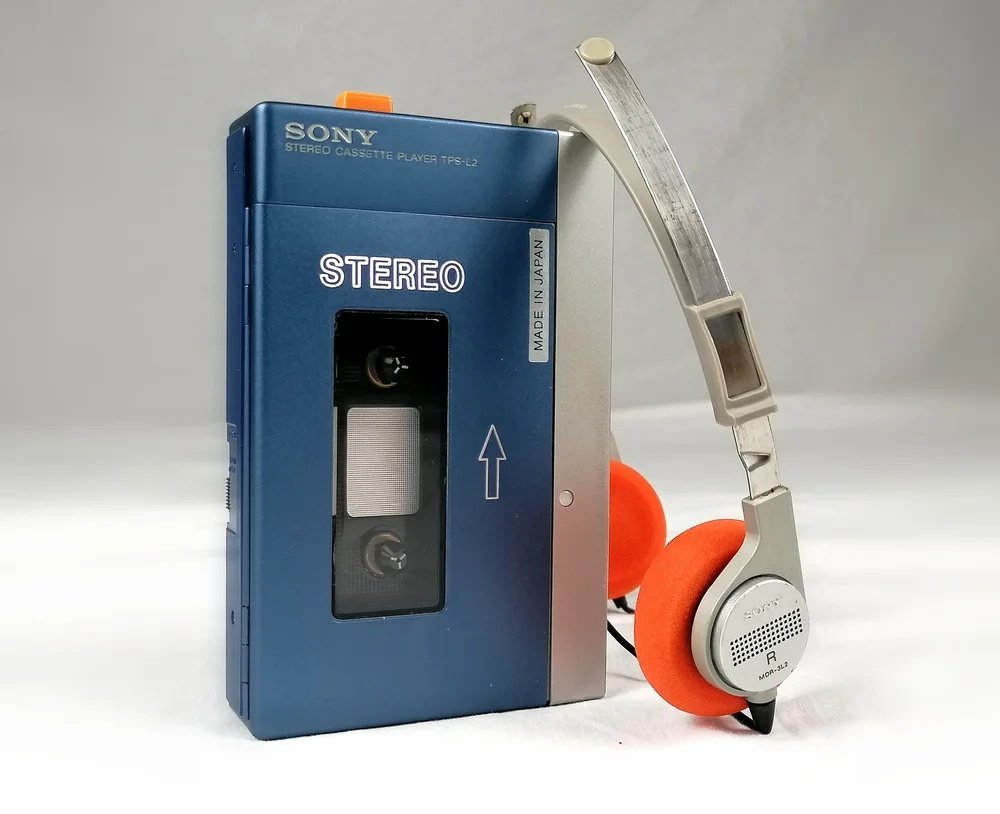
When the first Sony Walkman, the TPS-L2, arrived in 1979, it looked purposeful rather than futuristic. Its blue-and-silver metal case, clear cassette window, proper mechanical buttons and twin headphone sockets gave it the air of serious kit. It had no recording function, which initially seemed like an odd omission for a company known for portable recorders. But that was the point. This machine had one job: make your favourite music travel with you.
By the early 1980s, the Walkman had become a familiar sight in Britain. You saw one clipped to a belt, tucked into a blazer pocket or carried in a bag alongside school books, a packet of Polo mints and perhaps a battered copy of Smash Hits. The headphones were part of the statement. Foam pads in orange, yellow or electric blue had a habit of going flat, splitting or vanishing altogether, but we wore them anyway.
The word itself became shorthand for an entire category. Plenty of us owned a Sanyo, Aiwa, Panasonic or a supermarket own-brand alternative, yet still called it a Walkman. That is cultural victory of the highest order: like calling any sticky tape Sellotape, the name escaped the box and lodged in everyday speech.
A private world powered by AA batteries
There was freedom in the ritual, though it had its limits. You chose a cassette, opened the door with a satisfying click, fed the tape into place and pressed play. Then came the small calculations that modern streaming has removed from our lives: how much battery was left, which side of the album you were on, whether the tape had been rewound, and whether your headphones had snagged on a coat button.
A fresh pair of AAs could make a Walkman feel unstoppable. As the batteries faded, however, the music slowed almost imperceptibly and the singer's voice sank into an unplanned baritone. Sometimes you pushed on for another song; sometimes you raided the kitchen drawer for spare batteries. Recharging was not yet a nightly habit. Batteries were currency, and a Walkman could get through them with alarming enthusiasm.
The cassette itself made every listening session physical. You could see the reels turning. You could flip the tape at the end of Side A. You could fast-forward too far, stop, rewind, then overshoot again while trying to find that one song. Auto-reverse was a prized feature, particularly on later Sony Walkman models, but there was something pleasingly direct about doing it yourself.
The Mixtape Made the Walkman Personal
The real magic was not always the player. It was what you put inside it.
A shop-bought album was a treasure, especially if it had been saved for, requested as a birthday present or bought with Saturday-job money. Yet the homemade mixtape was the format at its most expressive. It was a playlist before playlists, assembled track by track from the radio, borrowed LPs, CDs or another cassette recorder. Every selection had consequences because there was only so much tape to fill.
C90 cassettes were the dependable all-rounders, offering 45 minutes per side. C60s felt short but safer, while C120s seemed wonderfully generous until their notoriously thin tape tangled, stretched or snapped. The case insert was just as important. Track listings were written in biro, often with little stars beside favourites and a title that now sounds either charmingly heartfelt or mortifyingly dramatic.
Recording from the radio demanded patience and quick reflexes. You waited through the DJ's chatter, finger poised over Record and Play, hoping they would not talk over the intro. They always seemed to talk over the intro. If you were lucky, the presenter announced the artist and title afterwards, giving you something useful to write on the sleeve. If not, that mystery song might remain "Track 7, probably Duran Duran" for months.
A Walkman gave these tapes a life beyond the bedroom. The mix made for a mate could accompany them on the train. The tape made after a break-up could be played repeatedly in the park, on the back seat of the bus or under the duvet after lights-out. Music had always carried emotion, of course, but the Walkman gave us the ability to curate it, carry it and replay it without asking permission from anyone else in the house.
More Than One Model, More Than One Memory
Sony did not stand still. Through the 1980s, Walkman models became slimmer, lighter and increasingly packed with features. Some had Dolby noise reduction to soften cassette hiss. Others offered radio tuners, auto-reverse, metal bodies, extra bass controls or clever mechanisms designed to keep tapes stable while you walked. Water-resistant sports versions appealed to joggers, cyclists and anyone who liked the idea of looking more athletic than they actually were.
The yellow Sports Walkman models deserve a special mention. Chunky, weather-conscious and built to look ready for an expedition, they made a standard commuter cassette player seem almost fragile. They were the sort of gadget you could imagine surviving a rainy British games lesson, although most of us would not have risked one near a puddle.
Then there were the premium machines. Later Walkmans could be astonishingly compact, with magnesium cases, remote controls on the headphone lead and sound quality that rewarded a decent pair of headphones. At the other end of the scale sat the cheap portable players that chewed tapes, leaked sound and had a lid that never quite shut properly. Both belong to the story. Retro technology was rarely only about owning the best model. It was about making whatever you had feel like yours.
The format changed, too. Sony carried the Walkman name into cassette, CD, MiniDisc and digital players. Each had its fans. A Discman offered cleaner sound but was less happy when jogged. MiniDisc felt wonderfully advanced, with its tiny protected discs and editable track names, but it never replaced the cassette's easy, messy familiarity. Digital Walkmans arrived in a world increasingly shaped by MP3 players and then smartphones.
Yet for many of us, the cassette Sony Walkman remains the one that stirs the strongest response. It belongs to a time when portable music asked for a little care. You had to own the album, borrow it, record it or patiently make a compilation. The inconvenience was real, but so was the attachment.
Buying a Sony Walkman Today
A working Walkman is still a lovely thing to own, whether you are building a collection or simply want to hear an old tape as it was meant to be heard. The key question is whether you want a display piece, a reliable everyday player or a particular model from your youth. Those are different searches, with very different price tags.
Condition matters more than a shiny case. A seller may say a player "powers on", but that does not prove it plays at the correct speed, fast-forwards, rewinds or delivers sound clearly to both ears. Old belts commonly perish, turn slack or dissolve into unpleasant black residue. This is a repairable fault, but it explains why an untouched bargain may need more work than expected.
Check the battery compartment for corrosion, inspect the cassette door and make sure the headphone socket is not crackly. If possible, ask whether the player has been tested with an actual cassette rather than merely switched on. Original headphones, belt clips and boxes add collector appeal, but a clean, serviced player with replacement foam pads will usually bring more pleasure than a complete set that cannot play a note.
Cassettes deserve similar care. Store them away from heat, damp and strong magnetic fields, and do not use a treasured tape as a test subject in an unserviced machine. A cheap cassette with nothing precious recorded on it is the sensible first choice. If a tape looks loose, gently wind it using a pencil before playing it. That little pencil trick remains one of the most useful pieces of analogue knowledge we grew up with.
The Sony Walkman reminds us that progress is not only about adding features. Sometimes it is about shrinking an idea until it fits into a coat pocket, then letting people make it part of their own lives. Put on those foam headphones, press play and give Side A your full attention. The world can wait until the tape clicks over.