
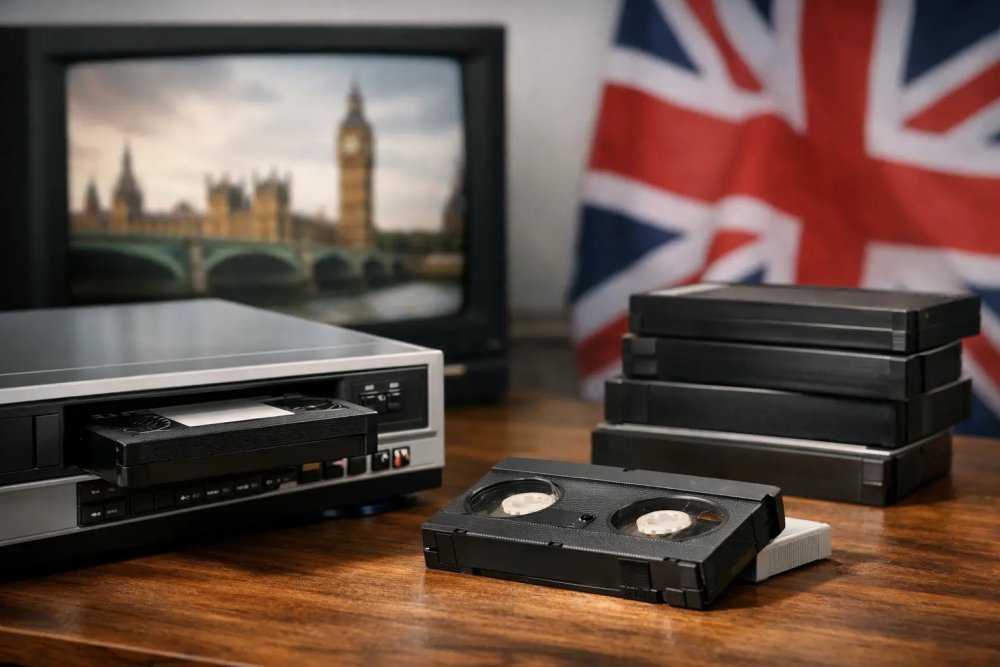
The real story of VHS player history is not just one of formats, patents and tape lengths. It is the story of the glowing red standby light beneath the telly, the satisfying clunk of a cassette sliding into place, and a generation learning that recording The A-Team meant nobody could change channel halfway through. For British households, the video recorder turned television from something that happened at a fixed time into something we could collect, pause, rewind and watch again until the tape wore thin.
Before VHS: Television Had the Final Say
Before the home video recorder became familiar furniture, television was wonderfully unforgiving. If you missed a programme, that was usually that. There might be a repeat months later, if you were lucky, but no catch-up menu and no box set waiting patiently for a Sunday afternoon.
Early videotape machines existed, although they were bulky, costly and aimed at institutions rather than the family front room. Reel-to-reel videotape had appeared in broadcasting and education long before home machines became plausible, but it demanded money, space and patience. The compact cassette changed the idea. A film, a football match or a few episodes of a favourite sitcom could fit into a plastic box that was still chunky enough to feel substantial in the hand.
Sony launched Betamax in 1975, while JVC introduced VHS in Japan the following year. Both formats reached Britain during the late 1970s, when a video recorder was a serious purchase - a gleaming slab of buttons, doors and mechanical confidence that could cost the equivalent of a small family holiday. Hiring one was often the sensible route, and many people first encountered a VHS machine as a weekend rental from the local electrical shop.
VHS Player History Begins With a Format War
The so-called format war is often told as a simple tale of VHS defeating Betamax because VHS was better. The truth, as ever, is more interesting. Betamax had a strong reputation for picture quality, particularly in its early form, and Sony was a powerful name. But VHS gave buyers something that mattered enormously in a pre-streaming age: longer recording time.
Early Betamax tapes commonly offered around an hour, while VHS was designed around two hours, enough for a feature film or a decent evening of television. VHS later stretched much further through long-play modes, albeit with compromises in picture quality. For families taping Saturday-night entertainment, a full film from ITV or a three-hour recording of the FA Cup Final, capacity often trumped finesse.
JVC also licensed VHS technology widely. That meant more manufacturers could make compatible machines, bringing more choice and pushing prices down. Soon, names such as Ferguson, Hitachi, JVC, Sharp, Panasonic and Akai filled catalogues and electrical showrooms. VHS did not win because every recorder was identical. It won because it became the tape format people expected shops, neighbours and rental libraries to support.
Britain had another contender too. Philips’ Video 2000 arrived with clever reversible cassettes and features that looked attractive on paper. Yet it arrived late, with a smaller catalogue of films and fewer machines in homes. The lesson was brutal: a home entertainment format depends on what people can borrow, buy and share as much as what it can technically do.
The Video Recorder Changes the British Living Room
By the 1980s, the VHS player had moved from aspirational gadget to household essential. Its front panel could look intimidating: channel selectors, tracking controls, a clock that flashed 00:00 for years, and a forest of buttons most of us ignored until a parent wanted to record something important.
The key feature was time-shifting. Suddenly, television schedules were negotiable. You could set the timer before leaving for work, then return home hoping you had correctly entered the channel, start time and finish time. The process was never entirely carefree. A power cut, an incorrectly tuned channel or somebody pressing the wrong button could ruin the plan. Even so, the possibility felt remarkable.
There were rituals attached to the machine. A fresh E180 cassette had promise: three hours of blank tape, a handwritten spine label and the chance to preserve something worth keeping. An E240 offered even more room, though the thinner tape could feel less reassuring. Families reused recordings relentlessly, taping over old programmes with new ones and discovering, years later, that the first five minutes of a comedy special gave way to half an episode of Coronation Street.
Then there was tracking. If the picture broke into snowy bands, the tracking buttons became a small act of television engineering. Too far one way and the image worsened; too far the other and the sound started to grumble. It was hands-on technology, temperamental but understandable - the sort of gadget that rewarded a tap on the casing, a careful rewind and occasional head-cleaning cassette.
Video Shops Made VHS Feel Like an Event
The VHS player mattered because of the culture that grew around it. Video rental shops became weekend destinations, their shelves organised by genre and their cardboard display boxes often more exciting than the film itself. Children wandered towards the animation section. Teenagers examined horror covers they were not allowed to rent. Adults debated whether a new release was worth the extra fee.
The arrival of rental also changed what could find an audience. Films that had come and gone quickly at the cinema could gain a long afterlife on tape. Low-budget action, cult horror, concert films, fitness workouts and instructional videos all found space beside Hollywood hits. A VHS collection became a personal library, even if it consisted of off-air recordings with adverts fast-forwarded badly.
This era had its controversies. The moral panic around so-called video nasties made headlines in the early 1980s, while the Video Recordings Act introduced a clearer classification system for video releases. The VHS player itself was not the cause of those anxieties, but it made moving images private, portable and repeatable in a new way. That unsettled some people and thrilled many more.
From Top-Loading Giants to Smarter Decks
The earliest domestic VHS recorders could be imposing machines, including top-loading models where the cassette sat visibly beneath a lid. Front-loading designs soon became the familiar standard, allowing the recorder to slip into a television cabinet alongside a stack of tapes and a nest of aerial leads.
As the 1980s rolled into the 1990s, players became slimmer and more polished. Remote controls became expected rather than exotic. On-screen programming made timer recording a little less cryptic, though it could still defeat the best of us. Later systems such as VideoPlus+ let viewers enter a code printed in the TV listings, a clever idea that saved a great deal of button pressing when it worked.
Picture and sound improved too. HQ circuitry helped reduce noise on standard VHS, while NICAM stereo machines brought better sound to compatible broadcasts. S-VHS offered sharper images, but it remained a premium option and never replaced ordinary VHS in most British homes. For the average family, standard VHS was good enough - especially on a curved 21-inch CRT television viewed from the other side of the room.
Camcorders extended the format’s reach. VHS-C, a compact cassette that could be played in a full-size deck using an adapter, captured birthdays, school plays, caravan holidays and children pulling faces for the camera. Those shaky home videos are now among the most valuable tapes many families own, not because the image is perfect, but because the people and voices are irreplaceable.
Why VHS Finally Lost Its Place
DVD began to replace VHS in the late 1990s and early 2000s. The appeal was immediate: no rewinding, cleaner pictures, chapter selection, extras and discs that did not gradually soften after repeated viewings. DVDs also took up less shelf space, an advantage once collections began to grow beyond a single cabinet.
VHS had genuine weaknesses. Tape could crease, snap or become tangled in the mechanism. Copies lost quality. Recording required planning and spare cassettes. A player with worn heads could turn a favourite film into a blizzard of static. Yet those flaws were tied to its physical charm. VHS made watching feel deliberate. You chose a tape, read the box, inserted it, waited for the mechanism to accept it and committed to the evening.
Production of new VHS machines dwindled as flat-screen televisions, digital recorders and streaming took over. But the format never disappeared from memory because it was woven into domestic life so thoroughly. It held rented blockbusters, taped chart shows, school holidays, Christmas specials and programmes recorded by someone who cared enough to get the timer right.
A surviving VHS player is more than a beige box with a SCART socket and a clock that may still be flashing. It is a bridge to the moments stored on those tapes. If you have a box in the loft marked “Family Videos” or “Don’t Tape Over”, treat it kindly: the machine may be old, but the memories inside are still waiting for play.






