
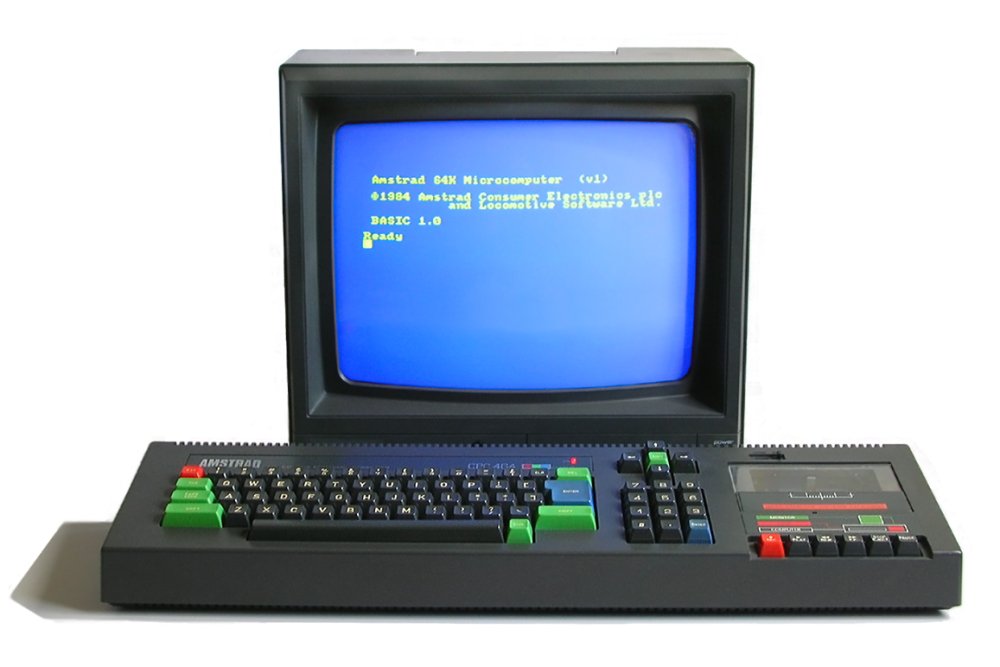
There was a particular kind of anticipation reserved for Amstrad CPC games. You pushed the play button on the built-in cassette deck, listened to the mechanical whirr and piercing loading noise, and hoped nobody knocked the table during the next ten minutes. Then, at last, colour flooded the screen. The CPC was the beige computer that made our bedrooms feel like arcades, adventure films and football grounds all at once.
The Amstrad CPC 464 and 6128 arrived with something many of us still remember fondly: personality. The chunky keyboard, the bright monitor, the joystick that never quite sat still on the carpet. Its games library was enormous, occasionally bewildering and packed with conversions that gave the Spectrum-and-Commodore debate fresh fuel for the school playground. These are the titles that made us forget our tea was getting cold.
The Amstrad CPC Games That Owned Our Afternoons
1. Gryzor
Before most of us knew it as Contra, we knew it as Gryzor: a gloriously over-the-top run-and-gun battle full of alien strongholds, laser fire and improbably muscular heroics. The CPC version was a genuine showpiece, with huge sprites, satisfying weapons and a sense that something enormous was happening on that colour monitor.
It was hard, naturally. A single mistake could send you back into the fray with a slightly tighter grip on the joystick and a renewed conviction that this was definitely the run where you would get further.
2. Dizzy
The little egg with boxing gloves became one of British gaming's most unlikely stars. Dizzy was part cartoon, part puzzle box and part test of whether you could remember which object had been left three screens back. The colourful Yolkfolk world felt friendly even when you were hopelessly stuck.
The series suited the CPC beautifully. Its bright graphics made the machine feel cheerful and alive, while its collectable objects gave us the enduring ritual of drawing rough maps on school paper. Nobody planned to spend an entire Saturday trying to find one missing item. We simply did.
3. Head Over Heels
Head Over Heels was the sort of game that made you feel clever just for understanding the controls. Two characters, each with different abilities, had to escape a bizarre isometric world of moving platforms, guards and fiendish rooms. One could jump; the other could fire sleeping pellets. Together, they made every solution feel like a tiny triumph.
Its angled perspective could be demanding, especially when a mistimed leap sent you tumbling into another life lost. But that was part of the appeal. This was a game with the confidence to ask a lot of us, and we kept returning because its strange planet felt worth conquering.
4. Renegade
Long before every game had a cinematic storyline, Renegade put us on a rough-looking city street and asked us to punch our way through gangs. It was simple, scrappy and absolutely compelling. A punch, kick, grab and throw felt astonishingly sophisticated when friends were gathered around the CPC.
The home-computer conversion could not quite recreate the swagger of the arcade cabinet, but it captured the important bit: the thrill of clearing the screen when the odds were against you. It also provided an excellent excuse to blame the joystick whenever your fighter walked straight into a barrage of kicks.
5. Target Renegade
If Renegade was the Saturday afternoon action film, Target Renegade was the bigger sequel with even more bad lads to flatten. Its co-operative two-player mode is what made it unforgettable. There was no finer domestic spectacle than two siblings or mates attempting teamwork, only to wander into each other's punches.
It had a proper sense of progress too, moving through grimy streets, industrial settings and hideouts that felt enormous after the first game. The CPC was brilliant at turning a rainy day indoors into an event, and this was one of its finest arguments.
6. Bomb Jack
Some games were all atmosphere. Bomb Jack was all momentum. You bounced around colourful single-screen stages, collecting bombs while avoiding enemies, with a jaunty soundtrack encouraging ever riskier jumps. The aim was easy enough to explain to anyone passing through the room, but staying alive was another matter entirely.
On the CPC, it looked wonderfully bold. The backgrounds were instantly recognisable, from Egyptian temples to city skylines, and the constant motion made it feel close to the coin-op experience we had seen in cafés, holiday arcades and chip shops.
7. Chase H.Q.
Blue skies, fast cars and a mission delivered with all the subtlety of an action-film trailer: Chase H.Q. let us play the pursuing police officer, racing to ram fleeing criminals off the road before time ran out. It was a fantasy of flashing lights and heroic handbrake turns, played out with a joystick and a great deal of shouting.
The CPC conversion made compromises, as home versions always did, but its speed and drama survived. That countdown created genuine tension. When the target car appeared in view, the whole room suddenly leaned towards the screen.
8. Barbarian: The Ultimate Warrior
The cover art was talked about almost as much as the game. Yet Barbarian earned its place through its brilliant one-on-one sword fighting. This was no button-mashing brawl. You had to learn range, parries and moves, then decide precisely when to risk the famous decapitating blow.
It was violent by the standards of our childhood bedrooms, which only added to its forbidden glamour. The animated execution, complete with goblin cleaner, remains one of those images that can instantly transport a former CPC owner back to a carpeted floor and a queue of friends waiting for the next bout.
9. Saboteur II
Saboteur II gave us a vast compound to infiltrate, a motorbike to ride and the uneasy knowledge that almost every room contained another way to go wrong. It was moody, open-ended and full of tiny discoveries. You could spend ages simply working out the layout, which made eventual progress feel properly earned.
This was the side of home computing that consoles could not always match. A game could be cryptic, sprawling and slightly mysterious, with no helpful tutorial waiting to rescue you. The manual might offer clues. Your mate might claim to know the route. Neither could always be trusted.
10. Rick Dangerous
By the end of the eighties, the CPC was still receiving games with real confidence, and Rick Dangerous was one of the best. Its hat-wearing hero swung through temples, escaped Nazis and navigated trap-filled caverns in a loving nod to old adventure serials. It looked superb, sounded sharp and killed you with ruthless efficiency.
Every spike, collapsing floor and unseen bullet taught a lesson. Usually the lesson was to memorise the level and try again. Yet the responsiveness of the controls and the charm of the presentation made that repetition hard to resent. We knew the trap was coming. We still walked into it.
11. Prince of Persia
Seeing Prince of Persia running on a CPC felt faintly miraculous. The fluid animation, careful jumps and cinematic dungeon escape seemed far more sophisticated than the simple games we had loaded years earlier. Suddenly, every step required patience. A leap was not just a leap - it was a calculation involving momentum, ledges and an alarming number of spikes.
It also demonstrated how long the machine endured. The CPC was never merely a starter computer waiting to be replaced. In the right hands, it kept finding new ways to surprise us.
12. Jet Set Willy
No list of beloved CPC memories feels complete without a trip around Matthew Smith's peculiar mansion. Jet Set Willy had eccentric rooms, strange hazards and an objective that sounded perfectly reasonable until you saw how much tidying was required. The game was famously punishing, but its offbeat character made it endlessly discussable.
We may not all have completed it fairly. Some of us had a cheat, a photocopied poke list or a friend who claimed their older brother had done it. That did not matter. The mansion was a place we all knew, even if we only ever survived a few rooms into it.
Why These Games Still Matter
The best Amstrad CPC games were not simply smaller versions of arcade hits or console adventures. They were part of a whole ritual: choosing a tape from a plastic case, waiting through the loading screen, adjusting the volume if the dreaded read error appeared, and swapping tips in the playground the next morning.
They also remind us that limitations can give technology character. CPC games often had to work around memory, speed and control constraints, but the results were inventive, colourful and direct. A brilliant idea could carry a game much further than polished graphics alone.
If you are returning to the CPC after years away, resist the urge to judge every game by modern standards or rush through a greatest-hits session. Give one title an unhurried evening, keep a notepad nearby for codes and maps, and let the loading noise do its work. Some machines were built to be efficient. Ours was built to make an ordinary afternoon feel enormous.






