
That shriek from the telly was not a game trying to escape. It was the game itself, arriving a few thousand bleeps at a time. For anyone wondering how cassette games loaded, the answer is wonderfully literal: our beige computers listened to a tape recorder, turned sound into digital data and hoped the volume dial was in a forgiving mood.
Before cartridges, discs and instant downloads, a cassette was the affordable way to bring sprawling worlds into British bedrooms. You pressed PLAY, watched coloured stripes or a loading screen appear, and waited. Sometimes it took three minutes. Sometimes it took the length of a family argument about whether anybody had touched the volume. Either way, that waiting was part of the ritual.
How cassette games loaded from sound
A home computer such as the ZX Spectrum, Amstrad CPC, Commodore 64 or BBC Micro stored a program as a sequence of numbers. Those numbers were converted into audio tones and recorded onto ordinary compact cassette tape. At loading time, the computer's cassette input received those tones and translated them back into the original stream of data.
At its simplest, one tone represented one binary value and another tone represented the other. Binary is the language computers use underneath everything: long patterns of ones and zeroes that can describe a picture, a line of code, a sound effect or the instruction that tells a pixel where to go. The tape deck did not understand games, and neither did the tape. It merely carried changing electrical signals, captured magnetically on a ribbon of brown tape.
The computer's job was to measure the timing of those tones accurately. Short pulses and long pulses could be treated as different values. Once enough values had been read in the right order, a game began to take shape in memory. A title screen might appear first, then the main program, then another block containing a level, music or extra graphics.
This is why pressing PLAY produced that unforgettable electronic chatter through the television speaker. If you could hear it, you were effectively hearing coded information. To our parents it may have sounded like a robot having a difficult morning. To a Spectrum owner, it sounded like possibility.
The pilot tone, headers and data blocks
Cassette programs were rarely one uninterrupted lump of information. They were generally split into blocks, each with a specific purpose. The computer needed a reliable way to find the beginning of each block, so many systems used a long, steady pilot tone first.
On the ZX Spectrum, that pilot tone gave the machine time to settle and synchronise with the incoming signal. It was followed by a header block that might identify the program name, its type and its length. Then came the data block itself. A brief pause between blocks gave the machine a moment to prepare for the next section.
That familiar sequence explains a classic childhood sight: the Spectrum border changing colour as the machine read the tape. The flashing stripes were not merely decorative. They were a visible sign that the computer was receiving and processing data. Watching those bands crawl around the screen became a tiny act of faith. No red-and-white error message yet? We might be all right.
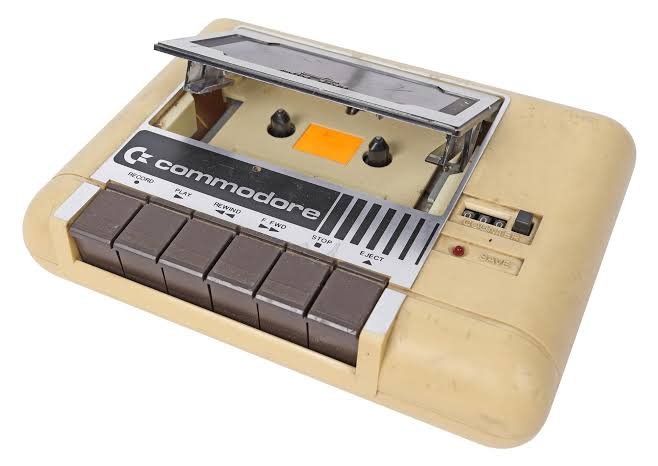
Different machines had their own methods. The Commodore 64 used its Datasette, a dedicated cassette unit with a more controlled connection than a standard audio lead. The BBC Micro could use cassette storage too, while Amstrad CPC owners often used a built-in tape deck with its chunky mechanical keys. The principle was shared, but timings, formats and reliability varied from one system to another.
Why the volume knob mattered so much
Cassette loading sounds simple until you remember the equipment involved. The data was travelling through magnetic tape, a cassette head, wires and analogue circuitry before the computer could make sense of it. Every stage could introduce trouble.
Set the volume too low and the signal might be too weak to read. Set it too high and the waveform could distort, making short pulses look like long ones or blurring them altogether. That is why so many of us developed a highly unscientific family procedure: start around the middle, try again, nudge it slightly, rewind, try again, blame the tape.
The condition of the cassette mattered too. A worn tape could stretch or shed its magnetic coating. Cheap blank cassettes were sometimes fine, until they were not. Tape heads gathered dust. A recorder running fractionally too fast or too slowly could alter the timing enough to confuse a fussy loader. Even a dodgy lead, a loose plug or a slightly tired battery in a portable recorder could ruin the afternoon.
Then there was the human factor. Somebody might open the cassette drawer halfway through loading, knock the recorder, or rewind to approximately the right place rather than the actual beginning. A game that loaded perfectly at a friend's house could become a stubborn mystery at home, despite everyone insisting they had copied it properly.
When loading failed
A tape error felt remarkably personal. After several minutes of patience, the computer would stop, flash a message or simply return to its prompt. On a Spectrum, the dreaded R Tape loading error could appear just as the game seemed within reach. That short line of text had the emotional impact of a power cut during the final level.
The sensible response was to clean the tape heads, check the cable and experiment with the volume. The less sensible but deeply familiar response was to hold the cassette player at a different angle, blow near the connectors, or ask whether anyone had breathed too loudly. We were all amateur technicians because we had no choice.
For copied tapes, another complication was generation loss. Each tape-to-tape copy added noise and softened the edges of the recorded tones. One copy from an original might work beautifully; a copy of a copy of a copy, passed around school in a labelled case, could be an adventure before the game had even started.
The strange joy of waiting
By modern standards, cassette loading was absurdly slow. A large game could take several minutes, and multi-load titles asked you to stop playing and load the next section from another point on the tape. Yet the delay had a peculiar magic.
Loading screens gave artists room to show off. On the Spectrum, a bright static picture might slowly emerge before the game began, often with colours that ignored the machine's infamous attribute clashes because it was only a still image. Music played from the telly, tea was fetched, instructions were read for the first time, and siblings negotiated who had the first go.
The wait also made games feel valuable. You had committed to this particular cassette. There was no library of hundreds of titles a button press away, no impatient flick through menus. If Jet Set Willy, Dizzy or The Way of the Exploding Fist was making its way into memory, you gave it your attention.
Some publishers even built anticipation into the process. A striking loading image, a proper tune and a reassuringly long pilot tone could make the arrival feel ceremonial. The game was not instantly summoned. It was coaxed from a plastic box, a folded inlay and a spinning cassette mechanism.
Faster loaders and bigger ambitions
Publishers did not always accept standard loading speeds. Many used turbo loaders, which recorded data more tightly or used cleverer encoding methods to reduce the wait. The trade-off was reliability. Faster signals left less room for imperfect tape alignment, noisy recordings or a slightly wayward deck.
Multi-load games made cassette limitations especially obvious, but they also encouraged ambitious design. Adventures, sports compilations and arcade conversions could spread content across both sides of a tape or ask players to load a new area between stages. It was clumsy, certainly, yet developers worked around the restriction with impressive ingenuity.
For many British households, cassette was also cheaper than floppy discs and much more accessible than cartridges. Blank tapes were familiar, recorders were everywhere, and the technology fitted the home-computing moment perfectly. It helped turn the bedroom computer into a place where games could be bought, borrowed, copied, typed in from magazines and treasured.
A noise worth remembering
Cassette loading was never elegant. It demanded patience, a decent tape head and just enough luck. But those flaws gave the machines personality. The rubber keys, the foam headphones, the clicking deck and the warbling data noise all belonged to the same era of technology that asked us to take part rather than merely press Start.
The next time you hear that harsh little chorus of tones, listen closely. It is not just noise from an obsolete storage format. It is the sound of a bedroom computer gathering itself for one more go, and a generation waiting for the border to turn blue.






