
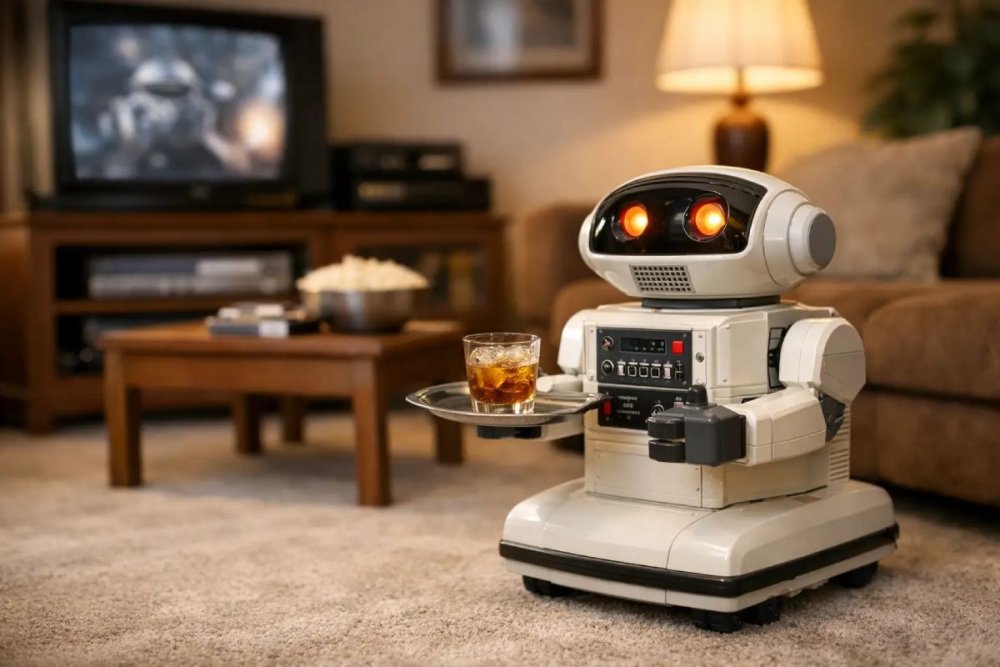
The first surprise in understanding how the Omnibot worked is that it was never trying to be a clever robot in the modern sense. It was a battery-powered machine with a boxy white body, a useful-looking tray and just enough electronic theatre to convince us it had a job to do. In an 1980s living room, weaving between the pouffe, the television cabinet and the family dog, that was more than enough.
Tomy’s Omnibot arrived at precisely the right moment. We had been promised robots by comics, television and films, while the real technology in our homes was more likely to be a cassette deck, a digital clock and perhaps a ZX Spectrum. Here was a robot you could actually command. It made noises, moved about, carried things and, with patience, appeared to follow a plan. It felt like a visitor from the future, even if that future needed a sizeable pile of batteries.
What the Omnibot was really doing
At heart, the original Omnibot was a remote-controlled vehicle wrapped in an unforgettable robot shell. Its electric motors drove the wheels, while a separate motor system helped it turn or operate features around its upper body. The plastic casing did much of the storytelling: the chest panel, head, arms and serving tray suggested a domestic helper rather than a toy on wheels.
Its controller sent coded instructions to the robot. Press a movement button and Omnibot would roll forwards, reverse, turn or stop. Other controls triggered its sound effects and actions. The exact layout and features varied across Omnibot releases, and memories often blur the original model with later versions such as the Omnibot 2000, but the basic proposition remained the same: give the robot a command and watch it act it out.
That sounds modest now. Yet the delay between pressing a button and seeing that chunky machine respond was part of the magic. Unlike a modern app-controlled gadget, Omnibot did not disappear behind a screen. You had to stand in the room with it, judge the space it needed and accept that it might clip the skirting board before delivering its cargo.
Wheels, motors and a rather optimistic serving tray
The wheels underneath were the real stars. Omnibot could not stride across the carpet like a character from science fiction. It rolled, usually best on a hard and reasonably clear floor, with turning that could be more hopeful than precise. Deep pile carpet, loose rugs and the edge of a fireplace hearth were all formidable opponents.
The tray was a brilliant piece of toy design because it gave the robot a purpose. A child could place a biscuit, a plastic cup or a tiny action figure on top, programme a route and declare that refreshments had been delivered. In reality, anything tall, heavy or badly balanced was likely to make the journey rather dramatic. Still, a successful trip from one side of the lounge to the other felt like a proper achievement.
The motors produced that familiar toy-robot soundtrack: whirring gears, abrupt changes of direction and the faint rattle of moulded plastic. Omnibot was not quiet, graceful or particularly subtle. Technology that had personality rarely was.
How the Omnibot worked when you programmed it
The cleverest party trick was Omnibot’s ability to remember a sequence of commands. Rather than reacting only to live control inputs, it could store a short routine. You might teach it to move forwards, turn, pause, make a sound, turn again and return. Then you pressed play and waited to see whether your mechanical butler had remembered the route.
This was programming in the most hands-on form imaginable. There was no code on a monitor and no blinking cursor asking for a command. The programme was built from physical button presses. Each instruction was a small event: forward, left, right, stop, action. Omnibot stored those events in electronic memory and played them back in the same order.
It was not learning from its mistakes. It was not mapping the room, recognising faces or deciding where the biscuits belonged. If it missed the coffee table by ten centimetres on the first run, it would miss it in much the same way on the next. But that limitation taught us something useful, even if we did not have the words for it at the time: machines only seem intelligent when the instructions, conditions and surroundings cooperate.
Why programmes so often went wrong
Omnibot routines depended on timing. A command to move forwards was not a measured instruction such as “travel exactly one metre”. It was closer to “run the forward motor for this amount of time”. On a smooth kitchen floor, that might produce a tidy journey. On carpet, with slightly fading batteries and a toy soldier wedged near one wheel, the result could be entirely different.
That is why an Omnibot demonstration could feel miraculous one minute and hopeless the next. Battery charge mattered. Floor surfaces mattered. The robot’s starting position mattered. Even a small difference in the angle of a turn could compound across a sequence of instructions.
For children prepared to experiment, this became part of the fun. You shortened a forward movement, adjusted a turn and tried again. It was trial and error, but with a plastic robot as your co-conspirator. In its own clunky way, Omnibot offered a first taste of debugging.
Sounds, lights and the illusion of a personality
The machine’s electronic noises did a great deal of work. Beeps, pre-recorded phrases or effects, depending on the model, gave the impression that something inside was thinking. The sounds were simple, but they arrived at the right moments: when a command had been received, when a routine began or when Omnibot wanted attention.
Later members of the family pushed this showmanship further. The Omnibot 2000 is especially remembered for bringing audio features into the act, making the robot feel closer to the all-purpose household companion children imagined from catalogues and television adverts. These evolutions were less about true artificial intelligence than about presentation. Add a voice, a tape-related feature or a new action and the fantasy becomes easier to believe.
The same principle made its illuminated panels and moving parts so effective. A spinning or turning section did not need to achieve much mechanically. It only needed to look busy. We were perfectly willing to meet it halfway, just as we did with flickering loading screens and the rubber keys of a home computer.
The limits were part of the charm
By modern standards, Omnibot had no camera vision, no internet connection, no useful voice assistant and no reliable understanding of its surroundings. It could not fetch a drink from the fridge, avoid every obstacle or hold a conversation. Its tray did not transform family life, despite what the packaging may have gently implied.
But judging it only by those limits misses the point. Omnibot made robotics physical and approachable. You could see the wheels working. You could hear the motors complain. You could open the battery compartment, feel the weight of the thing and learn that a futuristic machine was still subject to ordinary domestic realities.
It also sat in a wonderfully particular 1980s dream of the future. The future was expected to be white plastic, bright decals, flashing lights and a remote control with proper buttons. It would live in the lounge, not in a data centre. It might bring crisps to the sofa, provided nobody asked too much of it.
Why Omnibot still matters
For collectors, keeping an Omnibot working can involve more than simply fitting fresh batteries. Ageing gears, battery corrosion, tired belts, worn switches and remote-control faults can all affect performance. Original boxes, instructions and accessories add to the appeal because they restore the ritual as well as the object: the diagrams, the warnings, the promise that your home was about to become robotic.
For the rest of us, the enduring appeal is simpler. Omnibot represents the toys we begged for because they seemed impossibly advanced, then discovered were gloriously fallible. It turned a few motors, some stored instructions and a heap of imagination into an afternoon’s entertainment.
If you ever find one again, do not expect a machine that behaves like a modern robot. Clear a little floor space, give it fresh power, keep the tray load light and let it wobble through its routine. The charm is not that Omnibot predicted the future perfectly. It is that, for a moment in a beige-carpeted British living room, it made the future feel as though it had already arrived.






