
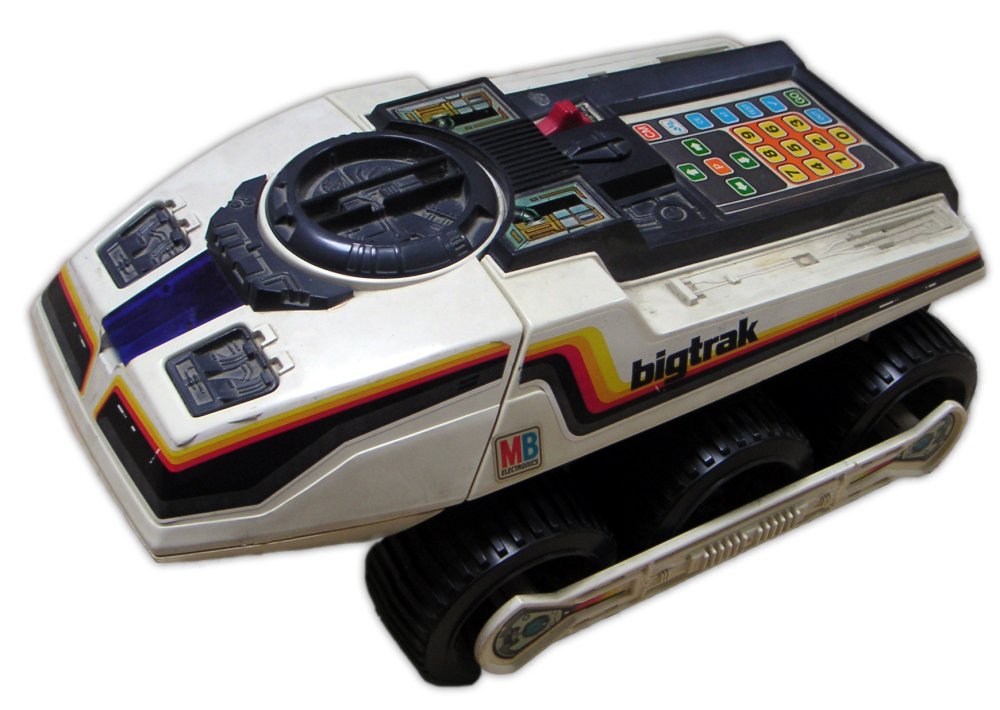
A black-and-white plastic tank rolling across the carpet might not sound revolutionary now. But ask what was Big Trak to anyone who spotted one in a toy catalogue, and you will soon hear about a machine that seemed to have arrived from the future. It had six chunky wheels, a keypad where a turret ought to be, and the rarest childhood superpower of all: it could remember what you told it to do.
Big Trak was not merely a vehicle you pushed about while making laser noises. You programmed it, pressed execute, then watched it set off on its own across the living-room floor. For children raised on Scalextric, wind-up toys and games with fixed rules, that felt faintly miraculous.
What Was Big Trak, Exactly?
Big Trak was a programmable electronic vehicle made by Milton Bradley and launched at the end of the 1970s, becoming a serious object of desire during the early 1980s. Its design looked part lunar rover, part tank, part prop from a television programme set a few years ahead of its budget.
At the front sat a red LED ‘phaser’, while the top carried a numerical keypad and a row of command buttons. Using these controls, you could enter a sequence for Big Trak to follow: move forwards or backwards by a chosen distance, turn left or right in set increments, pause, and fire the phaser. Then came the moment of truth. Press the execution command and the vehicle would trundle off, following your instructions from memory.
That distinction matters. Big Trak was not a remote-control toy in the familiar sense. You were not steering it second by second from the sofa. You had to plan the route first, account for turns, judge the space available and hope the dog did not wander into the test area halfway through the mission.
Its programme memory was limited, but that was part of the charm. A 16-step sequence was enough to send it around chair legs, towards a cardboard-box moon base, or directly into the skirting board after one optimistic calculation too many. The result was technology with personality: confident, mechanical and occasionally determined to expose the flaws in your arithmetic.
The Toy That Made Carpets Feel Like Space
Big Trak’s appeal was not just that it moved by itself. Plenty of toys moved. The remarkable thing was that it appeared to understand a plan.
A child could turn a lounge into a mission control centre with very little preparation. Cushions became craters. A copy of the Radio Times made a bridge. Empty cereal packets were hostile installations. Big Trak would be given a route, often scribbled down with the solemnity of a NASA launch procedure, then sent on its way with everyone watching to see whether it would complete the course.
It also looked the part. The body was mostly white, with dark panels and purposeful black wheels, at a time when household technology was becoming more visible and more exciting. Early home computers were beginning to appear in British homes. The ZX Spectrum, BBC Micro and Commodore 64 would soon put keyboards, loading screens and mysterious commands in front of a generation. Big Trak belonged to that same cultural moment, even if it lived on the bedroom carpet rather than the dining-room table.
It was a toy, certainly. Yet it carried the visual language of serious future technology. The buttons were chunky. The bodywork was angular. The movement was accompanied by a soft electric whirr rather than the clatter of clockwork. It felt like an appliance from a space station that had somehow ended up beside the Action Man figures.
Programming Before We Called It Coding
The most lasting thing about Big Trak was its quiet introduction to programming logic. Nobody needed to call it coding, and nobody needed to understand a line of BASIC. The lesson was built into the play.
You gave a machine instructions in a precise order. If it did the wrong thing, the machine had not become naughty or confused. Your sequence was wrong. Perhaps you had asked it to travel too far. Perhaps the turn was the wrong way round. Perhaps you forgot that a 90-degree corner needed two 45-degree turns. Back to the keypad you went.
That feedback loop was enormously satisfying. It made mistakes feel solvable. In an era before touchscreens offered instant correction and games constantly told us what to do next, Big Trak made children pause, think and try again. It rewarded planning, but it also rewarded glorious experimentation.
Of course, it had limits. It could not sense furniture, make decisions or adapt to the terrain. A deep-pile carpet, a slightly uneven floor or a wheel meeting a stray slipper could turn an elegant mission into a lopsided crawl. Its programming was a sequence rather than intelligence. But for its audience, those limitations made the achievement more tangible. You could see exactly what was happening because you had told it to happen.
For many children, that was their first encounter with the idea that machines were not magic boxes. They could be instructed. They could follow rules. And, rather wonderfully, they could be persuaded to fire a little red light at the cat basket.
The optional trailer made the mission bigger
Big Trak also had an optional accessory trailer, which extended the fantasy from simple exploration to full-scale logistics. The trailer could carry small cargo, making it ideal for delivering supplies to a fort, recovering a figure from behind the sofa, or transporting something your sibling had been told not to touch.
It was not essential to enjoying the main vehicle, and many children knew it only from adverts or catalogues. Still, it added to the sense that Big Trak was a system rather than a one-off toy. It suggested there was a whole miniature future to collect, one battery-powered component at a time.
Why Big Trak Became Such a British Childhood Icon
Big Trak was sold beyond Britain, but it lodged particularly strongly in British memories because it arrived at exactly the right time. We were surrounded by visions of the future that were both thrilling and slightly scruffy: Tomorrow’s World demonstrations, Doctor Who corridors, school computer rooms and cassette-loading home micros that promised more than they could always deliver.
It also occupied a tantalising place in the pecking order of toys. Big Trak was not a cheap pocket-money purchase. It was the sort of thing that appeared on Christmas lists with several underlines, or in the pages of the Argos catalogue as an object to stare at until someone needed the book back. Owning one made you the child whose house friends wanted to visit.
That does not mean every memory is rose-tinted. Big Trak required batteries, space and patience. Programming routes was less impressive when it was time for tea, and its practical performance depended heavily on the surface beneath it. Yet those quirks are precisely why people remember it so fondly. It was physical technology. You pressed real buttons, heard the motors work and learned that futuristic machines could still get stuck on a rug.
The Legacy of a Six-Wheeled Rover
Big Trak was later revived in updated forms, a sure sign that its basic idea never lost its appeal. Modern children have programmable robots with sensors, apps and colourful screens, while adults can command more processing power from a watch than Big Trak ever contained. But the original holds its ground because it made computing visible.
There was no hidden algorithm and no glossy interface doing the thinking for you. The instruction went in through the keypad, the wheels turned, and your plan either worked or did not. That directness is why it still feels special alongside the beige computers, cassette mechanisms and electronic toys we grew up with.
If you were lucky enough to own one, you may remember its motor noise, its stubborn turns and the nervous pause before a carefully plotted route began. If you only wanted one, the memory can be just as strong. Big Trak remains proof that the best retro technology did more than entertain us: it made an ordinary carpet feel like the edge of the known universe.






