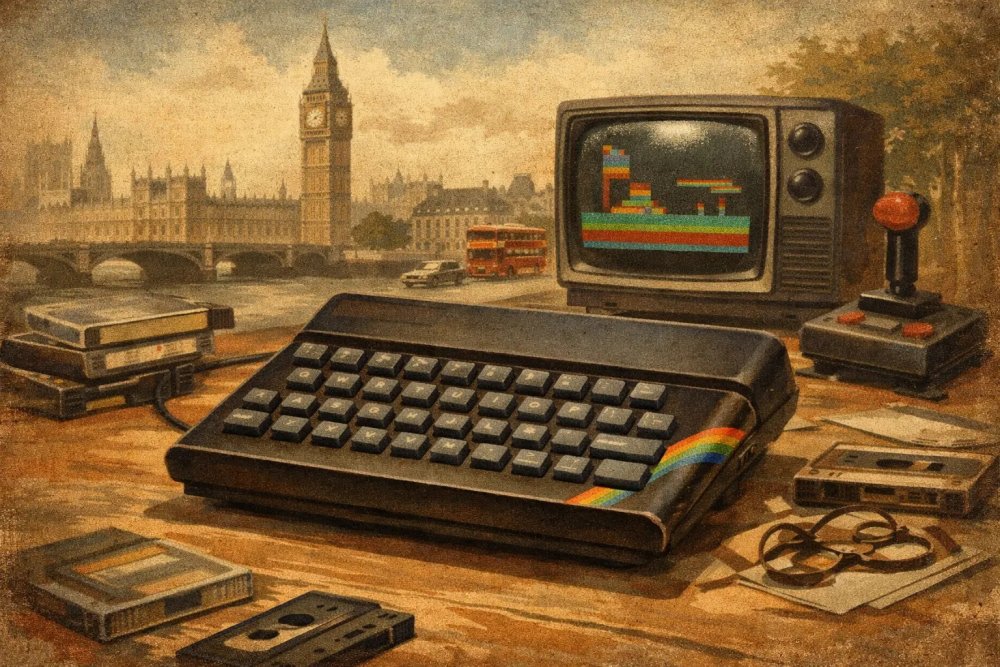
A ZX Spectrum did not merely sit in the corner of the living room. It colonised the telly, the coffee table and, eventually, the family patience. Its little rainbow flash promised possibility from the moment the black rubber keys appeared, usually beneath a tangle of aerial leads and a cassette recorder borrowed from somewhere in the house.
For a generation of British children, this was the machine that made computing feel like something you could touch, break, fix, copy and proudly show off. It was cheap enough to enter ordinary homes, strange enough to feel futuristic, and awkward enough to become unforgettable. Long before every device was polished glass and instant response, the Spectrum made us wait - and made the reward feel earned.
The ZX Spectrum made a computer feel possible
When Sinclair Research launched the ZX Spectrum in 1982, home computing still carried a whiff of science labs, offices and men in white coats. The 16K model cost £125, while the 48K version came in at £175. Neither was pocket money, obviously, but compared with many rivals it was within sight for families who saw a computer as a thrilling, vaguely educational investment.
That price mattered. The Spectrum did not arrive as a distant American dream or a machine reserved for schools with locked cupboards. It arrived in catalogue pages, independent electrical shops and Christmas wish lists. It could be plugged into the television already sitting in the front room. That familiar screen became a portal to alien planets, haunted mansions, football pitches and text adventures that seemed to stretch far beyond their tiny memory limits.
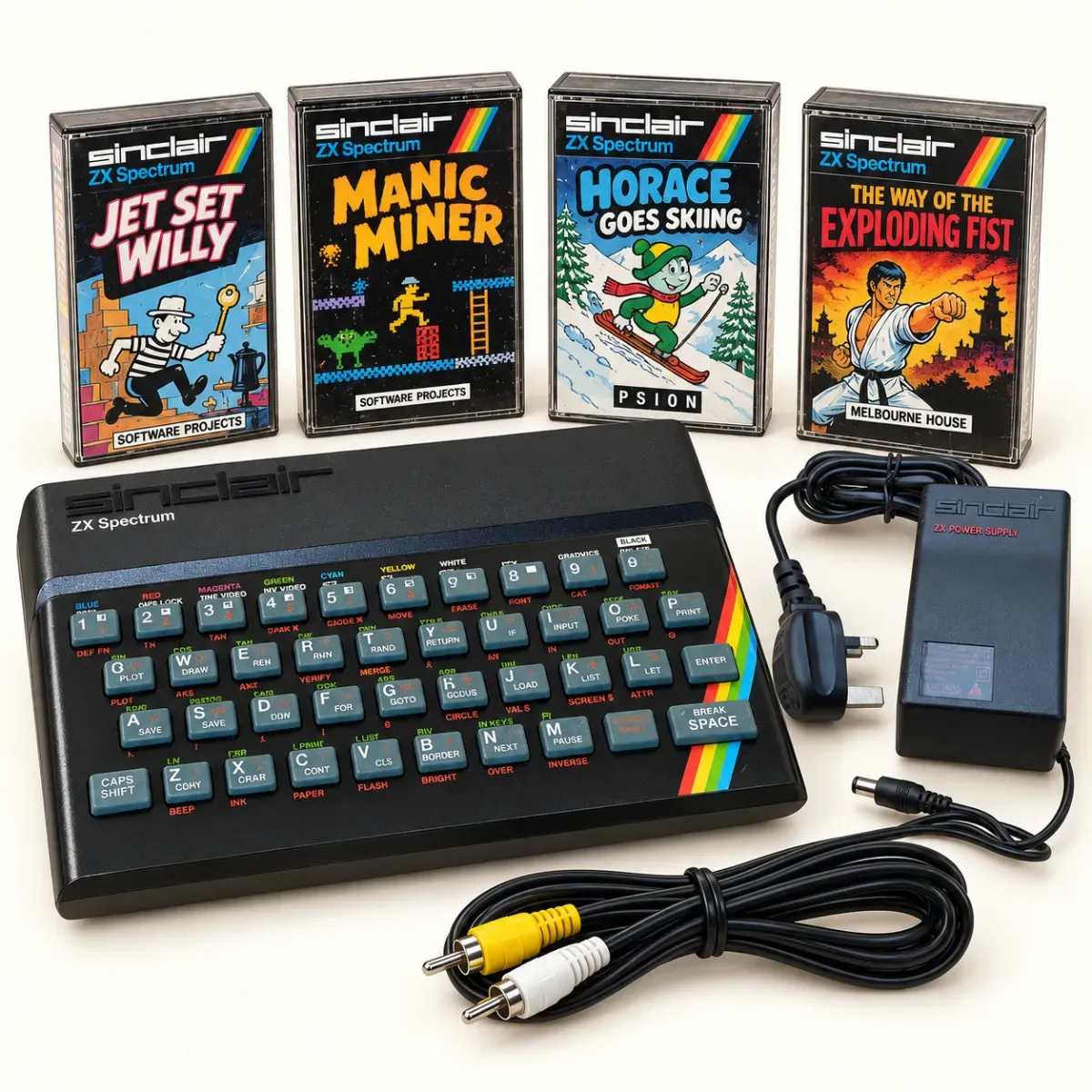
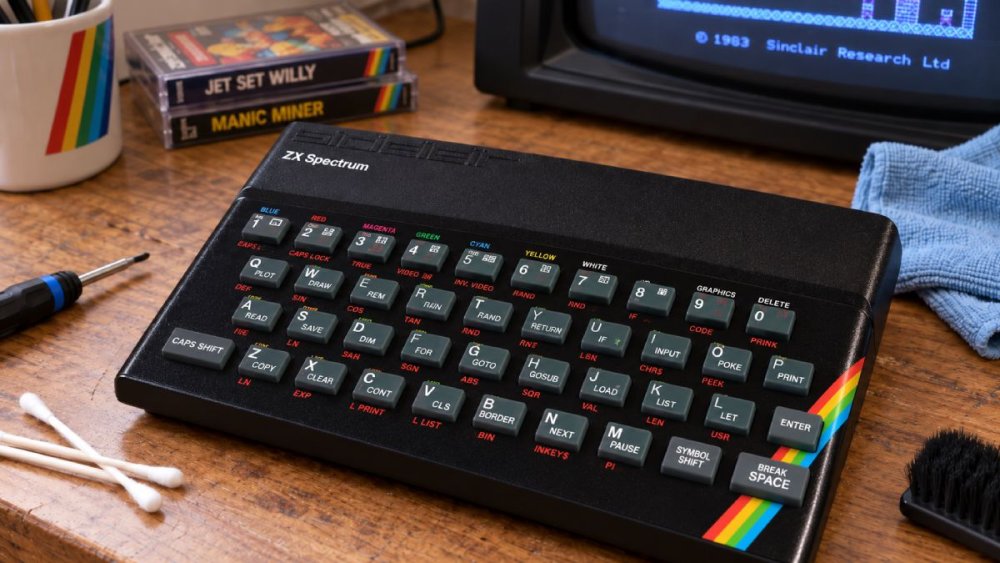
The machine itself had character before it had even loaded a game. The original Spectrum was a small black slab with its famous rubber keyboard, rainbow stripe and keys that felt more like determined little buttons than anything built for speed typing. It looked unlike the beige computers that followed. It looked like a prop from the future as imagined in 1982, which was rather more exciting.
Rubber keys, rainbow stripes and real personality
Modern technology works hard to disappear. The ZX Spectrum did the opposite. It announced itself through warm plastic, sharp corners, a slightly temperamental power supply and a keyboard that required a particular kind of thumb confidence. Every key carried several commands, because space was precious and Sinclair expected you to learn its peculiar language.
That was part of the appeal. The Spectrum did not flatter the newcomer, but it invited experimentation. Pressing a key could produce a letter, a BASIC command or a symbol, depending on the mode. You might begin by trying to load a game, then find yourself typing ten PRINT statements and making a sentence bounce around the screen. A mistake was not necessarily a failure. It was often the start of an afternoon.
Its colour palette became part of its visual identity too. Spectrum games used bright blocks of colour with a limitation that players came to know as colour clash. A character passing in front of a background could cause colours to flicker or change in ways no artist had intended. Yet the best developers treated that restriction like a challenge rather than an apology. Screens were bold, graphic and instantly recognisable, with dazzling loading art often doing as much to fire the imagination as the game itself.
There is a temptation to call these flaws charming, as though age automatically turns inconvenience into magic. Not every part was charming. The rubber keys could be frustrating. The power supplies could be unreliable. The keyboard was a poor fit for serious writing, and colour clash was colour clash. But the Spectrum's compromises were visible. They taught us that games and programs were made by people working around limits, not conjured from nowhere.
The cassette ritual was half the event
Nothing summons the era quite like the sound of a cassette loading. First came the careful adjustment of the recorder volume. Then PLAY. Then the shriek, chatter and electronic squeal filling the room as coloured stripes danced across the television. Finally, after several patient minutes, came either the title screen or the dreaded loading error.
This was technology with ceremony. You did not tap an icon and vanish into a game in three seconds. You committed. You might sit cross-legged on the carpet, study the inlay card, argue with a brother or sister about whether the tape was too loud, and wait for the machine to decide your fate. When a game finally appeared, the sense of arrival was enormous.
Of course, it could go wrong. One accidental nudge, a worn tape head, a dodgy recorder or an overconfident volume adjustment could send the whole operation back to square one. Some households developed folk knowledge worthy of a repair workshop: clean the heads, rewind fully, do not touch anything, and for heaven's sake do not let Dad switch over to the football.
That waiting changed how games were valued. A title was not simply content to be consumed and forgotten. It was an occasion. We gave games more time because getting them running had already demanded something from us. Even the cassette case mattered, with its dramatic cover art, screenshots and breathless claims of arcade action.
British bedrooms became software studios
The Spectrum's greatest legacy may be the way it turned players into makers. Its built-in BASIC was right there, waiting after the machine switched on. You did not need permission, a subscription or a degree in computer science to type a few lines and see something happen. The first program might have been dreadful. It was still yours.
Magazines fed that curiosity week after week. Listings filled pages, asking readers to type line after line of code with the concentration of a bomb disposal expert. One missing character could derail the whole thing, yet there was real satisfaction in finding the error and making a crude game, quiz or sound effect spring to life. The bedroom coder was not a myth. It was a genuine route into an industry that was being built at remarkable speed.
That is why the Spectrum story belongs as much to the people who made games as to the games themselves. Bedroom programmers and small British publishers proved that a hit could emerge from a terraced house, a shared flat or a tiny office above a shop. Ultimate Play the Game, Bug-Byte, Ocean and countless others helped create an energetic, sometimes chaotic games culture with its own heroes and rivalries.
Games such as Manic Miner, Jet Set Willy, The Hobbit, Atic Atac, Skool Daze and Dizzy did more than pass the time. They established tones that felt distinctly ours: surreal, cheeky, occasionally bleak, and happy to assume the player could cope with a bit of mystery. They were not all masterpieces, and plenty were punishingly difficult, but they felt like discoveries passed around in playground conversations and recorded on C90 tapes.
Why the Spectrum still has a hold on us
Nostalgia is not only about wishing for slower machines. Most of us would rather not return to waiting five minutes for a game to fail at the last moment. The pull of the ZX Spectrum comes from remembering a period when technology felt legible. You could see the cassette mechanism turn. You could hear the data arrive. You could type a command and watch the machine obey, or refuse with a blunt little error message.
It also represents a particular British confidence: make it affordable, make it clever, get it into homes, and see what happens. The results were messy, inventive and gloriously uneven. Alongside brilliant games were baffling ones, pirate tapes with handwritten labels, joystick arguments and hours spent trying to understand why a program would not run. That texture is the point. The Spectrum was not perfect, but it was alive in a way many immaculate devices are not.
Collectors may chase boxed 48Ks, a Spectrum+ with its more conventional keyboard, or the later 128K models with their extra memory and music. Others are content with an emulator, a miniature reissue or the memory of one particular loading screen. There is no wrong route back. The important thing is recognising why a small black computer still has the power to make grown adults grin at the mention of a rubber key or a tape counter.
If the Spectrum has stirred a memory, follow it. Dig out the game you never finished, ask a sibling whether they still remember the loading instructions, or write down the tiny household rituals that surrounded your machine. Those details are not trivial. They are part of the story of the tech we grew up with - and they deserve to be kept alive.