
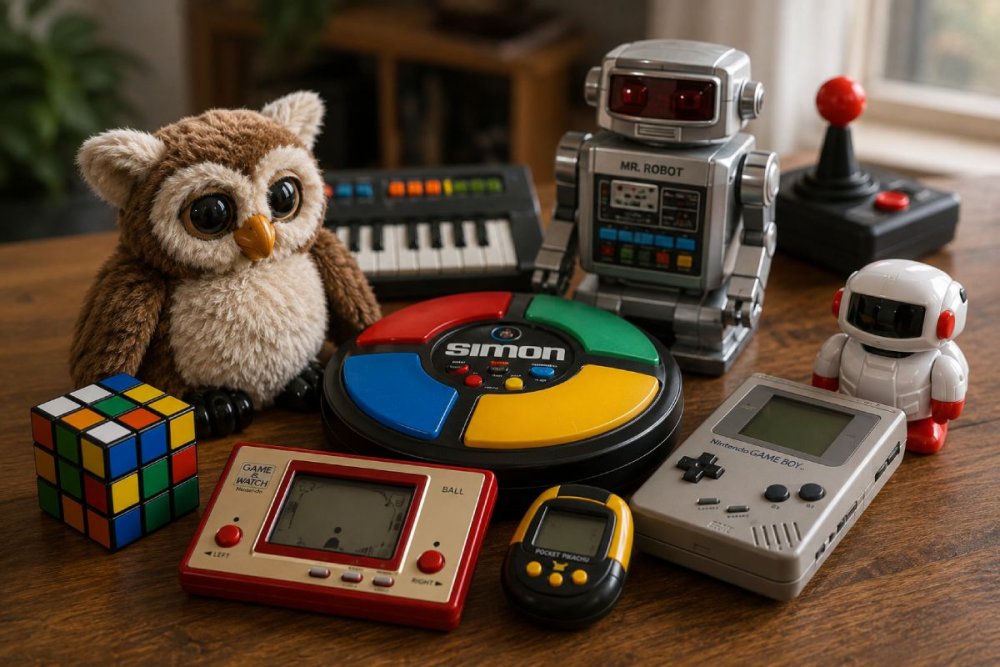
A red LED display could turn the back seat of a Cortina into an arcade. A robotic tank could make the carpet feel like the surface of Mars. And a tinny electronic voice saying “spell” was enough to convince us the future had arrived in the kitchen. The best electronic toys of the 1980s were rarely elegant and never quiet, but they had something modern gadgets often lack: instant personality.
This was the decade of chunky buttons, smoked-plastic screens, foil overlays and battery compartments secured with one impossible little screw. Some of these favourites technically began life in the late 1970s, while others became playground royalty later in the decade. What matters is that they were the toys we saved up for, begged for at Christmas and passed around with sticky fingers until the batteries gave up.
What made 1980s electronic toys so special?
Electronic toys sat in a brilliant middle ground. They were not quite computers, not quite consoles and definitely not ordinary toys. You could learn spelling on one, steer a tank with another, or spend an entire rainy afternoon trying to beat a blinking alien invasion with no story, no save file and no mercy.
Their limits were part of the appeal. A few sounds, a tiny screen and a handful of modes had to do a lot of imaginative work. The toy supplied the beeps; we supplied the drama. Here are 12 that earned their place in the great British memory bank.
12 best electronic toys of the 1980s
1. Grandstand Astro Wars
For many British children, Astro Wars was the electronic game to have by the television. Its tabletop cabinet, starfield display and controls made it look like a proper arcade machine that had somehow shrunk for the living room. The gameplay was simple - move, shoot, survive - but that orange-and-blue fluorescent display felt astonishingly alive.
It was also gloriously social. Siblings and visiting cousins would hover nearby, offering unwanted tactical advice while waiting for a turn. Astro Wars was proof that you did not need a screen full of detail when you had flashing lights and a high score to defend.
2. Tomytronic 3-D
Tomytronic 3-D games were the sort of thing you demonstrated to anyone who came round. You pressed your face to the chunky binocular viewer and, somehow, saw a proper-looking game world with depth. Titles such as Thundering Turbo and Sky Attack made the technology feel almost magical.
The effect was more clever than realistic, and the games could be rather unforgiving. Still, no one cared. The fact that a handheld toy could create an illusion of three dimensions was enough to make it feel like equipment from a science-fiction programme.
3. Nintendo Game & Watch
Before the Game Boy conquered school bags, Nintendo’s Game & Watch range made pocket gaming feel classy. The silver-and-gold models, the crisp black graphics and the handy clock function gave them a grown-up air, even if the real purpose was dodging hazards in Fire, catching falling objects in Oil Panic or rescuing characters in Donkey Kong.
They were limited to one game per unit, which sounds absurd now. Yet that limitation gave each model its identity. You did not simply own a game. You owned Parachute, Green House or the double-screen Donkey Kong everyone wanted a go on.
4. MB Big Trak
Big Trak was less a toy vehicle and more a programmable armoured personnel carrier for the lounge carpet. Its keypad let you enter a sequence of commands, then watch it roll forwards, turn, pause and fire its little beam. For children who had seen computers on Tomorrow’s World, it was a thrilling taste of programming without needing to understand BASIC.
It could be temperamental, especially on uneven carpet, and its turning circle was not exactly military precision. None of that diminished the joy of sending it on a mission to collect a biscuit or invade the hallway.
5. Speak & Spell
The Speak & Spell gave learning a distinctly extraterrestrial accent. Its angular orange body, membrane keys and synthesised voice made spelling tests feel less like homework and more like communicating with a friendly robot from Texas Instruments.
It was educational, certainly, but that was not why it became iconic. We loved it because it spoke. In an era when most toys clicked, rattled or beeped, a machine that asked questions and pronounced words seemed astonishingly clever. The wobbling electronic voice is still instantly recognisable.
6. Simon
Simon had only four coloured pads and a repertoire of tones. It also had the power to reduce an entire family gathering to silence. Watch the sequence, repeat the sequence, then fail one note from a personal best and insist the machine had cheated.
Its genius was that it was easy to understand in seconds but difficult to put down. Simon did not require instructions, cartridges or a television. It just needed four batteries, a tabletop and somebody prepared to say, “Right, let me have one more go.”
7. Merlin
Parker Brothers’ Merlin looked like a red telephone from a very optimistic future. Under its grid of buttons were several games, including noughts and crosses, music-making and a form of electronic mastermind. That made it feel unusually generous compared with single-game handhelds.
Merlin’s red LEDs were not much to look at by modern standards, but they left plenty to the imagination. It was a clever little machine for train journeys and rainy holidays, and a reminder that multi-game devices existed long before app stores.
8. Lazer Tag
Lazer Tag took the electronic toy out of the bedroom and into the garden, where every hedge became cover and every sibling became a target. Introduced in the middle of the decade, it used infrared rather than actual lasers, but that distinction mattered to precisely nobody wearing the sensor vest.
Its main drawback was practical: British weather. A grand battle planned for Boxing Day could quickly become a damp negotiation about whether the handsets were getting ruined. When conditions allowed, though, Lazer Tag made us feel like action-film heroes.
9. Armatron
The Armatron robotic arm looked wonderfully serious, with its black-and-yellow industrial styling and two joystick controls. It let you grip, lift and rotate small objects with surprising finesse after a little practice. For a child, operating it felt like running a factory, a space station and a secret laboratory at once.
It did not have a screen, a score or electronic speech. What made it special was the illusion of control. Every movement came from your own hands, translated through gears and motors into something that looked properly mechanical.
10. Mattel Electronics Football
Mattel Football was already a hit before the decade began, but it lived in countless 1980s coat pockets and school bags. The entire pitch was represented by red dots, the crowd noise was more suggestion than sound, and yet every touchdown felt monumental.
It showed how little technology needed to create sporting tension. You could barely see the players, but you knew exactly when a defender had trapped you. Its small size also made it ideal for playing under the duvet long after lights-out, if you could hide the beeping.
11. Star Wars Electronic Battle Command
The original trilogy made almost anything with a button and a sci-fi noise irresistible, and Electronic Battle Command understood the assignment. Players used an electronic control panel to destroy enemy ships and work through missions, with flashing displays doing a great deal of cinematic heavy lifting.
It was not a console experience in the modern sense. It was closer to an elaborate board-game prop from the Rebel Alliance. That was exactly its charm: it made the kitchen table feel briefly connected to a galaxy far, far away.
12. The Casio calculator watch
Strictly speaking, this was a gadget rather than a toy. In the 1980s, however, any watch that could calculate sums absolutely became a toy by break time. Casio calculator watches were worn with pride, operated with fingernails and frequently used for calculations nobody had actually been asked to do.
The buttons were comically tiny, the display was sparse and the novelty was enormous. It represented the decade’s confidence that technology should be portable, useful and just a little bit showy. If yours had a melody alarm, you were practically carrying the future on your wrist.
Why we still remember them
The best electronic toys of the 1980s did not need realistic graphics or endless content. They gave us rituals instead: switching them on, hearing the opening tone, learning the quirks and competing for scores that disappeared the moment somebody changed the batteries. Their plastic cases, odd noises and limited ambitions made them feel tangible in a way a touchscreen rarely can.
If one of these is hiding in a loft, check the battery compartment before you do anything else. Old batteries are far less nostalgic than the toy itself. Then give it a careful clean, find the right power supply or fresh cells, and listen for that first familiar bleep. For a few seconds, the carpet becomes a battlefield again and the future is made of buttons.






