
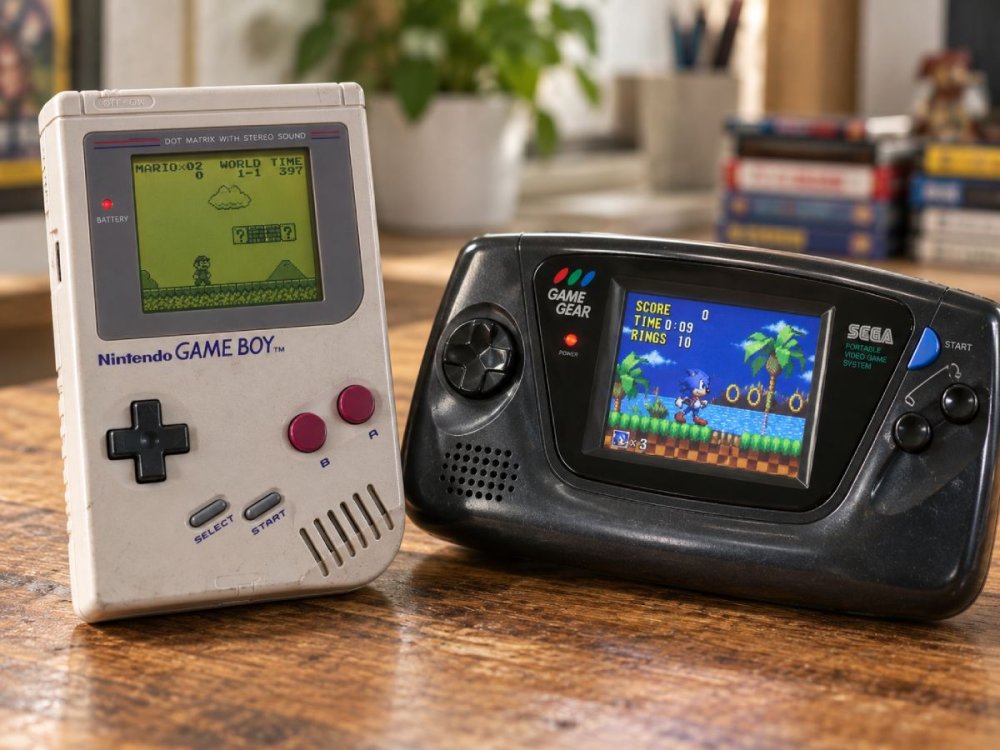
A Game Boy versus Game Gear argument could fill an entire wet playtime. One child would hold up Nintendo's plain grey brick, its pea-green screen showing Tetris blocks with monk-like clarity. Another would point to Sega's sleek black machine, glowing in full colour like a tiny television from the future. Both were right to feel smug. Both were also carrying very different ideas of what handheld gaming ought to be.
For the generation that grew up feeding pound coins into arcade cabinets, waiting for games to load from cassette, and arguing over Sonic versus Mario, this was more than a specification fight. It was a battle between the machine you actually owned and the one you desperately wanted after seeing it in a catalogue.
Game Boy versus Game Gear: two visions of portable play
Nintendo's Game Boy arrived in Britain in 1990, looking less like a glamorous consumer gadget than a particularly determined calculator. Designed by Gunpei Yokoi, it had a modest dot-matrix display, a cross-shaped control pad, two purple buttons and a chunky casing that felt ready to survive the bottom of a school bag. It played games in shades of greenish grey, without a backlight, and it made little electronic chirps through a single speaker.
None of that stopped it becoming a phenomenon. The Game Boy's secret was that its limitations had purpose. Four AA batteries could keep it going for roughly 30 hours, depending on the game and batteries involved. It was affordable enough to be realistic as a major birthday or Christmas present, tough enough to be borrowed by cousins, and simple enough to switch on anywhere. A car journey, a waiting room or the bit of a family holiday when the adults wanted five quiet minutes suddenly had a soundtrack of blips and button presses.
Sega's Game Gear, released in Britain in 1991, made Nintendo's handheld look old-fashioned at first glance. Here was a wide, black, landscape console with a bright 3.2-inch colour screen. It had a proper D-pad, a pair of red buttons, stereo sound through headphones and, crucially, the visual spirit of Sega's home-console games. With its Master System roots and optional Master Gear Converter, it felt like an arcade-minded machine shrunk for your hands.
The adverts knew exactly where to press. Why squint at green shades when you could play in colour? Why accept a screen that needed the right lamp, the right angle and sometimes a strategic seat near the window? The Game Gear was loud, glossy and brilliantly 1990s. It was the handheld equivalent of turning up at school in trainers with flashing lights.
The screen that sold the dream
The Game Gear's backlit screen remains its great party trick. In a dim bedroom, under a duvet, or on the back seat of a car after dark, it looked astonishing. You did not need to tilt it towards the light or sit beneath a lamp. Colour made familiar ideas feel more alive too: Sonic's blue, the bright scenery of Columns, the cheerful clutter of Sega's licensed games.
But that glow came at a price. The screen was not huge by modern standards, and its image could blur during fast movement. More importantly, it drank batteries at a shocking rate. Six AA batteries might last three to five hours. Parents who had already developed a healthy suspicion of replacement batteries saw the Game Gear as a small black financial commitment.
The Game Boy display was undeniably hard work in poor light. Anyone who owned one remembers the ritual: angle it towards the window, rotate it slightly, lose the picture, adjust again. Yet its lack of a backlight gave it incredible stamina. The humble screen also had a crispness that suited games built around strong shapes and clear action. On a Game Boy, a falling Tetris piece was always unmistakable.
That difference explains much of the contest. The Game Gear won the first impression. The Game Boy won the long journey.
Games mattered more than the colour count
A handheld lives or dies by the games you want to take everywhere, and Nintendo had a remarkable instinct for portable play. Tetris was the essential Game Boy companion. It was not flashy, but it turned spare minutes into an obsession. The familiar Russian dance tune could take over a whole room, while the game itself seemed to fit perfectly between bus stops, adverts and bedtime.
Then came Super Mario Land, The Legend of Zelda: Link's Awakening, Metroid II, Kirby's Dream Land and Pokémon later in the decade. These were not merely small versions of console games. They were adventures designed around the machine's rhythms: play for ten minutes, save your progress, then return tomorrow. Link Cable battles and trades gave the Game Boy another advantage. Pokémon did not just live on the screen. It travelled through friendship groups, playground rumours and carefully guarded teams.
Game Gear owners were not short of fun. Sonic the Hedgehog gave Sega a mascot with real handheld swagger, while Columns was a superb puzzle game with an almost hypnotic pace. There were strong versions of Shinobi, Wonder Boy, Castle of Illusion and plenty of licensed tie-ins that made sense to children raised on Saturday-morning television, comics and football stickers.
Its library did have a particular character, though. Sega often brought the flavour of its Master System catalogue to the Game Gear, which was a treat for fans but did not always make each game feel essential in the way Nintendo's handheld exclusives did. The Game Gear was capable of more colourful scenes, but the Game Boy had a growing collection of games that became part of childhood language.
The television tuner: magnificent, impractical, unforgettable
Sega also offered something Nintendo could not: a TV tuner. Slot the accessory onto the Game Gear and, in theory, you had portable television. For a child of the early 1990s, this was pure science fiction. A tiny telly in your hands, with no family argument over the living-room set.
In practice, reception could be temperamental, the attachment made an already substantial handheld even more cumbersome, and its hunger for batteries did not improve. None of that mattered. It was one of those gloriously overambitious gadgets we still love because it proved somebody had looked at a handheld console and asked, “Could it also be television?”
Why the Game Boy won, even when the Game Gear looked better
Nintendo's victory was not a verdict on Sega's ambition. The Game Gear really was more technologically impressive in several obvious ways. It had colour, illumination, a wider landscape layout and a more console-like presentation. If your memories are of playing it at night with foam headphones on, it may still feel like the most exciting handheld ever made.
But portable technology is shaped by the bits around the technology. How long does it run? Can you see it outdoors? Does it fit in a coat pocket? Are the games plentiful? Will your mates have one too? Nintendo made the Game Boy feel like an everyday possession rather than a special-occasion machine.
Price and battery appetite mattered in Britain, where a fresh pack of AAs was not an abstract number on a comparison chart but something requested from Mum or Dad at the corner shop. The Game Boy was also easier to carry. The Game Gear was portable, certainly, but calling it pocketable required either enormous pockets or considerable optimism.
Nintendo's timing helped as well. The Game Boy had already established itself before Sega entered the race, and its enormous installed audience encouraged more developers to make games for it. By the time Pokémon arrived, the Game Boy was less a gadget than a shared social object. It passed between hands on the bus, appeared at sleepovers and travelled in scratched plastic cases alongside spare batteries and a tangle of earphones.
The better handheld depends on the memory
Ask which machine was better, and the honest answer is that it depends on what you wanted from it. The Game Boy was the better companion: dependable, economical and supported by an all-time great library. It made technical restraint feel almost elegant.
The Game Gear was the better fantasy. It was the machine in the Argos catalogue, the one that promised colour Sonic and portable telly, even if the battery drawer emptied with alarming speed. It had technology with personality, and that counts for a great deal in the gadgets we obsessed over.
Perhaps that is why the old rivalry still has life. The Game Boy reminds us of the games we played until the screen went dim. The Game Gear reminds us of the future we thought we could hold in our hands. Put either one on a table today, add a few loose cartridges and that familiar battery-compartment smell, and the argument can begin all over again.






