A CRT television was never just something you watched. It was the glowing, humming centrepiece of the living room: a wood-effect cabinet in the 1970s, a heavy black box on a corner stand in the 1980s, or a silver widescreen set that made Saturday night feel properly cinematic in the 1990s. The history of CRT televisions is also the story of how Britain gathered around moving pictures, from the first BBC broadcasts to Ceefax, Teletext holidays, and a generation of consoles plugged into the front socket.
Before Television Had a Screen
CRT stands for cathode-ray tube, which sounds rather more scientific than the familiar object itself. Inside the set was a sealed glass tube, usually deep enough to make the television look like it had swallowed a small suitcase. An electron gun at the back fired a beam towards the phosphor-coated screen. Magnetic fields guided that beam, scanning line by line so quickly that our eyes saw a stable image.
The principle began in the late 19th century, when German physicist Karl Ferdinand Braun demonstrated an early cathode-ray tube. At first, it was a tool for scientific experiments, not family entertainment. Yet it provided the essential trick that television needed: a way to turn an electrical signal into a visible line of light.
Early television was not immediately electronic. In the 1920s, Scottish inventor John Logie Baird became a household name through mechanical television experiments using spinning discs, bright lamps and tiny flickering pictures. They were ingenious, but they were not the route to the big, bright screens we remember. Electronic television, based around the CRT, offered a sharper image and much greater potential.
The History of CRT Televisions Reaches Britain
Britain became one of television's great early homes. In 1936, the BBC began the world's first regular high-definition television service from Alexandra Palace in north London. “High-definition” then meant 405 lines, which is charmingly modest beside modern screens but astonishing for its moment. The service used electronic television systems, and CRT receivers brought those broadcasts into the homes of the very few who could afford them.
Then came the war. Television broadcasting stopped in 1939, and many sets fell silent for years. When the BBC resumed in 1946, it did so with a wonderfully theatrical continuity announcement: “As I was saying before we were so rudely interrupted...” Television was still a luxury, but the foundations were set.
The real turning point arrived with the 1953 Coronation of Queen Elizabeth II. Families who did not own a set crowded into neighbours' front rooms, pubs and shop displays to watch. The picture was small, often grainy, and usually surrounded by polished wood, but the event proved television could be a shared national experience. Sales soared. The telly became furniture, conversation starter and social calendar all at once.
Valves, cabinets and the ritual of warming up
Early CRT sets relied on valves, which took time to warm. Switching on could mean waiting for a dot of light to bloom into a picture while the set gave off a gentle electrical hum. The cabinet might have doors that closed over the screen, as though the television needed putting away after use like the good furniture.
These sets were not light. Moving one was a two-person job, preferably involving someone saying, “Mind the carpet.” Their screens were small by current standards, but the cabinet gave them presence. They belonged in the room in a way a thin panel fixed to a wall never quite can.
From Black and White to Saturday Night Colour
ITV's arrival in 1955 gave the BBC its first serious competition, and television ownership became increasingly ordinary. By the 1960s, portable black-and-white sets appeared in bedrooms, kitchens and student digs. “Portable” was a relative term, of course. A portable CRT still had a substantial glass tube and could leave an impressive dent in a flimsy table.
Colour transformed the medium. BBC2 began colour broadcasts in 1967, followed by BBC1 and ITV in 1969. Britain adopted the 625-line PAL system, delivering a more detailed, stable picture than the old 405-line standard. Colour sets were expensive at first, so many families watched major events in colour at relatives' houses or admired them through the windows of television shops.
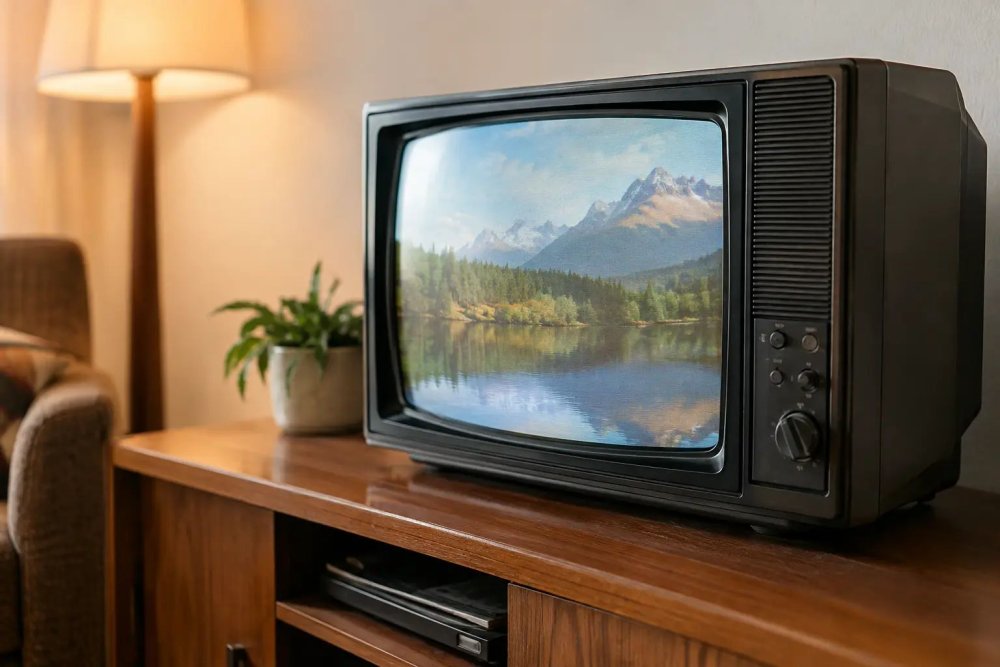
By the 1970s, colour TV had become one of the great domestic aspirations. This was the era of the big family set, with a convex screen, chunky channel buttons and a picture that could make the opening titles of Doctor Who, The Morecambe and Wise Show or The Generation Game feel like an event. The colour was sometimes a little enthusiastic, especially after someone had adjusted the controls, but that was part of the charm.
Why CRTs Had So Much Character
A CRT did not present a picture with clinical perfection. It had scanlines, slight screen curvature, occasional geometry quirks and a faint glow that softened everything from BBC ident animations to late-night films. On a well-adjusted set, motion looked wonderfully natural. On a poorly adjusted one, faces could appear slightly green and the corners might bow inwards. Every household seemed to have its own preferred compromise between brightness, contrast and colour.
The technology had physical habits too. Switch off a CRT and the image often collapsed to a bright dot before fading away. Put your hand near the screen and you could feel static. Dust clung to the glass. Some sets emitted a high-pitched whine that adults seemed able to ignore while children noticed it immediately.
Those traits were not faults to be tolerated so much as part of television's personality. The set was visibly working. You could hear it, feel its warmth and, if the aerial was playing up, watch snow dance across the picture while somebody went outside to turn the pole a fraction to the left.
CRT Television and the Home-Computer Generation
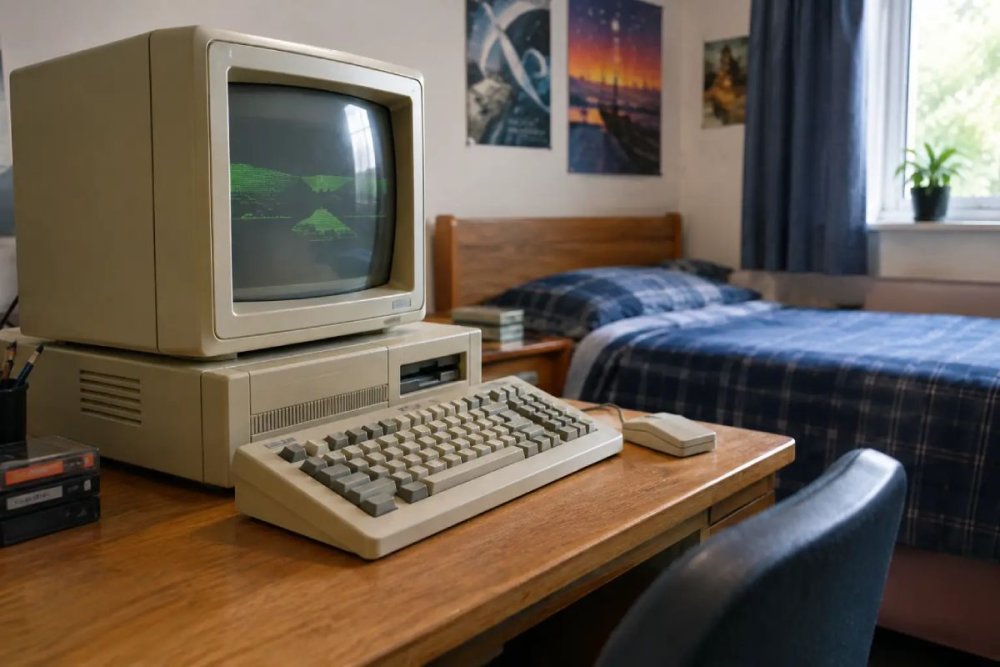
For RetroWins readers, the CRT's story is inseparable from home computing and gaming. A television was often the first monitor we owned, long before anyone called it a monitor. The ZX Spectrum, Commodore 64, Amstrad CPC, Atari 2600, NES, Mega Drive and PlayStation all found their way onto CRT screens across Britain.
There was an unmistakable ritual to it. You tuned the television to a spare UHF channel, flicked the little RF switch on the back of the computer or console, then searched for the signal through a haze of static. The reward was a blue BASIC screen, a loading border flashing in colour, or a game title screen accompanied by tinny but thrilling music.
Later sets made life easier with SCART sockets, introduced widely in the 1980s and 1990s. A proper RGB SCART connection could make sprites, menus and text look strikingly crisp compared with RF. Still, plenty of us spent years using the aerial lead because that was what came in the box, and because nobody had yet explained why Sonic looked as though he was sprinting through a snowstorm.
CRTs also suited the games of their era. Their near-instant response gave fast movement a directness that many modern displays initially struggled to match. Light guns, including the NES Zapper and arcade-style accessories, relied on the way a CRT drew its image line by line. Try some of those peripherals on a modern flat panel and they simply will not cooperate.
The 1990s: Bigger Screens, Better Pictures
By the 1990s, CRT television was mature technology. Sets gained stereo sound, remote controls became standard, and widescreen models arrived to make films and major sporting events feel more expansive. Brands such as Ferguson, Sony, Philips, Panasonic, Toshiba and Grundig filled British electrical shops, each promising a sharper tube, fuller sound or cleverer remote.
Teletext was another quiet CRT-era marvel. Pressing a coloured button and waiting for page 302 to roll around gave us football scores, weather forecasts, TV listings and holiday deals in blocky, brilliantly functional graphics. Ceefax and Oracle were slow by modern standards, but they made the television feel interactive long before the internet reached most homes.
There were trade-offs. Large CRTs delivered excellent pictures, but their weight and depth became absurd as screen sizes grew. A 32-inch model could dominate a room and require a cabinet built like a small fortress. They also consumed more power than modern flat screens and contained high voltages, so repairs were never a casual screwdriver job.
Why the Tube Finally Lost Its Place
Flat-panel televisions did not win because CRTs suddenly became bad. They won because they were thin, light, wall-mountable and eventually capable of much larger high-definition screens. Plasma first made an impression, then LCD became affordable and practical. As digital broadcasting, HD consoles and Blu-ray arrived, the old square-ish tube began to look less like the future and more like a beloved survivor from another age.
By the late 2000s, new CRT televisions had largely vanished from British shops. Many went to recycling centres, leaving behind a surprisingly intense wave of nostalgia. Collectors and retro gamers now seek particular models, especially Sony Trinitrons and late-era sets with RGB SCART inputs, because they display older games and video formats much as their makers expected.
A good CRT is not automatically better than every modern display. It depends on what you are watching or playing, the condition of the set, and whether you have space for a very heavy box. But when the room goes dim and that curved glass begins to glow, it is easy to understand why the technology still matters. It reminds us that the gadgets we grew up with did not merely show our favourite programmes and games - they helped make those moments feel enormous.