
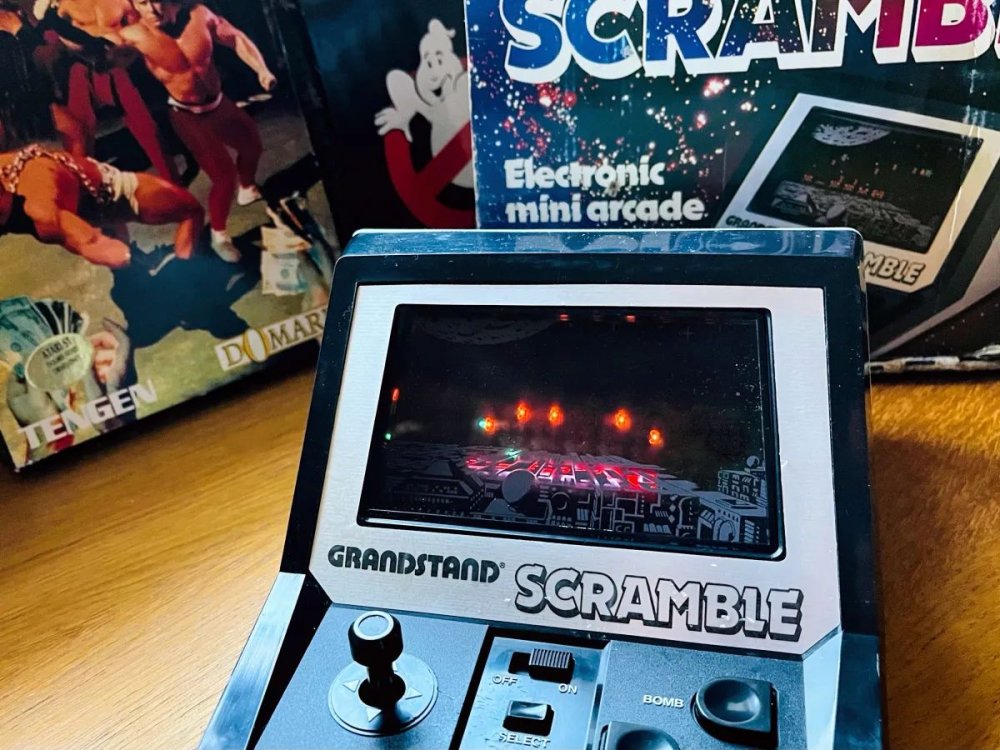
Before the Spectrum loading screen, before the Atari joystick became a permanent fixture beside the telly, there was the peculiar thrill of a Grandstand game. Grandstand electronic games history is really the story of how Britain learned to play at home: through boxy consoles, glowing red displays, clipped sound effects and rules simple enough to explain before tea went cold.
For plenty of us, Grandstand was not a single machine but a name that kept appearing in catalogues, toy shops and those irresistible Argos pages with their tiny product photographs. It appeared on television games, tabletop sports games and handhelds with bright vacuum fluorescent displays. The technology could be modest, but it had personality. A Grandstand game did not pretend to be the arcade. It brought a fragment of that excitement into the front room.
Where the Grandstand name came from
Grandstand was a familiar British badge during the great electronic-games boom of the 1970s and early 1980s. Rather than being a console maker in the mould of Atari or Nintendo, the name was used by UK distributor and importer Adman Grandstand for a changing range of electronic entertainment. That distinction matters. It explains why the Grandstand catalogue could feel so broad and why machines with similar innards sometimes appeared under different names in different countries.
The brand arrived at exactly the right moment. Electronic components were becoming affordable enough to turn a game of tennis, football or target shooting into a consumer product, yet home computers were still specialist, expensive things. A Grandstand unit needed no loading time, no programming knowledge and, usually, no more than a plug socket or a stack of chunky batteries. You switched it on, selected a game and claimed the better controller before your brother or sister could.
The badge also felt reassuringly local. Imported hardware could seem exotic, especially when its packaging promised a version of the arcade in your own home. But Grandstand sat naturally alongside the British high-street world of Binatone, Fidelity, Prinz and the ever-present catalogue counter. It was the technology we grew up with before brands became global identities in quite the same way.
Grandstand electronic games history begins with Pong
The earliest home television games were built around variations on one enormously successful idea: Pong. On screen, there might be two white bats, a square ball and a score. That was enough. The appeal was immediate because the television itself became part of the game. The family set, normally reserved for the BBC, ITV and the weekly chart show, suddenly hosted a fiercely contested electronic match.
Grandstand’s TV Game systems joined a crowded market of Pong-style consoles. Their offerings included familiar staples such as tennis, squash, hockey and practice modes, often selected by physical switches or buttons. Later variations added shooting games and more options, though the fundamentals remained beautifully direct. Turn the dial, guide the bat, miss the ball, accuse the controller of being faulty.
Today, a single-channel bat-and-ball game can look almost comically bare. At the time, it felt magical. The movement was happening live on your television, controlled by a knob in your hand. For children accustomed to board games, football in the park and whatever was on after Blue Peter, that was an extraordinary shift. It made the television interactive years before the phrase had become marketing wallpaper.
There were compromises, of course. Many sets needed to be tuned through the RF socket, producing snow, hiss and the occasional family argument when the picture disappeared. The paddles could feel twitchy, the scoring was basic, and the ball had all the personality of a moving dot. None of that weakened the ritual. The whirr of the channel dial, the click of a selector and the instruction to sit back from the screen are part of the memory.
The multi-game promise
As the market developed, console names grew more ambitious. A machine could advertise a collection of games even where several were variations on the same bat-and-ball circuit. It was not deception so much as the language of the period. Squash played differently from tennis. Hockey placed the action differently. A target game brought out the light gun, which was quite enough to make Christmas morning feel futuristic.
Grandstand models such as the 4600 and 3600 series are remembered by collectors because they represent this transition from simple dedicated TV games to more feature-packed living-room machines. Model names, revisions and regional equivalents can be confusing, especially as companies reused designs and packaging changed. For the nostalgic owner, though, the details that survive are often more personal than technical: the silver-and-black casing, the wired controllers, the cardboard box that smelled faintly of new plastic.
The glowing age of handheld sport
If the TV consoles made Grandstand a front-room name, its handheld electronic games made it portable. These were the machines that travelled in car gloveboxes, appeared after Sunday lunch or emerged during a boring adult visit. Their vacuum fluorescent displays, usually called VFDs, glowed in vivid reds, greens, blues and yellows. Against the beige and black plastic of the casing, they looked properly space-age.
Grandstand’s sports handhelds covered the games British children already understood: football, rugby, cricket, tennis, baseball and more besides. The action was abstracted into fixed positions of light. A player did not run fluidly across the screen. Instead, he snapped from one illuminated segment to another, accompanied by a beep that somehow suggested pace, contact and jeopardy.
That abstraction was the point. Like Subbuteo figures or Panini stickers, these games asked us to supply the missing world. A few coloured marks became a packed stadium. A rudimentary score became a cup final. The limitations left room for imagination, which is why so many of these handhelds remain strangely vivid in memory.
Football was especially important. Long before licensed games could reproduce real kits, stadiums and commentary, electronic football let us create our own drama. A late goal on a Grandstand handheld could feel like a genuine rescue, even if every attacking move followed the same pattern after ten minutes of practice. The difficulty was often unforgiving, the viewing angle could be awful, and the batteries vanished with suspicious speed. We played anyway.
Why Grandstand games felt different
Part of the affection for Grandstand comes from their physical presence. Modern games tend to disappear behind glass screens, menus and online accounts. Grandstand devices announced themselves. They had moulded plastic shells, printed overlays, battery doors, sliders and buttons that made a proper click. A game was an object before it was an experience.
They also had a wonderful lack of hesitation. There was no update, no login and no forty-minute installation. A handheld could be in play seconds after its batteries were fitted. A television game took a little more ceremony, but once the picture was tuned in, the whole room knew what was happening. Even spectators had a role, usually shouting advice nobody had requested.
That does not mean every Grandstand product was a classic. The market moved quickly, and dedicated games were vulnerable once programmable consoles and home computers became more affordable. The Atari VCS offered cartridges and richer action. Then British bedrooms filled with ZX Spectrums, Commodore 64s and Amstrad CPCs, machines that could become a new game every time a cassette was loaded. Compared with that, a fixed-game unit had obvious limits.
Yet the old machines retained an advantage: they were approachable. A Grandstand sports handheld was not asking you to learn a keyboard layout or wait while a tape screeched its way through several minutes of loading. It offered a clean, immediate challenge. That made it perfect for younger players and for the adults who claimed they were only having one go.
Collecting the games we once wore out
Grandstand equipment now occupies an interesting space for collectors. It is less predictable than collecting one tightly documented console family because the brand covered many formats, model variations and imported designs. Condition matters greatly. VFD handhelds need clean battery compartments and a display that still lights evenly; corrosion can turn a childhood treasure into a repair project very quickly.
For TV games, original controllers, power supplies and RF leads make a genuine difference, even if modern display connections may require extra thought. Boxes, instructions and point-of-sale stickers add another layer of fascination. They do not just raise collector appeal. They restore the context: the promises on the packaging, the dramatic illustrations and the list of games that seemed endless when you were nine.
If you are returning to Grandstand as an adult, resist the urge to judge it by modern standards. Play it on its own terms. Notice the cheerful electronic chirps, the deliberate button presses and the way a simple sporting contest can take over a room. These games were never trying to simulate everything. They were trying to make a spare half-hour feel special.
The next time you spot a Grandstand handheld with its fluorescent pitch still glowing, give it a moment. It is not merely an old toy. It is a small, noisy reminder that the future once ran on AA batteries, plastic buttons and the fierce belief that this time you really would beat the high score.






