
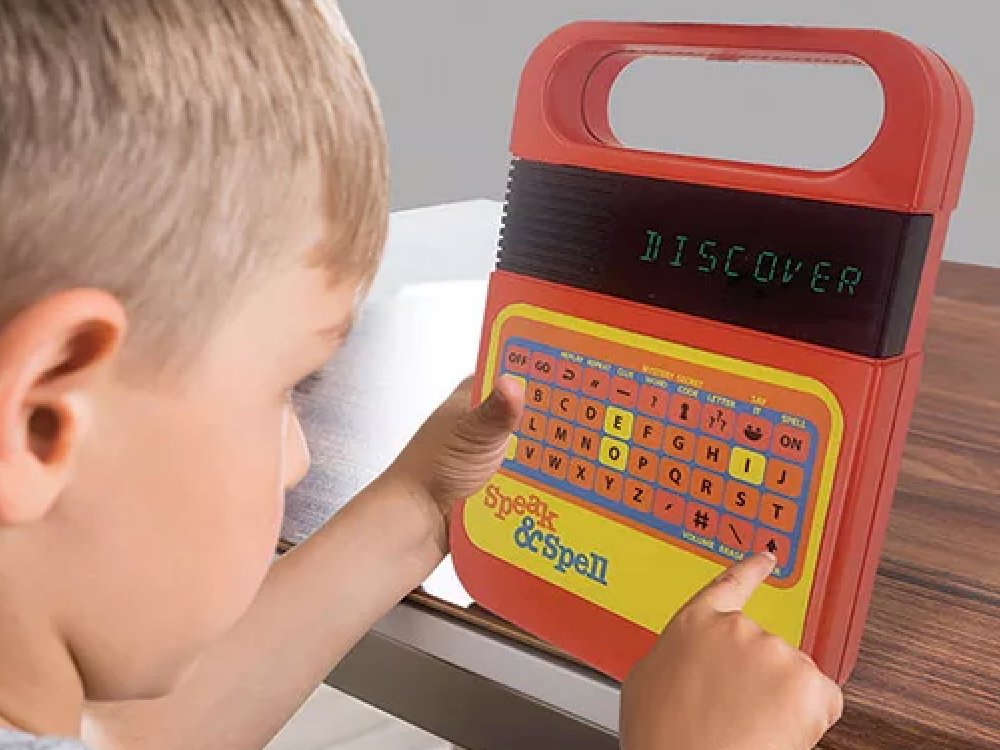
The first time a Speak & Spell answered back, it felt faintly unbelievable. We were used to toys that beeped, buzzed, flashed a red light or played a tinny tune. This chunky orange-and-yellow learning machine formed words with an oddly calm electronic voice, then waited for us to find the right letters. Speak & Spell toy history is not just the story of an educational gadget. It is the story of the moment a toy seemed to have a voice, a personality and, occasionally, the patience to tell us we had spelt something wrong.
Before toys could talk
Texas Instruments launched the original Speak & Spell in 1978, at a point when home technology was beginning to creep out of laboratories and into family life. Calculators had become familiar, digital watches were appearing on wrists, and the earliest home computers were still the preserve of enthusiasts prepared to spend an evening with a manual. A handheld device that could produce recognisable spoken words was something else entirely.
Its cleverness came from a speech-synthesis chip, developed by Texas Instruments engineers to compress speech into a form small enough and affordable enough for a consumer product. Rather than storing recordings in the way we might imagine today, the machine generated its strange, clipped voice from digital speech data. That technical leap mattered because it put computer speech in children’s hands years before most of us had a computer at home.
The result was deliberately friendly rather than scientific. The case had big inviting keys, a carry handle and colours that looked at home beside an Etch A Sketch, a cassette recorder or a box of felt-tip pens. It was educational, certainly, but it did not resemble school equipment. It resembled a prop from the future that had somehow ended up in the toy cupboard.
Why the Speak & Spell voice mattered
The original machine set spelling challenges, pronounced words and offered games that made repetition feel more like a contest than homework. A child could hear a word, tap out an answer on the satisfying keyboard and wait for judgement. Get it right and there was a little burst of triumph. Get it wrong and the toy simply brought you back to the task, in that famous synthetic accent.
That voice is the key to its lasting pull. It was neither natural nor especially warm by modern standards, but it was intelligible enough to feel alive. Many of the gadgets we grew up with had personality because of their limitations: cassette decks clunked, Spectrum games shrieked through television speakers, and electronic toys made every sound through a tiny grille. Speak & Spell’s voice had the same charm. It sounded like a machine trying very hard to speak to you.
For British children, there was an extra novelty in hearing a distinctly American-sounding voice in a bedroom or classroom. American films and television were already familiar, but a toy talking directly to you was another matter. Some words and pronunciations could feel a little foreign, yet that was part of the appeal. It was technology from the wider world, sat on the carpet beside a schoolbag and a packet of biscuits.
Speak & Spell toy history reaches British bedrooms
The Speak & Spell arrived in Britain at the right cultural moment. By the early 1980s, electronic toys were becoming a proper category rather than a curious corner of the shop. Parents could see a learning benefit, while children saw buttons, sounds and the promise of a machine that might be more entertaining than a workbook.
It also belonged to a very particular kind of birthday or Christmas wish list. Not every family had one, and that mattered. The machine was substantial enough to feel like a major present, somewhere between a toy and a serious bit of kit. Seeing it in a catalogue or behind the counter at a toy shop could make it seem even more desirable. The bright casing suggested fun, but the label promised something reassuringly useful to adults.
It was portable, too, which made it different from the television-bound electronics of the era. You could carry it to a grandparent’s house, set it on the kitchen table or take it away during the holidays. Batteries were always part of the ritual, naturally. A low or fading voice had a way of turning even a straightforward spelling game into a warning that the household battery drawer was about to be raided.
More than one talking teacher
Texas Instruments did not leave the idea alone. The success of Speak & Spell led to related machines including Speak & Math and Speak & Read, taking the same talking technology into sums and reading. Together they made learning electronics feel like a family of gadgets rather than a one-off novelty.
Different versions of Speak & Spell followed over the years, with altered cases, refreshed activities and changes in size. The original remains the visual icon, however. Its rounded handle, large black keys and warm plastic colours have the same instant-recognition power as a red View-Master or a black-and-silver Walkman. Later models may be more practical, but the first design is the one that makes people say, “I had one of those,” even if the family version was actually a later revision.
The toy also made a memorable appearance in 1982’s E.T. the Extra-Terrestrial, when Elliott uses a Speak & Spell as part of a makeshift communication device. That scene fixed the machine in pop culture. Its voice was no longer just helping with spelling. It had become a plausible fragment of alien-contact technology, which says a great deal about how futuristic it seemed at the time.
The line between learning and play
Part of Speak & Spell’s success was that it never completely chose between being a teacher and being a toy. That balance is harder than it looks. Make an educational product too stern and children avoid it. Make it too silly and parents wonder why they spent the money.
Speak & Spell got away with repetition because the interaction was direct. Pressing physical keys was satisfying, and hearing the response made every attempt feel acknowledged. There was no glossy screen to distract from the task, no notifications and no endless menu of options. Just a word, a keyboard and a small talking machine asking you to have another go.
That simplicity is why it remains enjoyable even for adults who have no interest in revising spellings. Pick one up now and the pleasure is tactile: the textured plastic, the slightly stubborn battery compartment, the key presses and the speaker that gives the voice its peculiar grit. It is technology that had personality because every part of it announced itself.
Why collectors still want one
A working original Speak & Spell is a wonderful display piece, but condition and version make a difference. Sun-faded plastic, battery corrosion and missing battery doors are common on machines that spent decades in lofts, garages and cupboards. A complete example with clean contacts, a clear speaker and a responsive keyboard will usually be more appealing than one that merely looks tidy from across the room.
For many people, though, perfection is not the point. A scuff on the handle or a name written underneath can be evidence of a real childhood object rather than a museum piece. If you find one among old toys, remove any ageing batteries promptly and avoid forcing sticky keys. Gentle cleaning is sensible; attempting an enthusiastic restoration can erase the very marks that make it yours.
There is also a useful distinction between collecting the object and chasing the exact memory. If your recollection is of the machine’s voice, almost any functioning period model may deliver that instant jolt of recognition. If it is the silhouette from an old catalogue page you want, the original 1978-style casing is likely the one to seek. Nostalgia is precise like that.
A small machine with a very big voice
The Speak & Spell did not teach every owner flawless spelling, and nobody bought one for its elegant pronunciation. What it offered was more valuable: proof that technology could feel playful, approachable and a little magical. Before our homes filled with talking assistants and glowing screens, this was a portable computer voice asking us to spell “elephant”.
That is why the machine still matters. It reminds us of the toys we begged for, the gadgets we showed off to friends, and the extraordinary thrill of pressing a button and hearing the future answer back. If an old Speak & Spell ever turns up in the family loft, give its keys a careful press. There is a good chance that familiar mechanical voice will make the years disappear.






