There was a time when choosing a video recorder felt like choosing the future of family entertainment. VHS versus Betamax home viewing was not simply a technical disagreement played out in glossy catalogues. It decided which machine sat beneath the telly, which blank tapes filled the sideboard, and whether the film everyone at school was talking about could be hired from the local video shop.
For plenty of British households, the eventual answer was VHS: a chunky black or silver box, a clock that blinked 0:00, and a drawer full of E180 tapes labelled in biro. Yet Betamax was not some flimsy also-ran. Sony's compact format had real strengths, a devoted following and, for a while, the unmistakable feeling of being the more refined machine. Its defeat is one of retro technology's great lessons: the product that wins is not always the one with the sharpest picture.
VHS versus Betamax home viewing: the basic battle
Betamax arrived with Sony's considerable confidence behind it. The cassettes were pleasingly compact, the machines looked purposeful, and early Beta recordings were widely regarded as having a cleaner, more detailed image than VHS. For viewers who cared about picture quality, that mattered. This was an era of curved CRT screens, indoor aerials and the occasional snowy ITV signal, so every extra bit of clarity felt like a victory.
VHS, developed by JVC, had a different advantage from the start: recording time. Early Betamax tapes offered roughly an hour at standard speed, while VHS could record up to two hours. That may not sound dramatic beside modern streaming libraries, but it changed the argument completely. A proper film could fit on one cassette. So could much of a Saturday evening's telly without a frantic dash to turn the tape over.
Sony later extended Betamax recording times, and the gap was not as simple as the old playground claim that Beta could not record a film. But longer Beta modes could involve compromises in picture quality. VHS had already planted its flag where families cared most: record the programme, hire the film, and do not make life complicated.
The Friday-night test
The format war was settled in ordinary lounges, not in laboratory demonstrations. Imagine the familiar ritual: the video recorder warming beneath a portable television, a parent studying the Radio Times, and someone being told not to touch the aerial while Coronation Street was on. A machine needed to fit around life.
VHS was exceptionally good at this. A three-hour E180 tape was ideal for taping a film, several episodes of a favourite programme or a football match that ran into extra time. Later E240 tapes made the recorder even more useful, although many of us learned the hard way that a long-play cassette could emerge from the machine in a nervous tangle of brown tape.
Betamax had its own loyal households, especially among buyers who liked Sony's reputation for quality. If you had a Beta machine, it could feel a little posher, like owning the hi-fi rather than merely the record player. But home viewing rewards convenience. The more a recorder became a family utility rather than a specialist purchase, the more VHS's longer running time made sense.
A better picture was not always the better experience
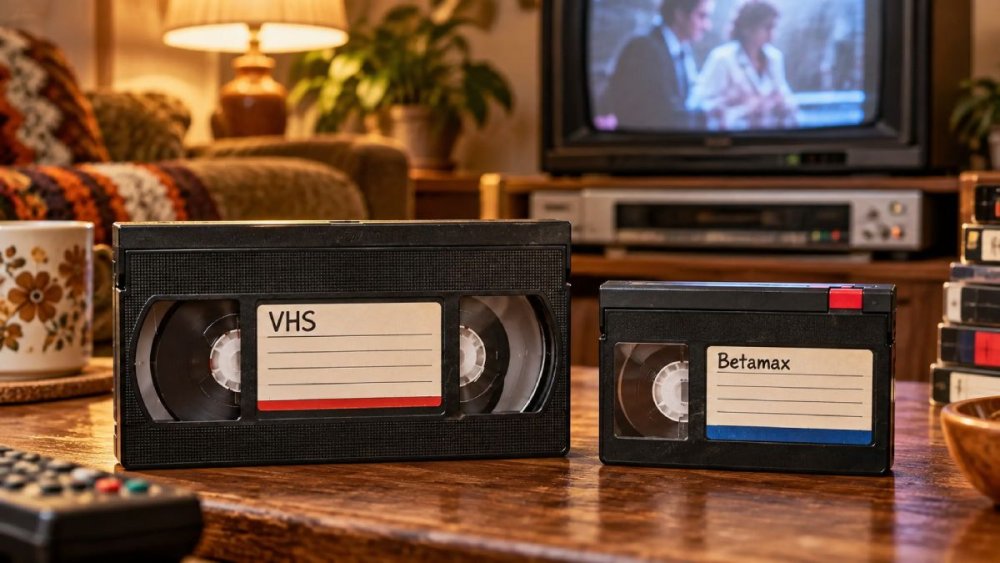
Betamax's reputation for superior picture quality was broadly earned, particularly in its earlier standard-speed forms. The smaller cassette also had a certain elegance. Put a Beta tape in one hand and a VHS cassette in the other and the contrast still feels telling: Betamax seems tidy and engineered; VHS seems built for the job.
But the difference was not always obvious in a typical sitting room. A well-worn tape, a less-than-perfect television, a tired video head or a dodgy SCART lead could level the playing field quickly. Most people were watching rented films with crisps on their knees, not conducting side-by-side image tests. The film itself, and whether the family could actually get hold of it, mattered more.
Video shops chose the winner too
The local video shop was VHS's most powerful ally. As rental shelves expanded through the 1980s, shops naturally favoured the format with the broadest potential customer base. More VHS machines in homes meant more VHS tapes on the shelves. More tapes on the shelves gave the next buyer another reason to choose VHS. It was a self-reinforcing loop, and Betamax struggled to break it.
That mattered enormously in Britain. Video rental was an event. You wandered the aisles judging sleeves, hoping the latest release had been returned, and perhaps came home with a strange science-fiction film because the one you wanted was out. If a title was available in VHS but not Beta, the debate ceased to be theoretical.
VHS also benefited from wider manufacturer support. JVC licensed its system to other companies, so shoppers could choose from a growing range of machines at different prices. Panasonic, Sharp, Ferguson and others helped VHS become a familiar badge on high-street shelves. Sony controlled Betamax more closely, which preserved a sense of quality but limited the format's reach.
Price did not decide everything, but it certainly helped. As VHS recorders became more common, competition brought costs down. The machine that once looked like an extravagant new gadget became a realistic household purchase, often bought for one practical reason: taping programmes while you were out.
The quirks we remember, whichever tape we owned
Both formats gave us the same wonderful analogue rituals. There was the heavy clunk of a cassette loading, the soft mechanical whirr as the tape threaded around the video heads, and the momentary blue screen before the picture appeared. There were tracking buttons, remote controls that vanished behind sofa cushions, and recordings of adverts because nobody had mastered the pause button in time.
VHS became the stronger cultural memory partly because there was simply so much of it. Birthday parties, off-air Christmas specials, battered copies of blockbuster films and homemade camcorder footage all ended up on those large, rectangular cassettes. Many homes had a cupboard full of them, each one carrying a handwritten promise: “Mum's programmes”, “Disney”, “DO NOT TAPE OVER” or, ominously, “Assorted”.
Yet Betamax has a special pull for collectors and enthusiasts. Its story gives it character. The format represents the brilliant product that did not quite fit the market that formed around it. A good Beta deck, carefully maintained and paired with a decent television, can still make a recording look lovely. For some, that compact cassette and Sony's precise engineering remain more desirable than the VHS box that conquered the rental counter.
Why VHS won, in one very human reason
VHS won because it made more sense for more people more often. It offered enough quality, longer recording times, a wider choice of machines and, crucially, access to the tapes everyone wanted to watch. Betamax may have had the technical edge in several respects, but VHS built the bigger everyday ecosystem.
That does not make Betamax a failure in the way we usually mean it. Its influence lingered in the standards people expected from home video, while Sony itself went on to shape whole generations of consumer electronics. The format war also reminds us that technology is never judged on specifications alone. It is judged at 7.30 on a Friday night, when the film is about to start and somebody has forgotten to set the timer.
If you still have a box of old tapes in the loft, do not be too quick to dismiss it as clutter. Those plastic cases hold more than fuzzy films and off-air recordings. They hold the shared, gloriously mechanical home-viewing habits that made the telly feel like the centre of the weekend.