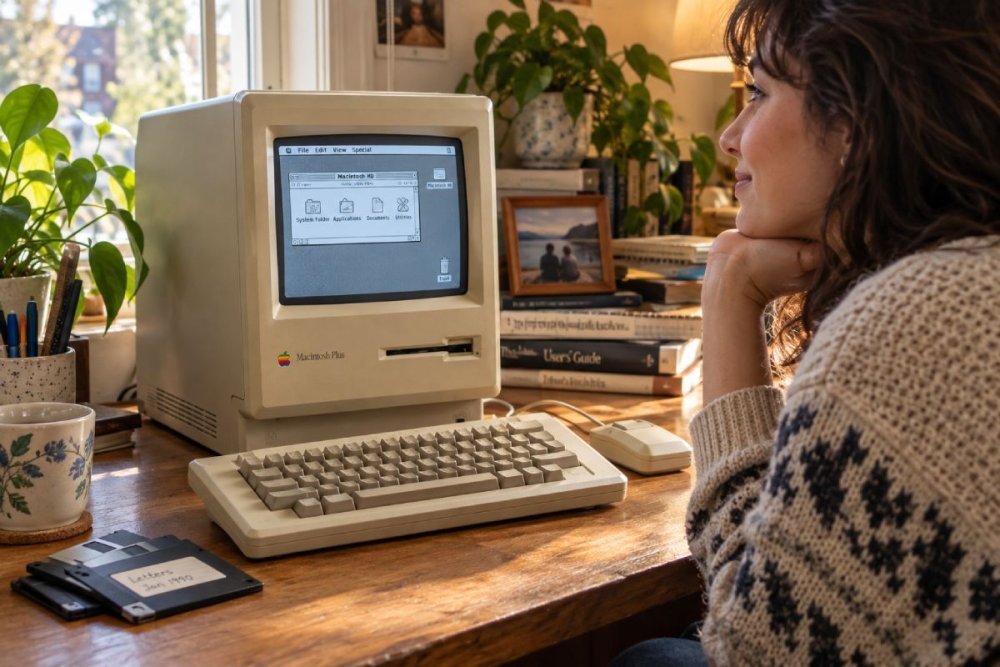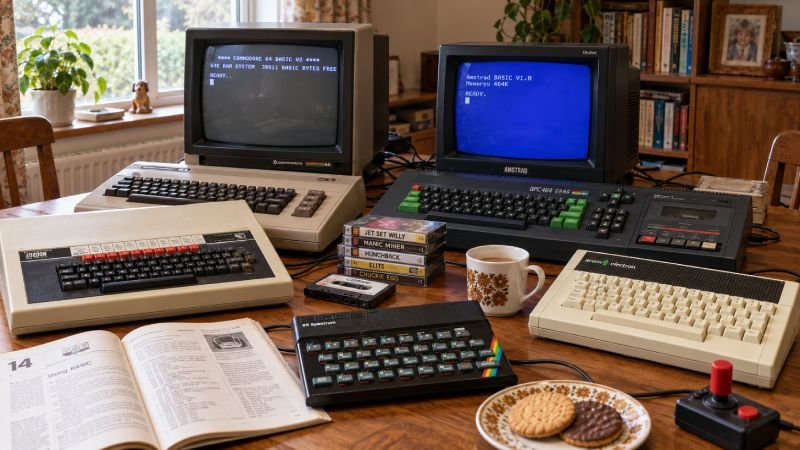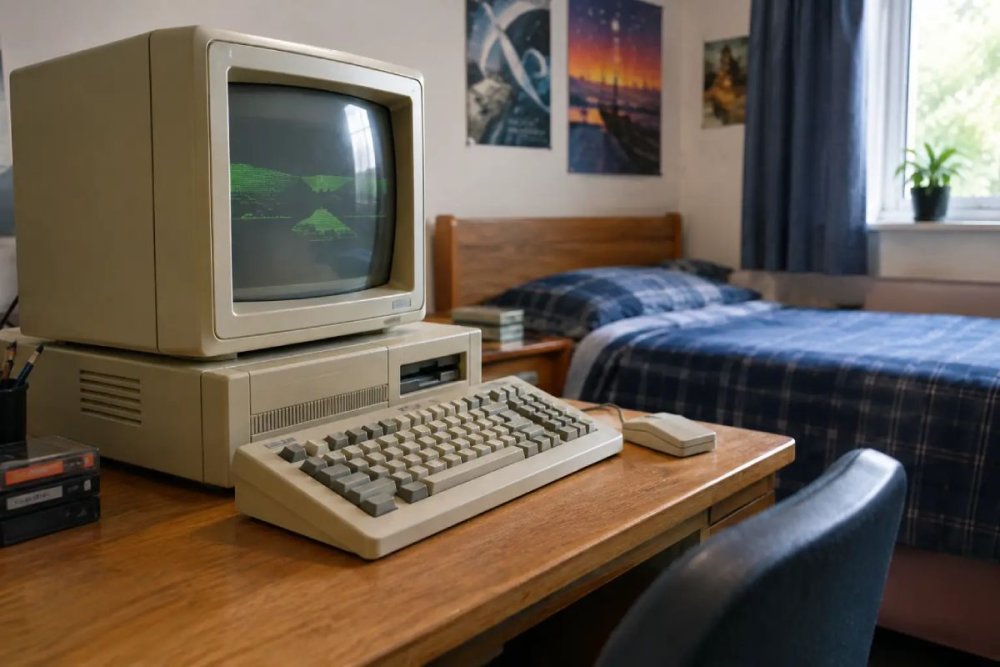
The home computers we remember were rarely tucked away in a study. They lived on the dining table beside the fruit bowl, under a bedroom telly balanced on a chest of drawers, or in the corner of the living room where the aerial lead would reach. They were beige, black, occasionally silver, often slightly warm to the touch, and somehow capable of turning an ordinary Tuesday evening into a small technological adventure.
For a generation of British families, a computer was not just a tool. It was a promise. A machine that might help with homework, teach us to code, balance the household accounts or bring the future into the house. More immediately, of course, it was a route to dizzying arcade conversions, football management, text adventures and cassette tapes that seemed to take an entire side of an album to load.
Why Home Computers Felt So Personal
Unlike the sealed boxes we use now, early home computers invited interference. You plugged things in yourself. You typed commands from magazines, often one line at a time. You adjusted the volume knob with the seriousness of a radio engineer, listened to the shriek of data loading from tape, and hoped the screen would not suddenly announce a dreaded loading error.
That awkwardness was part of the magic. A ZX Spectrum did not simply give you a game. It asked something of you first: patience, curiosity and perhaps a willing parent who had not yet decided that the television was needed for EastEnders. The machine was a destination in its own right, complete with its own sounds, rules and little rituals.
Home computing also arrived in Britain with a distinctly local flavour. American machines existed, certainly, but our collective memory is packed with Spectrum rubber keys, the BBC Micro in the school computer room, Amstrad CPC monitors glowing green, and the reassuring clunk of a Commodore 64 cartridge slot. These machines were not always the most elegant or powerful. They had character, and character counted for a great deal.
The Machines That Took Over British Homes
Sinclair ZX Spectrum: the small black legend
The ZX Spectrum was the machine that seemed to be everywhere, partly because it was relatively affordable and partly because it made such a strong first impression. The 48K model, with its rubber keyboard and rainbow stripe, looked unlike anything else in the house. It was compact, slightly odd and gloriously confident.
Its games were inventive because they had to be. Programmers squeezed whole worlds into tiny amounts of memory, creating bold colours, memorable music and gameplay that could keep us occupied for weeks. Jet Set Willy, Manic Miner, Horace Goes Skiing and Sabre Wulf were not merely games. They were playground currency. If you had reached a bit nobody else had seen, you had a story worth telling.
The Spectrum also made programming feel possible. Type in a few lines of BASIC and the screen would respond. Even if the result was a stick figure travelling sideways through a wall, it was yours. That ownership changed how many of us saw technology.
BBC Micro: the serious one with a wild side
The BBC Micro had a more respectable reputation. It was the computer connected to the BBC Computer Literacy Project, the machine many of us first met at school, usually sitting beneath a monitor with a surprisingly sturdy keyboard. It looked capable, expensive and faintly official.
Yet the Beeb was far from boring. It had superb games, a lively software scene and enough power to make its owners feel they had the proper kit. Elite, in particular, gave players a universe to explore long before anyone spoke about open worlds. Its wireframe spaceships and trading routes demanded imagination, but imagination was something these machines were very good at supplying.
For some families, the BBC Micro was the justification machine. It was educational. It could be used for work. It would prepare the children for tomorrow. All true, perhaps, though plenty of its keyboard time was spent dodging aliens or waiting for someone to finish their turn.
Commodore 64: the sound of a bedroom disco
The Commodore 64 had a look all its own: a chunky beige case, brown function keys and a presence that suggested it meant business. Its real secret weapon was sound. The SID chip produced music and effects that could make a tiny bedroom feel like an arcade, a sci-fi film or a late-night radio station.
Games such as The Last Ninja, Impossible Mission and Monty on the Run showed off that audio flair, while the machine’s broad range made it a favourite for gaming, programming and creative tinkering. Its datasette had its own soundtrack too - the familiar electronic warble that signalled either impending delight or several minutes of staring at a loading border.
Amstrad CPC: built like it could survive family life
Alan Sugar’s Amstrad CPC range had a practical confidence that suited British homes. Many came with their own monitor, which meant fewer arguments about commandeering the family telly. The green-screen versions could make a game look rather different from the glossy screenshots in the magazine, but they also gave the whole setup a wonderfully self-contained feel.
The CPC 464, with its built-in cassette deck, seemed ready for action straight from the box. Later disk-based models felt positively sophisticated. Amstrad machines earned devoted fans because they were capable, colourful and solidly made - less like a delicate experiment, more like something designed to withstand a sibling leaning on it while asking when it would be their go.
The Ritual Was Half the Entertainment
Modern devices have removed many frustrations, and nobody truly misses losing an hour of progress because a cassette failed at the last moment. Still, the rituals around these computers gave them a texture that is hard to recreate.
There was the collection of tapes in plastic cases, their handwritten labels fading at the corners. There were computer magazines with pages of listings, cheats and adverts for games that looked impossibly exciting. There was the familiar instruction to press PLAY, followed by the squeal, the striped loading screen and the temptation to touch absolutely nothing.
Then came the social side. Friends swapped tapes, copied programmes, compared joystick preferences and argued about which machine was best. A Kempston joystick owner might have strong feelings about a Spectrum keyboard player. Someone with a disk drive could seem almost impossibly wealthy. These were not just specifications. They were tribal badges.
More Than Games and Homework
It is easy to remember home computers only as games machines, because games were often the loudest part of the experience. But they also gave ordinary households their first taste of making digital things. We wrote simple programmes, drew crude pictures, typed schoolwork and watched text appear on a screen because we had told it to.
That matters. Earlier technology often asked us simply to consume: watch the television, play the record, listen to the radio. Home computers suggested we could participate. You did not need a lab coat or a company badge. You needed access to the family machine, a magazine listing and enough determination to spot the missing comma in line 240.
Not everyone became a programmer, naturally. Plenty of us learned only enough BASIC to make the border flash before returning to Chuckie Egg. But the idea lingered: technology was not entirely mysterious. It could be explored, altered and occasionally broken before tea.
Why We Still Care About These Old Boxes
By modern measures, these computers were slow, limited and often temperamental. That is not a flaw in the memory. It is the reason the memory has such weight. The limitations made every achievement feel earned, from a game loading first time to a program running without an error message.
Their physical design helps too. Rubber keys, chunky power switches, cassette mechanisms and joysticks with stiff red buttons gave computing a presence. You could hear it working. You could feel it click. Even the tangled leads seemed to belong to the occasion.
The best way to revisit the home computers of the 1970s, 1980s and 1990s is not to ask whether they were objectively better than what came after. They were not meant to compete with a phone in your pocket. Instead, remember what they gave us: a corner of the house that could become a racetrack, a dungeon, a space station or a first, thrilling lesson in how the future might work. If an old loading screen still makes you lean closer to the telly, that little machine has not finished its job yet.