That little clunk as the cassette door shuts can bring a whole bedroom back into focus: a stack of C90s, a handwritten track list, foam headphones and the careful hunt for the exact point where the radio DJ stops talking. Vintage cassette recorder buying is not simply a hunt for an old machine. It is a chance to bring back one of the rituals that gave the tech we grew up with so much personality.
The good news is that cassette recorders remain plentiful in the UK. The less good news is that age affects them in ways a quick glance at a shiny Sony badge will not reveal. A recorder can look immaculate on a car-boot table and still chew up your favourite tape five minutes later. Buy with a little patience, though, and you can find a machine that is genuinely enjoyable to use rather than another beige ornament for the shelf.
Start with the cassette life you want to recreate
Before choosing a make or model, decide what you want the recorder to do. This is the question that keeps a tempting bargain from becoming an expensive, dusty mistake.
If your memory is of taping the chart show, building a mixtape or copying a mate's album, look for a proper portable stereo recorder, boombox or home hi-fi cassette deck. These are built for music, usually offer better sound, and often include useful touches such as recording-level controls, Dolby noise reduction and a tape-type selector.
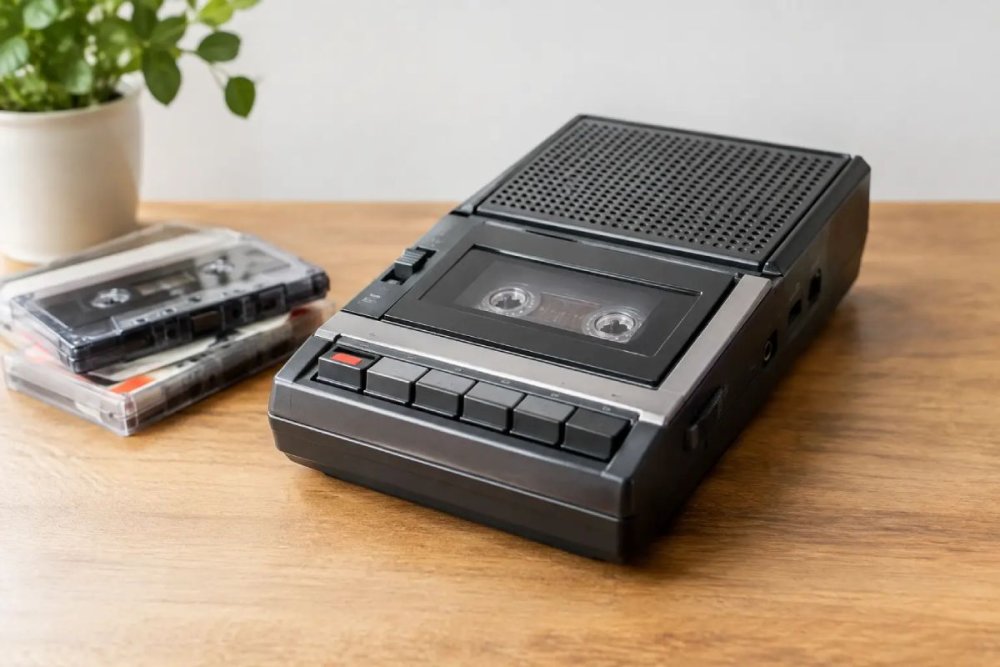
If you picture school projects, interviews, dictating homework or pressing Record on a chunky little unit with one built-in speaker, a mono cassette recorder may be exactly right. Brands such as Bush, Ferguson, Philips, Sanyo and Panasonic made countless dependable examples. Their sound is narrower and often a little hissier, but that can be part of the charm. A clicky mono machine recording Radio 1 in a childhood bedroom is its own kind of time machine.
Then there is the Walkman-style route. Some Sony, Aiwa, Panasonic and Sharp portables could record as well as play, often through a tiny built-in microphone or a socket for an external one. They are wonderfully compact and deeply evocative, but their mechanisms are delicate. A recording Walkman is best bought from a seller who can demonstrate it properly, not merely confirm that it powers on.
A large boombox occupies the other end of the kitchen-table spectrum. It is more of a statement piece, with big speaker grilles, telescopic aerials and enough buttons to make you feel as though you are about to host a local radio show. Check that both speakers work and that the aerial is intact. Replacement aerials exist, but finding one that looks right is another matter.
Vintage cassette recorder buying: condition beats cosmetics
The most desirable recorder is not always the one with the least yellowing or the brightest chrome trim. Cassette mechanisms rely on belts, rubber wheels, motors and switches. These parts age whether the recorder was used every day or stored untouched in a loft since 1987.
Ask to see it play a tape from beginning to end if possible. Better still, take a sacrificial cassette you do not mind risking. Listen for wavering pitch, often called wow and flutter. Mild instability is common, especially on a cheap portable, but a song that seems to swim in and out of tune usually points to tired belts, a dirty capstan or another mechanical problem.
Watch the tape path, too. Does the cassette run smoothly? Does it stop unexpectedly? Does it rewind and fast-forward with confidence? A machine that eats tape can often be repaired, but it is no longer a simple plug-in-and-play purchase. That may be perfectly acceptable if you enjoy fettling old kit. It is less charming when it has just swallowed the tape with your old band recordings on it.
Recording must be tested separately. A recorder can play beautifully while producing faint, distorted or silent recordings. Ask the seller to record a few seconds using the built-in microphone, then play it back. If it has an external microphone input, line input or radio tuner, treat those as bonuses unless they can also be checked.
Four areas deserve a close look:
Belts and transport: Slow winding, slipping, squealing or uneven speed usually means work is needed.
Heads and rollers: A dirty head may only need cleaning; a visibly worn or grooved head is more serious.
Battery compartment: White or green crust from leaking batteries can damage contacts and wiring.
Controls and sockets: Scratchy volume wheels, dead headphone sockets and intermittent record switches are common on neglected machines.
Do not be alarmed by every bit of crackle. A volume control that complains for a second before clearing may respond to careful cleaning. Corrosion spreading through the battery compartment, on the other hand, is a reason to put the recorder down and keep browsing.
The features that actually matter
It is easy to be seduced by rows of sliders and labels promising stereo, high speed dubbing or mega bass. Some features are worthwhile; others are mainly period decoration.
For music recording, manual recording-level control is a real advantage. It lets you avoid the distorted, overloaded sound that can happen when a loud chorus hits. A VU meter, whether needles or LEDs, makes the whole process more satisfying as well. You are not just pressing a button. You are watching the music arrive.
A tape-type selector is useful if you plan to use chrome or metal cassettes, although ordinary Type I ferric tapes are the easiest and most affordable choice today. Dolby B can reduce hiss on compatible recordings, but it can also make playback sound oddly muffled if the tape or machine was not recorded with the same setting. For casual nostalgia, do not treat Dolby as essential.
Auto-reverse is convenient, particularly on a portable, but it adds complexity. A straightforward single-direction mechanism is often the wiser choice for a first purchase. The same applies to high-speed dubbing. It is a lovely bit of late-1980s one-upmanship, yet standard-speed recording is more useful and generally sounds better.
For a home deck, inputs and outputs matter. A line input allows you to record from another source, while a line output makes connection to an amplifier or active speakers far easier. A headphone socket is almost non-negotiable if you want to relive late-night listening without announcing it to the whole house.
Brands, models and the trap of collector fever
Sony deserves its reputation. Its portable recorders and cassette decks were often well made, and the company understood that a recorder could be an object you wanted to carry around. Panasonic, under both its own name and the National badge on older equipment, is another strong bet. Aiwa made excellent feature-packed portables and decks, while Sharp and Sanyo offer plenty of underrated, affordable options.
That said, a working Ferguson can be a better buy than a non-working Sony. The badge tells you something about original quality, not the condition of the individual machine in front of you. Some UK high-street names also sold rebadged models made by reputable Japanese manufacturers, so judge the recorder rather than assuming a familiar logo guarantees mediocrity.
Rarer machines command collector prices, especially recording Walkmans, colourful 1980s portables and boomboxes with intact boxes. Buy one because you love it, not because somebody online has described it as rare. A genuinely scarce recorder with no power supply, damaged battery terminals and an untested transport is still a project.
Original packaging, manuals and microphones add pleasure and value, but they should come after functionality. The real prize is a recorder that lets you press Record and hear your own voice emerge from its speaker, slightly warm, slightly hissy and unmistakably from another age.
Give your new old recorder an easy first day
Once it is home, begin gently. Use fresh batteries or the correct power supply, clean dust from the exterior and play an ordinary tape before reaching for treasured recordings. A cotton bud with the appropriate cleaning fluid can remove grime from the heads, capstan and pinch roller, but avoid soaking anything and never scrape at components.
Keep cassettes away from radiators, damp sheds and strong magnetic fields. Store them upright in cases where possible. If a beloved tape sounds muffled, do not immediately blame the recorder: decades in a drawer can affect the cassette itself.
The best find is rarely the flashiest one. It is the recorder that feels right in your hands, works without drama and invites you to make something - a mixtape, a radio recording, a daft message for the family, or simply a few minutes of analogue noise. Let the buttons click, let the reels turn, and give those old cassettes another reason to be played.