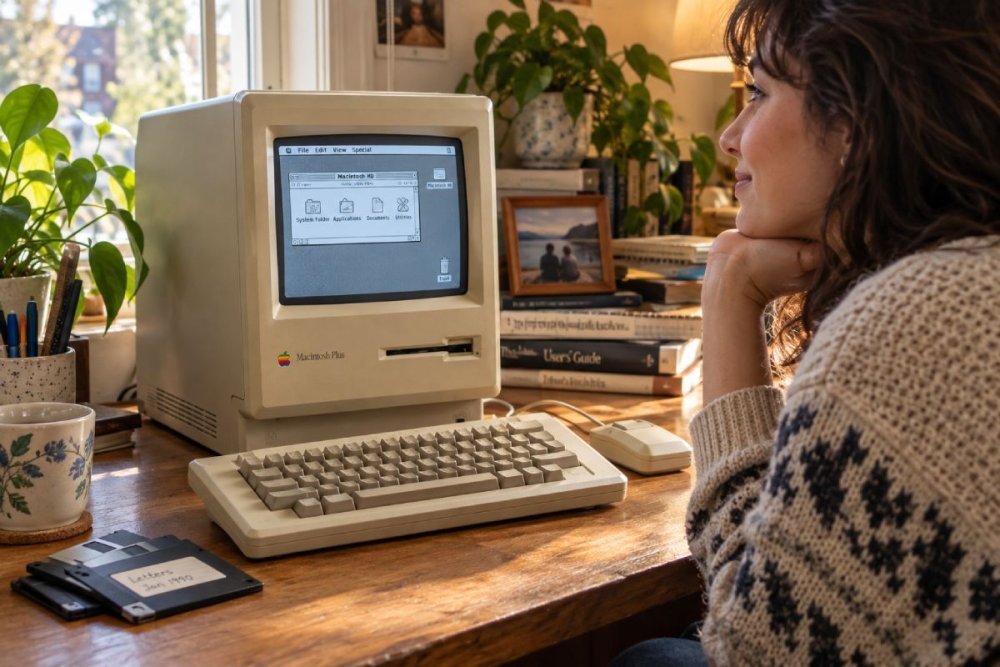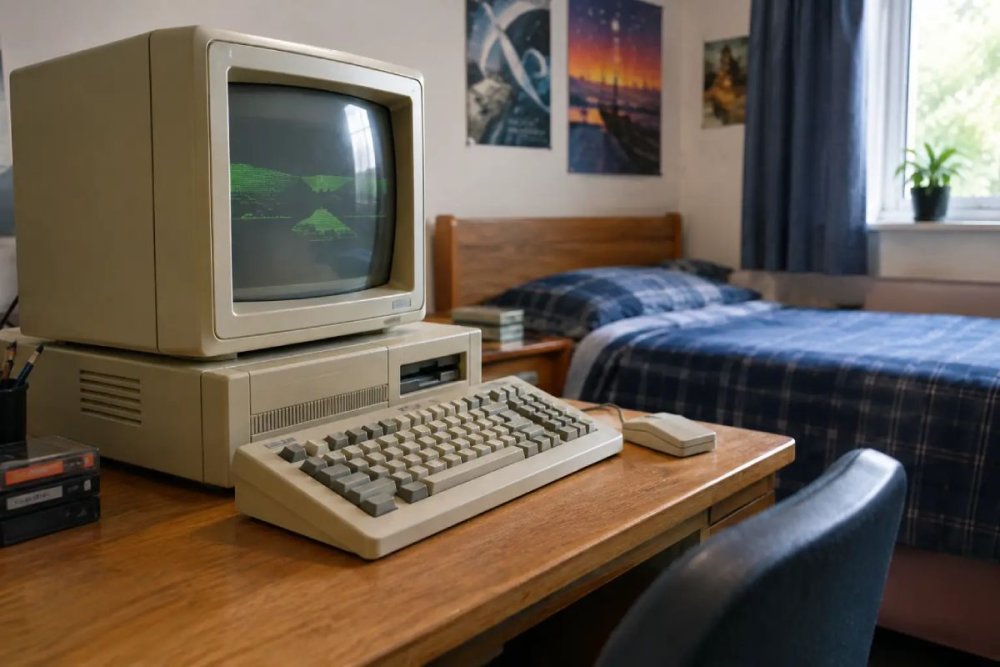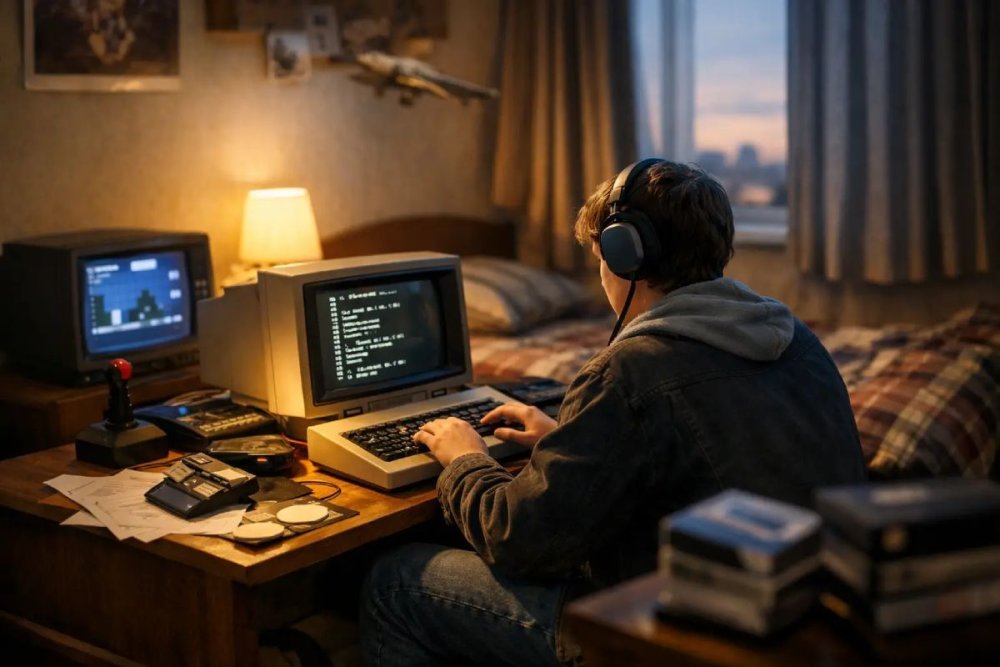
A ZX Spectrum balanced on a desk beside schoolbooks, a portable television humming in the corner, and a cassette recorder waiting for its next shriek of data: that was the unlikely workshop behind bedroom programming in 1980s Britain. Long before start-ups had exposed brick walls and free coffee, plenty of our best-known games began in box rooms, on dining tables and in bedrooms whose carpet had already seen a fair few failed loading attempts.
The remarkable thing was not that these machines were powerful. They plainly were not. It was that they invited their owners to have a go. The same beige, black or grey computer used for a few rounds of Jet Set Willy could, with patience and a magazine listing, become a tiny software studio. For a generation raised on finite pocket money, blank cassettes and the possibility of earning a few quid from a game, that felt properly thrilling.
Why bedroom programming in 1980s Britain took off
Britain's home-computer boom created the right mix of low entry cost, visible possibility and youthful obsession. The ZX Spectrum, Commodore 64, Amstrad CPC and BBC Micro each had their own devotees, but they shared a vital quality: they put programming within reach of ordinary households. Not every family had one, of course, and ownership often depended on income, a persuasive child and a parent willing to tolerate the television being commandeered. But compared with the mainframes and business machines that came before, these were personal in every sense.
The Spectrum was especially potent because Sinclair sold the dream as well as the hardware. Its rubber keys were awkward for serious typing, yet they made commands feel strangely approachable. Pressing a key could bring up a whole BASIC keyword, reducing the mystique of writing code. You might begin by making a coloured square move across the screen, then spend an entire Sunday trying to stop it travelling through a wall.
The BBC Micro told a slightly different story. It had the authority of the classroom, the educational television project and the family who wanted a machine that looked purposeful. Its owners often learned structured habits through BBC BASIC, while Spectrum owners were more likely to be squeezing miracles out of tiny memory limits. Neither route was inherently better. The best machine was often the one you had access to, or the one your mate could help you understand after school.
Programming magazines mattered just as much as the hardware. Titles such as Crash, Your Sinclair, Popular Computing Weekly and Computer and Video Games turned bedrooms into connected creative spaces. Pages of densely printed BASIC could be typed in line by line, usually with one error hiding somewhere near line 340. The resulting game might be a modest maze, a quiz or a spaceship dodging blocks, but it was yours because you had made it run.
That ritual taught a lesson modern software often conceals: code has a physical rhythm. There was the tap of keys, the warm plastic of the computer case, the ink-smudged page held flat by a mug, and the patient wait while a cassette loaded. Mistakes were not abstract. They arrived as a Syntax error, an unexpected freeze or a screen full of nonsense after ten minutes of loading noise.
From typed listings to shop shelves
The leap from hobbyist to published programmer could be surprisingly short. Britain’s early games industry did not initially require a degree, an office or a team of specialists. A determined teenager could write a game, copy it onto cassette, draw some cover art and send it to a publisher. Small labels were hungry for material, and the cassette format made duplication cheap enough for a bedroom-made title to reach newsagents and computer shops.
This was the era of one-person software houses with names that sounded grander than their address. Behind the branding could be a school leaver, a sibling doing artwork and a parent helping with post. Codemasters, Ultimate Play the Game, Bug-Byte and dozens of smaller outfits formed part of a lively, messy scene where a clever idea could travel far beyond the room in which it was built.
The games themselves often carried the fingerprints of their makers. A programmer who loved arcade machines might prioritise speed and scoring. Someone fascinated by fantasy novels could create a sprawling adventure with words crammed into precious memory. Another might make a game difficult simply because every extra life, sprite and sound effect came at a cost. Limitations were not charming by design. They were frustrating, real and ever-present. Yet they forced imaginative decisions that still give many 8-bit games their distinctive character.
Consider the scale of the challenge. Spectrum programmers worked with limited memory, bright but clashing colours, and attribute blocks that made moving graphics bleed into one another. The famous colour clash was not a fashionable visual effect. It was a compromise you learned to work around. Clever developers designed sprites, backgrounds and movement patterns to make the problem less obvious, or simply embraced the glorious chaos.
The freedom, and the pressure, of making games at home
It is tempting to treat every bedroom coder as a plucky genius who became a games-industry legend. The real picture was broader and more human. Many people typed listings, made small programs or copied routines from books without ever selling a game. That still counted. They were learning logic, persistence and the pleasure of making a machine obey an idea that had previously existed only in their head.
There were trade-offs, too. Working at home could mean freedom from corporate rules, but it also meant isolation. A young programmer might be debugging at midnight with no colleague to ask for help. Publishers could be unreliable, deadlines could be fierce, and success was far from guaranteed. Some talented creators produced hit after hit; others saw their work disappear among the vast cassette racks of budget compilations.
Access was uneven as well. The popular image is overwhelmingly male, partly because magazines and publishers promoted boys and young men most visibly. Girls and women were present as programmers, artists, players and contributors, but too often received less coverage and credit. The bedroom-programming myth also overlooks those who could not afford a computer, had no private room, or lacked the confidence and encouragement to experiment. Nostalgia is richer when we remember both the magic and the gaps.
Even so, the culture had an unusually open door. Knowledge moved through school computer clubs, copied cassettes, local user groups, handwritten notes and conversations on the bus. Someone who knew how to make a sprite move was suddenly the expert among friends. Someone else knew the PEEKs and POKEs that made a game more forgiving. This was a social world built around machines that often had only one keyboard and one screen.
What those tiny rooms gave British gaming
Bedroom programming helped create a recognisably British flavour in 1980s games. There was eccentric humour, surreal domestic detail, impossible difficulty and a readiness to make something odd because nobody had yet decided that games needed to follow a fixed formula. The industry’s rough edges were part of its energy. A game could be inspired by a playground joke, a television programme, a school subject or the simple desire to see whether a computer could do something nobody else had attempted.
It also gave us a generation that understood computers as things to be examined, prodded and occasionally repaired with a stern word and a re-seated cable. We did not just consume software. We waited for it, copied it, typed it, broke it and sometimes improved it. That relationship shaped future developers, designers and engineers, but it also shaped ordinary users who lost the fear of the machine.
Modern tools are kinder, faster and vastly more capable. They also hide much of the machinery. A child can now build a game with visual tools, tutorials and instant publishing, which is a genuine gain. But the 1980s offered a different kind of education: an invitation to understand what sat behind the screen, one numbered BASIC line at a time.
If you still remember the flash of a loading border or the panic of discovering you had overwritten a saved program, give that memory its due. Those little home computers did more than fill rainy afternoons. They made creativity feel close enough to reach from the edge of the bed, and that is a very good reason to keep their stories alive.