The whine of a cassette deck, a television tuned to the right channel, and that familiar plea from across the room: “Don’t touch it, it’s loading.” British home computing was never just about owning a machine. It was a small domestic revolution, usually wedged beside the telly or claimed on the dining table, that turned ordinary bedrooms into arcades, classrooms, music studios and command centres for imaginary space missions.
For a generation of British families, the home computer arrived with a peculiar mixture of promise and chaos. It might have been bought for homework, encouraged by a forward-thinking parent or spotted in the Argos catalogue after months of strategic page-folding. Within days, it was being used to guide a pixelated miner through danger, type in a programme from a magazine, or produce a screen full of glorious nonsense in BASIC.
Why British Home Computing Felt Different
Britain’s home-computing boom had a character all of its own. In the United States, the early personal-computer story often centred on offices, expensive hardware and polished business machines. Here, the computers that became part of family life were frequently affordable, eccentric and a little bit temperamental. They had rubber keys, bright plastic cases, strange power supplies and instructions that assumed you were prepared to learn by trial, error and the occasional shouted question downstairs.
Price mattered. Sinclair’s ZX81 and ZX Spectrum brought computing within reach of households that would never have considered a costly professional machine. The BBC Micro became the aspirational classroom heavyweight, its solid keyboard and serious reputation making it feel like a proper grown-up computer. Commodore offered colour, sound and a library of games that seemed impossibly vast, while Amstrad put everything in one chunky package and made the desk look like the future had arrived in beige.
None was perfect. The Spectrum’s rubber keyboard could make typing feel like playing a tiny piano in gloves. The BBC Micro was admired as much as it was owned. The Commodore 64 had exceptional sound but could feel slightly foreign in a British market built around Sinclair magazines and bedroom coders. The Amstrad CPC was wonderfully practical, but its built-in monitor made it rather less portable than the adverts implied. Those differences were part of the fun. Choosing a machine felt like declaring allegiance.
The Machines That Took Over Our Homes
The ZX Spectrum remains the visual shorthand for the era: black case, rainbow stripe, rubber keys and a screen that could make a handful of coloured blocks feel like a complete universe. Its limitations were obvious even then. Colour clash could turn heroic sprites into flickering mosaics whenever they got too close. Yet talented developers made those limits part of the style. Games such as Manic Miner, Jet Set Willy and The Great Escape had atmosphere in abundance, even when a single mistake meant starting all over again.
The BBC Micro occupied a different place in the national imagination. Many of us met one at school before we ever saw one in a home. It sat there with the authority of educational equipment, often connected to a little green-screen monitor and guarded by rules about who could use it. At home, a BBC Micro suggested serious intentions: programming, revision, perhaps even family accounts. Of course, it could also run a cracking game of Elite, proving that educational credentials and deep-space trading were not mutually exclusive.
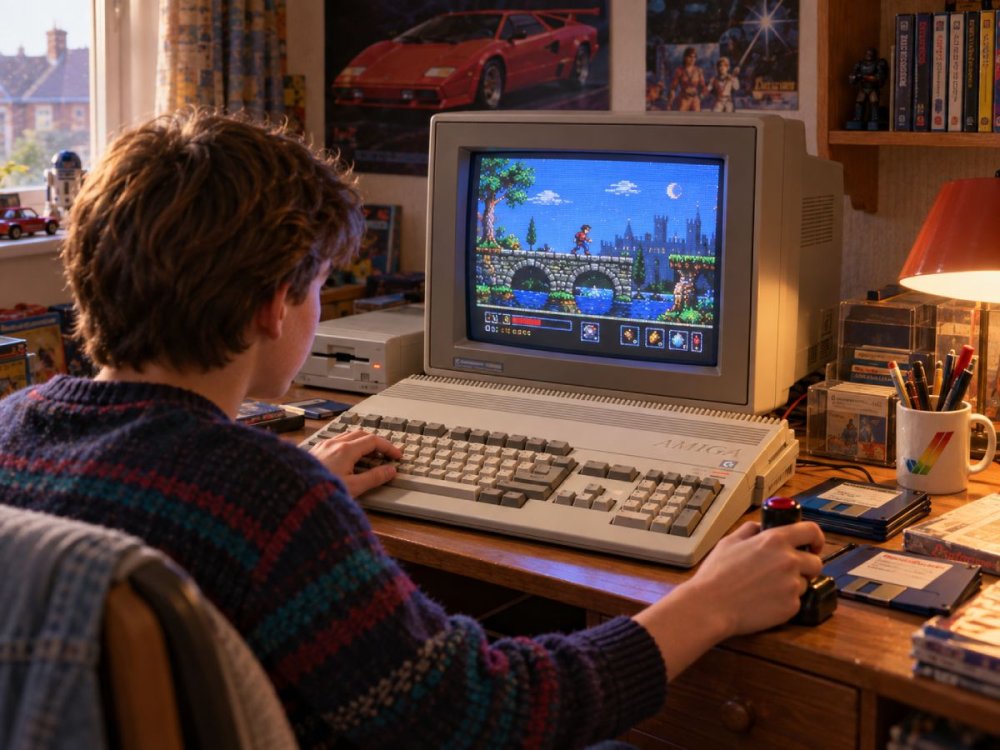
Then came the Amstrad CPC range, looking like it had been designed by somebody who wanted every component to stay together. The integrated cassette deck or disc drive made sense to parents tired of cables trailing behind the television. Its colour palette had real punch, and the CPC became the heart of countless bedrooms, especially once budget software began appearing in cheerful stacks at newsagents and department stores.
We should not forget the underdogs either. The Dragon 32, Oric-1, Acorn Electron and Memotech all had their champions. Their market positions may have shifted quickly, but each inspired the same fierce loyalty. In the eighties, your computer was not merely a purchase. It was the machine on which you knew the keyboard shortcuts, understood the loading quirks and discovered which joystick had to be held at a slightly alarming angle.
Cassette Loading Was a Ritual, Not a Delay
Modern patience has nothing on the patience required by cassette software. You would put the tape in, press play, adjust the volume to a mysterious sweet spot and wait as the screen flashed or the speaker emitted its electronic shriek. Sometimes it worked first time. More often, it did not.
That failure was woven into the experience. Rewinding to the start, cleaning the tape head, trying again at a different volume and hoping the family had not switched on the vacuum cleaner all became part of getting a game to run. A successful load felt earned. By the time the title screen finally appeared, accompanied by a tinny version of a chart tune, you were already emotionally invested.
Cassettes also made software feel physical. Games arrived in plastic cases with cover art that promised far more than the screen could show. Fold-out instructions, cassette inlays and typed loading commands made every title an object to study. Even budget releases had a presence. You could lend one to a mate, swap it in the playground or line it up beside the hi-fi like a tiny library of possible Saturday afternoons.
It Was Never Only About Games
Games were the loudest part of the story, but British home computers quietly taught us how technology worked. A machine that booted into a prompt rather than a friendly desktop practically invited experimentation. You did not need to be a future programmer to type 10 PRINT "HELLO" and feel a small spark of ownership when words appeared on screen.
Magazines fed that curiosity. Pages of BASIC listings invited readers to spend an evening typing code, only to discover a missed comma somewhere around line 240. The reward might be a crude racing game, a scrolling message or a bouncing ball, but the important bit was the revelation: software was not magic. It was made by people, and perhaps you could make some too.
That spirit helped create a remarkable British games industry. Bedroom coders became developers, publishers sprang up in unlikely places, and small teams made games with ideas larger than their hardware. The industry was messy, energetic and occasionally full of spectacular hype, but it gave British creativity a route from a spare room to shop shelves.
Home computers also changed the rhythm of family life. They competed with the television, monopolised the dining table and prompted arguments about screen time long before anyone had heard the phrase. Parents might have worried about wasted hours, then proudly shown visitors the spelling programme or the printer output with their child’s name at the top. Both reactions were fair. These machines could be educational, distracting, frustrating and brilliant, sometimes in the same evening.
The Arguments We Still Enjoy Having
Ask a group of retro fans for the best British home computer and you will quickly find yourself back in 1985. Spectrum owners will point to originality, affordability and the staggering size of the games library. C64 fans will rightly mention its sound, its sprites and the polish of many conversions. BBC devotees will talk about engineering quality and the joy of learning on a machine built to be explored. Amstrad supporters will remind everyone that an integrated monitor was a luxury when the household television was needed for something else.
There is no single winner because the experience depended on where you were, what your family could afford and what your friends owned. A Spectrum might have been the gateway machine in one street, while the lad two doors down had a CPC 464 and a shelf full of tapes nobody else could borrow. The computer that mattered most was usually the one attached to your memories.
Why These Machines Still Matter
It is easy to laugh at the tiny memory, the blocky graphics and the absurd wait for a cassette to load. But the charm is not simply about being old. British home computing made technology visible. You could hear it, touch it, troubleshoot it and occasionally thump the tape recorder beside it in the hope that would somehow help.
Today’s devices are faster, cleaner and vastly more capable, but they rarely invite the same kind of tinkering. Our old machines made us participants. We adjusted aerial leads, copied commands from magazines, swapped tapes and learned that a mysterious error message was not the end of the world, merely an invitation to try again.
If you still remember the smell of warm electronics, the click of a joystick and the panic of somebody walking past the television during a load, give that memory its due. The computers we grew up with did not just bring games into our homes. They gave ordinary people permission to imagine that the future might fit on the kitchen table.