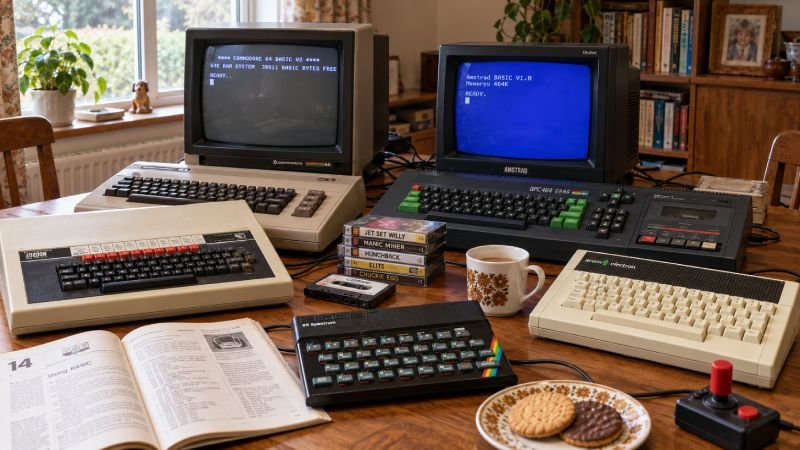
A blinking cursor. A blue or black screen. A manual opened somewhere around page 14, usually beside a packet of biscuits and a growing pile of cassette cases. Ask which computers ran BASIC, and the short answer is: almost every home computer we remember fondly. But BASIC was never quite the same experience twice. On one machine it meant rubber keys and wild colour effects; on another, it felt like a school lesson that had followed you home.
For a generation raised among beige computers, chunky buttons and cassette mechanisms, BASIC was more than a programming language. It was the invitation printed on the box. You did not have to be a professional, or even know what a programmer was. Switch the machine on, see the prompt, and you could make something happen.
Why BASIC belonged in the living room
BASIC, short for Beginner's All-purpose Symbolic Instruction Code, had been around since the 1960s. Its great trick was making programming look less forbidding. Commands could be read aloud: PRINT, LOAD, RUN, GOTO. The earliest home computers adopted it because it gave owners a useful, immediate reason to turn the thing on.
This mattered in Britain, where the home-computing boom arrived with a mixture of excitement and parental suspicion. A computer was sold as educational, practical and potentially life-changing. Yet the reality for many of us was typing in a game listing from a magazine, missing one line, then wondering why our laser battle had become a motionless square.
BASIC was the bridge between those two ideas. It could teach loops and variables, certainly, but it also let a bored child create a scrolling message, a simple quiz, or a noisy game before tea. The language gave these machines personality.
Which computers ran BASIC in Britain?
The most recognisable British home computers nearly all had a version of BASIC built in, generally stored in ROM and ready within seconds of switching on. There were exceptions, variations and a few machines where loading BASIC from cassette or disk was part of the ritual, but the following names formed the great BASIC-filled bedrooms, classrooms and dining-room tables of the era.
Sinclair ZX80, ZX81 and ZX Spectrum
Sinclair made BASIC feel wonderfully close to the metal, even when it was occasionally baffling. The ZX80 and ZX81 were inexpensive routes into home computing, and their tiny, cramped keyboards demanded commitment. On the ZX81, every key had several functions, with keywords such as PRINT and LOAD printed on the casing. You did not always type a command letter by letter. You pressed the right key in the right mode and hoped you had remembered the sequence.
The ZX Spectrum carried that approach into millions of homes. Its 16K and 48K models, with their famous rubber keys, used Sinclair BASIC. It was colourful, approachable and capable of surprisingly lively results, even with the Spectrum's notorious colour clash. A few lines could draw bright blocks, make the border flash, or send a shrill BEEP through the television speaker.
For many British children, Spectrum BASIC was their first encounter with code. It was not always elegant, but that was part of its charm. You could alter a game, break it completely, and start again after the cassette had finished squealing.
BBC Micro and Acorn Electron
If the Spectrum represented bedroom experimentation, the BBC Micro often represented the classroom. Developed alongside the BBC Computer Literacy Project, it arrived with a serious-looking case, a proper keyboard and a reputation for being the sensible machine. Its version of BBC BASIC was exceptionally well regarded: fast, structured for its day and packed with useful commands.
BBC BASIC gave beginners room to grow. It could handle graphics, sound and file operations without making every task feel like an obstacle course. More advanced users appreciated features that were absent from many rival versions, including named procedures and a built-in assembler. That sounds intimidating now, but it meant the BBC Micro could accompany its owner from a first PRINT "HELLO" to genuinely ambitious projects.
The Acorn Electron brought a more affordable version of that world into homes. It was not as capable as the BBC Micro, especially when several demands were placed on it at once, but its BASIC heritage was a major attraction. Many families who could not stretch to a Beeb still got a taste of its educational promise.
Commodore 64, VIC-20 and Plus/4
Across the Atlantic, Commodore had its own BASIC story, and British homes embraced it enthusiastically. The VIC-20, the Commodore 64 and later the Plus/4 all switched on to a BASIC prompt. The Commodore 64's screen famously announced that it had nearly 39,000 bytes free, which sounded like an enormous frontier at the time.
Commodore BASIC was friendly enough for beginners, but it had a notable limitation: the C64's best tricks were not directly available through BASIC commands. The machine had remarkable sound and graphics hardware, yet you often needed POKE commands, which wrote values directly into memory locations, to make sprites move or the SID sound chip sing. Magazine listings cheerfully supplied long strings of mysterious numbers, and we typed them in with the faith of apprentice wizards.
That limitation was frustrating, but it encouraged curiosity. BASIC on the C64 was not merely a language. It was a route towards discovering what the machine was hiding under its breadbin-shaped shell.
Amstrad CPC, PCW and the early PC
Alan Sugar's Amstrad CPC range brought BASIC to a generation who wanted a machine that looked a little more grown-up. The CPC 464, 664 and 6128 included Locomotive BASIC, one of the stronger home-computer BASICs. It had accessible commands for colour, graphics, sound and disk use, so owners could make attractive programs without immediately reaching for obscure memory addresses.
The CPC 464's built-in cassette deck remains one of the era's great pieces of industrial theatre. Pressing Play, adjusting the volume and watching the counter creep onwards was part of the deal. Once a game had loaded, BASIC may have been hidden behind the action. But turn the machine on without a tape, and there it was, waiting.
Amstrad's PCW range also ran BASIC, although its identity was more tied to word processing and the green-screen glow of Locoscript. Meanwhile, IBM PCs and compatible machines commonly ran Microsoft BASIC or GW-BASIC under MS-DOS. These were less likely to be found running arcade conversions from the newsagent, but they introduced countless office workers, students and hobbyists to lines numbered 10, 20 and 30.
MSX, Dragon and the machines at the edges
The 1980s were not only Spectrum versus Commodore. The Dragon 32 and Dragon 64 were popular in parts of Britain and used Microsoft Extended BASIC, offering graphics and sound commands that made them more inviting than their sober appearance suggested.
MSX machines, sold by firms including Sony, Philips and Toshiba, also usually arrived with MSX BASIC. They were more successful in Japan and parts of Europe than in the UK, but they still earned devoted fans here. Their shared hardware standard meant that BASIC programs could travel more easily between compatible machines than was usual in the fragmented home-computer market.
Then there were the American classics that influenced the whole scene. The Apple II ran Applesoft BASIC, while the TRS-80 used variants of Microsoft BASIC. British children might have encountered them in schools, specialist shops or glossy magazines rather than at home, but they helped establish the expectation that a personal computer should greet its owner with a programming prompt.
Not every BASIC was equal
It is tempting to remember BASIC as one universal language. It was not. The broad ideas travelled well - variables, loops, conditions and line numbers - but a Spectrum program would not simply run on a BBC Micro, and a Commodore listing might rely on memory addresses meaningless anywhere else.
The differences shaped what each machine felt like. Sinclair BASIC made keyboard shortcuts part of the language. BBC BASIC was polished and unusually powerful. Commodore BASIC offered a welcoming start but made owners work harder for the C64's flashiest features. Locomotive BASIC gave Amstrad users an especially practical toolkit.
That variation is why old computer magazines were so specific. A listing was not just “for BASIC”. It was for your BASIC, your computer, your particular collection of keys, quirks and cassette-loading patience.
The prompt that made us creators
By the late 1980s and early 1990s, many new computers became less likely to boot straight into BASIC. Graphical interfaces, consoles and increasingly polished commercial software changed what people expected from technology. We gained convenience, but lost something wonderfully direct: the sense that the machine was waiting for our instructions.
That little cursor gave the computers we grew up with a rare kind of generosity. A ZX Spectrum, BBC Micro, Commodore 64 or Amstrad CPC was not only a device for consuming someone else's game. It could be a sketchpad, a noisy experiment and a private laboratory for anyone prepared to type 10 PRINT and see where it led.