A television screen flickers into life, the remote control gets a rare outing, and somebody calls out, “What page is the football on?” Before smartphones put every result, forecast and TV listing in our pockets, Britain had a wonderfully blocky answer. So, what was teletext? It was an information service delivered through your television signal, turning the family telly into a news desk, weather station, travel board and late-night distraction.
For millions of us, teletext was not some distant technical curiosity. It was the familiar rustle of pages loading in fits and starts, the sharp little coloured buttons on the remote, and the satisfying certainty that page 302 probably had the scores. It was slow by modern standards, of course. But it made the television feel clever in a way that still has real charm.
What was teletext, exactly?
Teletext was a one-way digital information system broadcast alongside ordinary analogue television programmes. It used spare space in the TV signal - known as the vertical blanking interval - to send pages of text and simple graphics. A compatible television or set-top box could decode that hidden data and display it when you pressed the Teletext button.
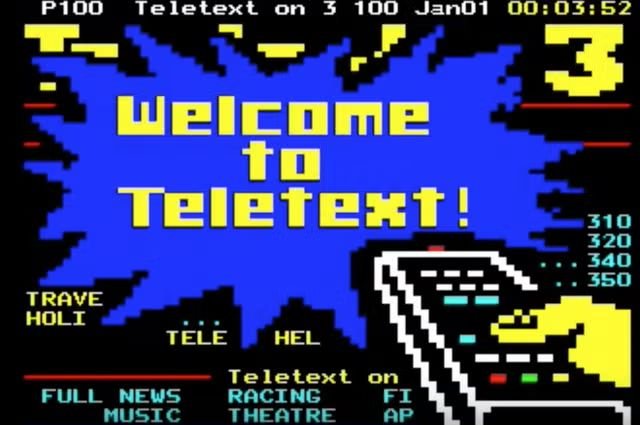
The result was a screen built from chunky coloured letters, mosaic blocks and a strict grid. There were no photographs, video clips or smooth scrolling feeds. Instead, each page was numbered, usually from 100 upwards, and viewers keyed in the number they wanted. The television then waited for that page to come round again in the broadcast cycle.
That last detail explains teletext’s particular rhythm. It was not truly on demand. Every page was continually being transmitted in a loop, rather like waiting for your favourite cassette track to come around again. If you were lucky, page 301 appeared immediately. If not, you watched the little page counter and tried not to lose patience.
Yet that limitation was part of the ritual. Teletext had character because it made you wait just enough to feel you had found something.
Ceefax, Oracle and the pages we knew by heart
The BBC launched Ceefax in the 1970s, with a wider public service arriving in 1974. Its name was a playful blend of “seeing” and “facts”, which perfectly captured the promise: facts appearing on the screen while you watched television. ITV followed with Oracle, short for Optional Reception of Announcements by Coded Line Electronics, a name so determinedly technical that it could only belong to its era.
By the 1980s, teletext was woven into British viewing habits. Ceefax became the dependable companion for headlines, sports results, weather, TV schedules and public information. Oracle offered similar essentials, along with entertainment and commercial content. Later, Channel 4’s 4-Tel and ITV’s Teletext service added their own flavours.
The page numbers became a kind of household shorthand. News lived around page 100. Sport was commonly found on page 300. Page 888 was used for subtitles, a genuinely valuable service for deaf and hard-of-hearing viewers, as well as anyone trying to follow a programme with the sound turned down. Depending on the broadcaster and region, the exact numbers varied, but the muscle memory was remarkably universal.
There was something reassuringly democratic about it. You did not need a computer, a modem or the confidence to make a phone call to an expensive information line. If the television was on and your set supported it, the information was there.
The original second screen was built into the telly
Calling teletext an early version of the internet would be slightly too neat. It did not offer conversation, personal publishing or an infinite library of information. You could not search it in the modern sense, and its content was tightly edited by broadcasters and service providers.
But it did change expectations. Teletext made us comfortable with the idea that a screen made for entertainment could also deliver useful, regularly updated information. It gave us live-ish football results while Grandstand was still on, holiday weather before packing the car, share prices, racing details, travel updates and breaking news without waiting for the next bulletin.
For a generation raised on scheduled television, that was quietly revolutionary. The TV no longer had to tell you what it wanted to tell you, at precisely the time it chose. You could ask it a question - admittedly in the form of a three-digit number - and get an answer.
It also encouraged a peculiarly British habit of information grazing. You might begin by checking the weather, wander into the TV listings, look up the league table, then end up reading a joke page or a competition result. The format was basic, but it made browsing irresistible.
Why the graphics looked so distinctive
Teletext’s visual language was born from strict technical limits. Pages were typically 40 characters wide and 24 rows deep. There was a small palette of vivid colours: black, red, green, yellow, blue, magenta, cyan and white. Large lettering, flashing text, double-height headlines and simple block graphics gave designers a surprisingly expressive toolkit.
Those little square graphics deserve some appreciation. By arranging mosaic characters, teletext artists could create footballers, weather symbols, cartoon faces and crude but recognisable illustrations. It was digital art with the same resourceful spirit as a ZX Spectrum loading screen: limited ingredients, huge imagination.
The colours were not always elegant. Yellow text on blue could feel like it was beaming directly from 1986. Flashing captions could be hard to ignore, particularly when you were trying to read the score. But the look was instantly legible and unmistakably its own. Teletext did not attempt realism. It had a graphic identity, and it wore it proudly.
More than headlines and football scores
Teletext had plenty of practical uses, but it also had a mischievous side. Pages carried horoscopes, puzzles, jokes, classifieds, music news, recipes and holiday offers. Children discovered games and quizzes in the gaps between programmes, while adults found the sort of concise advice that now turns up in a dozen tabs on a phone.
On Channel 4, 4-Tel became particularly loved for its youth culture coverage, music pages and listings. Ceefax had Bamboozle, the deceptively simple quiz game that turned selecting answers by page number into appointment viewing for some households. The mechanics were primitive, but the feeling was recognisable: a game hidden inside the television, waiting for you to find it.
Teletext also mattered because it offered speed without drama. A newspaper was fuller and more permanent. The radio was faster for urgent updates. Television news gave context and pictures. But teletext occupied the useful middle ground. It could be updated throughout the day and checked in private, without sitting through a bulletin or waiting for the paper to arrive.
Why teletext faded away
Digital television, 24-hour news channels and then the web steadily made teletext’s limitations harder to overlook. The wait for pages felt quaint once viewers had electronic programme guides and broadband connections. Smartphones finished the job, offering instant scores, maps, video and updates tailored to each person.
The main British services closed in stages. Ceefax ended when analogue BBC television transmissions ceased in 2012. The commercial Teletext service had already disappeared from analogue screens in 2009, although the name continued in other forms for a time. For many people, its disappearance was less a single dramatic goodbye than the gradual realisation that the button no longer did what it once had.
Still, teletext was not a failed version of the internet. It was a successful answer to the technology and habits of its moment. It made useful information available through the most common screen in the house, using signals that were already travelling through the aerial lead.
And that is why its memory endures. Teletext was functional, colourful and slightly awkward - technology with personality. The next time you remember the soft click of a remote and the anticipation of page 302, spare a thought for the little blocks of colour that taught our televisions to talk back.